

You’re reading the web version of Foreign Exchanges. If you’d like to get it delivered straight to your inbox, sign up today:
PROGRAMMING NOTE: Apologies, but I’m going to beg off of the usual voiceover again tonight. My voice has improved from yesterday but is still not completely back to normal.
TODAY IN HISTORY
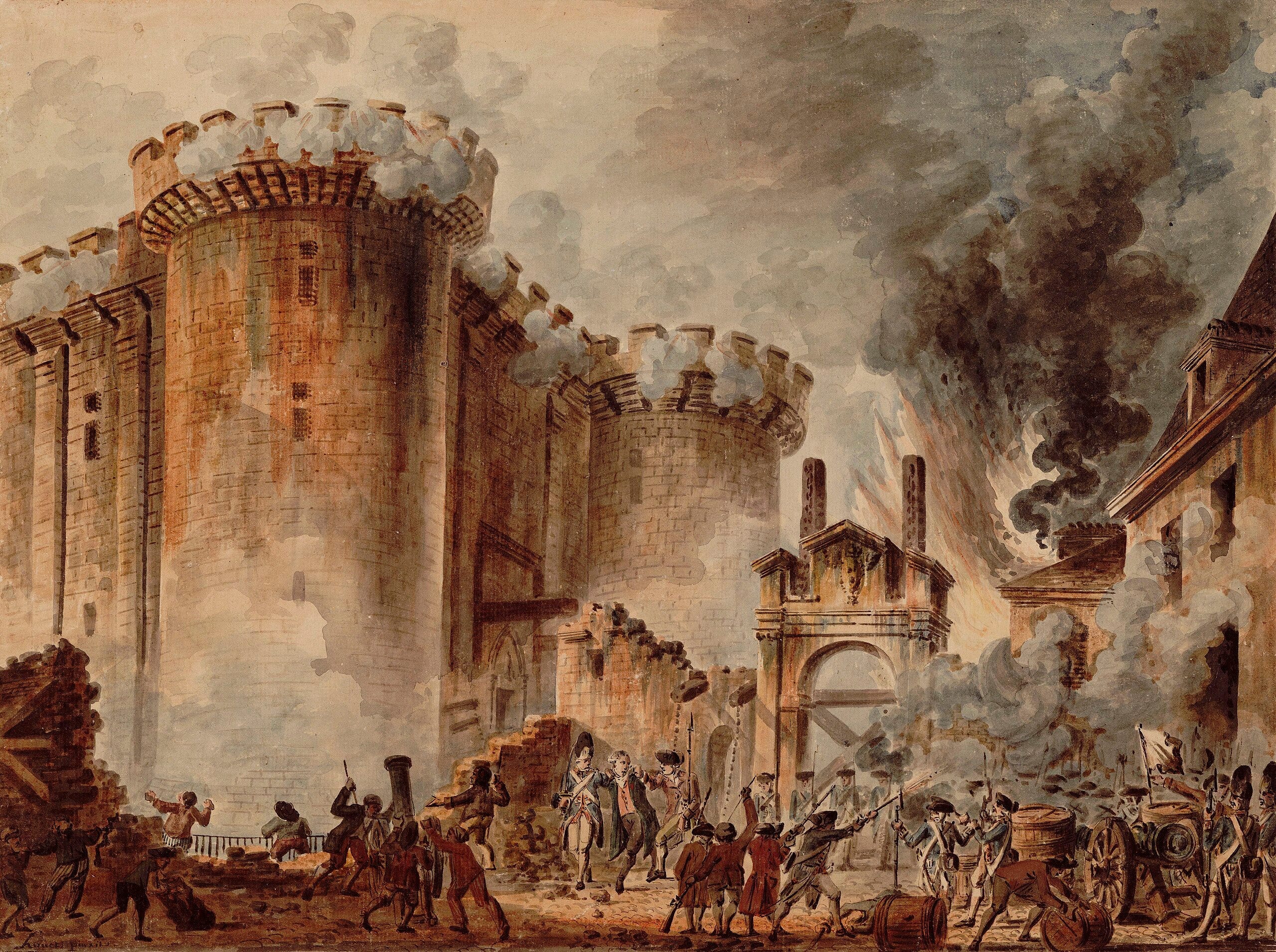
July 14, 1789: A crowd of Parisians, having been out in the streets demonstrating for two days over King Louis XVI’s sacking of finance minister Jacques Necker, attacks the Bastille to seize the arms and ammunition stored inside. The Bastille was mostly used at this point as an armory, but its reputation as a political prison also made it a potent symbol of royal abuse. The “Storming of the Bastille” is generally regarded as the event that triggered the French Revolution, as the insurrection then spread from Paris throughout the country.
July 14, 1958: The Iraqi military’s “Free Officers Movement,” modeled after the similarly named and more famous cabal in Egypt, overthrows the Hashemite monarchy in what’s become known as the 14 July Revolution. The movement’s leaders, General Abd al-Karim Qasim and Colonel Abdul Salam Arif, quickly fell out over Qasim’s less-than-full commitment to Arab nationalism and his reluctance to join Gamal Abdel Nasser’s “United Arab Republic” project, possibly because of his mother’s Shiʿa background (“Arab nationalism” or “pan-Arabism” tended to be more popular among Sunnis than among Shiʿa). Qasim soon had Arif arrested, but the latter would come out on top following the 1963 Ramadan Revolution.
MIDDLE EAST
LEBANON
Israeli and Lebanese negotiators met in Rome on Tuesday for a sixth round of talks regarding their peace/occupation agreement. This session won’t wrap up until tomorrow so there’s not much to say about it yet. The two sides were expected to focus mostly on when/whether to begin implementing their “pilot zone” project, which at one point was reportedly on track to start this week though that seems much less likely now.
ISRAEL-PALESTINE
The Israeli military (IDF) killed at least ten people in Gaza on Tuesday, including one child gunned down in the Rafah region according to officials in the territory. One airstrike on another police station in northern Gaza killed at least seven people.
Elsewhere, Barak Ravid reported on Tuesday that Donald Trump “told Israeli Prime Minister Benjamin Netanyahu during a phone call Thursday that Israel should start redeploying its forces out of Syria and urged him to do the same in Lebanon.” Netanyahu is unlikely to do so, at least before October’s Knesset election, though heavy US pressure might cause him to at least consider it. And The New Arab’s Mohamed Solaimane reports that Israeli officials have decided to stop referring to their Gaza ethnic cleansing plan with the euphemism “voluntary migration” and instead start using the term “free movement.” They’re apparently hoping that the new label will be more appealing to governments of countries to which they might send displaced Palestinians.
YEMEN
With the US and Iran having so much fun rebooting their war it looks like Saudi Arabia and the Ansarullah movement (the Houthis) have decided to give theirs another try as well. After Saudi/Yemeni forces attacked Sanaa’s international airport on Monday, Houthi forces launched their own attack on the airport in the Saudi city of Abha. There were no casualties and the Saudis haven’t retaliated as yet (at least as far as I’ve seen) but the group is now threatening to “besiege” Saudi Arabia by targeting all of the country’s airports. It is very easy to imagine things escalating from here.
IRAQ
New Iraqi Prime Minister Ali al-Zaidi visited the White House on Tuesday and apparently got Donald Trump’s agreement on a full US military withdrawal from Iraq by September 30. That’s reaffirming the deadline that former Iraqi PM Mohammed Shiaʿ al-Sudani negotiated with the Biden administration back in 2024. Trump told reporters that “we don’t think we need the military there anymore,” partly because “the oil companies are all going in now” so I guess Iraqis will have to take the good with the bad. Zaidi appears to be committing himself to either asserting control over or disarming all of Iraq’s militia factions by the withdrawal date, which may be a tall order. Couple that with Trump’s ability to just change his mind for no discernible reason and it’s probably best to treat this as a tentative agreement until the withdrawal actually happens.
IRAN
In Iran-related items:
The US and Iran began another round of fighting late Tuesday, which marks I believe their fourth consecutive evening/night of conflict. Despite insisting that its attacks are only meant to “degrade” Iran’s ability to interfere with ship traffic in the Strait of Hormuz, the US military appears to be expanding its target package and struck Bushehr—the location of Iran’s nuclear power plant—as well as an unspecified location near the Iraqi and Kuwaiti borders. The Iranians are continuing to attack ships in the strait, striking at least two more on Tuesday and killing at least one person in the process. The US military was also slated to reimpose its naval blockade on Iran on Tuesday night, but that’s only hours old and I don’t think there have been any blockade running incidents as yet.
It took Donald Trump all of one day to back down from his threat to impose (or try to impose, at least) a 20 percent toll on commercial shipping through the strait. Instead, he posted on Tuesday that the would-be toll revenue will come from “Trade and Investment Deals that the various Gulf States will be making with the United States.” When those Deals might manifest or what they might entail is, of course, left to the reader’s imagination, though he assured his audience that they would be “massive.” Trump said that he decided to change course after “highly productive conversations with Middle East leadership” in which one assumes they explained to him that a 20 percent Hormuz toll was a) batshit nuts and b) would undermine the strongest current US justification for continuing the war with Iran.
The resumption of conflict in Yemen may be a prelude to Ansarullah doing to the Bab el-Mandeb strait what the Iranians have done to Hormuz. That could be economically catastrophic and would risk further widening the war, which carries risks for Iran as well as for the US. But at some point Iranian leaders will probably come back to the position that they’re once again fighting an existential war against an enemy that doesn’t want peace and can’t be trusted to abide by any deal it signs. In which case they may decide to pull out all the stops.
I mentioned yesterday that Trump is now threatening to bomb Iran’s “Pickaxe Mountain” facility and realized that some additional context might be in order. Al Jazeera has an explainer about the site but the quick version is that the Iranians began building another hardened nuclear site in 2020 under a mountain near the Natanz uranium enrichment plant. They insist it’s only for the production of advanced centrifuges, but as far as I know the site hasn’t been inspected and the US position is that it could be a covert enrichment site.
Iranian officials claimed on Sunday that its strikes killed at least three US military personnel in Kuwait. The US military has denied that claim. It did raise its death toll in this conflict by one, to 14, on Monday but tentatively characterized the new death as “non-combat” so if that’s the case it wouldn’t be related to Iranian strikes in Kuwait. However, the Pentagon has fiddled around with its casualty numbers so many times during this conflict that those figures cannot be considered completely reliable.
ASIA
PAKISTAN
Clashes between security forces and protestors in Pakistani Kashmir left at least nine people dead on Tuesday, seven protesters and two security officers. The Pakistani government and the proscribed Joint Awami Action Committee have been at odds, often violently, for several weeks heading into the regional election later this month, mostly over a legal stipulation that reserves 12 seats in the regional legislature for Kashmiris refugees living in other parts of Pakistan. The committee argues that this is unfair to local residents.
MYANMAR
Myanmar president/junta leader Min Aung Hlaing is reportedly scheduled to make an official visit to Thailand next month. This would be his second trip abroad since making himself president, the first having been to Laos earlier this month. It’s also another indication that Myanmar’s neighbors are slowly but inexorably normalizing relations with the country’s military government.
AFRICA
SUDAN
World Politics Review’s Mohamed Wad Al-Sak contends that Sudan may be on the brink of “de facto partition”:
After three years of brutal civil war, the stage is set for a fight that could determine the fate of Sudan and whether it even remains a unified country. For 18 months, the paramilitary Rapid Support Forces (RSF) have besieged El-Obeid, the largest city in the vast Kordofan region, a powerful economic engine due to its livestock, oil processing and gum arabic production.
The city sits at a critical axis connecting the capital, Khartoum, to the oil fields of the south. It hosts a major military base, railway lines and an airport used for logistics and air operations. It also serves as the operational headquarters of the Sudan Armed Forces (SAF) for all of central Sudan.
If the RSF seizes the city, it will be able to sever the army’s western supply corridor, eliminate its primary command infrastructure in central Sudan, and establish a contiguous territorial arc from Darfur through Kordofan toward the Nile. That would shift the entire contest and call into question whether the SAF can hold any territory in Sudan’s heartland.
The coming battle will determine not only whether humanitarian aid can reach El-Obeid’s desperate population, but also which side controls the lion’s share of Sudan’s natural resources. In effect, RSF control of El-Obeid would mean a de facto partition of the country.
DEMOCRATIC REPUBLIC OF THE CONGO
World Health Organization emergencies director Chikwe Ihekweazu warned on Tuesday that the DRC Ebola outbreak “is at least two to four times the number of cases that we have found,” according to the organization’s modeling. Officially the outbreak currently stands at over 1960 confirmed cases and over 700 fatalities, which already makes it the third-largest outbreak on record. Authorities believe that the outbreak was already active for weeks before they identified it, in which case it is certain that its actual extent is bigger than what the official figures suggest. On the plus side, the WHO is about to begin clinical trials on an antiviral medication that may be effective against the relevant strain of Ebola, Bundibugyo.
EUROPE
RUSSIA
The Russian Ministry of Agriculture announced on Tuesday that it will begin routing grain shipments around the Sea of Azov, after Ukrainian drone strikes hit 11 more ships in that body of water overnight. The Ukrainian military has been heavily targeting ships in the Azov sea of late, which Russian Foreign Minister Sergei Lavrov is now apparently characterizing as “terrorism.” The ministry insists that the rerouting will affect neither Russia’s domestic grain market nor its grain exports.
UKRAINE
Amid all the conventional wisdom that Ukraine’s stepped up drone campaign is turning the tide of the war, civilians are suffering at the highest rate in several years. United Nations monitors reported on Tuesday that Russian attacks on Ukraine killed at least 293 civilians and wounded another 1990 last month. That made it the deadliest month for Ukrainian civilians since April 2022. They tallied 1396 civilians killed in the first six months of 2026, which is a 37 percent increase over the same period last year and about twice the number killed in the first six months of 2024. The Russian government is also reporting a significant increase in civilian casualties—some 250 this year through June, which is a 121 percent increase over last year.
UNITED KINGDOM
The European Union and the UK government signed a treaty on Tuesday that will streamline the process for crossing between the latter’s Gibraltar territory and EU member Spain. The measure allows both Gibraltar residents and Spanish citizens to cross the border with simple ID cards, rather than passports.
AMERICAS
MEXICO
Mexican President Claudia Sheinbaum announced on Tuesday that she is requesting that US authorities open an investigation into the deaths of 17 Mexican nationals in connection with the US Immigration and Customs Enforcement agency. ICE agents killed Mexican national Lorenzo Salgado Araujo during a raid in Houston earlier this month and the other 16 have either been killed in similar circumstances or died while coincidentally (or not) in ICE custody. There is no reason to expect that the Trump administration, which practically revels in these deaths, will be open to this request.
CUBA
Cuba’s national power grid collapsed again on Tuesday, triggering the third general blackout on the island in the past ten days. The US oil blockade remains the single biggest cause of these blackouts, though a decrepit power grid (also in part a product of US economic measures) is also a factor.
UNITED STATES
Finally, and continuing the theme, In These Times’ Chris Mills Rodrigo recounts the Trump administration’s six month run-up to the brink of a Cuban invasion:
In January, the administration declared the Cuban government posed an “unusual and extraordinary threat” to the United States. This designation, based on familiar yet baseless accusations of collusion with Russia, China, Hamas, and Hezbollah, has been devastating for the island because it created a secondary tariff system against any country selling or providing oil to Cuba.
In the six months since that executive order, only one tanker — the Russian ship Anatoly Kolodkin — has delivered fuel to Cuba. Over that period of time, the people of Cuba have dealt with rolling blackouts and a near collapse of the nation’s healthcare system.
In May, another executive order by President Trump imposed new sanctions targeting foreign individuals and businesses that engage with Cuba economically.
Then came the indictment against Raúl Castro, which Acting U.S. Attorney General Todd Blanche implied could be enforced by the U.S. military. That threat carries more weight after the illegal U.S. capture of President Nicolás Maduro from Venezuela early this year. Maduro was indicted in 2020—the final year of the first Trump administration — before the U.S. bombed Venezuela and captured him in 2025, the first year of the second Trump administration.
“The decision to indict Raúl Castro is a pretext that’s prompting fears of a Venezuela-like scenario via leadership decapitation,” [Cuban journalist Liz] Oliva Fernández says.
Lindsey Graham dies and suddenly "Derek Davison" (obvious pseudonym) can't do voiceovers anymore... hmmmm