

You’re reading the web version of Foreign Exchanges. If you’d like to get it delivered straight to your inbox, sign up today:
TODAY IN HISTORY
July 11, 1405: Chinese admiral Zheng He sets sail on the first of his “treasure voyages.” Between 1405 and 1433 Zheng led his fleets to destinations around Southeast Asia and across the Indian Ocean, visiting India, the Persian Gulf, the Red Sea, and East Africa. There’s even some creative pseudo-history out there that argues he visited South America and Europe. The voyages ended as suddenly as they began, for reasons that still aren’t entirely clear but probably involved the restoration of older Ming Dynasty policies that had been overridden temporarily by the Yongle Emperor (d. 1424).
July 11, 1804: In a duel fought in Weehawken, New Jersey, US Vice President Aaron Burr kills former US Treasury Secretary Alexander Hamilton. Burr challenged Hamilton in response to what he considered slanderous comments by the latter that had undermined Burr’s candidacy for governor of New York in 1804. After the duel Burr briefly fled to Georgia, but eventually returned to Washington to serve out the remainder of his term as VP. He was charged with murder in New York and New Jersey but was never tried in either state.
July 11, 1995: The Srebrenica massacre begins. Bosnian Serb forces killed almost 8400 Bosniak men and boys in and around Srebrenica over the next couple of weeks, and carried off an estimated 25,000-30,000 women, children, and elderly.
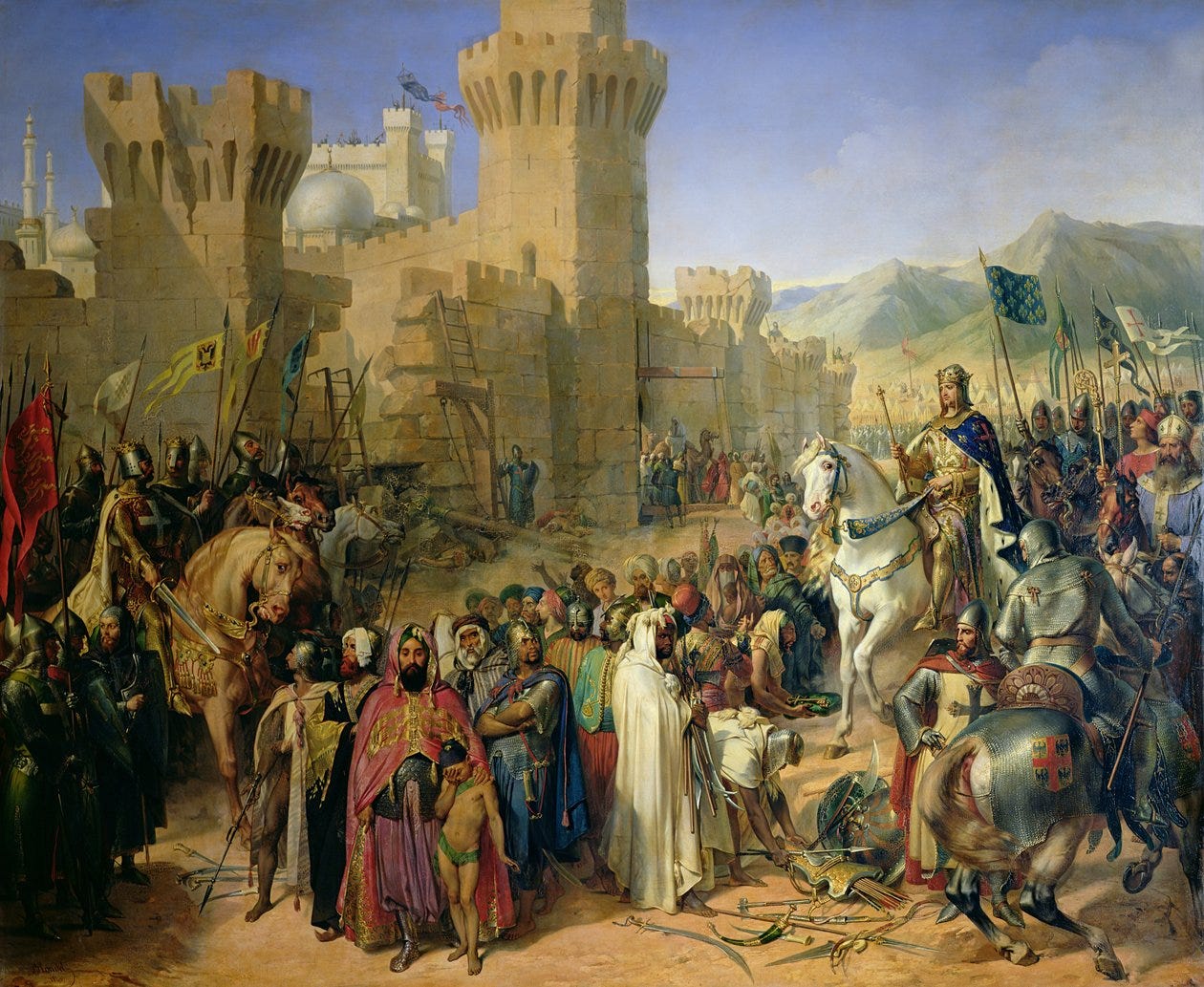
July 12, 1191: The Crusader Siege of Acre ends with a technical Crusader victory that set the stage for the ultimate failure of the Third Crusade. What had looked like a potential disaster for titular Jerusalem King Guy of Lusignan turned into a victory after the 1191 arrival of new European armies led by King Philip II of France, King Richard I of England, and Duke Leopold V of Austria. However, disputes between the various leaders prompted Leopold and then Philip to leave once Acre’s garrison had surrendered, and the remaining army under Richard was too small to achieve the expedition’s main objective of retaking Jerusalem.
July 12, 1575: At the Battle of Rajmahal, the Mughal Empire eliminates the Karrani Dynasty, capturing and executing its final ruler Daud Khan Karrani, and annexes the Sultanate of Bengal. The Mughals had partially occupied Bengal until the dynasty’s second ruler, Humayun, was temporarily dethroned by the Sur dynasty in 1540. The Pashtun Karranis emerged after the Mughals defeated the Sur and an independent Bengal Sultanate reemerged. The third Mughal emperor, Akbar I, invaded the sultanate and made relatively short work of it, though the region of Bengal wasn’t fully under Mughal control until the end of the century.
MIDDLE EAST
TURKEY
There is growing speculation (though nothing I’d feel comfortable sharing here as yet) that the Turkish government is about to sell its Russian-made S-400 air defense hardware to the United Arab Emirates, clearing the way for a potential F-35 deal. Al-Monitor’s Barın Kayaoğlu situates this decision in a bigger Turkish turn toward Western sources for its military procurement. In particular it seems that Turkish officials want to replace the S-400 with the French-Italian SAMP/T system, with Ankara not only purchasing the system but also participating in development and production. Turkey would gain some degree of ownership over the system and incorporating Turkey into the program would significantly increase its production capacity—a real benefit for European countries that want to wean themselves off of US armaments.
SYRIA
Syria’s new interim parliament held its first session on Sunday. As we’ve discussed previously, the 210 member body was entirely selected by Syrian President Ahmed al-Sharaa, who appointed one-third of its members directly and appointed the members of the regional electoral bodies who chose the other two-thirds. He made his direct appointments earlier this month, including 15 women to add to the six who’d already been named. It’s unclear whether he appointed any ethnic/religious minorities, who are also badly underrepresented. The body still lacks any representatives of southern Syria’s Suwayda province due to continued hostility between Druze groups there and Sharaa’s government.
LEBANON
US and Lebanese military officials met on Saturday in Beirut to discuss implementation of the first “pilot zone” project in southern Lebanon. As you may recall, Israeli media reported on Friday that the first “pilot zones” may go into effect as soon as this coming week, with the Israeli military (IDF) withdrawing from parts of the region—two small ones for starters— while the Lebanese army moves in to those areas. Saturday’s meeting doesn’t quite confirm that reporting but it does indicate that the “pilot zone” plan is moving forward.
ISRAEL-PALESTINE
The IDF killed at least six people, at least one of them a child, in Gaza on Sunday. Israeli officials claimed that they’d targeted “a weapons production facility” in one airstrike but professed ignorance as to the incident involving the child.
In the West Bank, US Congressperson Ro Khanna (D-CA) was on a tour on Wednesday when a group of armed Israeli settlers detained the group he was with. Israeli security forces eventually allowed the group to go on its way but any threat to a member of the US Congress is a serious issue—or, at least, it would be if it happened in virtually any other place on Earth. Here, not so much. And the Israeli National Security Ministry has reportedly gifted some $1.3 million to the nonprofit Ahavat Gilad, which provides financial support to settler groups and outposts. This seems like something that would be worth keeping in mind for the next time a US politician claims that the settlers are just some rogue bad actors with no institutional backing.
IRAN
I don’t see anybody saying this outright yet but it seems pretty clear that not only is the US-Iran ceasefire “OVER,” as Donald Trump put it on Friday, but the war is essentially back on albeit at a lower level than pre-ceasefire (at least for now). The two sides spent the weekend engaged in multiple rounds of back-and-forth attacks, including an Iranian strike on at least one commercial vessel in the Strait of Hormuz on Sunday morning. At least one Iranian soldier was killed in US strikes, and one crew member from that ship remains missing while Omani authorities rescued 23 others. The Iranian government declared late Saturday, amid the airstrikes, that it has now re-closed the strait completely. The US military insists that “traffic is flowing.”
Iranian Supreme Leader Mojtaba Khamenei issued a written statement on Saturday pledging to exact revenge for the killing of his father and predecessor, Ali Khamenei, in the opening salvo of the Iran war. It’s unclear exactly what form that revenge might take but one could probably hazard a guess or two. On a related note, CNN reported on Friday on the Israeli “intelligence” that supposedly pointed toward a plot to assassinate Trump and that may have prompted him to switch planes on his flight from the NATO summit in Turkey to the UK on Wednesday. According to that report, the intelligence suggested only “a desire among elements of Tehran’s hardline leadership to target the American leader … rather than a specific, detailed plan to carry out such an operation.” There is additionally a belief within US intelligence circles that the Israelis may have provided the intel to the US to try to undermine negotiations with Iran.
ASIA
AFGHANISTAN
The New York Times reports on a Taliban crackdown in the western Afghan city of Herat:
Since retaking power in 2021, the Taliban have enforced a rigid set of rules about religious practice, dress and daily life. Across Afghanistan, women and girls face restrictions on access to education, most jobs and travel. But in some parts of Herat, the country’s third-largest city, men kept their beards short and women wore heels and makeup — despite the Taliban’s dress codes.
Now, that’s changing.
[The NYT] traveled to Herat in June and found that these pockets of resistance to the Taliban are disappearing.
[Taliban Supreme leader] Sheikh [Hibatullah] Akhundzada’s morality police have arrested dozens of people over the last few weeks. Many women said they now avoided leaving their homes out of fear of being caught in the wave of arrests. Some people had even protested, a rare act of public resistance, but the Taliban cracked down on them, too.
The crackdown appears to be focusing particularly on Herat’s sizable Shiʿa population, with the Taliban demanding the suppression of any public displays of its religious expression. The official justification is that this is meant to protect Shiʿa communities from attacks by Islamic State jihadists, but that seems pretty weak.
CAMBODIA
Jacobin’s Michael Vann argues that the proliferation of scam operations across Cambodia and Laos—still happening despite an apparently performative “crackdown” by authorities in the former—is simply another outgrowth of capitalism:
Across the region, former casino towns, special economic zones, and speculative real estate developments have been transformed into fortified compounds where tens of thousands of trafficked workers from impoverished countries throughout the Global South spend their days impersonating cryptocurrency advisers, romantic partners, investment brokers, and customer service representatives.
Their targets are comparatively wealthy people in the Global North. Their employers are transnational criminal syndicates, and their workplaces are violent prisons. Governments describe these operations as organized crime, while human rights organizations simply brand them as a form of modern slavery.
The scam compounds proliferating across Cambodia and Laos represent one of global capitalism’s newest industries: a convergence of financial speculation, digital technology, artificial intelligence, human trafficking, and extreme labor exploitation. They reveal what happens when capitalism’s oldest imperative, the relentless search for profit, meets its newest technological tools.
AFRICA
ALGERIA
The Algerian and Malian governments announced on Saturday that they have fully restored diplomatic ties with one another, one day after they mutually decided to reopen their respective airspaces to each other’s flights. The two countries severed ties in April 2025 due to a controversy over a Malian drone that was shot down by the Algerian military. The governments of Burkina Faso and Niger, the other two members of the “Alliance of Sahel States” bloc, likewise cut ties with Algeria at the time but those relationships have since improved.
MALI
The Malian military acknowledged on Sunday that it lost some 30 soldiers in retaking the northern town of Anéfis from Azawad Liberation Front (FLA) rebels on Friday. Another 60 (give or take) were wounded.
EUROPE
RUSSIA
Ukrainian attacks on some 90 vessels in the Sea of Azov over the past week have forced the Russian government to halt commercial shipping in that body of water. In particular Moscow closed the Don-Azov canal, which is part of the Volga-Don network that connects those two rivers and, through them, the Azov and Caspian seas. On Saturday Ukrainian drone strikes killed at least one person and damaged four ships in Azov’s Taganrog Bay.
UKRAINE
Overnight Ukrainian attacks on Russia and Russian-occupied Ukraine killed at least five people, while Russian strikes on Ukraine killed at least four. The Russian military killed at least eight people across Ukraine on Saturday.
Elsewhere, Ukrainian President Volodymyr Zelensky has sacked his prime minister, Yulia Svyrydenko after about one year on the job. It’s not immediately clear why, though Zelensky did say that his government is “changing its political strategy,” whatever that means. He says he plans to move Svyrydenko to “a new, important area” managing some aspect of Ukrainian foreign relations. In her previous role as economy minister Svyrydenko negotiated a minerals agreement with the US so her sphere may involve relations with Washington. I haven’t seen any indication as yet as to her replacement as PM.
AMERICAS
VENEZUELA
The death toll from last month’s Venezuelan earthquakes has risen to 4490 with 16,740 injured and 17,907 people left homeless. The number of deaths is likely to keep rising as recovery work continues. Amid this unfolding catastrophe, The New York Times reports on the extent to which US Secretary of State Marco Rubio is now the de facto ruler of a new US colony:
In the six months since U.S. forces blew open [former Venezuelan President Nicolás] Maduro’s bedroom door and snatched him in the dead of night, Mr. Rubio has become the de facto viceroy of Venezuela, holding sway over a sovereign nation in a way that no American official has since L. Paul Bremer III arrived in Baghdad in 2003 to run U.S.-occupied Iraq.
Mr. Rubio now effectively controls Venezuela’s finances, the distribution of its natural resources and its government, according to interviews with more than a dozen officials and people close to both governments in Washington and Caracas, who provided details about his involvement in steering the country’s policies. Many spoke on condition of anonymity to describe private interactions and internal discussions.
While he has not visited Venezuela in person since the U.S. took over, the secretary of state is deeply involved in the country’s day-to-day operations, keeping in close contact with Delcy Rodríguez, who was Mr. Maduro’s vice president and now leads her country on an acting basis, with the imprimatur of the United States. The two exchange messages in Spanish on WhatsApp, trading gossip, birthday greetings and selfies.
Despite the banter, the relationship between Mr. Rubio and Ms. Rodríguez is far from a partnership. It is a manifestation of Trump-era American power, in which the winner takes all regardless of sovereignty and international law.
Rubio is apparently even managing Rodríguez’s travel schedule and her public appearances. About the only thing he’s not managing in Venezuela is any sort of transition back to democracy, despite paying frequent lip service to that aim back when Maduro was president and before Rubio became viceroy.
CANADA
The US and Canadian governments struck a deal on Friday to open the Gordie Howe International Bridge between the cities of Detroit and Windsor, which will now begin operating on July 27. The bridge had at one time been set to open last month, but back in February Donald Trump shut the project down while complaining that he would “not allow this bridge to open until the United States is fully compensated for everything we have given them, and also, importantly, Canada treats the United States with the Fairness and Respect that we deserve.” The fact that the owner of the competing Ambassador Bridge had just donated $1 million to a Trump political action committee was I’m sure purely coincidental.
Under Friday’s deal the US and Canada will reportedly split toll revenue 50/50 (even though the Canadian government paid for the bridge) and the US government will have the right to veto any major (greater than 10 percent) toll increases. There’s also apparently some sort of regional economic development fund that will be created using bridge proceeds.
UNITED STATES
US Senator Lindsey Graham (R-SC) died suddenly on Sunday of an apparent aortic dissection. Graham spent much of his time focused on US foreign policy and never met a war he didn’t think that US soldiers should fight. He died with a tremendous amount of blood on his hands and in the interest of not speaking too much ill of the dead let’s leave it at that.
Finally, the Trump administration trafficked 11 people to the southern African nation of Eswatini on Wednesday in an act that Amnesty International characterized as “cruel and racist” in addition to being “unlawful.” They are the latest in a string of “third country” trafficking episodes that AFP reports have been facilitated with a carrot and stick (or “cash and threats”) approach from the White House:
The first wave of the mass deportations during Trump’s second term concentrated on Central and South America. Asylum seekers were sent to Panama and at least 250 Venezuelans, accused of being gang members — many on flimsy evidence and without due process — were sent to El Salvador’s gigantic Terrorism Confinement Centre known as CECOT.
Africa has since emerged as a second wave, with Washington wielding the stick of visa bans while offering the carrot of millions of dollars to countries like Equatorial Guinea, according to Democratic Senators.
Eswatini — Africa’s last absolute monarchy — has agreed to take 160 deportees in exchange for $5.1 million (4.4 million euros), with Rwanda reportedly sealing a similar $7.5-million aid deal for 250 people, according to Human Rights Watch.
“It’s like modern-day human trafficking, through official channels,” Tin Thanh Nguyen, a US-based lawyer, told AFP.