

You’re reading the web version of Foreign Exchanges. If you’d like to get it delivered straight to your inbox, sign up today:
TODAY IN HISTORY
January 17, 1915: The Battle of Sarikamish ends with a very decisive Russian victory over the decimated Ottomans. The Russian army surrounded and nearly obliterated the entire Ottoman Third Army, winning a victory so decisive that the Russians were able to push the Ottomans back through the Caucasus and well into Anatolia before the 1917 Russian Revolution changed the course of the war. Ottoman Minister of War Enver Pasha, who’d assumed direct command prior to the battle, blamed his defeat at Sarikamish on Armenian treachery. That claim contributed to the forthcoming Armenian Genocide.
January 17, 1961: Former Republic of the Congo-Léopoldville Prime Minister Patrice Lumumba is executed within hours of being handed over to secessionist forces (and Belgian mercenaries) in the breakaway “State of Katanga.” Future dictator Joseph Mobutu (with CIA backing) had removed Lumumba from office in a military coup in September and was under pressure both internally and externally (from the Belgian and US governments) to remove him altogether. Mobutu had Lumumba arrested in late November 1960 and turned him over to the Katangans for execution.
January 17, 1991: The US military begins “Operation Desert Storm,” its offensive intended to push the Iraqi army out of Kuwait. After several weeks of airstrikes the ground operation began on February 15 and was over within two weeks with the Iraqis fully routed. The war marked a triumphal start to the post-Cold War “Unipolar Moment” and kicked off an obsession with toppling Iraqi leader Saddam Hussein among elements of the US foreign policy establishment.
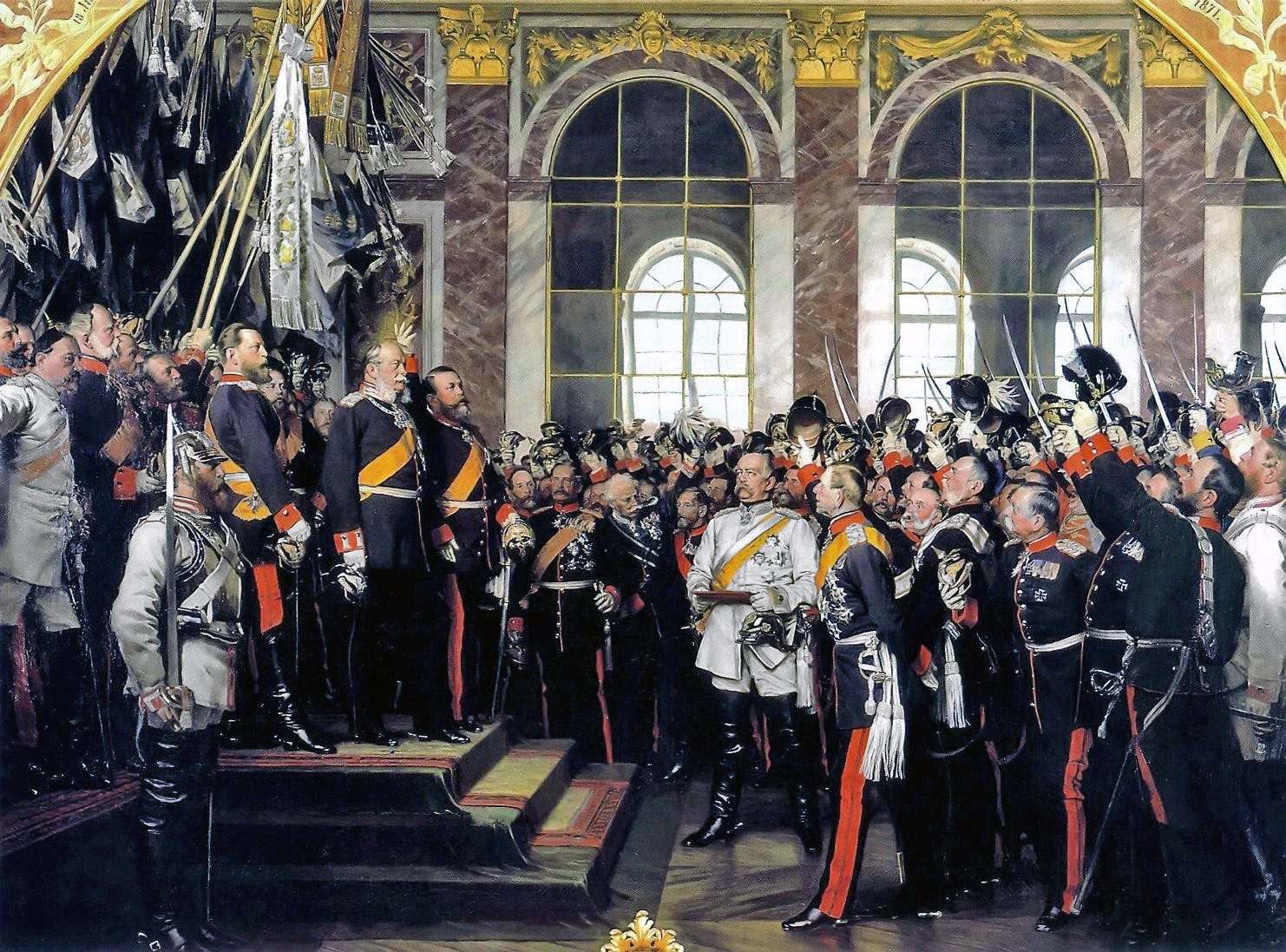
January 18, 1871: A group of 25 German states jointly issues the “Proclamation of the German Empire” from the Palace of Versailles in France. The proclamation marked both the by-then-inevitable German victory in the 1870-1871 Franco-Prussian War (hence the location) and the enactment of the Constitution of the German Confederation, forged by an agreement between the Prussian-led North German Confederation and several South German states, which had been adopted on January 1. It is often considered to mark the unification of Germany, though technical work on that process would continue through May.
January 18, 1976: Christian militias linked to Lebanon’s Kataeb Party rampage through the poor and predominantly Palestinian Karantina neighborhood in east Beirut. They’re estimated to have killed somewhere in the neighborhood of 1500 people, making the Karantina Massacre one of the first major atrocities of the Lebanese Civil War.
January 18, 2002: The Sierra Leone civil war, which had begun in 1991, ends with the victory of the British-backed Sierra Leone government over the Revolutionary United Front rebels backed by Liberian President Charles Taylor. The conflict was known largely for its atrocities, from the copious use of child soldiers to the mass killing and rape of civilians. For his involvement, the International Criminal Court convicted Taylor of war crimes in 2012 and he’s currently serving a 50 year prison term.
MIDDLE EAST
SYRIA
The Syrian Democratic Forces group withdrew its fighters from their positions in eastern Aleppo province on Saturday, as it had been ordered to do by the Syrian government. That gesture turned out not to be enough for Damascus, which went ahead with the major offensive into northeastern Syria that Reuters had previewed on Friday. Syrian government forces pushed the SDF out of the city of Tabqah, home to an important military airport and Syria’s largest hydroelectric dam, then continued deep into formerly SDF-held territory as the group’s defenses collapsed (in part due to the apparent defection of hitherto allied Arab tribal units, who may have preferred throwing in with Damascus to remaining under Kurdish rule).
By Sunday, government forces and their tribal militia auxiliaries had seized several northeastern oil fields including Al-Omar, the largest in Syria, and fighting had begun to center on the city of Raqqa. It was at that point that Syrian President Ahmed al-Sharaa announced a ceasefire and a new commitment from the SDF to incorporate its fighters into the Syrian security establishment under the terms of an agreement in principle that the two sides had reached last year but that has not been implemented. The new deal will dissolve the autonomous Kurdish-led administration of northeastern Syria and will incorporate SDF fighters into the Syrian state on an individual basis rather than retaining them in coherent units. It seems at least on its surface to be an almost total capitulation by the SDF, whose position crumbled so quickly that it likely didn’t have much of a choice but to meet Sharaa’s terms.
Alexander McKeever has a more detailed outline of these events.
After reportedly threatening Damascus with new sanctions should it pursue a large-scale offensive against the SDF, the Trump administration apparently did nothing to discourage Sharaa’s campaign. This is not terribly surprising given the US government’s history of using and discarding proxies, including Kurdish proxies, and given the degree to which this administration has been cultivating ties with Sharaa over the past year. The outcome is good news for Turkey, which views the Kurdish elements within the SDF as indistinguishable from the Kurdistan Workers’ Party (PKK) and opposes Syrian Kurdish autonomy. It remains to be seen what will happen to Syrian Kurds, who despite Sharaa’s nice-sounding decree about Kurdish rights on Friday are now somewhat at the mercy of the jihadist elements within his government.
Elsewhere, the US military says it killed a local al-Qaeda leader named Bilal Hasan al-Jasim in an airstrike in northwestern Syria on Friday. It’s claiming that he had some connection to the attack in Palmyra last month that killed two US soldiers and a civilian interpreter, though that was an Islamic State operation so the actual link here is somewhat unclear.
ISRAEL-PALESTINE
The Israeli government is displeased with the composition of Donald Trump’s newly-announced “Board of Peace,” or at least a part of it (more on this later). So displeased, in fact, that Israeli Prime Minister Benjamin Netanyahu made his objections public on Saturday rather than expressing them behind the scenes. He said that the committee’s makeup was “not coordinated with Israel and contrary to its policy.” In particular he appears to be upset with the inclusion of Turkish Foreign Minister Hakan Fidan and Qatari official Ali al-Thawadi on the “executive committee” that’s supposed to serve as a bridge between the full board and the Palestinian “technocratic” committee that’s being tasked with day to day administration in Gaza. According to Barak Ravid at Axios, in another entry in his “Washington Is Mad At Netanyahu” series, the Trump administration is prepared to tell the Israeli PM to cram his objections. We’ll see if that actually manifests.
IRAQ
The Iraqi government announced on Sunday that the US military has now fully withdrawn from all military facilities under its control. That excludes facilities in northern Iraq that are controlled by the Kurdistan Regional Government, but it is still a significant milestone that fulfills an agreement the Biden administration made in 2024 to wrap up anti-Islamic State operations in Iraq by the end of this year. Baghdad is hoping that the US military’s departure (which isn’t total, given its continued presence in the Kurdistan region and the fact that it will continue to provide training and other types of cooperation to its Iraqi counterpart) will entice the country’s Shiʿa militias to disarm. Several of those factions have demanded that the US military leave Iraq before they would consider such a step.
IRAN
The US-based Human Rights Activists News Agency (HRANA) reported on Sunday that it has catalogued at least 3919 deaths in the protests that hit much of Iran in late December. It’s hard to know for sure but the last time Iran experienced that level of carnage due to political unrest was probably the 1979 revolution. The protest movement appears to have dwindled in recent days so most of these additional deaths presumably occurred earlier but had not yet been counted. In part that could be due to the communications blackout that Iranian authorities imposed some ten days ago and that is still in effect despite a brief respite on Sunday.
The Iranian government hasn’t offered its own casualty count, but Supreme Leader Ali Khamenei did acknowledge “thousands” of deaths in an address on Saturday, blaming them on rioters and international “agents” backed by the US. He also said that Iranian authorities “must break the back of the seditionists” to whom he attributes the recent violence, which may augur a continuation of the government’s crackdown even now that the protests appear to have ebbed.
ASIA
MYANMAR
Official results from the second phase of Myanmar’s general election show, in another shocking upset, that the military cutout Union Solidarity and Development Party has extended the massive lead it took after the first phase. Its lead is so massive now as to render the third and final phase somewhat superfluous, since with 182 seats in hand the USDP already has a majority in the 330 seat People’s Assembly, the lower house of parliament. This election is intended to mark an end to five years of military government, though as the results show what it will really do is dress up that military government in a civilian guise.
JAPAN
The Diplomat’s Peter Chai questions whether Japanese Prime Minister Takaichi Sanae’s likely decision to seek a snap election might wind up backfiring:
Takaichi thinks she can turn a snap election to her advantage, but it remains a political gamble. Her soaring personal approval ratings appear to derive more from her status as Japan’s first female leader and a protégé of Abe Shinzo, as well as her nationalist posture, than from public confidence in her handling of persistent economic challenges. Some netizens have also questioned the reliability of the polling samples and raised suspicions of opinion manipulation through paid publicity, citing her high publicity spending during the 2024 [Liberal Democratic Party] leadership race.
Despite her popularity, the LDP continues to suffer from persistently weak party support amid lingering public distrust over political funding scandals and ties to religious groups. Voters remain anxious about inflation, a weak yen, potential economic fallout from China, and Japan’s ongoing demographic decline and labor shortages.
AFRICA
SUDAN
Rapid Support Forces militants are reportedly consolidating their control over Sudan’s North Darfur state and have killed over 100 people in that province since late December according to a local relief committee. RSF operations have further displaced more than 18,000 people. The Sudanese Armed Forces lost their last major foothold in North Darfur when the RSF took the regional capital, Al Fashir, in late October. But there are still government-aligned militias operating in more remote areas of the state and it’s those groups the RSF is now trying to subjugate.
UGANDA
To I assume no great surprise, Ugandan President Yoweri Museveni won a seventh term in office in Thursday’s election according to official results released on Saturday. The 81 year old incumbent took a very simple and believable 71.65 percent of the vote, well ahead of main challenger Bobi Wine’s 24.72 percent. Museveni’s National Resistance Movement party is also comfortably ahead in the parliamentary vote. Incidentally Wine took to social media on Saturday to reveal that he had somehow escaped a police raid on his home on Thursday night and says he is now in hiding.
EUROPE
BOSNIA AND HERZEGOVINA
At Foreign Affairs, Elmira Bayrasli tracks the breakdown of Bosnia’s tenuous Dayton Accords-based political order:
While Europe focuses on the war in Ukraine and the prospect of pared-back American security assistance, trouble is brewing in the southeast corner of the continent. Three decades ago, in November 1995, the U.S.-brokered Dayton accords ended the Bosnian war, a three-and-a-half-year ethnic conflict that killed roughly 100,000 people and displaced two million. The settlement imposed a complex power-sharing structure on a divided country, promising the state of Bosnia and Herzegovina a new start.
Europe and the United States led the charge to safeguard the carefully crafted peace. Yet that oversight has eroded in recent decades, as both Brussels and Washington turned their focus elsewhere. The absence of international pressure has emboldened nationalists within Bosnia such as Milorad Dodik, a Bosnian Serb leader who has repeatedly called for the secession of Republika Srpska, the semiautonomous region where he served as president. Dodik was banned from holding public office in 2025 and has faced U.S. sanctions since 2022. In late October, however, the Trump administration lifted those sanctions. The decision appeared to be an act of patronage by President Donald Trump: Dodik’s government had hired several Trump associates as lobbyists, including former Illinois Governor Rod Blagojevich, who argued that the sanctions amounted to political persecution. But it also reflected a long-running shift in U.S. policy, with the United States stepping back from the commitments it made to Bosnia three decades ago.
Unless Bosnia’s international partners start paying more attention, Dodik and other nationalist leaders will continue to erode Dayton’s constraints on ethnic autonomy and secessionist ambitions. The United States’ retreat from Bosnia is unlikely to reverse any time soon, so responsibility for the country’s political future now rests squarely with European leaders. If Europe cannot reclaim its role as a guarantor of stability and promoter of reform, it risks watching Bosnia’s fragile balance give way altogether. The failure of the Dayton accords would threaten European security, further damage the EU’s credibility, and legitimize the perception—already exploited by Russia in Ukraine—that borders and agreements can be revised by force.
PORTUGAL
Portuguese voters headed to the polls on Sunday to elect a new president, and it seems that they’ve opted to send the race to a runoff. As polling had foreshadowed, Socialist candidate António José Seguro won the first round with somewhere in the neighborhood of 30 percent of the vote. He’ll be joined in the second round by André Ventura of the far-right Chega party, who looks like he slightly exceeded the upper range of his polling to win a bit over 25 percent. Polling has consistently made Seguro a heavy favorite in that head-to-head match, but just getting into the runoff is a significant milestone for Chega.
AMERICAS
COLOMBIA
At The New York Times, the International Crisis Group’s Elizabeth Dickinson argues that the Trump administration’s recent activities may have strengthened the National Liberation Army’s (ELN) position along the Colombian-Venezuelan border:
Now the E.L.N. stands emboldened to challenge the authority of the Colombian state — and U.S. ambitions in Venezuela. The borderlands are webbed with lucrative corridors where the E.L.N. and other armed groups move seamlessly and often exercise more control than the government. With profits flowing from illegal mining, drug trafficking and human smuggling, both the Colombian guerrillas and complicit members of Venezuela’s security forces have deep interests in maintaining the status quo in Caracas and resisting attempts to bring rule of law to these territories.
In advance of [former Venezuelan President Nicolás] Maduro’s capture [by the US military], the E.L.N. was taking steps to ensure its interests in the borderlands were safe, regardless of what happened in Caracas. Since mid-December, it has gone on the offensive in the Colombian region of Catatumbo, displacing thousands of civilians in the process. It has also clashed with a local criminal group known as the 33rd Front, a dissident faction of the Revolutionary Armed Forces of Colombia, or FARC, which has repeatedly angered the E.L.N. with attempts to control key rivers used for trafficking in and out of Venezuela. President Gustavo Petro’s announced deployment of some 30,000 troops to the border has done little to stop the fighting.
But rather than anchoring the region with America’s longtime partner in Bogotá, Colombia’s capital, President Trump turned on Mr. Petro, threatening direct attacks on Colombia the day after Mr. Maduro’s capture on Jan. 3. Although a phone call last Wednesday between the leaders lowered tensions, the détente is fragile.
Elsewhere, fighting between factions of the FARC Central General Staff successor group left at least 27 people dead in southern Colombia’s Guaviare department over the weekend. All of the casualties were members of the faction led by Néstor Gregorio Vera, AKA “Iván Mordisco,” which was battling over territory with a faction led by Alexander Díaz Mendoza, AKA “Calarcá Córdoba.” Vera’s faction has rejected peace talks with the Colombian government while Mendoza’s is still engaged in them.
GREENLAND
Donald Trump fleshed out his Greenland tariff threat via social media on Saturday, declaring plans to impose a 10 percent tariff on eight European states: Denmark (of course) plus Finland, France, Germany, the Netherlands, Norway, Sweden, and the United Kingdom. Those tariffs would remain in place until “a Deal is reached for the Complete and Total purchase of Greenland” and would increase to 25 percent if said deal hasn’t been reached by June 1. It’s unclear whether these tariffs would replace current US tariffs on those countries or add to them, and while I am no expert I would imagine there may also be some question as to their legality. The European Union has called an “emergency” meeting of member state ambassadors to discuss the situation and perhaps plan a potential retaliation. I’ve seen reporting that it was supposed to take place on Sunday but I haven’t yet seen any indication that it actually did.
Meanwhile, thousands of people protested in Greenland on Saturday to express opposition to US annexation. You’ll note that the desires of the people actually living in Greenland have not entered Trump’s thinking at any point in this saga.
UNITED STATES
Finally, returning to the issue of Donald Trump’s “Board of Peace,” it still isn’t entirely clear what it is going to look like. Friday’s reporting indicated that such luminaries as Tony Blair, Jared Kushner, and Steve Witkoff would sit both on the board and on the Gaza executive committee, but subsequent reporting that I’ve seen has been more haphazard about who’s doing what and their participation may be limited to the executive committee alone. Al Jazeera reported on Sunday that Trump “has begun to invite world leaders and other prominent figures” to serve on the board, which suggests that its membership is still up in the air at present.
Also up in the air is its actual mandate. The language in the board’s apparent charter eschews a narrow focus on Gaza in favor of making the board a backdoor alternative to the United Nations. The Financial Times reported on Saturday that the board bills itself as “an international organization that seeks to promote stability, restore dependable and lawful governance, and secure enduring peace in areas affected or threatened by conflict.” It doesn’t specifically mention Gaza at all. Countries that join will serve a three-year term, unless they fork over a cool $1 billion to buy themselves a permanent membership. Trump, as chair, would have sole right to invite or dismiss members, though he could be overridden by a two-thirds vote of the membership.
As you might expect, Trump’s invitation letters, framed in this way, have generated a fair amount of trepidation among the recipients. Perhaps they fear replacing a UN that, while deeply flawed, does at least operate on a theoretical set of principles with a “friends of Donald Trump club” as the arbiter of world affairs. Maybe they’re also a little concerned that a board that hasn’t yet shown that it can achieve anything approaching peace in Gaza, its one acknowledged area of focus, is already setting up to expand worldwide.