

You’re reading the web version of Foreign Exchanges. If you’d like to get it delivered straight to your inbox, sign up today:
TODAY IN HISTORY
January 15, 1892: While working at Springfield College (then the “International YMCA College”), James Naismith publishes the rules of a game he’d recently invented in the campus newspaper under the very creative headline “A New Game.” The basic idea involved throwing a ball through a basket set several feet off the floor—hence its name, “basket ball.” I’m not sure what became of it but it sounds like fun.
January 15, 1967: The Green Bay Packers defeat the Kansas City Chiefs, 35-10, in the first National Football League-American Football League championship game. You may or may not be aware, but this tradition has continued and the NFL plays one of these “Super Bowls” every year.
MIDDLE EAST
LEBANON
The Israeli military (IDF) bombed two villages in eastern Lebanon’s Bekaa Valley region on Thursday after issuing evacuation orders to residents. It claimed to be targeting “Hezbollah infrastructure.” This was one of multiple IDF attacks across Lebanon throughout the day, all allegedly against “Hezbollah targets.” While the Lebanese army says that it has assumed control over all weapons south of the Litani River from non-state groups like Hezbollah, Israeli officials are refusing to let up in their daily attacks until the organization is disarmed completely. Hezbollah leaders have warned that any attempt to forcibly disarm the group outside of southern Lebanon could lead to civil war.
ISRAEL-PALESTINE
IDF strikes across Gaza killed at least ten people on Thursday, including a “local commander” in Hamas’s Qassam Brigades armed wing in central Gaza’s Deir al-Balah region along with several members of his family. At least six people were killed in that attack alone. Elsewhere, Donald Trump announced via social media late Thursday that his “Board of Peace,” which is supposed to oversee governance in Gaza under his ceasefire plan, has been formed. He’s planning to reveal the names of its members “shortly,” so perhaps there will be something to say about this tomorrow. Apparently “it is the Greatest and Most Prestigious Board ever assembled at any time, any place,” so that’s good to know.
Drop Site reports on the struggle to shelter displaced Palestinians in the midst of the eastern Mediterranean winter:
Israel’s continued strangulation of essential supplies during winter has left hundreds of thousands of Palestinians shivering in the wet and cold and nearly three dozen dead. The genocidal war has displaced nearly the entire population and reduced Gaza to a broken landscape of rubble and collapsed structures. Hundreds of thousands of Palestinians are now living in flimsy tents that provide little shelter from the elements. According to the UN, the heavy rains and flooding have rendered thousands of tents uninhabitable and placed nearly 800,000 people, almost 40 percent of the population, in flood-prone sites at heightened risk—leaving families exposed to the winter cold without blankets, mattresses, or heating. Hundreds of tents have simply blown away and makeshift shelters have been heavily damaged.
Despite the so-called ceasefire that went into effect on October 10, Israel has continued to restrict desperately needed humanitarian aid. More than one million people are estimated to be in need of emergency shelter assistance, according to the UN. Among the items Israel restricts are drainage equipment, heaters and solar equipment, and reconstruction items such as cement and timber, many of which are classified as “dual-use” items. According to the Government Media Office in Gaza, only 24,611 aid trucks have entered the enclave during the ceasefire, out of a total of 57,000 trucks under the deal. Israel has also completely prevented the entry of mobile homes, caravans, and shelter materials such as tents and plastic tarpaulins. “The Gaza Strip is facing a slow-motion genocide, as the occupation has continued to evade its obligations stipulated in the agreement and the humanitarian protocol,” the Government Media Office said in a statement on Thursday.
YEMEN
The prime minister of Yemen’s internationally recognized government, Salem bin Breik, resigned on Thursday and that government’s presidential council named Foreign Minister Shaya Mohsen Zindani as his replacement. Presumably this stems from the recent conflict with the Southern Transitional Council, though it’s unclear why bin Breik is taking the fall.
IRAN
One day after a US attack seemed so imminent that the Iranian government went so far as to close the country’s airspace, Donald Trump appears to be standing down a bit. After telling reporters on Wednesday afternoon that he’d been assured that “the killing in Iran is stopping,” Trump took to social media to highlight Tehran’s apparent decision to suspend the executions of several protesters. The White House later claimed that Iranian authorities have halted some 800 planned executions. He’s made that his red line over the past couple of days so the message appears to be that he’s satisfied with the Iranian government for the time being. The Iranian government felt secure enough to reopen its airspace a few hours after closing it. The Trump administration did announce new sanctions targeting several Iranian officials (most prominently Supreme National Security Council Secretary Ali Larijani) on Wednesday, which could be meant as an alternative to military action.
There are indications that Trump has latched on to the execution angle as a justification for backing away from a military action that started to seem less enticing for other reasons. NBC News reported late Wednesday that Trump had asked his national security team for options to “deliver a swift and decisive blow” to the Iranian government, but that he’d been disappointed with their admission that nothing the US military could do to Iran would guarantee a change of regimes in Tehran. In this telling Trump is concerned about opening up a quagmire, so he was discouraged by what he heard from his advisers.
As it happens, several of the Middle Eastern governments most closely aligned to Trump are also worried about a regional quagmire, and as he appeared to be ramping up to military action officials from Oman, Qatar, Saudi Arabia, and Turkey reportedly engaged in “a last-minute lobbying campaign” urging him to change course. According to The New York Times even Israeli Prime Minister Benjamin Netanyahu asked Trump to hold off, though his reasons for doing so are unclear. The Washington Post reported yesterday that the Israeli and Iranian governments passed messages to each other via Russia late last month, before the Iranian protests began, with each disavowing any plan to attack the other. The Israelis, according to this story, are planning a major military operation against Hezbollah and wanted to minimize the chances of Iran getting involved. Maybe that explains Netanyahu’s position.
Faced with the realization that he couldn’t accomplish his goals with military action and that his pals in the region didn’t want him to try, Trump seems to have backed down. He could of course change his mind abruptly. However, indications from within Iran are that the protests that underpin this situation are tapering off, owing predominantly to a government crackdown that’s blacked out communications and left at least 2637 people dead according to the latest count by the Human Rights Activist News Agency (HRANA). An end to the protests would eliminate Trump’s current rationale for bombing Iran, though he could always find another.
Later in the day the United Nations Security Council held an emergency session on the protests that doesn’t appear to have involved much more than posturing by the US and Iranian delegations. The former insisted that military action is still on the table if Iranian authorities continue their violent crackdown, while the latter warned that it will respond to any US attack.
ASIA
PAKISTAN
Picking up on something we talked about last week, Pakistani Minister for Defense Production Raza Hayat Harraj gave an interview to Reuters on Wednesday in which he said that a Pakistan-Saudi Arabia-Turkey mutual defense agreement “is something that is already in pipeline.” Apparently drafts of the agreement are already circulating in the respective countries. According to Harraj this deal would be separate from, though it presumably builds upon, a bilateral defense agreement that the Pakistanis and Saudis reached last year. Depending on how it’s structured, and there are no details available as far as I know, this could also represent a significant regional geopolitical realignment—particularly the Saudi Arabia-Turkey piece. It would also presumably boost an arms industry that is quickly becoming a major revenue generator for Islamabad, hence Harraj’s interest in particular.
SOUTH KOREA
The deterioration of Chinese-Japanese relations has put South Korean President Lee Jae-myung on the spot, as The Diplomat’s Yoonki Lee explains:
Despite early concerns that Japan-South Korea relations would deteriorate under the progressive Lee administration, the opposite has proven true. Lee is pursuing a pragmatic “two-track” approach, compartmentalizing historical grievances from forward-looking cooperation. The rapprochement between Seoul and Tokyo has been welcomed by Washington, which has called for steadfast trilateral security cooperation in the face of mounting threats from China and North Korea.
Nevertheless, Beijing has been increasing pressure on Seoul to take sides amid the Sino-Japanese rift. Although Lee stressed the need for South Korea, Japan, and China to “communicate and collaborate to find the largest common ground,” it is highly unlikely that the three nations will resume stalled negotiations on the China-Japan-South Korea Free Trade Agreement anytime in the foreseeable future.
AFRICA
SUDAN
Sudanese peace talks of a sort resumed in Egypt on Wednesday. I say “of a sort” because this was a meeting of the “Consultative Mechanism for Peace in Sudan” a group that includes attendees from an array of countries and international organizations but nobody connected with either of the warring Sudanese parties. They’ve all apparently agreed on the urgent need for a humanitarian truce in Sudan, for whatever that’s worth.
NIGERIA
Alex Thurston analyzes Donald Trump’s Christmas airstrikes on Nigeria:
I continue to see Trump’s actions vis-a-vis Nigeria as driven primarily by U.S. domestic politics. The sloppiness and indeed pointlessness of these strikes owe, I suspect, to a combination of (a) Trump’s own indifference to anything beyond the headlines about ISIS members being killed and (b) what seems to be the inefficacy of AFRICOM’s intelligence and targeting. For broader context, a journalistic investigation of an AFRICOM drone strike in Somalia that killed a major politician concluded, “Behind the escalation of the U.S. campaign against ISIS and al-Shabaab in Somalia lies a targeting process that multiple officials and analysts described as opaque and deeply flawed.”
He’s expecting additional US strikes, to similarly minimal effect.
ETHIOPIA
Ethiopian authorities are claiming that they seized some 56,000 rounds of ammunition this week that was sent from Eritrea to Fano militia fighters in Ethiopia’s Amhara region. They’re further claiming that a “preliminary investigation” into two individuals arrested alongside the seizure shows that the ammunition came from the Eritrean government itself. Ethiopia’s federal government has been in a low level conflict with the Fano since 2023 and tensions between Ethiopia and Eritrea have been rising steadily since the latter helped the former (along with the Amhara militias) to defeat the Tigray People’s Liberation Front back in 2022. The Eritrean government denied sending the ammunition and accused Ethiopian officials of trying to manufacture a pretext for war. Eritrean officials have alleged that Ethiopia is plotting a conflict that could enable it to seize parts of Eritrea’s Red Sea coastline.
UGANDA
Ugandan voters headed to the polls on Thursday for a presidential election that has so far featured a national internet shutdown and hours long delays at several polling stations. Barring some completely unforeseen twist of fate, 81 year old incumbent Yoweri Museveni will win. Indeed, opposition candidate Bobi Wine has already begun alleging fraud, which may very well be true but there’s really no way for him to challenge the eventual outcome.
EUROPE
RUSSIA
The Russian government expelled a diplomat from the UK’s Moscow embassy on Thursday, alleging that he is an “undeclared British intelligence officer.” UK officials rejected that claim as “malicious and baseless” and say they’re considering options in terms of a response. Russian-UK relations are deteriorating rapidly, because as Moscow tries to recalibrate its relations with the Donald Trump-led US it has recast the UK as its main foreign adversary.
ICELAND
US ambassador-designate to Iceland Billy Long is off to a great start in his new would-be job, after he was heard earlier this week referring to the country as the “52nd [US] state,” with himself as its “governor,” in a conversation with senators on the sidelines of his confirmation hearing. I gather that Greenland is the 51st state in this scenario, though that’s complicated by Donald Trump’s repeated references to Canada as the 51st state so I’m not 100 percent sure about that. Anyway, mere hours after Long’s comment was reported a petition demanding that Icelandic Foreign Minister Katrín Gunnarsdóttir reject his credentials had already garnered thousands of signatures. Long has apologized and insisted that he was only joking, making reference to Louisiana Governor Jeff Landry’s new post as Greenland envoy/“governor.”
AMERICAS
VENEZUELA
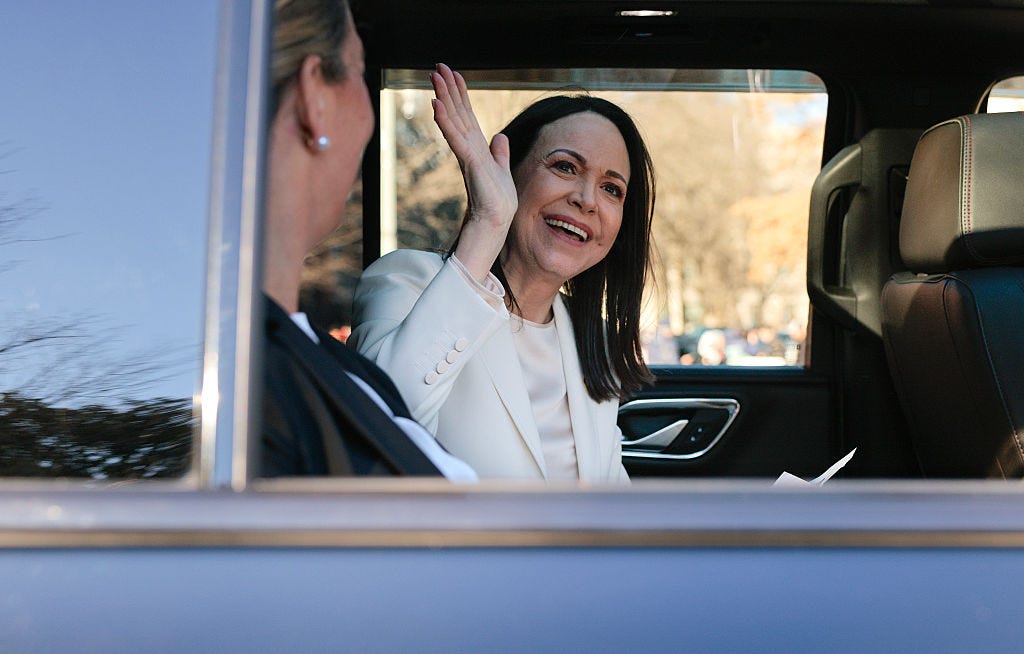
Donald Trump hosted Venezuelan opposition leader María Corina Machado at the White House on Thursday, and as I suppose was to be expected she presented him with her Nobel medal. Trump unsurprisingly accepted it, but aside from charting bold new frontiers in the realm of groveling it doesn’t seem like the gesture accomplished anything. Trump has given no indication that he’s prepared to organize new elections in his Venezuelan colony nor has he suggested that he’s open to making Machado his Venezuelan viceroy in place of the so far very compliant Delcy Rodríguez and the other remnants of Nicolás Maduro’s former administration.
In oil news, the US military seized another tanker carrying Venezuelan oil on Thursday, making it the sixth act of piracy it’s committed in this regard since it abducted Maduro from Caracas earlier this month. And the Trump administration has apparently completed its first of what should be many sales of Venezuelan oil in a deal worth a cool $500 million. Semafor reported on Wednesday that the administration has decided to stash the lion’s share of that windfall in a bank in Qatar, which certainly raises some questions about its plans for those funds. In the most charitable interpretation, depositing the money in Qatar gives the administration the ability to distribute it quickly, with minimal oversight from the US Congress and shielded from potential legal claims on the money from Venezuelan creditors. The less charitable interpretation is basically the same but acknowledges the massive potential for corruption that this creates.
For no particular reason it might also be worth mentioning that one of the buyers in this transaction turns out, according to The Financial Times, to be linked to a major Trump donor. Vitol, a major energy and commodities firm, purchased $250 million of this batch of oil, with a similar firm called Trafigura purchasing the other $250 million. A senior partner at Vitol named John Addison apparently kicked some $6 million into Trump’s 2024 presidential campaign. I’m sure it’s all very neat and above board.
HAITI
Haitian police and foreign mercenaries carried out drone strikes targeting three houses owned by gang kingpin Jimmy “Barbecue” Chérizier on Wednesday. There’s no indication yet of any casualties, let alone whether Chérizier himself. A former police officer, Chérizier is probably the most notorious of the leaders of the Viv Ansanm gang coalition that now controls most of Port-au-Prince and is expanding its reach beyond the Haitian capital.
GREENLAND
Several European countries, including France and Germany, have begun deploying soldiers to Greenland in some sort of response to Donald Trump’s desire to annex that island. According to Al Jazeera this is a two-day “recognition-of-the-territory exercise” during which, in “a symbolic act,” soldiers will raise the European Union flag. The exercise is also supposed to demonstrate to any would-be conquerors that European forces can mobilize quickly to defend Greenland. The thing is, a small detachment of soldiers is not exactly much of a deterrent, and whether those European governments would even be willing to go that far in the case of a US invasion very much remains an open question.
UNITED STATES
Finally, The Intercept’s Nick Turse reports on a proposal that’s circulating to reconfigure the US military to correspond with Donald Trump’s focus on exploiting and immiserating the Western Hemisphere:
President Donald Trump has touted the “Donroe Doctrine” — a bastardization of the 1823 Monroe Doctrine. Whereas President James Monroe’s policy sought to prevent Europe from colonizing and meddling in the Western Hemisphere, Trump views his as license for America to do exactly that. The new U.S. National Security Strategy, released last month, decrees the “Trump Corollary” to the Monroe Doctrine a “potent restoration of American power and priorities,” rooted in the “readjustment of our global military presence to address urgent threats in our Hemisphere … and away from theaters whose relative import to American national security has declined in recent decades or years.”
With this reshuffling of American military priorities in mind, senior War Department officials have developed a plan to downgrade several of the U.S. military’s major overseas combatant commands and curtail the power of their commanders. The revised Unified Command Plan would shrink the number of geographic combatant commands, combining Northern and Southern Commands into a single American Command, or AMERICOM, and would merge the European, Central, and African Commands into a single International Command, according to three government sources. Indo-Pacific Command would remain a standalone command. (The proposed reorganization was first reported by the Washington Post.)
One of the government officials said that the new plan would “streamline” U.S. military efforts abroad while “reorienting” U.S. combat power to bring it into line with the new National Security Strategy, which makes clear that the U.S. will be “avoiding any long-term American presence or commitments” in Africa and “avoiding the ‘forever wars’ that bogged us down in” in the Middle East.
Yes, from now on we’ll only be doing those things in Latin America. How fortunate for the people there.