

You’re reading the web version of Foreign Exchanges. If you’d like to get it delivered straight to your inbox, sign up today:
TODAY IN HISTORY
January 12, 1945: The Soviet Red Army begins World War II’s Vistula–Oder Offensive, a massive push into Poland involving over 2.2 million soldiers. The operation ended on February 2 with the defeat of German Army Group A, the successful conquest of most of Poland, and the liberation of several Nazi concentration camps, including Auschwitz. Although at one point Soviet forces had advanced close to Berlin with little or no remaining German defenses between them and the city, Marshal Georgy Zhukov opted to halt the advance and shore up his flanks against German attack, buying the Germans a bit more time to, shall we say, put their affairs in order.
January 12, 1970: “Operation Tail-Wind” ends with the surrender of the separatist Biafran army, bringing the 1967-1970 Nigerian Civil War (or the “Biafran War” if you like) to a close. Biafran rebel leader Odumegwu Ojukwu fled into exile on January 9 and the remaining leaders of the would-be country formally surrendered to Nigerian authorities on January 15.
January 13, 532: The Nika Riots begin in Constantinople. Two factions of chariot racing fans, the Greens and the Blues, both frustrated over taxation, corruption, and recent crackdowns on their hooliganism by the authorities, revolted during that day’s chariot races in the Hippodrome. Over the next week the mob seized control of the city, crowned its own “emperor” named Hypatius (against his wishes, it seems), and nearly put the real emperor, Justinian I, to flight. Justinian and his military officers were able to regain control of the situation by bribing leaders of the Blues and by bringing an army into the city and massacring a large number of the remaining rioters.
January 13, 1951: A French army is able to win a decisive victory over a larger Việt Minh force in the Battle of Vĩnh Yên. The battle ended a several months-long string of victories by the Việt Minh and helped to extend the First Indochina War, which continued into August 1954.
MIDDLE EAST
SYRIA
The weekend ceasefire in the city of Aleppo apparently marked only a pause in fighting between the Syrian government and the Syrian Democratic Forces group, who have taken their conflict on the road into the eastern part of Aleppo province. There are no reports of casualties so far after the two sides “exchanged fire” in the Deir Hafer region, which the Syrian army had earlier designated as a “closed military zone.” Syrian officials accused the SDF of massing forces in that area, a claim the Kurdish-led group denies.
On at least a tangentially-related note, Syrian Druze community leader Sheikh Hikmat al-Hijri gave an interview to an Israeli outlet on Tuesday in which he accused the Syrian government of trying to “eliminate…any minority that is not like them.” Hijri has been openly agitating for an independent Druze political entity in parts of what is now southern Syria and has cultivated ties with the Israeli government toward achieving that aim. His plans aside, and even if we leave out the current conflict with the SDF, this government’s record when it comes to minority issues—specifically its treatment of Druze and Alawite Syrians—does not do much to refute that accusation.
ISRAEL-PALESTINE
Severe weather killed several Palestinians in Gaza overnight and into Tuesday. At least five died when the damaged buildings in which they were sheltering collapsed, while “several” others—I have not seen a count—died of exposure. The Israeli refusal to allow durable shelter materials into Gaza remains arguably the most egregious of its ceasefire violations, even taking into account the hundreds of people the Israeli military (IDF) has killed directly since the accord went into effect. That includes at least two more killed on Thursday in southern Gaza’s Rafah region, both classified as “terrorists” by the IDF. An IDF drone killed three people in Khan Younis on Monday, while an Israeli-backed militia claimed responsibility for the killing of Khan Younis’s police chief.
In the West Bank, The Guardian reported on Tuesday that the Israeli government is preparing to break ground on the access highway that will mark the first stage in the construction of the “E1” settlement east of Jerusalem. As we’ve noted previously the E1 project aims to fully block off the central West Bank and permanently foreclose on the possibility of a contiguous Palestinian state.
EGYPT
The Trump administration has designated the Muslim Brotherhood branches in Egypt (where the group originated), Jordan, and Lebanon as “specially designated global terrorist” groups and “foreign terrorist organizations.” It cited alleged support for Hamas and opposition to Israel as the justification. This has been brewing for some time now and is unlikely to have any immediate effect, given that those parties have been outlawed in Egypt and Jordan and the Lebanese party only has a small parliamentary presence.
IRAQ
In something of a surprise development, the AP reported on Tuesday that Iraqi Prime Minister Mohammed Shiaʿ al-Sudani is giving up his bid for another term so as “to clear the field” for former PM Nouri al-Maliki to retake the job. Shiʿa parties were apparently stymied in trying to choose between them. There’s no official confirmation of this so take it with a grain of salt for now. A dispute between Kurdish parties over control of the Iraqi federal presidency remains the most immediate obstacle to forming a government after November’s election.
IRAN
The Iranian human rights network HRANA is now reporting at least 2003 people killed amid ongoing antigovernment protests in multiple cities across Iran, and Reuters cited “an Iranian official” who more or less confirmed the number while deflecting blame away from Iranian security forces. That shocking figure, up from HRANA’s estimate of 538 over the weekend, may still only be the tip of the iceberg given the communications blackout that continues over most of the country. In HRANA’s count 1850 of those killed have been protesters along with 135 security personnel, nine children, and nine unaffiliated civilians. The blackout continues to make it difficult to judge the size and scope of these protests though the Iranian government has unsurprisingly been more forthcoming about images of the large pro-government counter-protests that have also been held in several major cities.
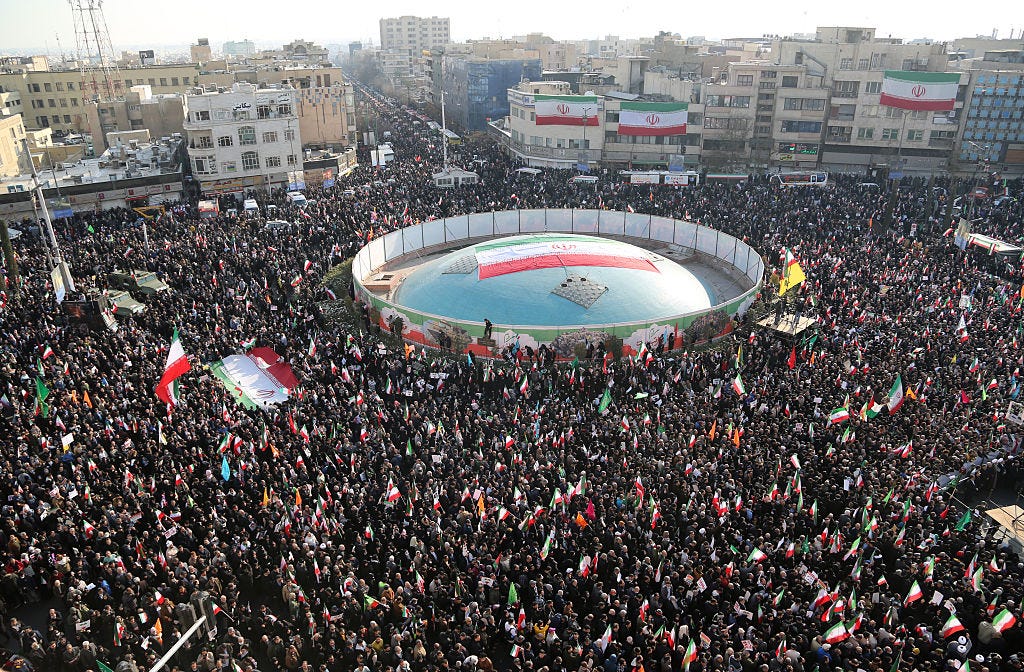
Donald Trump continues to threaten a military response to the rising casualty figures, and took to social media on Tuesday to declare that he’s “cancelled all meetings with Iranian Officials until the senseless killing of protesters STOPS.” While there has been some contact between Iranian Foreign Minister Abbas Araghchi and US envoy Steve Witkoff (who is also reportedly meeting with would-be Iranian shah Reza Pahlavi). I’m unaware of any other scheduled meetings of that sort. Tehran has reportedly inquired about the possibility of resuming nuclear negotiations as a way to tamp down Trump’s threats, so presumably he was ruling that out at least for the time being. Trump further called on the protesters to “KEEP PROTESTING – TAKE OVER YOUR INSTITUTIONS!!! and “Save the names of the killers and abusers” who apparently “will pay a big price.” He capped this message off by writing that “HELP IS ON ITS WAY. MIGA!!!” That is of course an acronym for “Make Iran Great Again” because we live in an exceptionally stupid era.
His online musings suggest that Trump is leaning toward military action of some kind and according to The New York Times the Pentagon has presented him with “a wider range of strike options…than previously reported.” These include nuclear sites and ballistic missile sites. Striking those sites would be meant to deter Iranian authorities from maintaining their current crackdown but it would have no direct material effect on the protests, and there remains some chance that foreign military intervention right at this juncture would work to the detriment of the protest movement. In the meantime, Trump announced on Monday that he’s imposing a new 25 percent tariff on any country interacting commercially with Iran. If implemented in the way Trump described it this could have a significant impact on several major Iranian trading partners who also do substantial business with the US, but it seems unlikely to sway the Iranian government’s handling of the protests.
ASIA
PAKISTAN
A roadside bomb killed at least seven police officers in northern Pakistan’s Khyber Pakhtunkhwa province on Monday. The Pakistani Taliban claimed responsibility for the attack.
MYANMAR
The Bangladeshi government summoned Myanmar’s ambassador in Dhaka on Tuesday over multiple incidents of spillover violence that have impacted Bangladeshi civilians. Fighting in Myanmar’s Rakhine state involving government forces, the Arakan Army, and the Arakan Rohingya Salvation Army left a 12 year old girl wounded by gunfire in Bangladesh’s Cox’s Bazar district earlier this month and a fisherman was maimed in a landmine blast also apparently connected to the Rakhine conflict.
CHINA
Wired’s Noah Shachtman reports that the Trump administration is losing its own “race” to the moon:
[US Senator Ted] Cruz brought a little surprise to [NASA administrator nominee Jared] Isaacman’s confirmation hearing last April. It was a poster of the moon. On one side stood three astronauts and a giant Chinese flag. On the other were two more figures in space suits, with the tiniest Stars and Stripes planted in the lunar soil. Cruz apologized for the imbalance. “My team used ChatGPT,” explained the senator, who chairs the committee that oversees NASA.
Then Cruz, with a bit more seriousness, asked Isaacman, “Do we have your commitment that you will not allow the scenario on the right of this poster to happen? That China will not beat us to the moon?”
Isaacman, a billionaire entrepreneur who had paid for his own missions to space, replied, “Senator, I only see the left-hand portion of that poster.”
It was a red-meat, fuck-yeah, pitch-perfect response. And Isaacman may have meant it. But by the time of his testimony, the Trump administration had started a process that would lay waste to NASA, pushing nearly 4,000 agency employees to quit. Then the White House proposed a massive, 24 percent cut to NASA’s budget. Then Trump yanked Isaacman’s nomination and named a new part-time acting chief, a fellow who boasted in his official NASA biography that he is one-half of “America’s first and longest-married reality TV couple.” Then that guy picked a fight with Elon Musk, who’s building NASA’s moon lander. And Isaacman was back in the running. In December, Trump capped off the year with an executive order pushing Americans to get back to the moon by 2028.
If all of this sounds suboptimal to you, welcome to the club, space ranger. That dysfunction is one of many reasons why the vast majority of the two dozen sources I interviewed for this story believe that China will put people on the moon first. I spoke with nine former NASA officials who served at the highest rungs of the space agency under presidents Trump and Biden; none of them were optimistic about America’s chances. “We did the worst of all worlds,” one of the nine tells me. “We positioned it as a race without planning to win.”
AFRICA
SUDAN
A Rapid Support Forces drone strike killed at least 27 people in the city of Singa in southeastern Sudan’s Sennar state on Monday. There are varying reports on the number of people wounded, ranging from 13 to more than 70. The attack targeted an army base but it’s unclear how many of the casualties were military versus civilian.
Elsewhere, the Sudanese Armed Forces says that it is gearing up for a major operation aiming to retake the Kordofan and Darfur regions from the RSF. The paramilitaries control nearly all of Darfur and a healthy portion of Kordofan, a state of affairs that has led to much speculation about the de facto (at least) partition of Sudan. The SAF has had some recent success in North Kordofan state that likely reflects at least a preliminary phase of this operation.
SOMALIA
The Somali government says that it has cancelled all of its agreements with the United Arab Emirates, a decision that covers an array of deals including security and defense arrangements and port management contracts. The UAE’s heavy investment in the breakaway Somaliland region and its apparent tacit recognition of that region’s independence had soured relations, but Somali officials cited the UAE’s use of the country’s airspace to evacuate Southern Transitional Council leader Aidarous al-Zubaidi last week as the “last straw.” There’s been no comment from the UAE but there are indications that it is refusing to accept the Somali government’s authority to cancel these agreements. The governments of Somaliland and the autonomous regions of Puntland and Jubaland are all rejecting the federal government’s decision as well.
EUROPE
RUSSIA
TomDispatch’s Michael Klare looks ahead to next month’s likely expiration of the New START accord, the last remaining treaty limiting the sizes of the US and Russian nuclear arsenals:
So, the question is: What, exactly, will it mean for New START to expire for good on February 5th?
Most of us haven’t given that a lot of thought in recent decades, because nuclear arsenals have, for the most part, been shrinking and the (apparent) threat of a nuclear war among the great powers seemed to diminish substantially. We have largely escaped the nightmarish experience — so familiar to veterans of the Cold War era — of fearing that the latest crisis, whatever it might be, could result in our being exterminated in a thermonuclear holocaust.
A critical reason for our current freedom from such fears is the fact that the world’s nuclear arsenals had been substantially diminished and that the two major nuclear powers had agreed to legally binding measures, including mutual inspections of their arsenals, meant to reduce the danger of unintended or accidental nuclear war. Together, those measures were crafted to ensure that each side would retain an invulnerable, second-strike nuclear retaliatory force, eliminating any incentive to initiate a nuclear first strike.
Unfortunately, those relatively carefree days will come to an end at midnight on February 5th.
UKRAINE
Last year was the most dangerous for civilians in Ukraine since 2022, the first year of Russia’s latest invasion, according to data from a United Nations monitoring mission. The mission tracked 2514 civilian deaths and 12,142 injuries due to “conflict-related violence,” with “the vast majority” of those casualties occurring due to Russian attacks on Ukrainian-controlled areas. Most occurred around the front-line, which is unsurprising but also highlights the danger of staying home versus evacuating to a safer place.
It’s still quite early but 2026 isn’t offering much of an improvement so far. Russian strikes killed at least four people in Ukraine’s Kharkiv oblast during another major overnight bombardment of Ukrainian electrical and heating infrastructure. The Russian military has made depriving Ukrainians of heat and power a priority during every winter since this invasion began.
BULGARIA
The right-wing GERB-SDS alliance has turned down Bulgarian President Rumen Radev’s generous offer to form a new government to replace the one that collapsed last month. Caretaker Prime Minister Rosen Zhelyazkov, whose government is the one that resigned en masse and who would have stayed in office in a hypothetical GERB-led government, cited the bloc’s lack of broad parliamentary support. Radev can offer the governing mandate to up to two more parties but a snap election is all but certain at this point.
AMERICAS
VENEZUELA
The White House confirmed on Monday that Donald Trump will host Venezuelan opposition leader María Corina Machado on Thursday. She will be attempting to convince him that she should be in charge of the post-Nicolás Maduro Venezuela instead of Delcy Rodríguez and most of the rest of Maduro’s former administration. That seems like a long shot but Trump’s lack of object permanence might work in her favor. What remains to be seen is whether Machado will try to present Trump with her Nobel Peace Prize in hopes of winning him over. The Nobel Committee has already made it clear that she can’t actually transfer the award to him in an official sense but I bet he’d still be happy to have the physical medal.
UNITED STATES
Finally, if you missed it earlier please check out Alexander Aviña’s latest FX column on the Maduro abduction:
The US bombing of Caracas on January 3 that provided cover for the special forces operation that abducted Venezuelan President Nicolás Maduro and his partner Cilia Flores left at least 100 people dead. US bombs destroyed residential homes in and near the capital city and medical warehouses in La Guaira port. Jonatan Marrolla, a resident of La Guaira state, told Reuters that “it’s sheer luck they didn’t kill my kids.” The apartment where his neighbor Angel Alvarez lived also suffered serious damage. “We’re alive by a miracle,” the young street vendor said.
Add these deaths to the dozens of extrajudicial executions in the Caribbean and Eastern Pacific ordered by Donald Trump since mid-2025, along with the establishment of a naval blockade that seeks to further strangle the people of Venezuela—victims of nearly a decade of intensified economic war that has resulted in tens of thousands of excess deaths and an economic contraction “three times the severity” of the US Great Depression. We could say that all of this is illegal under international law. But then again, international law suffered its final blow in Gaza, massacred by the Israeli military and US-European weaponry, money, and diplomatic cover. We are left with, as Trump recently told The New York Times, his “morality” to curb or restrain his power. The type of morality expressed in the open genocidal threats and policies enacted by political leaders against entire peoples and countries in western Asia and the Americas. The type of morality that underscores what I have referred to elsewhere as the “Palestine-Mexico Border:” a line of demarcation between those allowed to live and those who deserve to die.
Trump’s attack on Venezuela is what Yankee isolationism looks like, past and present: the openly naked and violent re-assertion of US imperial power in the Americas—empire coming home to its laboratory—when faced with intractable political, economic, and military challenges elsewhere. As Pete Hegeseth said last year while in Panama, “to put America first, we will put the Americas first.”
You wise to make these every-other day. Easier to digest.