

You’re reading the web version of Foreign Exchanges. If you’d like to get it delivered straight to your inbox, sign up today:
TODAY IN HISTORY
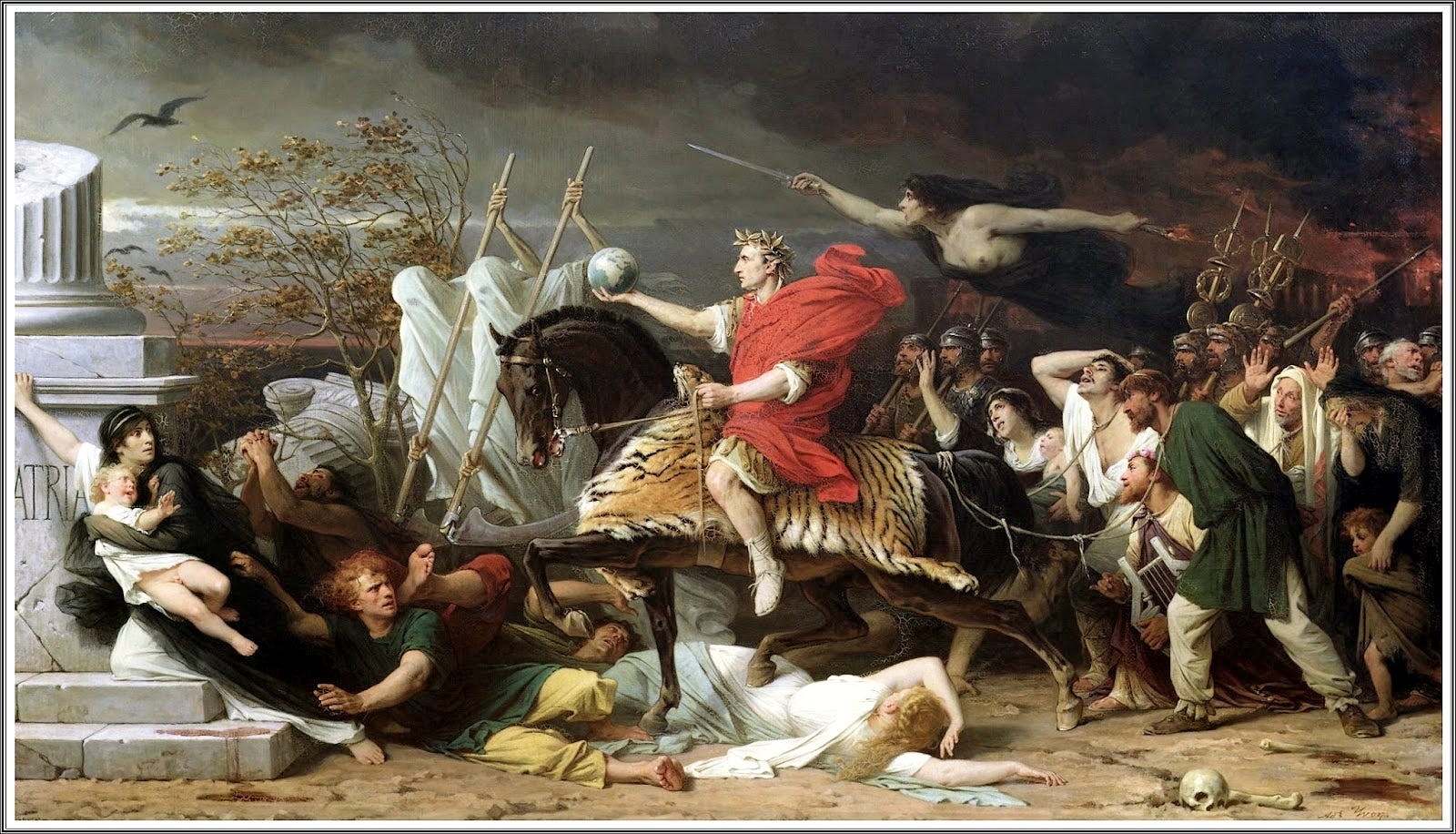
January 10, 49 BCE: Julius Caesar proverbially “crosses the Rubicon” by literally crossing the Rubicon River and marching his army toward Rome. Caesar, whose term as proconsul in Gaul had ended, took the provocative action of bringing his army back with him to the capital due to fears that he would be prosecuted by his political opponents without some kind of leverage on his side (specifically, the kind of leverage you get from bringing along thousands of armed men who are ready to start killing people on your orders). The act kicked off a civil war between Caesar and Pompey (plus his traditionalist allies in the Roman Senate), that did much to hasten the end of the Roman Republic.
January 10, 1475: Stephen III of Moldavia defeats the Ottomans at the Battle of Vaslui. Sparked by a dispute over the ruler of neighboring Wallachia and really over control of the key region of Bessarabia, the battle was the culmination of an extended scorched earth campaign by the Moldavians, who lured the larger Ottoman army deeper and deeper into their territory and finally into a place where it could easily be surrounded. Stephen’s success was relatively short-lived, as more successful Ottoman invasions in 1476 and 1484 eventually forced him to accept the status of tribute-paying imperial vassal.
January 11, 630 (or thereabouts): Muhammad and his followers conquer Mecca.
January 11, 1942: In battles at Kuala Lumpur and Tarakan, the Imperial Japanese military wins major victories over Britain and the Netherlands, respectively. Tarakan was the more significant victory as the Japanese military was able to seize control over a substantial oil drilling and refinery operation as well as a major regional airfield. While the victory at Kuala Lumpur helped to expand Japan’s control over Southeast Asia, the city was not nearly as large or as important as it is today, so this was perhaps not quite as significant a victory as it might seem.
MIDDLE EAST
SYRIA
Kurdish Syrian Democratic Forces fighters agreed on Sunday to vacate the city of Aleppo following several days of fighting with government security personnel. This was after those government forces said that they had secured control of the heavily Kurdish neighborhoods of Ashrafiyah and Sheikh Maqsoud, which had seen the heaviest of that fighting. SDF personnel have been evacuated to parts of northeastern Syria that are under the group’s control.
The US military’s Central Command reported on Saturday that it had carried out airstrikes targeting Islamic State positions “throughout Syria.” It did not go into any further detail. The Pentagon has taken a more active interest in IS in Syria since one of the group’s operatives killed two US soldiers and a civilian translator last month.
LEBANON
The Israeli military (IDF) issued an evacuation warning for the town of Kafr Hatta in southern Lebanon on Sunday, then heavily bombarded it in an attack on what it called “Hezbollah infrastructure.” This came after multiple strikes on other parts of southern Lebanon that were apparently conducted without advance notice. At least one of those strikes killed someone whom the Israelis claimed was affiliated with Hezbollah.
ISRAEL-PALESTINE
IDF strikes killed at least three people and wounded nine others across Gaza on Saturday and overnight. That’s based on separate claims from the IDF itself and from “medical sources” in Gaza and it’s unclear whether both of those reports are referring to the same three deaths. In the West Bank, Israeli soldiers shot and killed a Palestinian man in the city of Hebron, claiming that he had attempted to ram them with his vehicle. After Palestinian media reported that the man’s children had been in the car with him, suggesting that perhaps he had not been trying to attack Israeli personnel, the IDF retracted its initial claims and said that it had “no conclusive findings” to support the ramming story.
In other items:
Hamas and the Egyptian government are reportedly working to finalize the Palestinian “technocratic” committee that will manage day to day governance in Gaza under the oversight of Donald Trump’s “Board of Peace,” which is supposed to roll out in the coming week. Hamas officials have said that they’re prepared to “dissolve” their governance of the territory once the “technocrats” are in place, but there’s no timeframe for that and any candidates who pass muster with Hamas may have a hard time getting approval from the Israeli government.
While procedurally the Gaza ceasefire seems to be moving inexorably toward its “second phase,” The Wall Street Journal reports that the IDF “has drawn up plans for a new ground operation inside Hamas-controlled territory in Gaza” while “Hamas is focusing on rebuilding military capabilities lost during the war, including parts of its damaged tunnel infrastructure.” They may be gearing up for the ceasefire to break down over the most contentious of the second phases’s obligations, which is for Hamas to disarm. The group has offered to give up heavy weapons but has so far refused to consider surrendering small arms, which its leaders argue would constitute the end of Palestinian resistance. The IDF failed to disarm Hamas through more than two years of genocidal violence and deprivation of humanitarian aid, so it’s unclear how a resumption of that campaign is supposed to get the job done.
Benjamin Netanyahu told The Economist on Friday that he’s planning to “taper off” US military aid to Israel in the coming decade. On a similar note I’m hoping to taper off of eating pizza in 2026 though I did just order a couple of extra large supreme pies for dinner tonight. Netanyahu may simply be bending to the possibility that a future US presidential administration might not be willing to enable the IDF’s mass slaughter of tens of thousands of people, which would force the Israeli government to either give up on mass slaughter as a tactic or become self-sufficient in the weapons department (you’ll note which option Netanyahu is choosing in that case). Even so, this very much sounds like a “believe it when you see it” type of thing.
IRAN
Iranian human rights organizations are painting a very grim picture of the violence that has attended mass anti-government protests over the past few days, as the Iranian government has been blacking out communications. The human rights network HRANA, which was talking about a death toll in the 60s as recently as Friday, has updated its count to at least 538, including 490 protesters and 48 members of Iranian security services (along with more than 10,000 arrests). The Iran Human Rights NGO is reporting the more modest figure of 192 protesters killed, but says that those are only the deaths they’ve been able to verify and that the full count is likely higher. Iranian media seems to be eschewing any count of protester casualties but the Tasnim news agency has reported the deaths of at least 109 security personnel across the country. Even HRANA’s casualty figures may only be a partial glimpse into how dangerous this situation has become.
The communications blackout continues to make it hard to assess the scale of the protests. Piecemeal accounts, including videos shared online, suggest massive demonstrations and large-scale rioting in several major cities, but that’s at best a selective slice of information. By contrast, Iranian authorities have suggested in the past day or two that the protests are subsiding but there is absolutely nothing to indicate that’s really the case. Consequently most analysis about what this all means as far as the stability of the Iranian government is concerned is likely speculative at best. That said, one thing that is not speculative is that the economic grievances underpinning this unrest are very real, very serious, and nigh impossible for the Iranian government to address given the extent to which they’ve been driven by external pressures. Iranian President Masoud Pezeshkian talked about working to “resolve” protesters’ “concerns” in a televised interview on Sunday but how he might go about doing so remains an open question.
Speaking of external pressures, The Wall Street Journal is reporting that the the Trump administration will convene a briefing on Tuesday to offer Donald Trump “specific options to respond to the protests in Iran.” Trump has repeatedly threatened military action if Iranian security forces kill protesters, and while he excused the rising death toll in a Thursday Fox News interview as the result of “stampedes” (a claim that human rights organizations have disputed) the figures that are now being tossed around may increase the likelihood of US intervention. Military strikes at this juncture could completely derail the protests, which would presumably run counter to US aims, but there are other less drastic options reportedly under consideration including additional sanctions, cyber attacks on Iranian security services, and providing Starlink service to the protesters to get around the government’s internet blackout (indeed, Trump indicated to reporters on Sunday that he would speak to Elon Musk about that idea). There’s been no US force buildup in the region of the sort that would presumably be necessary ahead of an outright military intervention—at least not yet.
ASIA
MYANMAR
Voters in parts of Myanmar headed to the polls on Sunday for the second phase of the national election that’s currently being staged by the country’s military government. The junta’s Union Solidarity and Development Party was the overwhelming winner of last month’s first phase, and while past isn’t necessarily prologue something tells me that it’s going to have similar success in this second tranche of races. Authorities may also be hoping to improve upon the first phase’s alleged 52 percent turnout, though under the circumstances (a sham election held amid a civil war) that’s a pretty high figure to reach (or to make up, as the case may be).
SOUTH KOREA
The South Korean government says that it is investigating a couple of recent incidents wherein somebody—presumably a civilian, since Seoul has disavowed any involvement in or knowledge of the situation—flew drones into North Korean airspace. One such incident took place back in September and the other earlier this month. Kim Yo-jong, the sister of North Korean leader Kim Jong-un, is urging South Korean officials on with a not-so-subtle warning of repercussions if the drone flights continue.
AFRICA
SUDAN
Kamil Idris, the prime minister of Sudan’s military government, announced on Sunday that said government will return to Khartoum from its current home in Port Sudan. The Sudanese military decamped to that city shortly after its war against the Rapid Support Forces group began in April 2023, as the RSF controlled most of the capital region. But a military surge early last year drove the RSF out of Khartoum and its environs and an estimated 1.2 million people have returned to the city as a result. The Sudanese military has slowly been expanding its presence in the capital, and with the RSF fielding its own rival Sudanese government the move back to Khartoum in full can be read as a claim about which side is the “legitimate” claimant to authority.
On the battlefield, the Sudanese military is claiming that it has driven the RSF out of the Umm Qulayb region of North Kordofan state, “freeing” hundreds of civilians and displaced persons in the process. There’s no independent verification of this assertion. The military also says that it’s destroyed some 240 RSF “combat vehicles” in airstrikes on the Kordofan and Darfur regions over the past week.
SOMALIA
Somali Defense Minister Ahmed Moalim Fiqi claimed in an interview with Al Jazeera on Saturday that the secessionist government of Somaliland agreed to take in forcibly displaced Palestinians in return for the diplomatic recognition it recently received from Israel. This echoes an allegation leveled by Somali President Hassan Sheikh Mohamud in a previous Al Jazeera interview and should probably be taken with a grain of salt, inasmuch as the Somali government has plenty of incentive to toss out these sorts of claims to discredit Somaliland’s administration.
Somaliland and Israeli officials have denied any agreement on facilitating the ethnic cleansing of Palestinians, though those denials should also be taken with a grain of salt given the incentive that both governments have to obfuscate such an agreement if it exists. Somaliland officials have now acknowledged that they are discussing a potential Israeli military base, after initially insisting that such a facility was not part of the recognition deal.
EUROPE
RUSSIA
Ukrainian drones set fire to another Russian oil facility on Saturday, this time in Volgograd oblast. I haven’t seen any indication as to casualties or the extent of the damage, but this continues a string of Ukrainian attacks on Russian oil infrastructure that has had a noticeable effect on Russia’s energy sector.
UKRAINE
The Russian military used one of its advanced Oreshnik ballistic missiles to strike the western Ukrainian city of Lviv late Thursday night. I haven’t seen any reports of casualties but the use of this particular weapon has set off a flurry of “explainer” pieces that to be honest strike me as fairly overheated.
To the extent that its specs are known, the Oreshnik is classified as an intermediate-range ballistic missile, which puts its range somewhere between 3000 and 5500 kilometers. It is labeled as a “hypersonic” weapon because it is very fast, with a top speed exceeding mach 10, even though ballistic missiles don’t meet the basic definition of “hypersonic weapon” because they’re not maneuverable in the way that cruise missiles are. Nevertheless that speed makes the Oreshnik dangerous even if it isn’t carrying an explosive payload—the Russians first used it in a strike on Dnipro in August 2024 carrying “dummy” warheads and it still caused damage. It can also carry multiple payload warheads, amplifying its destructive potential especially if nuclear-armed. The decision to use it now and to strike Lviv, which is close to the Polish border, was presumably intended to send a message to European governments about their involvement in Ukraine, but it doesn’t really seem to be a huge advance in missile technology and I’m not sure all the handwringing is particularly useful.
AMERICAS
VENEZUELA
US Treasury Secretary Scott Bessent speculated in a Reuters interview on Friday that the Trump administration could begin easing sanctions on Venezuela within the next several days. That could include the unfreezing of as much as $5 billion worth of special drawing rights at the International Monetary Fund, which would offer a relatively quick means to inject revenue into the Venezuelan government. Banking sanctions could follow, since Donald Trump’s aim of enticing US oil companies to invest heavily in Venezuela depends to some degree on restructuring the country’s international debt and that can’t happen under current sanctions.
In Venezuela, it may be worth noting, the Trump administration advised US nationals to leave the country on Saturday. It cited “reports” that pro-Nicolás Maduro colectivo militias are hunting for US citizens. The Venezuelan Foreign Ministry labeled those reports “fabricated accounts aimed at creating a perception of risk that does not exist.”
CUBA
Donald Trump took to social media on Sunday to demand that the Cuban government “make a deal, BEFORE IT IS TOO LATE.” It’s not clear what the “TOO LATE” part means although Trump did preface his demand by saying that “THERE WILL BE NO MORE OIL OR MONEY GOING TO CUBA – ZERO” now that he’s abducted Maduro from Caracas. Venezuela had provided Cuba with oil in the past, though the level of that support has declined over the past decade and it’s no longer clear how vulnerable Cuba is on this front (though obviously the country has been dealing with regular power shortages in general). What’s uncertain here is whether Trump’s plans for Cuba include simply trying to starve its government out or if there’s some threat of a military action like the one he ordered in Venezuela earlier this month.
UNITED STATES
Finally, at Foreign Affairs Michael Brenes argues that Donald Trump’s “transactional” approach to foreign policy is not a recipe for international stability:
The post–World War II order is dead. In its place, countries are fast adopting a values-neutral, transactional approach toward foreign policy. China was the progenitor of this approach to international relations: for over a decade, Beijing has pursued quid pro quo arrangements with countries around the world to create new markets and enhance its economic reach, generating diplomatic ties with both autocratic and democratic states. It has established itself as a great power through a model of state-capitalist economic development that eschews universal human rights or concerns about its trading partners’ system of government. Its lending practices may be predatory, but the recipients of Chinese loans and infrastructure projects have willingly, if sometimes begrudgingly, participated in its model.
The United States has, in recent months, pursued its own version of a transactional foreign policy. During his second term, President Donald Trump has rejected the framework of great-power competition. Washington has punished allies, partners, and enemies alike with exorbitant tariffs in order to gain diplomatic leverage, extract resources, and win concessions on trade. And he has pursued deals with countries as varied as Argentina, China, Japan, Saudi Arabia, and South Korea, without regard to those countries’ regime form, and relentlessly attacked the institutions (such as NATO) that undergirded the rules-based order. Most recently, after capturing and extraditing the Venezuelan leader Nicolás Maduro, he appears eager to secure deals with Maduro’s successor to benefit U.S. oil companies.
The future into which China and the United States are leading the world resembles the past—specifically, the nineteenth century, in which a handful of empires competed for economic spheres and resources and territorial control in the absence of effective multilateral institutions and international law that could constrain avaricious and authoritarian behavior. But world leaders should think twice before they resurrect that century’s transactional politics, whose fundamental instability created the urgent need for a better world order. As the historian Odd Arne Westad has argued, conflict between great powers, and the prospect of it, loomed large over the nineteenth century. And nineteenth-century-style politics cannot simply be superimposed onto the twenty-first century. The world is much more multipolar now than it was then, with smaller states exerting greater influence on the global stage. A transactional approach to foreign affairs will yield not stable spheres of influence but instability characterized by competition over who can extract the most from the international system in terms of trade and resources—and it will inhibit the development of solutions to global problems that demand collective engagement.