

You’re reading the web version of Foreign Exchanges. If you’d like to get it delivered straight to your inbox, sign up today:
TODAY IN HISTORY
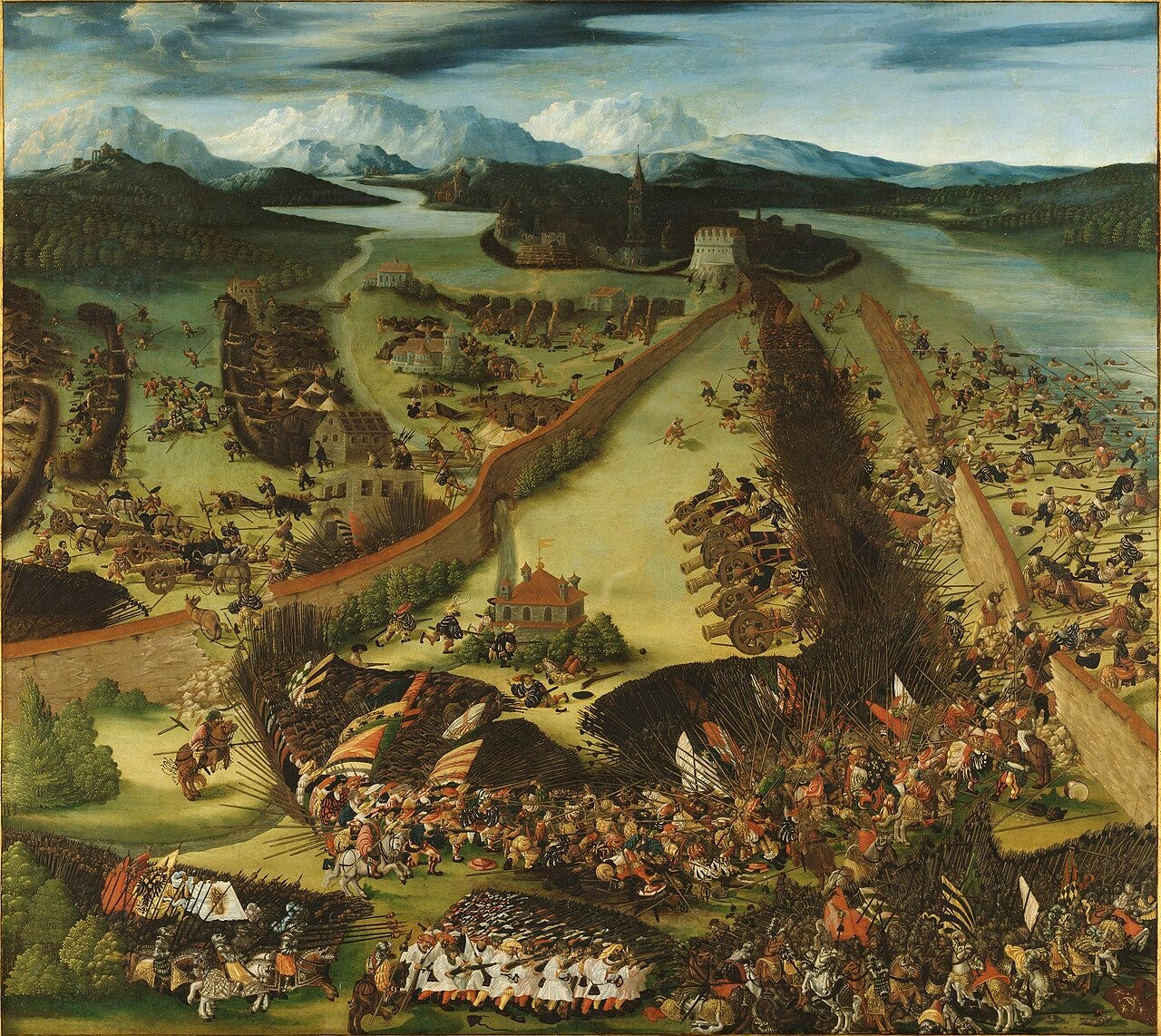
February 24, 1525: In a battle outside the northern Italian city of Pavia, a besieging French army under King Francis I is so thoroughly defeated by a Habsburg relief force that Francis himself is taken prisoner. Francis’ capture led directly to the end of the 1521-1526 Italian War, which had begun over Charles V’s election as Holy Roman Emperor in 1520 and Pope Leo X’s decision to switch alliances from Francis to Charles, Leo having decided that the emperor would be a more useful partner in his spiritual battle against Martin Luther. Francis spent the rest of the war in captivity, first in Genoa and later in a series of Spanish cities, before he and Charles signed the Treaty of Madrid in 1526, ending the war on terms favorable to the Habsburgs.
February 24, 1739: An Iranian army led by Nader Shah defeats and forces the surrender of the Mughal army under Emperor Muhammad Shah at the Battle of Karnal. The Mughal surrender cleared Nader Shah’s path to Delhi, where his forces conducted a campaign of looting and slaughter that stands among the very worst atrocities in human history.
MIDDLE EAST
LEBANON
The Israeli military (IDF) apparently attacked an under-construction army “observation post” in southern Lebanon on Tuesday. There’s no word of any casualties but the incident is notable in that after an IDF drone began warning Lebanese personnel to withdraw from the post, army command ordered them to stand their ground and return fire if necessary. That is certainly not the Lebanese army’s standard operating procedure where the IDF is concerned. Given the possibility of a US-Iran conflict sparking another war between Israel and Hezbollah it remains to be seen whether the Lebanese army will stand aside as it did during the previous war.
ISRAEL-PALESTINE
The IDF killed at least two people in northern Gaza’s Beit Lahia area on Tuesday. There’s no word as to the circumstances around those killings. Another major winter storm hit the territory overnight, flooding the inadequate tents that displaced civilians are using for shelter. And Palestinians awaiting medical evacuation from Gaza continue to be stymied by a slow Israeli process for passing through the Rafah checkpoint. A two year old child died on Sunday while awaiting evacuation.
In the West Bank, the Trump administration is extending US consular services to the Israeli settlement of Efrat this coming Friday. It is planning to roll out this service to other settlements in the future as well. This amounts to de facto recognition of the settlements’ legality, contravening official US policy even under this administration.
IRAN
With another round of US-Iranian nuclear talks theoretically two days away and Iranian officials insisting that a deal is within reach, trying to figure out where Donald Trump stands on the prospects of military action continues to feel like staring into the abyss. Monday’s barrage of leaks (including one from The Wall Street Journal that I didn’t mention yesterday) made it clear that somebody within the Trump administration isn’t keen on war and they’re either trying to push back in the press or to get their objections out before things potentially go south. Maybe it’s multiple somebodies. Maybe it’s the whole White House attempting to explain a decision not to go to war.
OK it’s probably not that last thing if only because Trump denied the main thrust of those leaks, that Joint Chiefs of Staff Chair Dan Caine was cautioning him against military action. Notably he did so in such a way that Spencer Ackerman argues he set Caine up to take the fall if things go badly. Somebody in Caine’s inner circle (probably) then ran to The New York Times to deny the main thrust of Trump’s comments, specifically that Caine had told him that war with Iran would be “something easily won.” So basically the administration and the US military seem to be coming apart internally and the war hasn’t even started yet.
You want to add a bit more madness to the mix? White House Press Secretary Karoline Leavitt reiterated on Tuesday that last year’s US airstrikes “obliterated” Iran’s nuclear program. That’s the same nuclear program that Trump now says he may have to start a war to eliminate, the same one that US envoy Steve Witkoff claimed on Saturday is “probably a week away from having industrial-grade bomb-making material.” I know we live in a post-truth world but this is taking things a bit too far.
In other items:
An Iranian court sentenced a man to death on Tuesday related to last month’s antigovernment protests. This is the first capital sentence issued to anyone who was arrested during that unrest and it still has to be reviewed by Iran’s Supreme Court, but it could serve as a pretext for US military action. The furor over those protests and the ensuing crackdown has subsided, but Trump at the time seemed to make the execution of protesters a red line for triggering a US military response.
The protests may be resuming, by the way, at least on some level. Tuesday marked the fourth day in a row in which students demonstrated on several Iranian campuses, and the fourth day in a row in which they clashed with counter-protesters. There are apparently indications that some of the counter-protesters are members of the Basij, the paramilitary force attached to the Islamic Revolutionary Guard Corps, which raises the risks of serious violence if these clashes start to escalate.
Reuters reported EXCLUSIVELY on Tuesday that “Iran is close to a deal with China to purchase anti‑ship cruise missiles.” The piece tries to paint this potential deal as a threat to the current US naval deployment around Iran, which seems silly. The deal isn’t complete yet and there’s no indication when the missiles would be delivered, but in all likelihood it would be months or even years away, or maybe never. Iranian personnel would then need to position those missiles and their launchers and train on operating them. Suffice to say that it is highly unlikely that any Chinese anti-ship missiles are going to be arriving in Iran in time to impact a war that could begin in a matter of hours or days.
ASIA
AFGHANISTAN
The Afghan and Pakistani militaries renewed their weekend conflict on Tuesday, with each side of course accusing the other of firing the first shots. There’s no indication of casualties but these exchanges of small-scale hostilities may become a regular feature again, as they’ve been for parts of the last two years.
PAKISTAN
Pakistani Taliban (TTP) militants killed at least nine people in two separate attacks in Pakistan on Tuesday. In one incident, attackers struck a police patrol in Khyber Pakhtunkhwa province, killing at least five security personnel and two civilians. In the other, a suicide bomber attacked a checkpoint in Punjab province, killing at least two police officers. Islamabad accuses the Afghan government of harboring TTP groups or at least of failing to do anything about their presence on the Afghan side of the border. Afghan officials reject that criticism and consider the TTP to be an internal Pakistani problem.
AFRICA
SUDAN
Rapid Support Forces militants assaulted the town of Misteriha in Sudan’s North Darfur state on Monday, killing at least 28 people and wounding another 39 while destroying its only medical facility according to the Sudan Doctors’ Network. The RSF may be after Arab tribal leader Musa Hilal, who hails from Misteriha, or people loyal to him. Hilal is one of the senior figures in the Janjaweed militia that was primarily responsible for the Darfur Genocide in the 2000s and from which the RSF emerged in 2013. Despite that link he has supported the Sudanese military in its war against the RSF. The militants appear to have attempted to kill Hilal by drone over the weekend, and then attacked the town when that failed.
SIERRA LEONE
The Sierra Leonean government is accusing its Guinean counterpart of abducting 16 soldiers over the weekend and on Tuesday demanded “their safe and unconditional release.” Guinean officials are of course telling a different story, which is that they detained those 16 Sierra Leonean soldiers only after they had entered Guinea on Sunday. At the root of this situation is a border dispute that according to Reuters dates back to the 1991-2002 Sierra Leonean civil war. The soldiers were apparently building an outpost on what one assumes they believed to be Sierra Leonean territory when they were captured.
DEMOCRATIC REPUBLIC OF THE CONGO
A drone strike killed M23 spokesperson Willy Ngoma in the eastern DRC’s North Kivu province early Tuesday morning. There’s been no claim of responsibility though if this wasn’t the Congolese military’s doing that would be quite surprising. With that in mind, there are concerns that Ngoma’s death could further complicate efforts to negotiate a ceasefire and peace deal between the warring parties.
EUROPE
UKRAINE
Tuesday marks the fourth anniversary of Russia’s latest invasion of Ukraine, and amid the concurrent economic crisis in Ukraine and pledges of continued support from Kyiv’s international support network World Politics Review’s Paul Poast doesn’t see the conflict ending anytime soon:
As the battle lines now stand in Ukraine, the map of territorial control looks largely the same as it did back in late 2022, with Russian forces controlling most—though not all—of the eastern and southern provinces, as well as holding the Crimean Peninsula. As Michael Kofman writes in a recent assessment of the conflict, “it is increasingly a war of adaptation, endurance, and exhaustion, as both sides struggle to break out of the prevailing battlefield dynamic.” It’s been four years of fighting for seemingly marginal territorial gains, rendering the human toll not only tragic but seemingly pointless.
Sadly, the protracted and stalemated nature of this war was foreseeable. At its one-year anniversary in 2023, I wrote that the war seemed “built to last,” and nothing in the intervening years has changed that assessment.
Critical to the war’s longevity is that both countries are sustained by external support. For Ukraine, the members of the NATO alliance, especially the United States, have been a lifeline. Under U.S. President Joe Biden, that assistance largely took the form of direct military aid to Ukraine. Under his successor, Donald Trump, the assistance has shifted to indirect means, namely through the European NATO members purchasing U.S. arms and then distributing them to Ukraine. For Russia, it has been the so-called “axis of resistance” of China, Iran and North Korea. That assistance has ranged from deeper economic and industrial cooperation with China, to troops and artillery shells from North Korea and drones from Iran.
But the core reason that the war is now in its fourth year despite the battle lines not moving in over three years is the same reason that the war started in the first place: Vladimir Putin isn’t interested in compromise. This is a war for his legacy, and that legacy is to make Ukraine once again part of Russia. In his mind, he wants to be seen as recreating the Russian Empire, or regaining the glory of the Soviet Union.
(Foreign Exchanges readers can sign up for WPR’s free newsletter here and try out an all-access subscription free for 30 days, then $35 off—$77/year—after that.)
FRANCE
According to the AP, US ambassador to France Charles Kushner appears to be taking steps to resolve the dispute that’s seen him barred from meeting with French government ministers. Kushner reportedly telephoned French Foreign Minister Jean-Noël Barrot on Tuesday, and the two had what the US embassy in Paris called “a frank and amicable call, reaffirming their shared commitment to working together, along with all other ministers and French officials, on the many issues that impact the United States and France, particularly as the two countries celebrate 250 years of rich diplomatic relations.” Kushner refused a summons by the French Foreign Ministry on Monday evening but apparently he and Barrot agreed to meet in the near future.
AMERICAS
BOLIVIA
The Bolivian government confirmed on Tuesday that it is once again collaborating with the US Drug Enforcement Administration. Former Bolivian President Evo Morales ended that cooperation in 2008 and expelled the DEA from the country. Current President Rodrigo Paz is eager to improve relations with the US and this is another step in that direction.
MEXICO
According to AFP, life is starting to return to some degree of normalcy in Mexico’s Jalisco state, after the violence that followed the government’s killing of Jalisco New Generation Cartel (CJNG) leader Nemesio Oseguera Cervantes (AKA “El Mencho”) on Sunday. Schools and many stores remain closed and people are reportedly stocking up in case the violence flares up again and they are forced to shelter indoors. Mexican authorities have deployed an additional 10,000 security personnel to clamp down on violence in Jalisco and several other states. At Jacobin, Benjamin Fogel argues that the violence was a demonstration that Oseguera’s death isn’t really going to change anything:
Rumors about El Mencho’s death have been circulating for years, either from kidney problems or some unspecified cause, but this time his death has been confirmed by the Mexican government; he was tracked down through a mistress, according to the authorities. The killing of El Mencho sparked an immediate reaction from CJNG forces in the form of narco blockades on what veteran journalist Ioan Grillo described as an “unprecedented scale” in at least fifteen different Mexican states, along with the torching of targets such as oil trucks, buses, pharmacies, and banks. As of writing, the death count includes several civilians, including a pregnant woman, twenty-five members of the state and federal security forces, and thirty “criminals.” Tourists and locals in affected areas were advised to shelter in place, while 2,500 additional troops are being deployed to Jalisco.
As the political scientist Benjamin Lessing argues in a landmark paper on criminal insurgencies, “When cartels turn to fighting strategies, I argue, their aim is not to conquer the state but to constrain it — to change its behavior, which in the case of states means policy outcomes. In wars of constraint, the function of violence is generally coercive.” In this sense, criminal violence does not represent an attempt to destroy the state but forms a negotiation with it; the message in this case is that Mencho might be dead, but the power of the organization remains intact.
UNITED STATES
The US military seized another blacklisted oil tanker in the Indian Ocean overnight. This makes three vessels it has pirated in that body of water. This one, the Bertha, had been tracked from the Caribbean since early January and US officials are alleging that it was sailing in defiance of US sanctions on Iran.
Finally, there’s more exciting tariff news. FedEx sued the US government on Monday to recover the money it paid under Donald Trump’s previous tariff regime, the one that the Supreme Court invalidated on Friday. It is the first of what could be many more companies to come. The court didn’t take a position on refunds in its ruling, so this is by no means an open and shut case but it will definitely set a precedent. In the meantime, Trump’s new “global” tariff regime came into effect on Tuesday, albeit at the 10 percent level that he announced on Friday and not the 15 percent he declared over the weekend. It’s unclear why he didn’t go with the 15 percent tariff and he may yet increase it to that level.
Amid all this fuss about Trump’s tariffs you may be wondering if they’re actually working. This is a difficult question to answer since Trump has never really explained what he’s hoping they’ll do. But if the goal is to reduce the US trade deficit, then they are definitely not having the desired effect:
From Berlin to Tokyo, the world’s biggest exporting countries have reacted to U.S. tariffs by further committing to economic policies that support exports, subsidizing manufacturers to help them leap over the tariff wall.
As for America, it very much remains the world’s importer of last resort. The U.S. trade deficit in goods rose to a record high of $1.24 trillion in 2025, driven by a 4.3% increase in goods imports, according to data published Thursday by the Census Bureau.
Big exporting countries—Germany, Japan, South Korea, Taiwan and others—have launched government spending programs that are largely tilted toward supporting manufacturers dependent on overseas markets.
These aim to lower the cost of energy, transportation and capital, making it cheaper and more efficient for businesses to produce and export goods, partly offsetting the competitiveness hit from the Trump tariffs.
They are among the reasons that global growth and trade flows have held up better than expected over the past 11 months.
I disagree with Poast’s assessment of Russia’s objectives in Ukraine, although I do agree that this war will go on for a long time.
Nothing in the Kremlin’s actions over the past four years or their rhetoric over the past 10 years (at least) suggests that Russia’s quest is to retake all of Ukraine.
But if Poast has found a way to read Putin’s mind, as he suggests here, then please tell us more—we’re all ears.