

You’re reading the web version of Foreign Exchanges. If you’d like to get it delivered straight to your inbox, sign up today:
Apologies to anyone who received multiple versions of tonight’s newsletter. That was an error on my part.
TODAY IN HISTORY
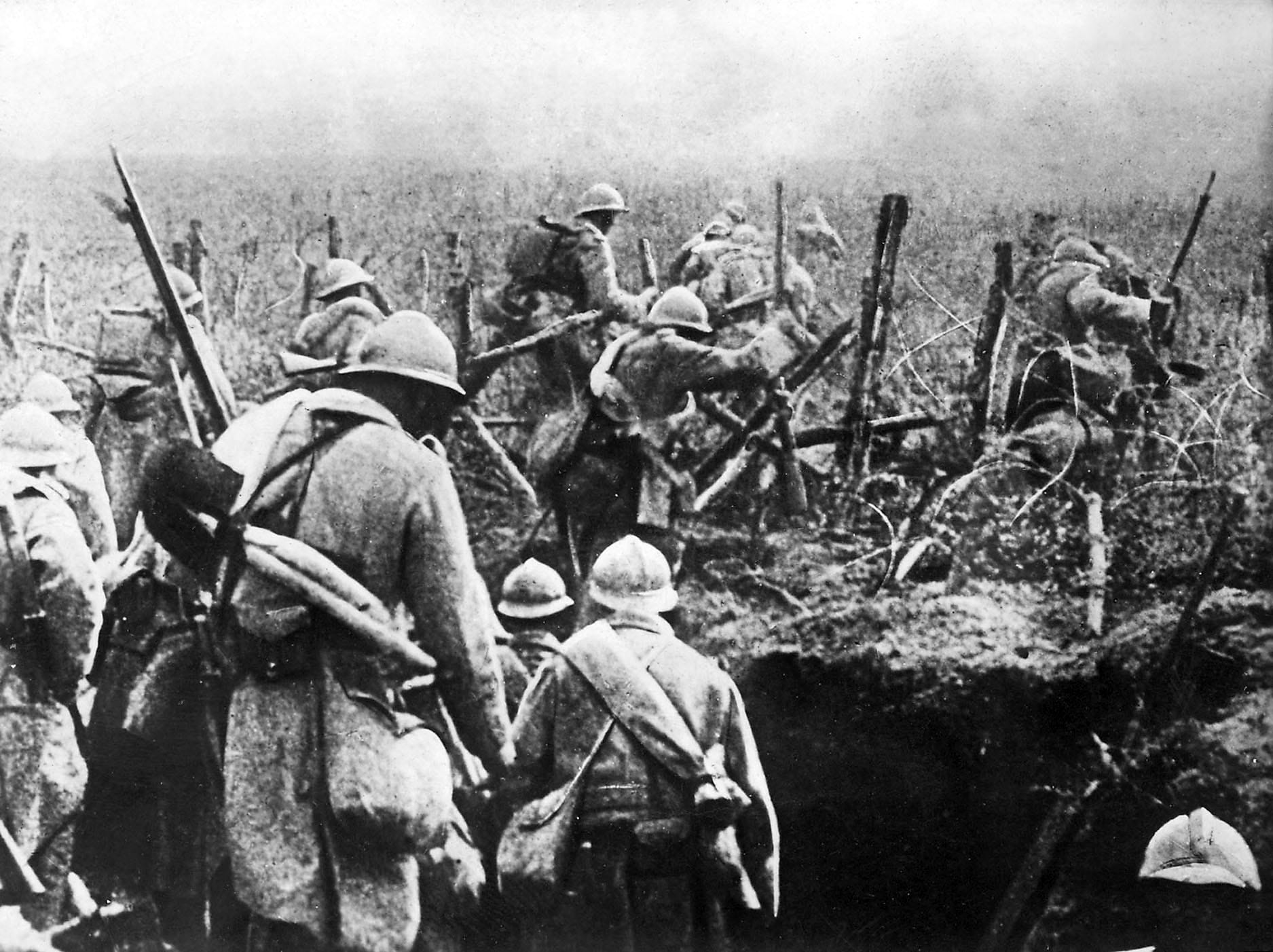
February 21, 1916: The Battle of Verdun—the longest battle of World War I and, I believe, in modern history—begins. It would end with a French victory over the attacking Germans almost a full ten months later, on December 18, after more than 300,000 soldiers had been killed on either side and upwards of 800,000 wounded. The battle is remembered today for its extended brutality and, in France, for the resistance the French army showed in the face of a sustained German effort to wear it down.
February 21, 1921: The Iranian Cossack Brigade marches into Tehran and, in a coup supported by British officials in Iran, forces Ahmad Shah Qajar to appoint a new cabinet led by journalist Ziaʾeddin Tabatabaee and military commander Reza Khan—the future Reza Shah Pahlavi.
February 22, 1797: A small French military force comes ashore near the town of Fishguard in southern Wales, kicking off the Battle of (you guessed it) Fishguard. Intended as part of a diversionary operation to mask a planned French invasion of Ireland, the incursion failed when it met stiff local resistance and the Irish invasion failed to materialize. Two days later the French force surrendered, and this marks the last time to date that a foreign army has attempted to invade the island of Britain.
February 22, 1848: A large crowd gathers in downtown Paris to demonstrate its anger against French King Louis Philippe I and demand the resignation of his prime minister, François Pierre Guillaume Guizot. The following day, Guizot’s resignation was overshadowed when French soldiers fired on the crowd, massacring more than 50 of them and kicking off the French Revolution of 1848. The revolution toppled Louis Philippe and instituted the French Second Republic, which lasted until 1852 when its president, Louis Napoléon Bonaparte (AKA Napoleon III), declared himself emperor as his uncle had done in 1804. Louis Philippe was the last King of the French.
MIDDLE EAST
SYRIA
Islamic State claimed responsibility for two attacks targeting Syrian soldiers on Saturday, one in Deir Ezzor province and the other in the city of Raqqa. The Syrian military has acknowledged the death of one soldier and a civilian in violent incidents without linking them directly to this IS claim. IS released an audio statement announcing that it has begun “a new phase of operations” in Syria while denouncing Syrian President Ahmed al-Sharaa’s government as an “apostate…regime” that had only shifted Syria “from Iranian occupation to Turkish-American occupation.”
ISRAEL-PALESTINE
The Israeli military (IDF) killed at least two people in separate incidents in Gaza on Saturday. It claimed that one of the deceased had crossed the “yellow line” in a threatening manner in northern Gaza’s Jabalia area. The IDF has killed at least 614 people and wounded another 1640 under this ostensible ceasefire.
In other items:
US ambassador to Israel Mike Huckabee caused a stir across the Middle East on Friday, when he gave an interview to far-right commentator Tucker Carlson in which he said that “it would be fine” if Israel were to seize all the land encompassed in the so-called “Greater Israel” concept, which includes the territory between the Nile and Euphrates Rivers and contains parts of at least six modern states (seven if you extend the Euphrates border all the way into Kuwait). The term “Greater Israel” is sometimes just applied to Israel proper plus the West Bank and Gaza, though Carlson made it clear that he was asking about the larger formulation. I don’t think it’s worth dwelling on this—even including Carlson’s name in this newsletter made me throw up in my mouth a little—and might not have even mentioned it had Huckabee’s comment not drawn condemnation via a joint statement from the governments of Bahrain, Egypt, Indonesia, Jordan, Kuwait, Lebanon, Oman, Pakistan, the Palestinian Authority, Qatar, Saudi Arabia, Syria, Turkey, and the UAE plus the Arab League, the Gulf Cooperation Council, and the Organization of Islamic Cooperation. The US embassy issued a statement contending that Huckabee’s words were “taken out of context,” a standard dodge in a situation like this even though they plainly were not, and stressing that they did not reflect a change in US policy. That latter part is true—while “Greater Israel is not Israeli policy (yet)—though prominent Israeli politicians have espoused it either openly or obliquely—we can assume that if it became Israeli policy the US government, under this administration or any other, wouldn’t do very much substantively to stop it.
AFP, citing a “senior Hamas official,” reports that the organization is “in the final phase of selecting a new leader.” Former Hamas leader Khaled Meshal and politburo member Khalil al-Hayya are apparently the last two candidates. Both have been serving as part of an interim leadership committee since the death of Yahya Sinwar in Gaza in October 2024. Hamas members recently elected a new Shura Council, the body that is responsible for electing the politburo which then in turn chooses the group’s political leader. Hayya has also been serving as the group’s lead negotiator in ceasefire talks.
An Israeli settler shot and killed 19 year old Palestinian-American Nasrallah Mohammed Jamal Abu Siam in a village near the West Bank city of Ramallah on Wednesday. The settlers had attacked the village in order to steal sheep, apparently, and he was one of several residents who attempted to stop them. The US embassy issued a statement saying that the State Department “has no higher priority” than protecting US citizens overseas, and we can probably expect that to be the last thing it says or does regarding this case.
Israeli Prime Minister Benjamin Netanyahu announced on Sunday that he will host Indian Prime Minister Narendra Modi in a couple of days. Apparently he aims to bring India into a “hexagon of alliances in and around the Middle East” incorporating an “axis of nations” whose governments are deferential toward Israeli interests. They would work to counter both the “radical Shiʿa axis,” or in other words Iran, and “the emerging radical Sunni axis,” which if I had to guess refers mostly to Turkey. As other potential members of Netanyahu’s axis he mentioned Greece, Cyprus, and “Arab, African, and Asian countries” without specifying.
IRAN
Omani Foreign Minister Badr al-Busaidi confirmed via social media on Sunday that another round of US-Iranian nuclear talks is scheduled to take place on Thursday in Geneva. I guess we can pencil the war in for sometime after that, unless Donald Trump is once again lying about his intention to keep negotiating as cover for a forthcoming military operation. Nobody is suggesting that, though The New York Times did report on Sunday that Trump currently favors a small-scale initial attack in an effort to pressure Iran at the negotiating table, followed by “a military assault later this year intended to help topple [Iranian Supreme Leader] Ali Khamenei” if the Iranians still haven’t given in to US demands. The initial attack could come soon, maybe if the Trump administration is dissatisfied with the “draft agreement” that the Iranians are supposed to present on Thursday.
I have no idea if what the NYT is reporting is accurate but if it is the whole thing sounds completely batshit to me. This initial strike is as likely to push the Iranians away from negotiations as to encourage them to “capitulate” (not my term; more on that in a moment), and the US military has massed so much force in the region right now that the idea of doing something bigger “later this year,” maybe months from now, seems like a logistical conundrum. Either the US will have to leave those forces in place indefinitely, which is a massive undertaking, or it will have to rotate them out of the region and then back in, which is also a massive undertaking. I guess one could take the idea of delaying a full scale “regime change” operation to mean that Trump really would prefer a deal to war, though that may be a stretch.
In related news:
In terms of the prospects of a negotiated settlement it remains unclear what either party is offering. Publicly the Trump administration has insisted on “zero enrichment” while Iranian officials insist that they will not compromise on what they view as a national right (that view is likely the correct legal one under the Non-Proliferation Treaty, so long as the Iranians do not pursue nuclear weapons). Privately, though, there continue to be reports that the administration is willing to allow the Iranians to maintain a “token” enrichment program—the NYT piece says it would be limited to producing medical isotopes and other scientific research—and Iranian rhetoric has focused on the US accepting Iran’s right to enrichment—which it could do even if the Iranians agreed to severe restrictions on their actual enrichment program. There is a path in there to a peaceful deal, but the odds still seem to favor conflict.
Enrichment aside, the Iranians are reportedly dangling US investment opportunities in energy, minerals, and other sectors, having undoubtedly seen from other cases that such offers can appeal to Trump. But they want sanctions relief, and at this point there’s no indication that the US is offering relief from current sanctions. This is part of the reason the prospects for talks still don’t look very good. There’s also US rhetoric to consider, for example envoy Steve Witkoff’s decision to go on Fox News on Saturday and question why the Iranians haven’t “capitulated” yet. Maybe the fact that the “deal” the US is offering strikes even its own lead negotiator as a “capitulation” helps to explain why the Iranians haven’t accepted it yet.
The NYT is also reporting that Khamenei has put together a succession plan for several senior positions, including his own. The names floated in this report as potential Khamenei successors are Supreme National Security Council Secretary Ali Larijani, parliament speaker Mohammad Baqer Ghalibaf, and former President Hassan Rouhani. All three would presumably be intended to succeed Khamenei on an interim basis only, since they all lack the religious qualifications to serve as Supreme Leader (of course so did Khamenei when he took the office, but I digress). Regardless it’s clear he’s preparing for a regime change-esque offensive from the US.
Anti-government protests have begun to reemerge in recent days on a number of Iranian college/university campuses. Those demonstrations have met resistance from pro-government counterprotestors and those encounters have turned violent in some places, though I haven’t seen any reports of fatalities.
ASIA
AFGHANISTAN
The Pakistani military launched another large scale attack across the border into Afghanistan early Sunday, killing by its estimates at least 70 militants—state media later reported that the figure was 80. Afghan officials are rejecting those claims and accuse the Pakistanis of targeting civilians, though they haven’t to my knowledge offered their own casualty figures as yet. The Red Crescent office in Afghanistan’s Nangarhar province is claiming that at least 18 people were killed but that may be limited to that province. Pakistani President Asif Ali Zardari cited repeated attacks from Pakistani Taliban militants, whom Islamabad believes are operating from bases in Afghanistan, as justification for this latest operation. Afghan officials are promising to retaliate “in due course.”
PAKISTAN
Prior to the Pakistani attack on Afghanistan, a suicide bomber attacked a military convoy in northern Pakistan’s Khyber Pakhtunkhwa province and killed at least two soldiers. This was presumably a Pakistani Taliban operation. I don’t think it caused the Pakistani retaliation directly but it may have served as a trigger for an attack that the Pakistani military was already planning to carry out at some point.
CHINA
Donald Trump will be heading to China on March 31 for a three day trip that will overlap with April Fools’ Day. Make of that what you will. The White House confirmed the date and length of the trip on Friday. This of course assumes that US-Chinese relations don’t sour between now and then, though they seem to be on relatively stable footing at present.
NORTH KOREA
To I assume no particular surprise, the North Korean Workers’ Party reelected Kim Jong-un as its leader on Sunday, the fourth day of its ninth party congress. Condolences to anyone who was supporting one of the other candidates.
AFRICA
SUDAN
A landmine explosion killed at least nine people, including three children, in Sudan’s South Kordofan state on Sunday. There’s no way to know who planted the device or even if it was planted amid the current war between the Sudanese military and the Rapid Support Forces group. It may be a relic of an earlier conflict. Elsewhere, there are dueling accounts of a battle in the town of al-Tina in Sudan’s North Darfur state on Saturday, with the RSF claiming to have seized it and the military and its local militia allies claiming to have repelled the RSF attack. In the military’s account its forces initially fell back into Chad and the RSF seized al-Tina, but they were able to regroup and retake the town in a counterattack, so maybe both of these accounts are true based on when they were reported. Either way the fighting did spill across the border into Chad and there were Chadian casualties, though how many is unclear.
SOMALIA
A Somaliland official named Khadar Hussein Abdi gave an interview to AFP on Saturday in which he made it clear that the country’s mineral resources and its territory (for military bases) are available to the United States for the low, low price of diplomatic recognition. Israel remains the only country to recognize Somaliland independence but where Israel goes the US may be willing to follow, particularly if Donald Trump thinks there’s financial reason for doing so. The Somaliland government has claimed that its territory includes deposits of critical minerals though those claims remain unsubstantiated. Trump has disavowed any interest in recognizing Somaliland to date, though as you may have noticed he does tend to change his mind from time to time.
The Somali government is, unsurprisingly, making similar offers to sway Trump in its direction.
EUROPE
UKRAINE
Multiple bombings in the western Ukrainian city of Lviv killed at least one person, a police officer, and wounded another 25 on Sunday morning in what authorities are characterizing as a “terrorist attack.” One person has been arrested on suspicion of planting the explosives on orders from a Russian handler. Elsewhere, another massive Russian overnight bombardment killed at least one person near Kyiv and targeted Ukrainian energy infrastructure across the country.
FRANCE
The French Foreign Ministry is summoning US ambassador Charles Kushner to answer for comments from several members of the Trump administration over the killing of a right wing activist in the city of Lyon earlier this month. US Undersecretary of State for Public Diplomacy Sarah Rogers referred to the killing as an act of “terrorism,” while the department’s counterterrorism bureau chalked it up to the “threat” of “violent radical leftism.” The ministry isn’t terribly pleased with what it views as US interference in a French matter. Italian Prime Minister Giorgia Meloni has also commented on the killing, provoking a rebuke from French President Emmanuel Macron.
AMERICAS
VENEZUELA
Aside from cutting off Venezuelan energy and financial assistance to Cuba, Reuters identifies another way in which the Trump administration is severing the alliance between those two nations:
Cuban security advisers and doctors have been leaving Venezuela as Interim President Delcy Rodriguez’s government faces intense pressure from Washington to unwind Latin America’s most consequential leftist alliance, according to 11 sources familiar with the matter.
Venezuela’s Interim President Delcy Rodriguez has entrusted her protection to Venezuelan bodyguards, according to four of the sources, unlike deposed president Nicolas Maduro and his predecessor, the late president Hugo Chavez, who both relied on elite Cuban forces.
MEXICO
Mexican authorities killed the leader of the Jalisco New Generation Cartel (CJNG), Nemesio Oseguera Cervantes AKA “El Mencho,” on Sunday during an operation to capture him in the town of Tapalpa in Jalisco state. Several other cartel members were also killed in the operation. Oseguera was one of the most powerful and notorious criminal figures in Mexico and had a $15 million bounty on his head in the US. His death sparked immediate retaliatory violence from gunmen in at least six Mexican states, violence that may continue for some time particularly as competing cartels and factions within the CJNG jockey for position.
According to Reuters the US government’s “Joint Interagency Task Force-Counter Cartel” provided Mexican security forces with a “detailed target package” that was the basis for the operation. The task force, led by the US military, is apparently “mapping” Mexican cartel networks using techniques that were developed to gather intelligence on al-Qaeda and Islamic State.
GREENLAND
Donald Trump took to social media on Saturday to announce his plan “to send a great hospital boat to Greenland to take care of the many people who are sick, and not being taken care of there. It’s on the way!!!” Why, you ask? Nobody knows. There’s no swell of Greenlanders who are in need of medical care as far as anybody can tell and in fact, like its parent country Denmark, Greenland has a national health care system. The hospital boat would be better served treating the very large number of people in the United States “who are sick, and not being taken care of there,” but again I digress. The downgrade in healthcare is one of many reasons why Greenlanders are not keen on Trump’s proposal to make the island part of the US. Unsurprisingly, Greenland Prime Minister Jens-Frederik Nielsen turned down Trump’s offer.
UNITED STATES
Donald Trump announced on Saturday that he’s raising his new “global tariff” from 10 percent to 15 percent. That’s the maximum allowed under the Trade Act of 1974, the law he cited to impose this duty after the US Supreme Court struck down most of his previous tariffs on Friday. It’s unclear why he didn’t just start at 15 percent in the first place. The 1974 legislation only allows those tariffs to remain in place for a maximum of 150 days unless Congress authorizes an extension.
Finally, Spencer Ackerman offers his thoughts about Marco Rubio’s white nationalist speech at the Munich Security Conference:
Rubio’s speech, as you may have read or heard over the past week, exhorts Europe to reembrace unapologetic Western dominance under American hegemony. It isn’t really a policy speech. It instead seeks to go deeper than policy, to what Rubio calls the “fundamental question” that ought to unite America and Europe instead of divide it: the preservation of “centuries of shared history, Christian faith, culture, heritage, language, ancestry, and the sacrifices our forefathers made together for the common civilization to which we have fallen heir.”
If you are perhaps outside of any such ancestry, whether in America [or] Europe, you understand the point of this speech. Rubio is very deliberately excluding you from both the American and European stories, as a way of saying you are not welcome at the table in the emerging Trumpist world order, and so will be on the menu. It is an absurd and accordingly ideological exclusion to anyone who understands actual American or European history from pre-modernity to now. Rubio cannot admit any indigenous, Black or non-Christian influences on cultures inextricable from them. That’s particularly unfortunate for Rubio when he talks about his ancestors from Seville. His aunts and uncles didn’t tell him that the Real Alcázar Palace was built by the Ummayyad Emirate and then improved upon by the Almorad Caliphate and that’s why it looks so splendid? They didn’t tell him why it’s called Andalucia?
While Joan Didion could have told Rubio all the ways white Americans are ready to exclude Cubans like him from that heritage, Rubio, like many a white Cuban emigré, elides the issue. He locates his own heritage not in the Caribbean but in what are now Spain and Italy. Whiteness is an invention and Rubio will demand his place in its sun. However refracted through the ahistorical inventions of the far-right imagination, we are supposed to find in the sunshine the civilizational purpose of American hegemony.