

You’re reading the web version of Foreign Exchanges. If you’d like to get it delivered straight to your inbox, sign up today:
Happy Spring Festival to those who are celebrating and Ramadan Mubarak to those who are observing the fast!
TODAY IN HISTORY
February 17, 1979: The Sino-Vietnamese War begins with a Chinese invasion, in response to Vietnam’s invasion of Cambodia (ousting the Khmer Rouge) the previous year. The “war,” such as it was, lasted only about a month and ended when the Chinese army, having stalled out around 20 kilometers over the border, declared victory and withdrew. Vietnam also claimed victory in repelling the invasion, and their claim is generally more accepted today—though admittedly the Chinese military did do serious damage to northern Vietnam’s infrastructure.
February 17, 2008: Kosovo declares its independence from Serbia. The Kosovan parliament voted (with ethnic Serb MPs boycotting) to declare independence after United Nations-supervised negotiations on a sort of independence-in-all-but-name status fell apart. Though still not recognized by Serbia and an ongoing source of tension in the Balkans, this date is commemorated as Independence Day in Kosovo.
MIDDLE EAST
LEBANON
The Lebanese government is rolling out the second phase of its project to disarm non-state actors (i.e., Hezbollah), giving itself four months to seize weapons in the area between the Litani and Awami Rivers. That would move the process north to within around 25 miles of Beirut if it happens. But that’s a big “if,” because while Hezbollah has more or less complied with disarmament south of the Litani (or at least hasn’t resisted violently), it is rejecting any disarmament further north. Its understanding of the November 2024 ceasefire between Hezbollah and Israel is that the group is only obliged to disarm in the territory between the Litani and the Israeli border, while the Israeli government is demanding total disarmament before it might consider complying with its own ceasefire obligations.
ISRAEL-PALESTINE
Continuing a theme, Hamas official Mahmoud Mardawi told Al Jazeera on Monday that the group is rejecting a 60 day disarmament ultimatum floated by Israeli Cabinet Secretary Yossi Fuchs earlier in the day. Mardawi said that the deadline has “no basis in the ongoing negotiations” over implementing the current/theoretical ceasefire. Fuchs is close to Israeli Prime Minister Benjamin Netanyahu so it’s unlikely he brought up the deadline, which in his telling has been requested by the Trump administration, without Netanyahu’s assent.
More broadly, Hamas official Basem Naim is telling Drop Site that the group will not “unilaterally disarm” or demilitarize Gaza, in 60 days or otherwise, absent the realization of Palestinian statehood. The Israeli and US governments have proposed disarmament as a precondition for Gaza’s reconstruction, but Naim and other senior Hamas figures have argued that this would be tantamount to surrendering the Palestinian resistance to occupation. They’ve proposed workarounds, like putting the group’s heavy weaponry into some sort of verifiable “storage” so that it could not easily be used in offensive action but would be accessible in case of major conflict, but there doesn’t seem to be any appetite for considering those alternatives on the Israeli side and this remains the most difficult hurdle for the ceasefire process.
IRAN
US and Iranian negotiators met indirectly for several hours in Geneva on Tuesday morning, after which Iranian Foreign Minister Abbas Araghchi pronounced that they had agreed on the “guiding principles” for further negotiations. Araghchi did not announce a date for the next round of talks, but a “US official” told reporters that “the Iranians said they would come back in the next two weeks with detailed proposals to address some of the open gaps in our positions.” Omani Foreign Minister Badr al-Busaidi, who mediated the talks, said via social media that the parties had made progress in “identifying common goals and relevant technical issues.”
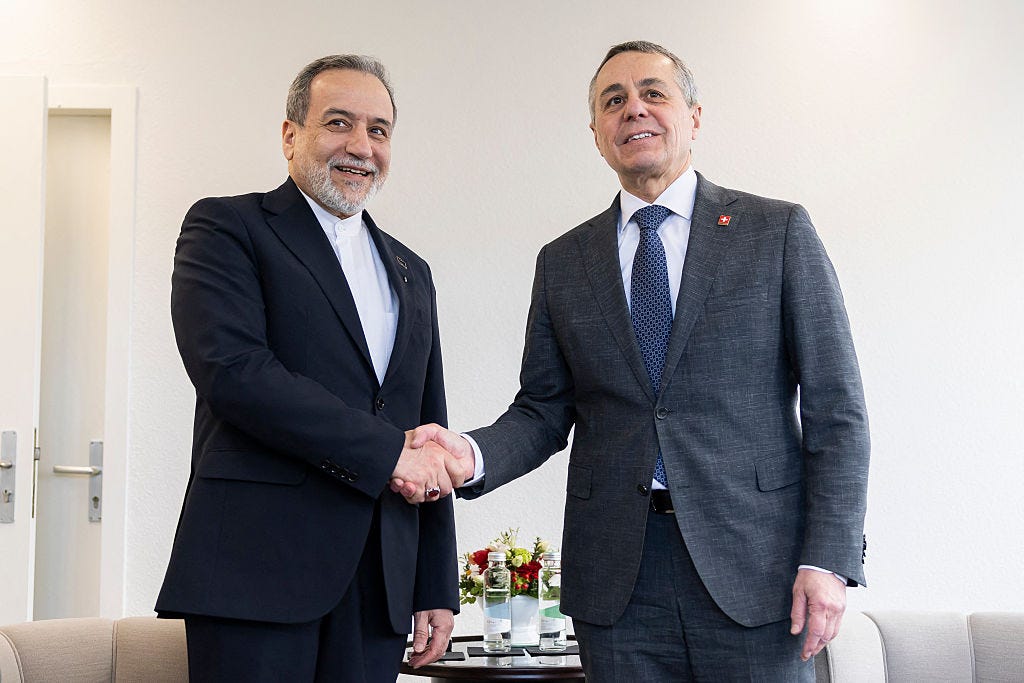
“Guiding principles” could mean anything or nothing. It’s unlikely that the parties got into any of the really contentious issues like the future of Iran’s enrichment program or the possibility of sanctions relief. Maybe those things will become clearer after the Iranians come back with those “detailed proposals.” Whether Tehran’s red lines have changed at all from where they were last year is unknown, but the bigger threat to a potential deal is that the Trump administration doesn’t seem inclined to offer anything because Donald Trump has decided that he’s ok with a war. “Surrender and maybe we won’t attack you” is not an especially attractive offer from the Iranian perspective but that’s all that appears to be on the table right now.
ASIA
AFGHANISTAN
The Afghan government said on Tuesday that it has freed three Pakistani soldiers it had been holding since October’s border conflict between the two countries. Saudi diplomats apparently negotiated their release, which Afghan officials are describing as a friendly gesture ahead of Ramadan.
PAKISTAN
Militants killed at least 17 people—14 security personnel and three civilians—in several incidents in northern Pakistan’s Khyber Pakhtunkhwa province on Monday. In the deadliest incident, attackers rammed an vehicle packed with explosives into a security checkpoint in the Bajaur district, killing at least 12 people including one civilian. The other incidents involved a bombing at a police station and an attack on a police patrol. At least 15 militants were also killed. From what I can tell there’s no indication as to responsibility, but given the location it seems likely that these attacks were the work of the Pakistani Taliban or related factions.
CHINA
The Trump administration is still pushing its claim that China conducted a surreptitious nuclear weapons test back in 2020, even though the Comprehensive Nuclear-Test-Ban Treaty Organization (CTBTO) says that it cannot verify that allegation. US Assistant Secretary of State Christopher Yeaw said at an event in DC on Tuesday that the administration’s accusation is based on data recorded by a CTBTO seismic station in Khazakhstan on June 22, 2020. He claims that the data is “what you would expect with a nuclear explosive test.” According to CTBTO executive secretary Robert Floyd, the organization detected two seismic events that day, both of them “far below” the threshold that would be required for analysts to determine that either was a nuclear blast. It’s unclear why the Trump administration feels differently.
AFRICA
ALGERIA
Nigerien junta leader Abdourahamane Tchiani visited Algiers on Monday, where he met with President Abdelmadjid Tebboune and subsequently declared his hopes to “inspire a new dynamic” in bilateral relations. As we noted last week the two countries are restoring their respective ambassadors after nearly a year of downgraded ties, motivated largely it seems by a desire to resume progress on the Trans-Saharan Gas Pipeline project. If it’s ever completed, that pipeline will carry natural gas from Nigeria through Niger to Algeria, where it could link up with pipelines running across the Mediterranean into Europe. This explains why Algeria is working to improve relations with Niger specifically and not so much with its “Alliance of Sahel States” cohorts Burkina Faso and Mali (though there have been some recent diplomatic contacts between Algeria and Burkina Faso as well).
ETHIOPIA
World Politics Review’s “Jane Cybulski” (a pseudonym) reports on the Ethiopian government’s conflict with the Fano militia in Amhara:
During the Tigray War, the Fano were estimated to have between 15,000 and 20,000 formal members. But after the Pretoria agreement [that ended that war], half of the Amhara region’s special forces—a regional detachment of the federal army numbering around 30,000—defected and joined the Fano’s cause. As a result, the militia are now more numerous and better armed than ever.
They are fighting for control of Ethiopia’s second-most populous region, with about 33 million people in an area larger than Bangladesh. Amhara is also in many ways the cultural and religious heartland of Ethiopia.
While there is no official death toll from the Fano insurgency, the monitoring group ACLED has documented some 9,000 deaths related to the fighting between April 2023 and April 2025. And by 2024, the Ethiopian government said that more than 2 million people in the region were in urgent need of humanitarian aid.
(Foreign Exchanges readers can sign up for WPR’s free newsletter here and try out an all-access subscription free for 30 days, then $35 off—$77/year—after that.)
EUROPE
UKRAINE
The first day of the latest round of US-Russia-Ukraine peace talks came and went without any major developments on Tuesday, with a “source close to the Russian delegation” describing them as “very tense.” The talks will continue on Wednesday so it would be premature to pronounce them a failure, but if the full endeavor does not generate any meaningful progress toward an agreement we can probably conclude that the Trump administration’s goal of ending the war in Ukraine by June is very unlikely to be met.
BELGIUM
The Belgian Foreign Ministry summoned US ambassador Bill White on Tuesday to complain about a social media post the previous day in which White accused Belgian authorities of antisemitism. Their offense, apparently, was investigating three men who have been accused of “performing circumcisions without certified medical training” in the city of Antwerp. That is a violation of Belgian law, which according to Foreign Minister Maxime Prévot requires that circumcisions be “performed by a qualified physician under strict health and safety standards.”
AMERICAS
PERU
The Peruvian Congress removed President José Jerí from office on Tuesday over allegations of secret dealings with shady Chinese businesspeople. Jerí had only been on the job since October, when as Congress president he assumed the office following the ouster of Dina Boluarte. He is the third straight Peruvian president to be removed in this way and continues a run of instability that goes back to the end of Ollanta Humala’s presidency in 2016. Humala remains the last Peruvian president to serve a full five year term. Since Jerí had no vice president the office should have passed to the current head of the legislature, Fernando Rospigliosi. But he refused to assume the presidency and as a result the congress will need to elect a new leader who will then succeed Jerí. Peru will hold a general election in April that might, but probably won’t, bring this chaos to an end.
COLOMBIA
The Colombian government and the Gulf Clan cartel decided on Tuesday to resume peace talks that the latter suspended earlier this month. The cartel objected to an agreement that Colombian President Gustavo Petro reached with Donald Trump during his early February White House visit, when they promised to work together against drug trafficking. One of the specific pledged that Petro made as part of that agreement was a commitment to pursue Gulf Clan leader “Chiquito Malo” (real name Jobanis de Jesús Ávila Villadiego). At that point the clan said that it would suspend peace talks pending an explanation from Colombian authorities. Apparently it was satisfied with whatever explanation it received.
CANADA
POLITICO reports that Canadian Prime Minister Mark Carney is “spearheading” negotiations on what would be an absolutely massive new trade formulation that very pointedly would not include the United States:
The European Union and a 12-nation Indo-Pacific bloc are opening talks to explore proposals to form one of the largest global economic alliances, multiple people with knowledge of the talks told POLITICO.
Canada is spearheading the discussions after Prime Minister Mark Carney called on middle powers to buck trade war coercion last month, days after [Donald] Trump threatened to raise tariffs on Denmark’s European allies if it didn’t cede Greenland.
Ottawa is “championing efforts to build a bridge between the Trans-Pacific Partnership [CPTPP] and the European Union, which would create a new trading bloc of 1.5 billion people,” Carney told world leaders and the global business elite in Davos.
The middle powers are taking action. The EU and CPTPP are starting talks this year to strike an agreement to intertwine the supply chains of members like Canada, Singapore, Mexico, Japan, Vietnam, Malaysia and Australia with Europe.
UNITED STATES
Finally, the US military destroyed three more speedboats in a significant outburst late Monday, two in the Pacific and one in the Caribbean. It summarily executed at least 11 more people in the process, bringing the total number of people it’s murdered since early September to at least 146, according to United Nations Special Rapporteur on Human Rights and Counter Terrorism Ben Saul. On that note, The Intercept’s Tomi McCluskey and Nick Turse report that the US military has been staging essentially phantom “rescue missions” to feign concern for the survivors of its boat attacks:
A total of 11 civilians died due to the U.S. attack on December 30 — including the eight who jumped overboard, according to information provided exclusively to The Intercept by SOUTHCOM, which is responsible for U.S. military operations in and around Latin America and the Caribbean. This represents one of the largest single-day death tolls since the U.S. military began targeting alleged drug smuggling boats last September.
Using open-source flight tracking data, Airwars and The Intercept learned that a Coast Guard plane did not head toward the site of the attack for almost two days. A timeline provided by the Coast Guard confirmed that it was roughly 45 hours before a flight arrived at the search area.
The slow response and lack of rescue craft in the area suggests there was scant interest on the part of the U.S. in saving anyone. It’s part of a pattern of what appear to be imitation rescue missions that since mid-October have not saved a single survivor.
A US official told The Intercept that “SOUTHCOM doesn’t want these people alive.” Maybe that’s because, as ex-State Department lawyer Brian Finucane says in the piece, they don’t want “to rescue additional survivors and then be faced with the question of ‘what do we do with them?’”