

All this month Foreign Exchanges is joining several other Substack outlets in raising money for GiveDirectly’s Rwanda initiative. Thanks in part to FX readers that effort has been so successful that GiveDirectly has raised its initial $1 million goal to $1.2 million, which would support more cash payments to impoverished families. If you’re able, please support the campaign. Those of you who are not already subscribed to FX can purchase an annual subscription at this link, save 20% on your first year, and I will contribute 50% of your payment to GiveDirectly’s campaign:
Thanks for reading!
TODAY IN HISTORY
December 6, 1240: The Mongols sack Kyiv after a brief siege. Their forces devastated the city, burning most of it to the ground and slaughtering the vast majority of its inhabitants while plundering nearly every movable object of value. The sack is often regarded as the event that ended the Kyivan Rus’ confederation, though in reality that body had been coming apart for quite some time and the sack is really more a convenient date marker than anything else.
December 6, 1904: In his State of the Union message to Congress, US President Teddy Roosevelt issues his “corollary” to the Monroe Doctrine. The Roosevelt Corollary took the mostly defensive (at least on paper) Monroe Doctrine, which warned against European intervention in the Western Hemisphere, and made it offensive, stipulating that while European nations should butt out, the United States was entitled “to the exercise of an international police power” in the Americas. This remained the US regional approach until Franklin Roosevelt introduced his “Good Neighbor Policy,” and then once that brief interlude was over the Corollary became the basis of US policy toward Latin America during much of the Cold War.
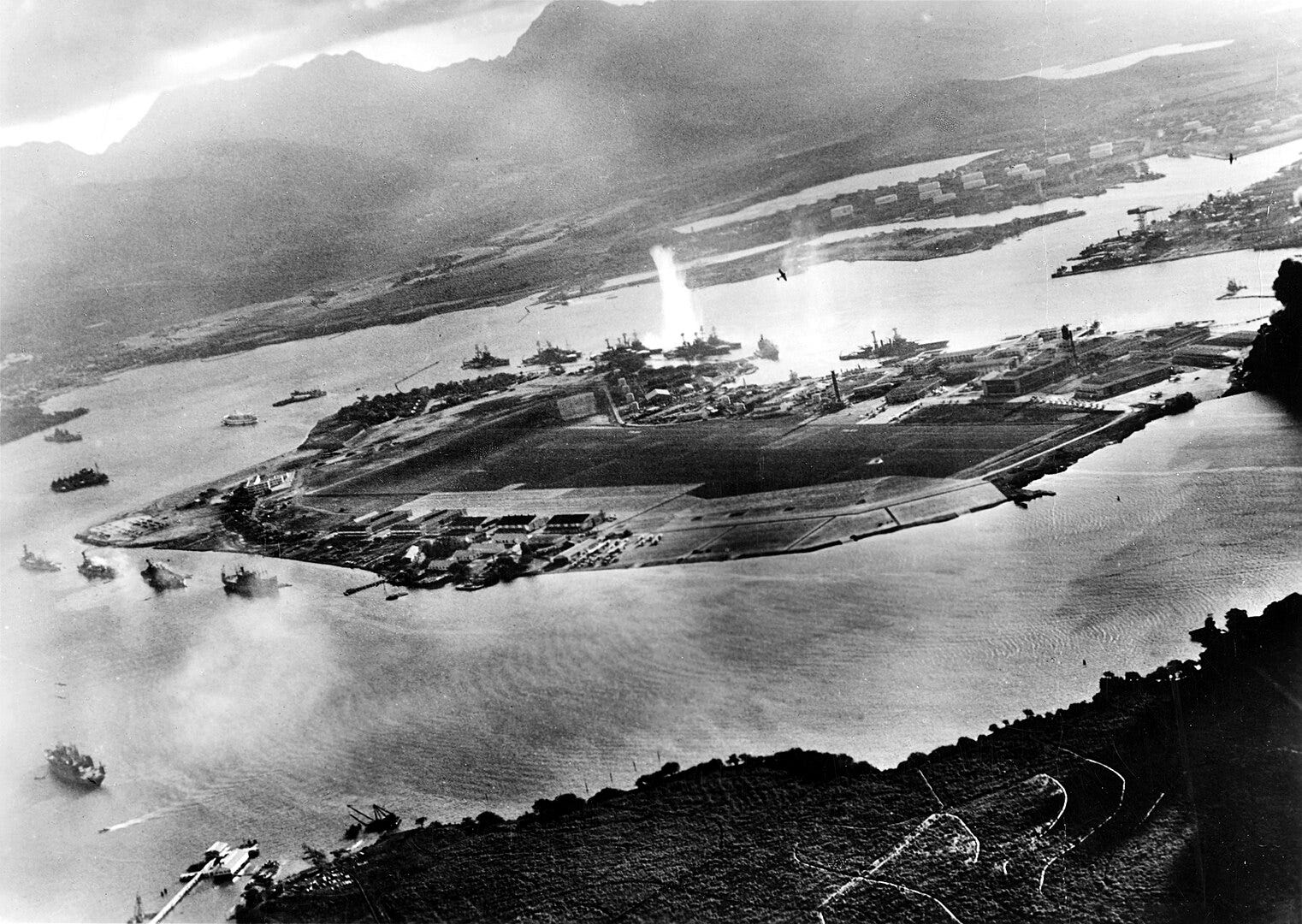
December 7, 1941: The Japanese military undertakes a coordinated series of attacks on US and British colonial holdings throughout the Pacific region. Of these, certainly the best remembered is the assault on the US naval base at Pearl Harbor, in Hawaii. Over 2400 people were killed in what was intended to be a preemptive strike to ensure that the United States would not interfere with Japanese plans in the Pacific. Of course it had the opposite effect, drawing the United States into World War II. Which, needless to say, did not work out to Japan’s (nor, for that matter, to its European allies’) benefit.
December 7, 1965: During the Second Vatican Council, Pope Paul VI and Ecumenical Patriarch Athenagoras I issue the Catholic–Orthodox Joint Declaration of 1965. The declaration reversed the mutual excommunications that had been issued by Pope Leo IX and Ecumenical Patriarch Michael I Cerularius in the Great East-West Schism of 1054. The Catholic and Orthodox churches are still in schism, of course, but their relationship has improved considerably since the 11th century.
MIDDLE EAST
ISRAEL-PALESTINE
There are several items of note:
The Israeli military (IDF) killed at least seven Palestinians across Gaza on Saturday, including a 70 year old woman and her son who, according to Al Jazeera, were “hunted down and killed by a drone in Gaza City.” The IDF seems increasingly to be operating on what is supposed to be the Palestinian side of the “yellow line,” whose location keeps changing anyway. The IDF killed at least one person around the “yellow line” in southern Gaza on Sunday. In the West Bank, Israeli forces killed two people on Saturday in what they’re claiming was an attempted ramming incident near the city of Hebron. One of them was a 17 year old who allegedly accelerated his car toward a group of soldiers at a security checkpoint and the other was a 55 year old bystander. Israeli soldiers also killed at least one person who was among a group of alleged “rock throwers” in the West Bank on Sunday. I’m unclear as to where exactly that incident took place.
Israeli Prime Minister Benjamin Netanyahu hosted German Chancellor Friedrich Merz on Sunday and, during their media availability, predicted that the Gaza ceasefire will advance to its next phase “very shortly.” The last outstanding issue in the first phase from the Israeli perspective is the repatriation of the final Gaza captive’s body, that of police officer Ran Gvili. But huge questions remain about many elements of the ceasefire plan, most immediately its proposed “international stabilization force” (the formation of which is supposed to lead into the next phase) but also involving governance of the territory and what should be additional IDF withdrawals beyond the “yellow line.”
One of those questions has to do with Hamas’s disarmament. Hamas official Basem Naim told the AP on Sunday that the group is “very open minded” on this issue and is prepared to consider “freezing or storing or laying down” its arms. None of those options necessarily means the full and irreversible disarmament that the Israeli government is undoubtedly seeking. Naim also indicated that Hamas will not hand its weapons over to the “stabilization force,” which seems to be what the US and Israel are expecting will happen. But none of the governments that might participate in that force want their soldiers to take on the responsibility of disarming Hamas, so this discrepancy remains a huge potential complication in terms of advancing the ceasefire.
In a joint statement issued on Friday, the foreign ministers of eight countries—Egypt, Indonesia, Jordan, Pakistan, Qatar, Saudi Arabia, Turkey, and the UAE—condemned the Israeli government’s decision to open the Rafah border checkpoint only to allow Palestinians to leave Gaza and not to allow aid and people to enter the territory via that route. Rafah is supposed to be reopened fully under the ceasefire, though there’s some wiggle room for the Israelis to argue that “conditions” won’t allow it. But opening it to allow people out without allowing them back in smacks of another way that the Israelis can slowly depopulate the territory while still claiming plausible deniability if they’re accused of ethnic cleansing. That said, allowing people to leave Gaza via Rafah is essential in terms of giving sick and wounded Palestinians a chance to seek medical care.
Several Palestinian groups have expressed concern over the health and safety of imprisoned Fatah Party figure Marwan Barghouti, after his son Qassam claimed via social media on Friday that Israeli prison guards had severely tortured him and left him “physically shattered.” The Israel Prison Service has dismissed this allegation as a “total lie” and “propaganda,” and Qassam Barghouti has since deleted the post while saying that he’s trying to confirm its claims.
Barak Ravid is reporting that the Trump administration wants to “broker a summit between Israeli Prime Minister Benjamin Netanyahu and Egyptian President Abdel Fattah al-Sisi,” who apparently “haven’t spoken” since prior to the October 7 2023 attacks. Aside from tensions over Gaza, Sisi is upset that Netanyahu’s government hasn’t moved forward with a proposal that would sell Israeli offshore natural gas to Egypt. The administration apparently views this as the quickest way to begin rebuilding Israel’s reputation in the Arab world.
IRAN
According to Al-Monitor’s Francesco Schiavi, leaked documents suggest that Russia is close to completing a “long-delayed” sale of at least 16 Sukhoi Su-35 fighter jets to Iran. This would be noteworthy inasmuch as the Su-35 is a fairly modern aircraft, typically identified as a “4.5” generation fighter as an improvement on the Soviet Union’s fourth generation Su-27. Both the Iranian Air Force and the Islamic Revolutionary Guard Corps Aerospace Force have been forced by Western and international sanctions to maintain decades-old aircraft that are completely overmatched in combat with more recent models, as the “12 Day War” earlier this year amply demonstrated. This would be a small but definitely real upgrade that might force the Israeli government to reconsider its plans for a sequel to that conflict, particularly if this is just the first tranche and there are additional aircraft to come. It would also mark the first major Russian reciprocation of the drone and missile support that Iran has provided for the war in Ukraine.
ASIA
PAKISTAN
Friday night’s exchange of fire along the Afghanistan-Pakistan border extended into Saturday morning and left at least five people dead (all in Afghanistan) and another eight wounded (five in Afghanistan and three in Pakistan). The Pakistani military is also claiming that its forces killed nine Pakistani Taliban fighters in two operations in Khyber Pakhtunkhwa province on Friday.
THAILAND
This story just broke as I was wrapping up tonight’s newsletter, but the Thai military announced on Monday morning (local time) that it had begun carrying out airstrikes along the Cambodian border. That development came after a clash that left at least one soldier dead in Thailand’s Ubon Ratchathani province. Cambodian officials confirmed the strikes but at time of writing had not yet retaliated. This is the latest round of fighting to threaten the ceasefire that Donald Trump claimed credit for negotiating back in July and that he signed, along with the prime ministers of both countries plus fellow mediator Malaysia, during October’s Association of Southeast Asian Nations summit in Kuala Lumpur.
JAPAN
The Financial Times is reporting that Japanese officials are frustrated with the Trump administration amid escalating tensions with China since the hawkish Takaichi Sanae became prime minister back in October. The most recent manifestation of those tensions took place on Saturday, when Chinese military aircraft provocatively locked radar on Japanese F-15s that had scrambled to monitor Chinese exercises. Japanese officials protested the incident while the Chinese military accused Tokyo of “harassing” its forces.
The US has more or less stayed out of the China-Japan spat as the administration tries to avoid upsetting the trade “detente” that Donald Trump and Xi Jinping negotiated several weeks ago, and the sense in Tokyo is apparently one of disappointment that Washington hasn’t been more publicly supportive. What may be adding to the disappointment is that said spat began after Takaichi committed publicly to supporting the US should it go to war with China over Taiwan. She did that after apparent pressure from some within the administration, chiefly Undersecretary of Defense for Policy Elbridge Colby, for the Japanese government to be clearer about how it would approach such a conflict. That said, Donald Trump reportedly “urged Takaichi not to provoke China over Taiwan” in a phone call after his South Korean summit with Xi, in which case it could be argued that she defied his request.
AFRICA
SUDAN
The death toll from Thursday’s Rapid Support Forces drone strike on a kindergarten in the town of Kalogi in Sudan’s South Kordofan state has risen to at least 116, 46 of them children. The strike also hit a hospital and a government building in the town. The death toll may rise further, though communications limitations have made it difficult to get information on the attack and the recovery effort.
On Friday, the RSF accused the Sudanese Armed Forces (SAF) of attacking the Adré border checkpoint that connects Chad’s Ouaddaï province and Sudan’s West Darfur state. That checkpoint has been a main artery for humanitarian aid flowing into Sudan and particularly into war-torn Darfur, as well as for refugees fleeing the conflict into Chad. There’s been no comment as yet from the SAF. There’s also been no indication of casualties or any sense as to the damage caused. The RSF is no doubt hyping this incident to distract from what it did in Kalogi, though that doesn’t absolve the SAF of blame for striking an important humanitarian site.
TUNISIA
Demonstrators marched in Tunis on Saturday for the third straight week to protest Tunisian President Kais Saied’s authoritarianism. Saied has over the past couple of months been on a new spree of arresting and prosecuting opposition politicians and other critics, though he of course continues to deny that he’s functioning as a dictator. Protesters demanded the release of prisoners and chanted calls for the end of Saied’s rule, while the UGTT trade union has called for a general strike on January 21.
MALI
An AP investigation alleges that Russia’s Africa Corps is maintaining the same standards for human rights and treatment of civilians that characterized its predecessor, the Wagner Group:
A new Russian military unit that replaced the Wagner mercenary group is carrying out abuses including rapes and beheadings as it teams up with Mali‘s military to hunt down extremists, dozens of civilians who fled the fighting have told The Associated Press.
The Africa Corps is using the same tactics as Wagner, the refugees said, in accounts not reported by international media until now. Two refugees showed videos of villages burned by the “white men.” Two others said they found bodies of loved ones with liver and kidneys missing, an abuse the AP previously reported around Wagner.
“It’s a scorched-earth policy,” said a Malian village chief who fled. “The soldiers speak to no one. Anyone they see, they shoot. No questions, no warning. People don’t even know why they are being killed.”
Elsewhere, The Wall Street Journal reported on Friday that the UAE government paid some $23 million to the Jamaʿat Nusrat al-Islam wa’l-Muslimin jihadist group as ransom for a member of Dubai’s royal family whom the group took captive back in September. JNIM has undoubtedly put those funds to use in its ongoing campaign to blockade Bamako and potentially topple Mali’s ruling junta. The prince in question is Sheikh Ahmed bin Maktoum Al Maktoum, who apparently owns a “farm” south of Bamako and “is involved in the precious-metals trade out of Mali.”
BENIN
The Beninese military foiled an apparent coup attempt on Sunday. What President Patrice Talon characterized as “a small group of soldiers” attacked the presidential residence in Cotonou on Sunday morning, while members of the would-be junta went on state television to declare that they had overthrown Talon’s government. But the bulk of the military seems to have remained loyal and moved quickly to protect Talon and put down the uprising. Later in the day Talon himself appeared on state TV to declare the situation “totally under control.” At least 14 people have been arrested so far. Talon is in his second term and is constitutionally barred from running again in April’s election. Last month the Beninese parliament approved a lengthening of the presidential term from five to seven years, but that won’t take effect until after the election and Talon has given no indication, at least not as yet, that he’s planning to run for a third term. The rationale behind the attempted coup is unclear.
EUROPE
UKRAINE
The latest round of US-Ukrainian negotiations around formulating a deal for peace with Russia ended without an agreement on Saturday, prompting Donald Trump to opine to reporters on Sunday that he’s “not sure” that Ukrainian President Volodymyr Zelensky is ready to end the war. According to Trump, Russian officials are “fine” with the peace framework his administration has proposed—which seems reasonable inasmuch as the Russian government helped draft it, though Vladimir Putin has expressed opposition to changes that have been made to the original framework at Ukrainian urging—and Zelensky’s “people love it.” I’m not sure I buy that claim, but anything is possible.
In Ukraine, the Russian military is claiming to have seized two more villages—one in Donetsk oblast and the other in Kharkiv oblast. And the International Atomic Energy Agency is warning that a drone strike back in February damaged the protective shield around the Chernobyl nuclear disaster site to such an extent that it “can no longer provide its main containment function.” There’s no indication of any radiation leakage at the site and the radioactive dust that is the real danger is contained in a “sarcophagus” within the shield. But that structure’s reliable lifespan lapsed around a decade ago, necessitating the construction of the protective shield. The agency called for repairs to the structure. Ukrainian officials blamed that drone strike on Russia at the time, though the Russian military denied it.
BULGARIA
The Bulgarian government began a rescue effort involving the drifting tanker Kairos on Saturday, several days after it became one of several ships that have recently been attacked (presumably) by Ukrainian naval drones. The Kairos, suspected of being part of the “shadow fleet” that Russia uses to dodge Western sanctions, is currently stranded in waters off the coast of the Bulgarian port of Ahtopol. It had been towed there by a Turkish vessel on Friday but that ship abandoned the rescue operation for reasons that are unclear—Bulgarian authorities apparently aren’t even sure why the Turkish ship towed the Kairos into their waters in the first place. The tanker is empty and there doesn’t seem to be any immediate danger either to the environment or the crew, though the risk will rise if their supplies of food and water run out.
AMERICAS
HONDURAS
Somewhat improbably, Honduran election officials still have not finished counting the votes that were ostensibly cast in last Sunday’s presidential election. As of Sunday they hadn’t even produced an updated count for two full days. Former Tegucigalpa Mayor Nasry Asfura remains ahead by around 20,000 votes over Salvador Nasralla but questions are starting to swirl about what’s taking so long and whether some sort of fix is in play, as Drop Site reported on Saturday:
Days removed from Sunday’s presidential vote, and still without a clear winner, Honduras’s post-election crisis became more contentious after a member of the country’s electoral authority denounced “monumental electoral fraud” on Thursday evening.
Marlon Ochoa, a representative for the Libre Party on the three-member National Electoral Council (CNE), alleged coordinated and deliberate electoral fraud carried out by the other council members, Cossette Alejandra López-Osorio of the National Party and Ana Paola Hall of the Liberal Party.
The CNE had claimed in a social media post on Tuesday that the delays in election results were due to technical issues. Two members of the council criticized Grupo ASD S.A.S, the company behind the Transmission and Dissemination of Election Results reporting system (known as TREP), for carrying out software modifications without the unanimous authorization of the council plenary.
But on Thursday, after repeated downtime of the TREP system continued to prevent the public from accessing real-time updates, the Honduran Center for Democracy Studies (CESPAD) issued an alert calling on CNE to take action.
MEXICO
A car bombing outside a police station in Mexico’s Michoacán state killed at least five people on Saturday according to state authorities. Several members of a “community police force” were among the victims and may have been the intended target. There’s no indication as to responsibility, but several Mexican criminal organizations are active and jockeying for position in Michoacán because it is a major entry point for the chemicals used in manufacturing synthetic drugs.
UNITED STATES
Finally, following the release of the Trump administration’s National Security Strategy, featuring the “Trump Corollary” to the Monroe Doctrine explicitly asserting US imperial rights to the Western Hemisphere, TomDispatch’s Eric Ross considers the history and present of US intervention in Latin America:
A recent wave of extrajudicial killings at sea, the directing of the CIA to launch covert ops inside Venezuela, the surge of U.S. troops into the Caribbean, the reopening of a long-shuttered naval base in Puerto Rico, and the deployment of the aircraft carrier the U.S.S. Gerald Ford in the region represent striking but not surprising developments. These are little more than the latest expression of an ideological project through which Washington has long sought to shape the hemisphere in ways that would entrench U.S. power further and protect the profits of Western multinationals.
That formal project dates back to at least the 1823 Monroe Doctrine, when the U.S. unilaterally claimed Latin America as its exclusive sphere of influence. Its revival today is unmistakable and distinctly dangerous. As Secretary of Defense Pete Hegseth declared, echoing the language of that two-century-old policy, “The Western Hemisphere is America’s neighborhood, and we will protect it.”
The results of that doctrine have long been clear: immense profits for the few and violence, political upheaval, social dislocation, and economic devastation for the many. While Washington’s imperial desires in the hemisphere have long been met by movements challenging U.S. dominance, these have repeatedly been forced back into the subordinate position assigned them in a global capitalist order designed to benefit their not so “good neighbor.”
Thanks for reading! Please do consider supporting GiveDirectly’s campaign either with a donation or by subscribing to FX: