

You’re reading the web version of Foreign Exchanges. If you’re appreciating the newsletter, sign up for an annual subscription today at this special link and not only will you save 20% on your first year, but 50% of your subscription price will go to support GiveDirectly’s Rwanda campaign:
You can contribute directly to the project at this link.
I have a family commitment this evening so that’s why tonight’s roundup is coming out earlier than usual. Thanks for reading!
TODAY IN HISTORY
December 4, 1676: A Swedish army under King Charles XI defeats an invading Danish army at the Battle of Lund. Though a relatively small battle in terms of the number of soldiers involved, in percentage terms this is one of the bloodiest battles in European history. Of the 21,000 or so soldiers involved on both sides, roughly two-thirds were killed or wounded. The Swedish victory thwarted the Danish invasion and is therefore considered a turning point in the 1675-1679 Scanian War.
December 4, 1872: The merchant vessel Mary Celeste is discovered floating adrift and deserted near the Azores Islands. The Mary Celeste’s lifeboat was missing but the vessel itself was still seaworthy, which needless to say was puzzling. Conditions on board suggested that the crew abandoned ship fairly abruptly, but their ultimate fate was never determined so there’s no testimony as to what caused them to flee. Theories as to what happened have ranged from the paranormal (giant sea monsters, the Bermuda Triangle even though the ship was nowhere near that area) to the scandalous (mutiny, piracy, attempted insurance fraud) to the mundane (weather, malfunction, concerns about the safety of the ship’s alcoholic cargo).
MIDDLE EAST
LEBANON
It took all of a day for any goodwill generated in Wednesday’s Israeli-Lebanese ceasefire negotiation to be tossed out the window amid a new round of Israeli military (IDF) attacks. The IDF struck at least four southern Lebanese towns after issuing evacuation orders. Al Jazeera is reporting “extensive damage” but there’s no indication as to casualties so far. And the Israeli and Lebanese governments are, at least for now, planning another round of talks for December 19.
ISRAEL-PALESTINE
Israeli media is reporting the death of Yasser Abu Shabab, leader of Gaza’s Israeli-backed “Popular Forces” gang, in some sort of clash between “Gaza clans.” Circumstances beyond that are uncertain, though the gang has said that he was killed while “attempting to resolve a dispute between members of the Abu Seneima family.” Abu Shabab’s group has reportedly been sheltering in IDF-controlled territory in southern Gaza’s Rafah area. It has been accused of looting aid trucks and other criminal activities, with Israeli support. Rejecting any future role for the Palestinian Authority in Gaza, Israeli Prime Minister Benjamin Netanyahu has floated the idea of empowering Hamas-opposed groups like the “Popular Forces” to take control of the territory, so Abu Shabab’s death seems to be a blow to that plan.
Elsewhere, the remains that Hamas turned over to the International Red Cross/Red Crescent on Wednesday belonged to one of the two previously missing Gaza captives. That leaves just one body left, that of Israeli police officer Ran Gvili. Recovering all of these bodies is a necessary step in terms of advancing the Gaza ceasefire beyond its current “first phase,” though there are other obstacles like the ongoing failure to form an international “stabilization”/occupation force for the territory.
IRAQ
According to Reuters, a series of Iranian drone strikes on US oil operations in northern Iraq earlier this year may have had the effect of steering Iraqi politics in a more US-favorable direction:
By the end of the four-day assault, which also disrupted operations at a local company and Norway’s DNO, nearly half of the Kurdistan region’s production had been halted.
The direct attack on U.S. interests enraged Washington, which had long felt Iraq was not doing enough to tackle pro-Iranian militias, and spurred it to ramp up a pressure campaign on Baghdad, according to nine sources familiar with the matter.
That campaign ultimately led to Iraq reopening a key export pipeline for Kurdistan’s oil - a major concession that points to a tilt in the balance of influence within Iraq away from Tehran and towards Washington.
That pipeline runs from Iraqi Kurdistan to Turkey’s Ceyhan port and was shut down in 2023 amid a dispute between the Iraqi federal government and the Kurdistan Regional Government over revenue sharing and ultimate control over Iraq’s oil resources. It finally reopened in late September after the Trump administration threatened sanctions if it remained closed. The KRG and Iraqi government will review the situation later this month and decide whether or not to leave it open.
YEMEN
As far as I know, fighting between the Southern Transitional Council and forces loyal to Yemen’s internationally-recognized government has continued through Thursday in Hadhramaut province. However, Al Jazeera is claiming that “a Saudi delegation” that was trying to negotiate a ceasefire “has reportedly reached a settlement with the opposing parties.” I haven’t seen any elaboration beyond that.
ASIA
INDONESIA
Drop Site’s Kristo Langker has an interview with former West Papua National Liberation Army faction leader Lamek Taplo, whom Indonesian security forces killed shortly thereafter, about the intensifying campaign to subjugate the West Papuan independence movement:
Indonesia has laid claim to the western half of New Guinea since the 1960s with the backing of the U.S. For the past year, the Indonesian military has ramped up its indiscriminate attacks on subsistence farming villages, especially those that deny Indonesian rule.
The military presence has been growing exponentially after the October 2024 inauguration of President Prabowo Subianto, who is implicated in historic massacres in Papua from his time as commander of Indonesia’s special forces—called Komando Pasukan Khusus or “Kopassus.” According to witnesses interviewed in Kiwirok and its surrounding hamlets, and documented in videos, there are now snipers stationed along walking tracks, and civilians have been shot and killed attempting to retrieve their pigs.
Indonesia immediately retaliated against TPNPB’s September attacks by sending two consumer-grade DJI Mavic drones, rigged with servo motors, to drop Pindad-manufactured hand grenades. One drone targeted a hut that Taplo claimed did not house TPNPB but belonged to civilians. No one was killed as the grenade bounced off the sheet metal roof and exploded a few meters away. The other drone flew over a group of TPNPB raising the Morning Star flag of West Papua but was taken down by the guerrillas before a grenade could be dropped.
Holding the downed drone and grenade, Taplo likened the ordeal to Moses parting the Red Sea for the escaping Israelites: “It’s like Firaun and Moses… It was a miracle.” Then joking, “The bomb (grenade) was caught since it’s like the cucumber we eat.”
CHINA
According to The Financial Times, the Trump administration “has halted plans” to sanction the Chinese Ministry of State Security and affiliated hacker organizations in connection with the “Salt Typhoon” campaign against US telecommunications firms. It is concerned that sanctions might upset the trade detente reached between Donald Trump and Xi Jinping back in October. The administration also appears to be shelving any new export controls or other provocative actions while it tries to reduce US dependence on Chinese supplies of critical minerals (which is likely a long-term process). Deputy White House Chief of Staff Stephen Miller has reportedly been tasked with blocking any measures that might threaten the trade status quo.
AFRICA
DEMOCRATIC REPUBLIC OF THE CONGO
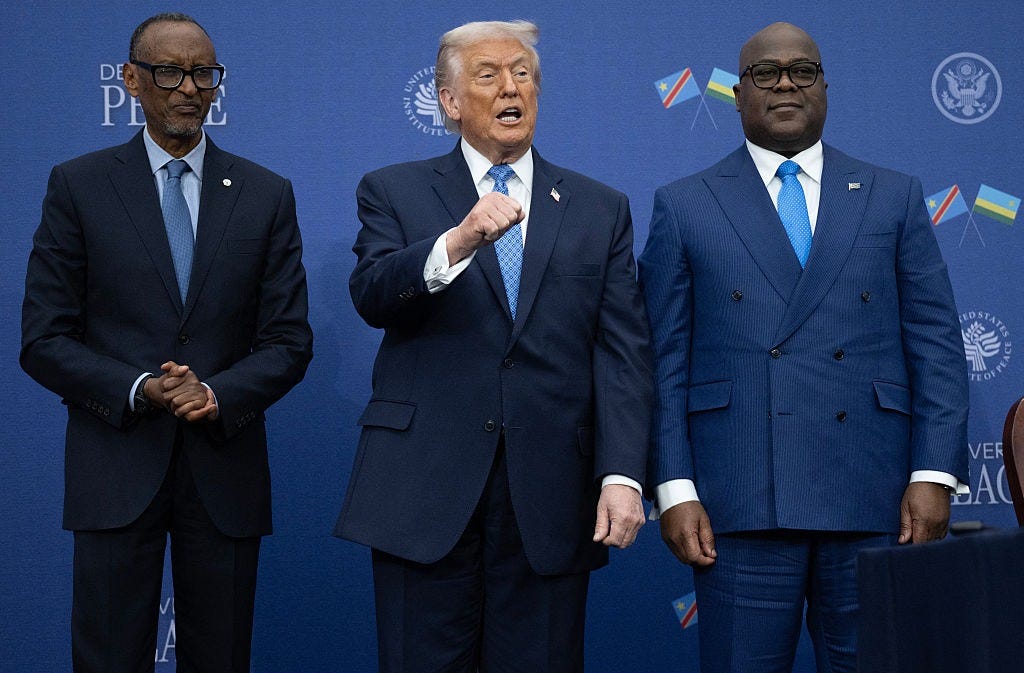
As planned, Donald Trump, Rwandan President Paul Kagame, and DRC President Félix Tshisekedi met at the United States Institute of Peace on Thursday to sign a new peace deal that’s supposed to end the M23 conflict in the eastern DRC and develop the region’s mineral resources. Heavy fighting is still raging between the Congolese military and M23 in South Kivu province, highlighting how much work needs to be done to actually implement what Trump and company have signed.
Meanwhile, a new report from the NGO Global Witness argues that a US-EU plan for developing and accessing the region’s minerals could be devastating to thousands of Congolese citizens:
Up to 6,500 people are at risk of being displaced in the Democratic Republic of the Congo by a multi-billion-dollar infrastructure project funded by the EU and the US, amid a global race to secure supplies of copper, cobalt and other “critical minerals”, according to a report by campaign group Global Witness.
The project, labelled the Lobito Corridor, aims to upgrade the colonial-era Benguela railway from the DRC to Lobito on Angola’s coast and improve port infrastructure, as well as building a railway line to Zambia and supporting agriculture and solar power installations along the route. Angola has said it needs $4.5bn (£3.4bn) for its stretch of the line.
The project is designed to facilitate the export of minerals used in green energy technologies, such as electric car batteries. It comes as western countries, China and Gulf states vie to control the critical minerals trade.
Up to 1,200 buildings are at risk of demolition due to the planned rehabilitation of the stretch of railway from the Congolese mining city of Kolwezi to the Angolan border, most in Kolwezi itself, Global Witness estimated, based on analysis of satellite data.
TANZANIA
The US State Department says that it is “reviewing” the US relationship with Tanzania due to the “ongoing repression of religious freedom and free speech, the presence of persistent obstacles to U.S. investment, and disturbing violence against civilians in the days leading up to and following Tanzania’s October 29 elections.” Opposition parties and the United Nations have claimed that Tanzanian forces killed hundreds of people around the election, perhaps over 1000. UN analysts say they are aware of reports that authorities are burying some bodies in mass graves and burning others in an attempt to obfuscate the extent of the killing.
EUROPE
RUSSIA
A UK public inquiry found on Thursday the Russian government, and Vladimir Putin specifically, to be responsible for the 2018 death of Dawn Sturgess. She died after accidentally exposing herself to the same novichok nerve agent that two men who were allegedly Russian operatives had used in the attempted murder of former spy Sergei Skripal earlier that year. In response to the inquiry the UK government announced that it is blacklisting Russia’s GRU military intelligence agency as well as 11 individuals accused of “behind Russian state-sponsored hostile activity.”
UKRAINE
A new Reuters analysis finds that Ukraine is in the midst of a full-blown population collapse:
Ukraine’s population - 42 million before the full-scale invasion in February 2022 - has already shrunk to below 36 million, including several million in areas captured by Russia, according to the demography institute at Ukraine’s National Academy of Sciences.
It estimates the figure will drop to 25 million by 2051.
The collapse is gathering pace.
The country has both the highest death rates and lowest birth rates in the world, according to 2024 estimates in the CIA World Factbook: for every birth there are around three deaths.
According to government estimates, Ukraine’s average male life expectancy dropped from 65.2 years before the war to 57.3 years in 2024. For women, the figure fell from 74.4 to 70.9.
Ukraine will need millions of people to rebuild its shattered economy, experts and politicians say, and to be able to defend itself in a post-war future should Moscow attack again, as many Ukrainians fear it will.
The death of young men in combat and the flight of other young men abroad to evade conscription have a double effect in that under normal circumstances many of them would be fathering children. There are things the Ukrainian government could do to arrest this collapse and even reverse it a bit, but those start with ending the war and that seems unlikely to happen anytime soon.
AMERICAS
HONDURAS
Honduran presidential contender Salvador Nasralla is calling for an investigation into what he says are irregularities in the counting of votes cast in Sunday’s election. This seems significant inasmuch as he’s currently leading that count, though the irregularities he’s claiming do appear—if he’s correct—to have cost him thousands of votes. Multiple delays in the count have fueled accusations of malfeasance, particularly from a Trump administration that is openly rooting for the election of former Tegucigalpa Mayor Nasry Asfura.
SAINT LUCIA
Saint Lucian voters headed to the polls on Monday for a general election that saw Prime Minister Philip Pierre’s Labour Party retain its majority in the country’s House of Assembly. Labour won 14 seats in the 17 seat legislature, a one seat improvement over its 2021 result.
UNITED STATES
Donald Trump has decided to rename the US Institute of Peace, which he and his “Department of Government Efficiency” tried to gut earlier this year, after himself. How nice for him. The USIP’s former leadership is still challenging the administration’s takeover of what had been a quasi-independent agency in court, though at present the administration is winning that battle.
Finally, the Trump administration is moving to declare the Muslim Brotherhood’s Egyptian, Jordanian, and Lebanese branches as terrorist organizations and Republicans in Congress are pushing it to go further than that. Responsible Statecraft’s Connor Echols explains a) why this is a bad idea and b) who’s pushing it anyway:
The sudden movement against the Muslim Brotherhood has left many observers confused. Trump considered designating the group in his first term but ultimately decided against it. At the time, career officials in the State Department and Pentagon were adamant in their assessment that the group didn’t qualify as a terrorist organization. In fact, it barely qualified as a single group. Nearly 100 years after its founding, the loosely organized Islamist political movement had inspired an endless number of different organizations, the vast majority of which have never participated in violence. And those that do advocate violence, like Hamas and Liwa al-Thawra, have already been designated as terror groups by the U.S.
Intelligence agencies have also long opposed efforts to designate the group. In 2017, the CIA said such a move would “fuel extremism” and lead to endless diplomatic headaches given that many political parties in the region are affiliated with the group in one way or another. And a wide range of national security experts say that designating the Brotherhood as a terrorist organization would divert resources away from more serious threats, like al-Qaida or ISIS.
So why, exactly, is this controversial effort suddenly so close to the finish line? An analysis of publicly available information suggests that the credit goes to a pair of influential advocates: hawkish D.C. think tanks and Middle Eastern governments.