

TODAY IN HISTORY
December 17, 1398: The Turco-Mongolian warlord Timur decisively defeats the Delhi Sultanate. The battle at Delhi is less notable than what came after, which stands as one of the most brutal sacks of a major city in world history. Over the next several days Timur’s forces ravaged Delhi, looting whatever they could and killing anyone who inconvenienced them—to the tune of tens or perhaps hundreds of thousands dead. Even with India’s tremendous wealth it was decades before the city fully recovered from the damage.
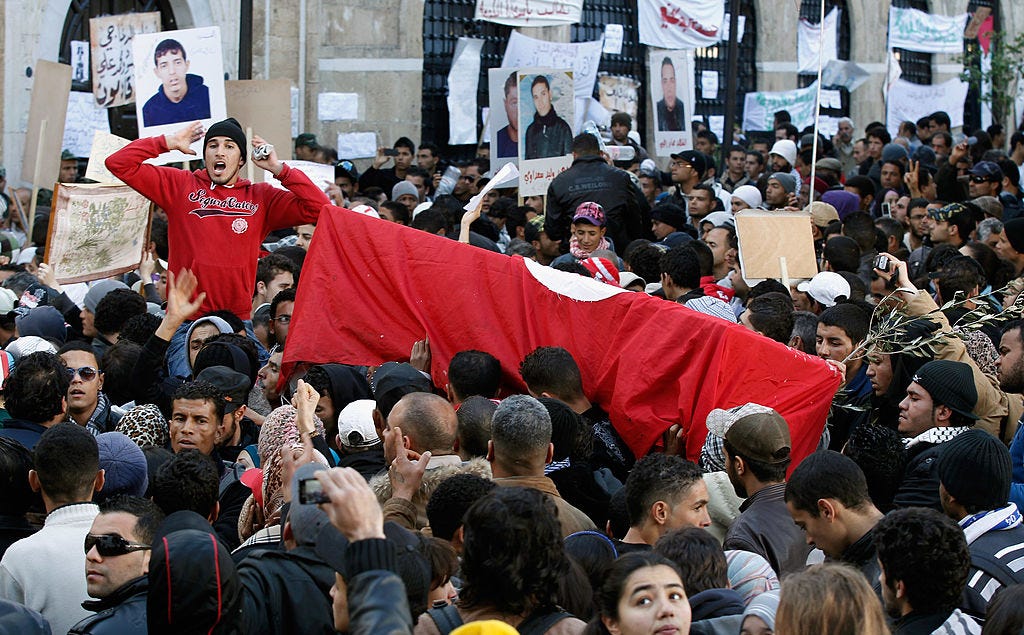
December 17, 2010: A Tunisian street vendor in Sidi Bouzid, named Mohamed Bouazizi, sets himself on fire to protest mistreatment by corrupt municipal authorities. Public outrage over Bouazizi’s case sparked the Tunisian Revolution, which in turn helped to spark the Arab Spring movement.
MIDDLE EAST
TURKEY
The Arab Center’s Salim Çevik has an interesting piece on a dynamic that has the US pushing hard for substantial Turkish involvement in Gaza despite Israeli resistance. He argues that Turkish President Recep Tayyip Erdoğan is offering to manage Gaza in return for US concessions:
President Donald Trump envisions a central role for Turkey in Gaza. At the October 2025 Sharm el-Sheikh peace summit, Trump named Turkey as one of four guarantors of the ceasefire, along with Egypt, Qatar, and the United States. In addition, the Trump administration sees Turkey as an important player in Gaza’s reconstruction and stabilization, including by participating in the proposed International Stabilization Force (ISF) there. This envisioned role for Ankara is the result of a strategic convergence between Washington’s desire to delegate the burden of overseeing the Gaza ceasefire to capable regional actors and Turkish President Recep Tayyip Erdoğan’s willingness to assume that burden in exchange for US support for Turkey’s plans for Syria, other tangible gains in US-Turkey relations, and enhanced domestic support by presenting himself as a champion of Palestinian rights. Ankara’s success in persuading Hamas to accept Trump’s ceasefire deal paved the way for this development.
Two broader trends have contributed to this convergence. One is Ankara’s recent pivot from failed Gaza mediator to Hamas’s primary political patron, which elevated Turkey’s regional influence. The second is the improvement in US-Turkey relations during Trump’s second term. But the convergence rests on fragile foundations, including the strong personal rapport between the two leaders, untested assumptions that Trump can overcome Israel’s staunch opposition to a Turkish role in the ISF, and the risk that either failed reconstruction or entrenched Israeli control in Gaza could turn into domestic political liabilities for Erdoğan. As a result, Turkey’s durability as a partner in the stabilization effort is not certain. Even if Israeli resistance is somehow overcome, Turkey’s continued commitment to Gaza depends upon Erdoğan achieving his foreign policy and domestic goals; otherwise, Turkey may pull back.
