

All this month Foreign Exchanges is joining several other Substack outlets in raising money for GiveDirectly’s Rwanda initiative. Thanks in part to FX readers that effort has been so successful that GiveDirectly has raised its initial $1 million goal to $1.2 million, which would support more cash payments to impoverished families. If you’re able, please support the campaign. Those of you who are not already subscribed to FX can purchase an annual subscription at this link (it must be that link to support GiveDirectly), save 20% on your first year, and I will contribute 50% of your payment to GiveDirectly’s campaign:
Thanks for reading!
PROGRAMMING NOTE 1: As I mentioned on Sunday we’re coming up on FX’s annual holiday break, with Thursday’s roundup set to be our final regular newsletter of 2025. We’ll be resuming our regular schedule on January 4. Thanks for reading!
PROGRAMMING NOTE 2: I’ve set up a Foreign Exchanges affiliate site at Bookshop.org, which gives a portion of its sales to support local bookstores. I’m still filling it out but you can check it out at this link. I’ve included books that have been featured on the FX podcast as well as other works by those authors, along with a selection of things that are on my bookshelves now that I thought might be of interest. Any books you buy from that site will support FX as well as those local sellers so please check it out (and check back as I add more titles)!
TODAY IN HISTORY
December 16, 755: Chinese general An Lushan declares himself emperor, attempting to usurp power from the ruling Tang Dynasty. The An Lushan Rebellion lasted over seven years (long after the death of its namesake in 757), and while it failed it also badly weakened the Tang Dynasty, which strengthened the neighboring Uyghur Khaganate and the Tibetan Empire.
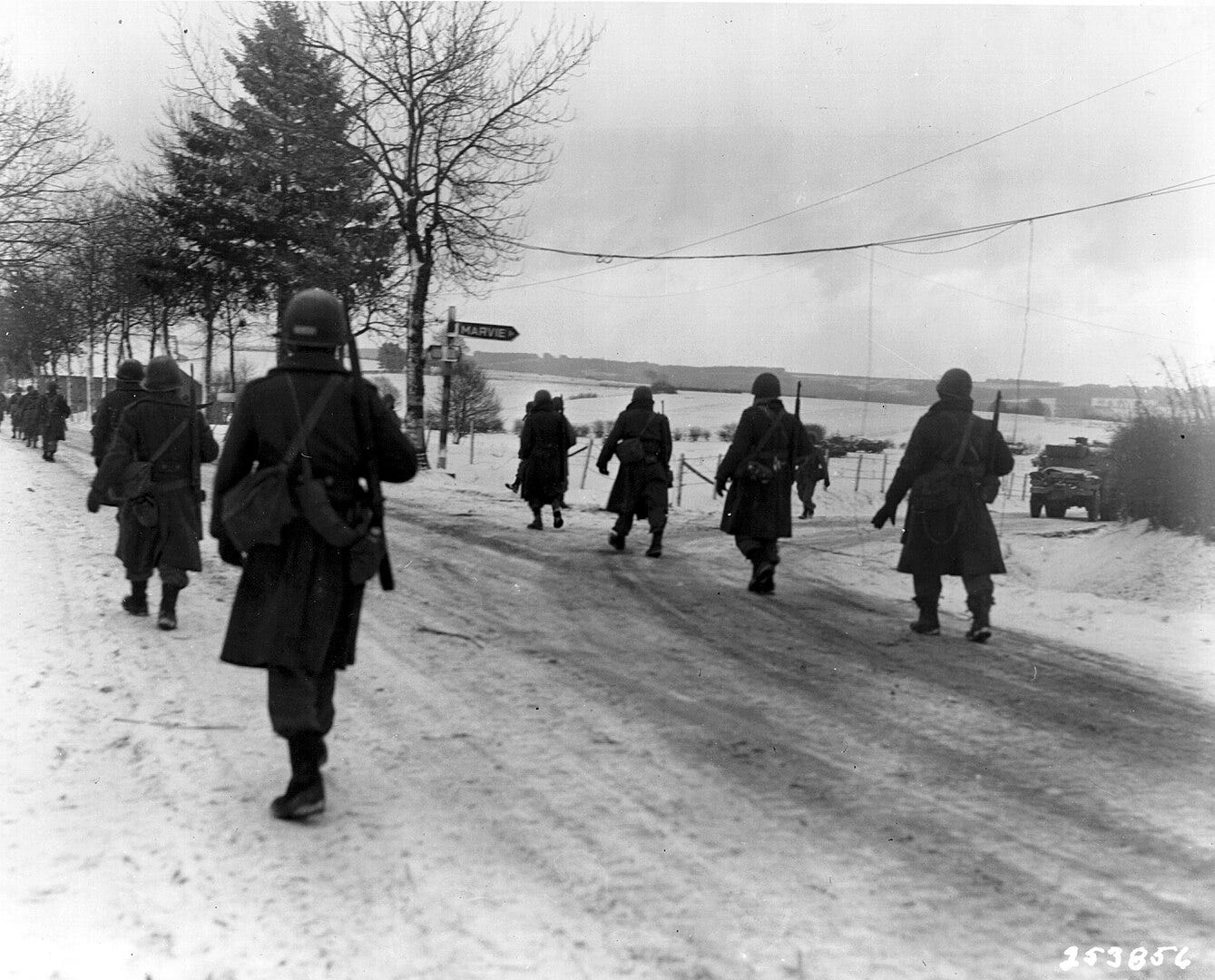
December 16, 1944: A major and sudden German offensive in the Ardennes Forest begins the Battle of the Bulge, one of the most important engagements on the European Western Front in World War II. The battle ended on January 25, 1945, with an Allied victory. The German attack did delay the Allied advance into Germany by several weeks, but the cost was the near obliteration of whatever remained of the German military’s capacity to wage an offensive war.
December 16, 1971: The Indo-Pakistani War and Bangladesh Liberation War (two parts of the same conflict) both end.
INTERNATIONAL
The US National Oceanic and Atmospheric Administration released its 2025 “Arctic report card” on Tuesday and the grades are not good. The Arctic region was hotter this year than it’s been at any point in the past 125 years and the maximum extent of its ice coverage was the lowest recorded in 47 years. And melting permafrost is apparently releasing “toxic metals” into Arctic waterways. If there is a bright spot to this report it’s that the Trump administration allowed it to be released at all, which I’m guessing may not be the case in 2026. Even if it does allow NOAA to produce a 2026 report the cuts it’s currently making to programs that measure environmental conditions in the Arctic may make it impossible for that report to say very much.
MIDDLE EAST
LEBANON
Israeli airstrikes killed at least two people in Lebanon on Tuesday, one near Beirut and the other near the Israeli border. The Israeli military (IDF) later said that it had targeted two Hezbollah members, though it’s unclear whether they correspond to the two people who were killed.
ISRAEL-PALESTINE
In an interview with Responsible Statecraft, Palestinian journalist Mohammed Mhawish describes the extent of Israeli surveillance in Gaza:
In Gaza, surveillance actively structures daily life. It determines how people move, communicate, gather, and survive. Nearly everyone I spoke to understood themselves as data points inside a system that continuously observes, records, and evaluates them.
This awareness produces a constant state of constraint. Phones are treated with suspicion, even fear. People limit calls, change SIM cards, power down devices, avoid repeated routes, and hesitate before gathering with others. Parents instruct children not to linger in certain places. Journalists and medics described modifying their work because they knew patterns could be extracted and interpreted later. Surveillance works by narrowing the range of what feels safe for everyone there.
What distinguishes Gaza is that surveillance is both totalizing and opaque. People know they are being watched, but they don’t know how, by whom, or according to what criteria. There is no way to clarify a misunderstanding or correct a false assumption. The system does not explain itself. That uncertainty turns ordinary behavior into potential exposure.
For those who have never lived under it, they might need to imagine that every movement, call, or association could be logged and assigned meaning by an unseen authority, and that those judgments could lead directly to deadly consequences in real time. It is fear of being misclassified by a system that can not be challenged.
Meanwhile, Gaza continues to be battered by storms. Authorities say that a two-week old infant died of hypothermia on Monday, less than a week after an eight month old died of similar causes amid “more than a dozen casualties from exposure” as the eastern Mediterranean winter sets in. The IDF killed one person near the “yellow line” in southern Gaza and another person died when a damaged residential building in Gaza City collapsed due to heavy rainfall. And an Israeli settler shot and killed a Palestinian teenager in the West Bank town of Tuquʿ on Tuesday. That incident took place just after a funeral service for another teenager who’d been killed by the IDF in that town on Monday.
ASIA
PAKISTAN
In what police are calling “an organized heist,” militants attacked at least three banks in Pakistan’s Baluchistan province on Monday and made off with a cool 150 million rupees, or around $530,000. Attempted operations at two other banks were reportedly thwarted. The size and level of coordination behind this operation speaks to something more than simple bank robbers, and while there’s been no claim of responsibility authorities are pointing fingers in the direction of the Baluchistan Liberation Army militant group.
MYANMAR
Reuters describes the tactics that have allowed the Myanmar military to regain momentum in its operations against several of the country’s rebel movements:
Two years after a major rebel offensive left much of Myanmar’s borderlands in resistance hands, the junta has found its footing on the battlefield, according to Reuters’ interviews with six rebel fighters and three security analysts, including some who interact regularly with the military.
The junta has reshaped its tactics by introducing conscription and expanding its drone fleet, enabling it to reclaim some territory after defeats or stalemates on the battlefield. The generals have also been boosted by the backing of China, which has applied diplomatic and financial pressure on resistance groups to stop fighting.
Three rebel fighters, including [interviewees] Htike and Khant, said they had witnessed the military using “human wave” manoeuvres to overwhelm rebel defences, reflecting new battlefield tactics that have not previously been reported.
THAILAND
The Thai Foreign Ministry said on Tuesday that the Cambodian government “must” announce a unilateral ceasefire before there can be a full cessation of their latest round of hostilities. A ministry spokesperson referred to the Cambodians as “the aggressor onto Thai territory” in a press briefing, a characterization with which I suspect the Cambodian government would disagree (though it hasn’t commented yet).
Thai elections officials have scheduled the country’s forthcoming snap parliamentary election for February 8. Prime Minister Anutin Charnvirakul dissolved parliament last week, a bit ahead of schedule but in keeping with a promise he made when he assumed office in September to move to an election within four months.
AFRICA
SUDAN
Yale University’s Humanitarian Research Lab released a new report on Tuesday outlining the Rapid Support Forces militant group’s “systematic multi-week campaign to destroy evidence of its mass killings through burial, burning, and removal of human remains on a mass scale” in the Sudanese city of Al-Fashir. War monitors have said that the RSF killed at least 1500 people in taking that city in late October, but information has been very limited and that figure is almost certainly a vast undercount. The lab found evidence via satellite imagery consistent with “clusters” of human remains that appeared to diminish in size over subsequent weeks, suggesting an effort to conceal the extent of the violence.
NIGERIA
A suicide bomber killed at least five soldiers in northeastern Nigeria’s Borno state on Sunday. This was presumably a jihadist attack but there’s been no claim of responsibility as yet.
SOMALIA
Spencer Ackerman looks at what has been Donald Trump’s most active, yet possibly least noticed, war zone:
ON SUNDAY, a U.S. warplane, probably a drone, struck a target 50 miles from Kismayo, Somalia. U.S. Africa Command, which conducted the strike and announced it today, said nothing in particular about the strike. It released no casualty information, nor even specified whether there were casualties, nor gestured at the achievement of any objective. The command merely said it “targeted” al-Shabaab, the al-Qaeda affiliate that the U.S. has been fighting inconclusively for nearly 20 years. As far as AFRICOM was concerned, it was just another day in Somalia.
That strike was, by my count, the 87th kinetic U.S. military engagement in Somalia that AFRICOM has announced this year. That is likely an undercount of the actual number of strikes. Some of the announcements involve multiple incidents, not only from above, but on the ground as well. The New America Foundation tallies 114 U.S. strikes in Somalia in 2025, some of them not publicized by AFRICOM. Their tally includes an estimate of between 115 and 292 people, militant and civilian and unknown, killed by the U.S. and its Somali proxies this year alone.
New America counts 443 US airstrikes on Somalia since 2003, and 333 of them have occurred during Trump’s five years as president. There’s no evidence of any particular strategy to this and I suspect, given his recently stated views on Somalis in general, that Trump views Somalia as nothing more than a convenient place to get his war on while only risking the lives of people he regards as “garbage.”
DEMOCRATIC REPUBLIC OF THE CONGO
In something of a surprise move, the M23 militant group declared on Tuesday that it will leave the recently-captured city of Uvira at the request of the Trump administration. The political head of the Congo River Alliance coalition that includes M23, Corneille Nangaa, called it a “unilateral trust-building measure in order to give the Doha peace process the maximum chance to succeed.” M23 and the Congolese government have been engaged in talks mediated by the Qatari government for several months. The Trump administration has heavily criticized Rwanda, M23’s patron, over the group’s latest offensive—which has threatened to undermine not only the Doha talks, but also the DRC-Rwanda accord that Donald Trump just orchestrated earlier this month. According to Reuters the militants envision establishing a “buffer zone” around Uvira, requiring the withdrawal of both M23 fighters and Congolese military forces. We’ll see if that’s amenable to the DRC government.
Elsewhere, Human Rights Watch is reporting that members of the Mobondo militia massacred at least 22 people in a November 23 attack on a village in the western DRC’s Mai-Ndombe province. The Yaka and Teke communities have been in conflict with one another in that region since 2022. The Mobondo is an ethnic Yaka militant group that has been heavily involved in that conflict.
EUROPE
EUROPEAN UNION/NATO
European leaders have begun browbeating their publics with warnings of an impending Russian invasion:
Rarely a week goes by now without a European government, military or security chief making a grim speech warning the public that they are headed toward a potential war with Russia. It is a profound psychological shift for a continent that has rebuilt itself after two world wars by trumpeting a message of harmony and joint economic prosperity.
Over the weekend, German Chancellor Friedrich Merz compared Russian President Vladimir Putin’s strategy in Ukraine to that of Hitler in 1938, when he seized the German-speaking Sudetenland region of Czechoslovakia before pressing on to conquer a large chunk of the continent. “If Ukraine falls, he won’t stop. Just like the Sudetenland wasn’t enough in 1938,” Merz told a party conference on Saturday.
That came days after NATO Secretary-General Mark Rutte made a speech warning that “conflict is at our door” and that “we must be prepared for the scale of war our grandparents or great-grandparents endured.” Rutte said that Russia could be ready to use military force against the North Atlantic Treaty Organization within five years. The head of the French military recently said that France was at risk “because it is not prepared to accept the loss of its children.”
This sense of urgency has been amped-up as the Trump administration looks to broker an end to the war in Ukraine. There is concern in European capitals that Ukraine will be pushed by Trump into accepting a lopsided peace-deal that leaves Putin emboldened and Ukraine vulnerable to future Russian attack. Crucially, a cease-fire would free Russian military resources to focus on Europe, too, potentially paving the way for a future attack on its eastern flank.
None of these warnings ever seems to include an explanation as to why Russia is going to attack Europe—I’m afraid “Putin emboldened” doesn’t actually explain anything. Given how difficult a time it’s had conquering Ukraine I’m unconvinced that Moscow is going to be eager to invade anywhere else in the near future. Of course I could be wrong, but this messaging could also be meant to acclimate those European publics to the likelihood/certainty of higher military spending in years to come. That has as much to do with the transatlantic relationship—the US is likely to reduce its European military presence—as with anything Russia might or might not do.
UKRAINE
Voldymyr Zelensky suggested on Tuesday that a joint US-Ukrainian (and European, I guess) peace proposal could be ready to present to the Russian government in a matter of days, after meetings in Berlin this week produced a “very workable” draft. Big issues remain unresolved, especially the issue of territorial concessions, and anyway it’s unlikely that the Russians will like much of whatever they get. But The New York Times is reporting that the parties in Berlin seem to have found common ground on the issue of security guarantees, which apparently includes “a more robust Ukrainian military, the deployment of European forces inside the country and increased use of American intelligence.” The Russians are likely to object at least to the European deployment but the Ukrainians likely won’t agree to territorial concessions without these guarantees.
AMERICAS
VENEZUELA
Donald Trump has imposed a blockade on sanctioned oil vessels traveling to and from Venezuela. This is a clear escalation after last week’s US Coast Guard seizure of a sanctioned tanker off the Venezuelan coast and at least arguably is an act of war. I say “arguably” because the US government can claim that this is not a full blockade of Venezuela since it’s only seizing sanctioned vessels, though it’s probably worth pointing out that violating US sanctions is not a legitimate cause for seizure under international law and the US does not have the unilateral right to enforce any international sanctions that any of these ships might be under. Consequently the US is still unilaterally interdicting otherwise lawful Venezuelan commerce.
COLOMBIA
A roadside bomb planted by National Liberation Army (ELN) fighters killed two police officers in the Colombian city of Cali on Tuesday. The incident took place amid a 72 hour “armed strike” by the ELN that’s intended to protest the US military buildup in the Caribbean but that mostly seems to involve forced curfews and attacks on Colombian security forces in areas that are under ELN control. It’s unclear how that’s supposed to affect the US military.
On a tangential note, the Trump administration designated Colombia’s Clan del Golfo, also known as the “Gaitanist Army of Colombia,” as a foreign terrorist organization and a specially designated global terrorist group on Tuesday. Clan del Golfo is generally regarded as Colombia’s largest criminal organization, as distinct from rebel militant factions like the ELN. It has been engaged in peace talks with the Colombian government of late, and these designations may complicate that process though they don’t necessarily have to stymie it.
UNITED STATES
The US military attacked three more boats on Monday, this time back in the eastern Pacific, killing at least eight people. That makes at least 90 extrajudicial murders since the US began this killing spree in early September. On Tuesday, the Trump administration extended its travel ban, barring nationals from Burkina Faso, Mali, Niger, South Sudan, and Syria from entering the US as well as anyone traveling on Palestinian Authority documents. It imposed partial travel restrictions on people from another 15 countries: Angola, Antigua and Barbuda, Benin, Dominica, Gabon, The Gambia, Ivory Coast, Malawi, Mauritania, Nigeria, Senegal, Tanzania, Tonga, Zambia, and Zimbabwe.
Finally, for anyone hoping that the US military might rein Donald Trump in should he get too carried away, The Intercept’s Nick Turse offers some bad news:
The commander of the arm of the U.S. military responsible for President Donald Trump’s illegal military occupations of American cities said he is willing to conduct attacks on so-called designated terrorist organizations within the U.S. This startling admission comes after months of extrajudicial killings of alleged members or affiliates of DTOs in the waters near Venezuela, which experts and lawmakers say are outright murders.
Gen. Gregory Guillot of U.S. Northern Command, a four-star general who takes his orders from War Secretary Pete Hegseth, made clear his position in testimony before the Senate Armed Services Committee last week. When asked about his willingness to attack DTOs within U.S. borders by Sen. Jack Reed, D-R.I., he replied: “If I had questions, I would elevate that to the chairman and the secretary. … And if I had no concerns and I was confident in the lawful order, I would definitely execute that order.”
Guillot’s openness about the potential for unprecedented military action within U.S. borders comes as the White House, Pentagon, and Justice Department continue to refuse to rule out summary executions of Americans on Trump’s secret enemies list, after weeks of requests for clarifications from The Intercept.
Thanks for reading! Please do consider supporting GiveDirectly’s campaign either with a donation or by subscribing to FX: