

All this month Foreign Exchanges is joining several other Substack outlets in raising money for GiveDirectly’s Rwanda initiative. Thanks in part to FX readers that effort has been so successful that GiveDirectly has raised its initial $1 million goal to $1.2 million, which would support more cash payments to impoverished families. If you’re able, please support the campaign. Those of you who are not already subscribed to FX can purchase an annual subscription at this link (it must be that link to support GiveDirectly), save 20% on your first year, and I will contribute 50% of your payment to GiveDirectly’s campaign:
Thanks for reading!
PROGRAMMING NOTE: We are approaching the holiday season and it has been my custom to take a couple of weeks off at this time of year to recharge. My plan at this point is for Thursday’s roundup to be our final scheduled roundup of 2025, with the intention of resuming our regular schedule on January 4. I may pop back in if events dictate but as I always do this time of year I will be trying to take a break from the news as much as possible. As always, thanks for reading and supporting the newsletter!
Wishing a Happy Hanukkah to those who are celebrating!
TODAY IN HISTORY
December 13, 1577: Francis Drake begins the expedition that would eventually take him around the world, returning to England in 1580. Although Ferdinand Magellan circumnavigated the Earth first, roughly 60 years earlier, he managed to get himself killed along the way. So Drake has the distinction of being the first person to command a voyage around the world from start to finish.
December 13, 1937: The Imperial Japanese army defeats the Chinese National Revolutionary Army and captures the city of Nanjing. What followed became known as the Nanjing Massacre, as Japanese soldiers spent the next six weeks slaughtering prisoners and civilians in the city. Estimates of the death toll vary widely, but most scholars believe it was somewhere between 40,000 and the official Chinese count of 300,000.
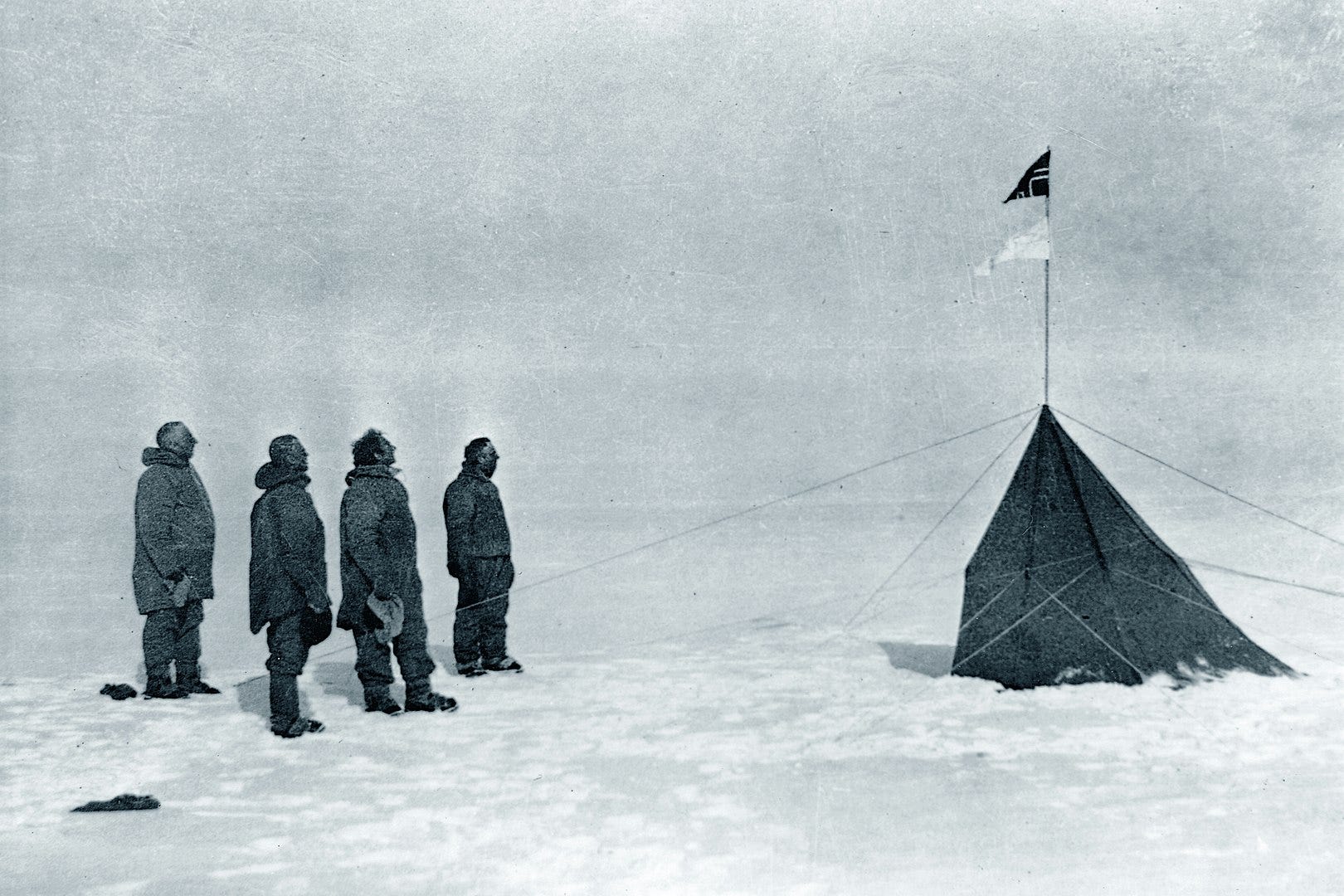
December 14, 1911: Norwegian explorer Roald Amundsen and his team become the first human beings (that we know of, I suppose) to set foot on the South Pole. The expedition had set out from its base camp on October 19 and arrived back on January 25, 1912.
December 14, 1995: The Dayton Agreement ends the 1992-1995 Bosnian War. While ending that war was no minor feat, the agreement has had mixed at best results overall. Under Dayton’s terms the various warring parties—Bosniak, Bosnian Croat, and Bosnian Serb—agreed not to divide Bosnia and Herzegovina but instead to establish an internal partition between the Serbian Republika Srpska and the Croatian-Bosniak Federation of Bosnia and Herzegovina. The effect has been similar to a full partition or arguably worse, because instead of two functioning states (or one, had Republika Srpska united with Serbia) what’s emerged is one state whose two component halves rarely agree on anything. That leaves most governance up to the “High Representative for Bosnia and Herzegovina” who is selected by Dayton’s “Peace Implementation Council” or in other words imposed on Bosnia from abroad.
INTERNATIONAL
In a bit of potentially good climate news, a recent study suggests that the longstanding correlation between economic growth and carbon emissions may no longer exist:
The analysis, which underscores the effectiveness of strong government climate policies, shows this “decoupling” trend has accelerated since 2015 and is becoming particularly pronounced among major emitters in the global south.
Countries representing 92% of the global economy have now decoupled consumption-based carbon emissions and GDP expansion, according to the report by the Energy and Climate Intelligence Unit (ECIU).
Using the latest Global Carbon Budget data, it finds that decoupling is now the norm across advanced economies, with 46% of global GDP in countries that have expanded their economies while cutting emissions, including Brazil, Colombia and Egypt. The most pronounced decouplings occurred in the UK, Norway and Switzerland.
More important is the spectacular shift in China. The world’s biggest emitter is sharply reducing its economic dependence on coal and other fossil fuels. Between 2015 and 2023, China’s consumption-based emissions rose 24%, less than half the growth of its economy (more than 50%). For the past 18 months, its emissions have plateaued and many analysts believe they may have peaked. If China can turn the corner, the rest of the world should follow.
MIDDLE EAST
SYRIA
A “lone ISIS gunman” (as the US military’s Central Command described him) attacked a meeting between US and Syrian personnel in the city of Palmyra on Saturday, killing two US National Guard members and a military interpreter and wounding three other US soldiers. Syrian forces killed the attacker, who’s been described as a member of the Syrian Interior Ministry’s security forces who’d apparently been flagged for holding “extremist ideas” (including Islamic State allegiances, I guess) pending an investigation. It’s not clear how he carried out the attack but it does not appear that he was involved in the meeting. Donald Trump told reporters at the White House that he intends to “retaliate” for this attack, but what form that retaliation might take I couldn’t tell you. The incident apparently hasn’t caused him to rethink the presence of US forces in Syria, even though he’s questioned this deployment in the past.
LEBANON
The Israeli military (IDF) carried out airstrikes on three southern Lebanese towns on Sunday, killing one alleged Hezbollah member in each of them. It apparently suspended a planned airstrike on Saturday after the Lebanese army requested time to enter the targeted village and dismantle whatever alleged Hezbollah infrastructure the Israelis were intending to target.
ISRAEL-PALESTINE
The IDF killed at least five people on Saturday in an airstrike in northern Gaza. Among the dead was Raad Saad, the head of Hamas’s weapons production operation and, according to Israeli officials, one of the planners of the October 7 attacks. His status notwithstanding this strike violates the Gaza ceasefire, which doesn’t have any exceptions for “the IDF sees a chance to kill a Bad Guy.” Israeli Prime Minister Benjamin Netanyahu and Defense Minister Israel Katz claimed that the strike was “in response to the detonation of a Hamas explosive device that wounded our forces today in the Yellow Area of the Gaza Strip” to give it some veneer of legality.
Haaretz reported on Sunday that the Italian government “is committing to send troops for the international stabilization force in Gaza,” according to “several sources…including a Western diplomat.” If this is accurate it presumably comes as welcome news to the Trump administration, as this makes Italy the first and only country to make such a commitment. Other governments have made vaguer statements about possible involvement (Indonesia has said it would send personnel but only in support roles, for example), although to be fair the Turkish government has repeatedly expressed willingness to participate but is being vetoed by Israel. The extent of any Italian deployment remains to be seen.
In the West Bank, The Guardian reports on the new Israeli security wall that’s being used to displace Palestinian communities:
The death knell for the Palestinian village of Atouf, on the western slopes of the Jordan valley, arrived in the form of a trail of paper, a series of eviction notices taped to homes, greenhouses and wells, marking a straight line across the open fields.
The notices, which appeared overnight, informed the local farmers that their land would be confiscated and that they had seven days from the date of their delivery, 4 December, to vacate their properties. A military road and accompanying barrier was to be built by Israel right through the area.
Lawyers for the Atouf village council have lodged an appeal, but long and bitter experience has taught Palestinians here to have low expectations of Israeli courts.
“The Israeli military can do anything they like. They don’t care about the law or anything else,” said Ismael Bsharat, a local farmer.
Similar eviction notices had been delivered on the same day all along an almost 14-mile (22km) strip of Palestinian farmland running north to south through Atouf, tracing out the route of the planned road and fence. And this week it became clear that this abrupt gash across Palestinian land was the first section of a new line of division that would redraw the map of the West Bank.
YEMEN
There’s not much new to say here as far as I know, but Reuters did report later in the day on Friday that a “joint Saudi-Emirati military delegation” had “arrived in Aden to discuss measures aimed at defusing tensions in southern Yemen.” They’re trying to unpack the fallout from the Southern Transitional Council’s takeover—if that’s the appropriate term—of much or arguably all of that region in the wake of its attack on Hadhramaut province earlier this month. State media also reported on Friday that said attack left at least 32 Yemeni military personnel dead and some 45 others wounded, which is the first attempt at a casualty figure that I’ve seen. It’s still unclear how extensive the STC operation has been, though the group says it’s seized much of Hadhramaut and neighboring Mahra province and is apparently operating out of the presidential palace in Aden, the de facto southern capital.
IRAN
According to Al-Monitor, a new militant group calling itself the “People’s Resistance Front” made a public rollout in Iran’s Sistan and Baluchistan province on Wednesday and has claimed responsibility for an attack that same day that left four Islamic Revolutionary Guard Corps personnel dead. It sounds like this is mostly a rebranding of the Jaysh al-Adl jihadist group with the incorporation of a few other small militant groups and an ideology that is intended to appeal to disaffected communities across Iran rather than being limited to Sunni extremism and Baluch separatism. Unless that broader ideology catches on outside of Sistan and Baluchistan there’s not much to mark this new arrangement as particularly innovative or threatening to Tehran.
ASIA
MYANMAR
Myanmar’s military government took responsibility on Saturday for bombing a hospital in Rakhine state on Wednesday night. The junta doesn’t usually acknowledge when it bombs civilian targets but in this case the coverage must have been intense enough to draw a response. It claimed that the hospital was being used as a “base” by multiple rebel groups, including the long-established Arakan Army and smaller groups that emerged after Myanmar’s 2021 coup. Even if that’s true it doesn’t necessarily make the facility a legitimate target, though it’s not as though the junta is concerned with adhering to the fine points of international law. It’s claiming that all of the victims were rebels, while local officials say that the casualties (34 dead and over 80 wounded) included “patients and medical staff.”
THAILAND
Far be it from me to question Donald Trump’s preternatural peacemaking abilities, but despite his declaration of a new (or renewed) ceasefire between Thailand and Cambodia on Friday there is no indication of any lessening of their latest round of hostilities—which, if anything, escalated over the weekend. On Saturday the Cambodian government announced that it was closing all of the crossing checkpoints along the Thai border, then on Sunday the Thai military announced the opening of an apparently new “military operation to reclaim Thai sovereign territory” around Trat province. I’m unsure whether this means that the Thai military is now holding territory on what would have been regarded as the Cambodian side of the border prior to Sunday, but that seems like a possibility. This new outbreak of violence, which began on Monday, has left at least 16 soldiers and ten civilians dead in total so far.
OCEANIA
AUSTRALIA
A pair of gunmen opened fire on a Hanukkah celebration on Bondi Beach in the Australian city of Sydney on Sunday evening, killing at least 15 people. Police killed one of the attackers and the second is apparently in custody and in critical condition. Australian media has identified the attackers as a father (who was killed) and son, the latter of whom had been “examined” by Australian domestic intelligence “six years ago over his close ties to a Sydney-based Islamic State (IS) terrorism cell.” Monitoring organizations have noted a rise in antisemitic incidents in Australia over the past couple of years, though if this was an IS or IS-inspired operation (as it seems to have been) it’s questionable how much that trend would have influenced the attackers. Police say they’re not looking for anyone else who was “directly involved” in the incident but that doesn’t rule out additional arrests as the investigation proceeds.
AFRICA
SUDAN
A Rapid Support Forces drone strike hit the city of El-Obeid in Sudan’s North Kordofan state on Saturday, killing at least three people and wounding nine others. The RSF has been attempting to besiege El-Obeid, as it did until the Sudanese military lifted that siege earlier this year, but hasn’t been able to invest the city as yet.
Another drone strike on Saturday hit a United Nations peacekeeping facility in Kadugli, the capital of South Kordofan state, and killed at least six Bangladeshi peacekeepers. All of them were attached to the UN’s mission in Abyei, a disputed, oil-rich territory whose status was left undecided when South Sudan seceded in 2011. It’s currently administered as a condominium of sorts, though with control shaded slightly toward South Sudan. The Sudanese military is blaming the RSF for this attack, but there’s been no comment from the RSF and it’s not immediately apparent what they (or the military) would be trying to gain by attacking UN peacekeepers.
TUNISIA
Police and protesters have been clashing violently in the Tunisian city of Kairouan after a man died on Friday likely of injuries suffered while in police custody. Local officials have pledged to investigate the man’s death but tensions are nevertheless high. This incident comes as protests are taking place across the country over multiple grievances, including those related to President Kais Saied’s increasing authoritarianism. Saied’s government has been intensifying its efforts to arrest and imprison opposition leaders and critics of late, fueling the unrest.
MALI
The AP reports on a number of Malian women and girls who say they’ve been subject to sexual assault by Russian Africa Corps personnel:
[content warning for sexual assault]
The girl lay in a makeshift health clinic, her eyes glazed over and her mouth open, flies resting on her lips. Her chest barely moved. Drops of fevered sweat trickled down her forehead as medical workers hurried around her, attaching an IV drip.
It was the last moment to save her life, said Bethsabee Djoman Elidje, the women’s health manager, who led the clinic’s effort as the heart monitor beeped rapidly. The girl had an infection after a sexual assault, Elidje said, and had been in shock, untreated, for days.
Her family said the 14-year-old had been raped by Russian fighters who burst into their tent in Mali two weeks earlier. The Russians were members of Africa Corps, a new military unit under Russia’s defense ministry that replaced the Wagner mercenary group six months ago.
Men, women and children have been sexually assaulted by all sides during Mali’s decade-long conflict, the U.N. and aid workers say, with reports of gang rape and sexual slavery. But the real toll is hidden by a veil of shame that makes it difficult for women from conservative, patriarchal societies to seek help.
The silence that nearly killed the 14-year-old also hurts efforts to hold perpetrators accountable.
The AP learned of the alleged rape and four other alleged cases of sexual violence blamed on Africa Corps fighters, commonly described by Malians as the “white men,” while interviewing dozens of refugees at the border about other abuses such as beheadings and abductions.
SOMALIA
Drop Site’s Amanda Sperber reports on an apparent massacre in Somalia last month that involved the US military:
U.S. airstrikes and Somali government ground troops, including a militia trained by the U.S., killed at least 11 civilians, including seven children—one as young as seven months—during an operation on an al-Shabaab stronghold in southern Somalia last month.
Drop Site News spoke to four witnesses of the attack from [Jamame], a major town in the Lower Jubba region, that has been under control of al-Shabaab—an al-Qaeda-affiliated militant group—for decades. On November 15, the witnesses said, after hours of aircraft circling overhead, shelling and bombing started, leaving body parts strewn on the ground and caught in trees.
The United States Africa Command (AFRICOM) released a statement confirming that it conducted strikes in the area to support Somali troops. AFRICOM did not respond to requests for comment about the operation it supported killing civilians; neither did the government of Jubbaland.
EUROPE
BELARUS
The Trump administration sent lawyer John Coale as an envoy to Belarus on Saturday, where he met with President Alexander Lukashenko and secured the release of 123 political prisoners including human rights activist and Nobel laureate Ales Bialiatski and opposition leader Maria Kalesnikava. Coale in return agreed to lift US sanctions against Belarusian potash exports. Lukashenko also reportedly agreed to end cross-border balloon flights into Lithuanian airspace, a practice that had caused the Lithuanian government to declare a state of emergency on Tuesday. According to Coale there is some chance that hundreds more Belarusian political prisoners could be released in the coming months as negotiations continue.
The administration has made a point of engaging with Lukashenko’s government, reversing Western efforts to isolate it that began when it cracked down against protesters after a disputed presidential election in 2020 and intensified when Lukashenko helped to facilitate Russia’s invasion of Ukraine in 2022. Ostensibly the goal is to pry Belarus away from its current dependence on Russia, though with the administration also looking to improve relations with Moscow if/when the Ukraine war ends I’m not sure that’s really a priority.
UKRAINE
US and Ukrainian negotiators met in Berlin on Sunday in an attempt to settle their differences over a potential peace agreement and present a single proposal to Russia. US envoy Steve Witkoff claimed via social media that they made “a lot of progress” and said that they would continue discussions on Monday, while The Wall Street Journal reported that the discussions had been “difficult” according to someone who was “briefed” on them. The main issues continue to be the future status of Ukrainian territory in the Donbas that Russia wants and the US wants Kyiv to give up, as well as the nature of security guarantees that the Ukrainian government is seeking from the West. To the latter, Volodymyr Zelensky offered before Sunday’s talks began to give up his drive for NATO membership in return for “Article 5-like guarantees” from the US, European, and other nations. It’s unclear whether that gained him anything in discussions with the US officials.
AMERICAS
CHILE
As expected, far-right politician José Kast won Chile’s presidential runoff on Sunday, taking nearly 58 percent of the vote. Kast, whose father was a member of the Nazi Party in Germany, finished second in November’s first round, two points behind leftist Jeannette Jara, but head-to-head polling consistently favored him heading into the decisive round. He will become Chile’s most right-wing president since former dictator Augusto Pinochet (whom Kast openly praises) left that office in 1990.
UNITED STATES
Finally, The Intercept’s Sam Biddle reports on a US defense contractor that appears to be compromising its stated values in its latest big money partnership:
The American weapons maker Anduril says its founding purpose is to arm democratic governments to safeguard the Western way of life. The company’s official mission document, titled “Rebooting the Arsenal of Democracy,” contains 14 separate references to democracy, two more than the name of the company. Building weapons isn’t simply a matter of national security, the company argues, but a moral imperative to protect the democratic tradition. “The challenge ahead is gigantic,” the manifesto says, “but so are the rewards of success: continued peace and prosperity in the democratic world.”
Mentions of democracy are noticeably absent, however, from Anduril’s recent announcement of a new joint venture with a state-run bomb maker from an authoritarian monarchy that is facilitating a genocide.
Anduril is partnering with EDGE Group, a weapons conglomerate controlled by the United Arab Emirates, a nation run entirely by the royal families of its seven emirates that permits virtually none of the activities typically associated with democratic societies. In the UAE, free expression and association are outlawed, and dissident speech is routinely and brutally punished without due process. A 2024 assessment of political rights and civil liberties by Freedom House, a U.S. State Department-backed think tank, gave the UAE a score of 18 out of 100.
The EDGE–Anduril Production Alliance, as it will be known, will focus on autonomous weapons systems, including the production of Anduril’s “Omen” drone. The UAE has agreed to purchase the first 50 Omen drones built through the partnership, according to a press release, “the first in a series of autonomous systems envisioned under the joint venture.” The Omen drone was described as a “personal project” of Anduril founder and CEO Palmer Luckey, a longtime Trump ally and fundraiser.
One wonders how many of Anduril’s swanky new drones will wind up in Sudan. Hypothetically, of course. Anyway I hope the company’s leaders, who routinely tout their support for “human rights,” enjoy working with their new partners.
Thanks for reading! Please do consider supporting GiveDirectly’s campaign either with a donation or by subscribing to FX: