

You’re reading the web version of Foreign Exchanges. If you’d like to get it delivered straight to your inbox, sign up today:
TODAY IN HISTORY
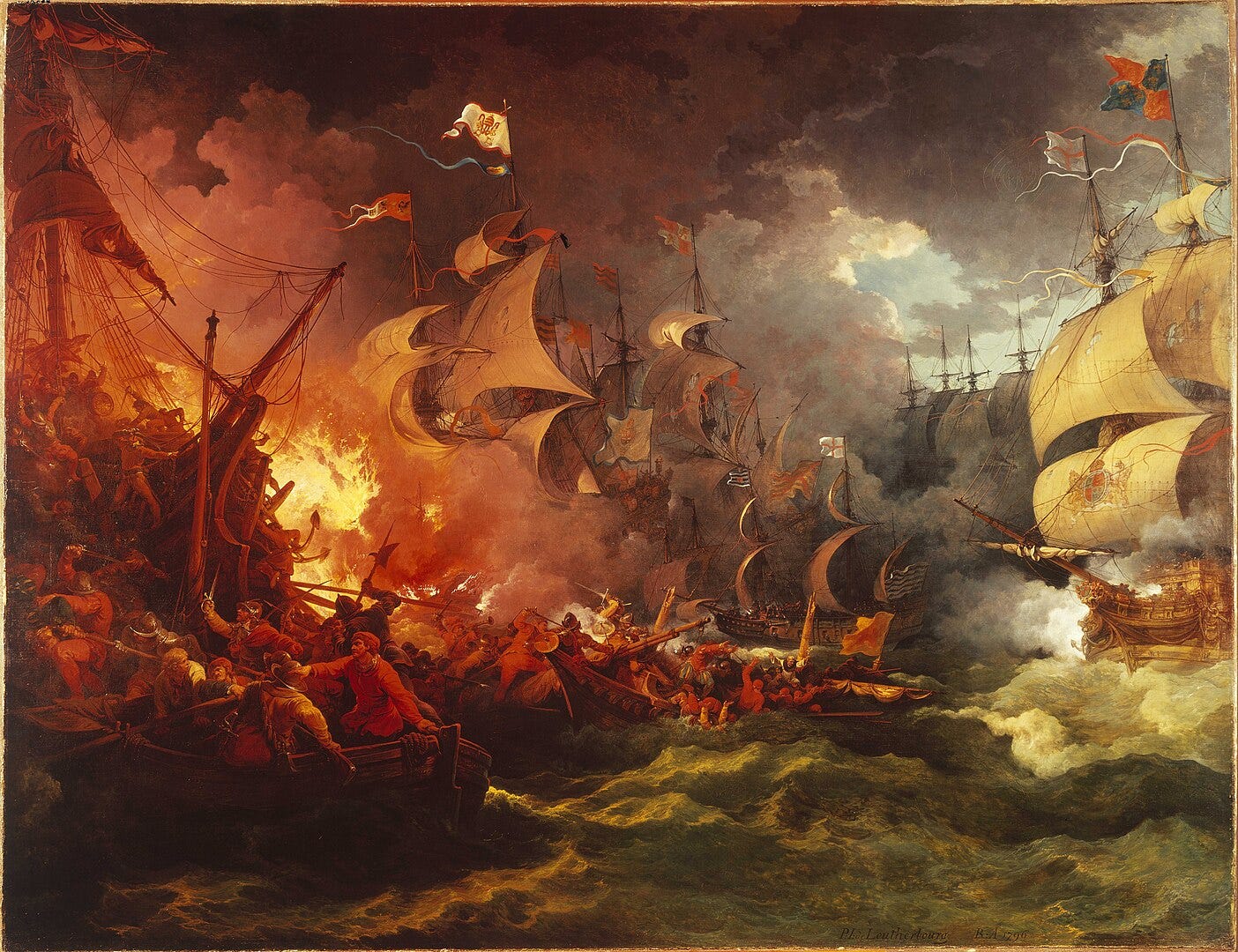
August 8, 1588: The English fleet puts the final nail in the Spanish Armada’s coffin at the Battle of Gravelines. After harassing the armada for the previous nine days, forcing it to regroup in the Spanish Netherlands, the English fleet used its superior mobility to inflict a serious defeat on its Spanish counterpart, sinking five ships and killing some 600 people. The Spanish fleet was forced to beat a hasty and badly managed retreat north, and by the time it had circled back around Ireland and returned home it had lost about a third of its ships and thousands of men.
August 8, 1967: Five Southeast Asian states—Indonesia, Malaysia, the Philippines, Singapore, and Thailand—found the Association of Southeast Asian Nations (ASEAN). The new bloc succeeded the three member (Malaya, the Philippines, Thailand) Association of Southeast Asia, with the aim of encouraging regional peace and economic interaction. ASEAN was intended as a specifically anti-communist institution, overlapping somewhat with the US- and UK-backed Southeast Asia Treaty Organization (SEATO) until that institution dissolved in 1977.
August 8, 1988: Hundreds of thousands (perhaps millions) of protesters engage in demonstrations and civil disobedience across Burma (Myanmar if you prefer) to protest the ruling Burma Socialist Programme Party’s repression, corruption, and economic mismanagement. The BSPP came to power following a 1962 coup and led a military government that purged itself of much of its leftist/socialist element in the 1970s. The 8888 Uprising, as it’s known, briefly sparked a move toward elections that ended with a military coup in mid-September and the imposition of a new junta. With the partial exception of the country’s 2011-2021 experiment in semi-civilian governance, the military has remained in power to the present day.
August 9 (or so), 378: A Gothic army annihilates a larger Roman army at the Battle of Adrianople (modern Edirne). Some two-thirds of the Roman soldiers were killed, including Emperor Valens. This virtual eradication of an imperial army opened the door for the Goths to move into the empire for good and contributed to the eventual collapse of the empire in the west.
August 9, 1945: The United States drops its second atomic bomb, this time on the Japanese city of Nagasaki, while the Soviet army invades Japanese-occupied Manchuria. Some 80,000 people are believed to have died of causes that can be linked to the bombing. The combination of the atomic bombings and the entry of the Soviets into the war against Japan is credited with convincing Japanese leaders to surrender, though there was and is evidence that they were preparing to do so anyway and the debate over the necessity of the bombings continues to the present day.
MIDDLE EAST
SYRIA
The Russian and Syrian governments have reached an agreement about the disposition of Hmeimem airbase and Tartus naval base, the two Russian military facilities in Syria. Or maybe it would be better to call them soon-to-be-former Russian military facilities, since the deal returns both of them to Syrian authority while maintaining parts of them as “joint Russia-Syrian training centers.” The Syrian Foreign Ministry made the announcement on Sunday without going into much detail. There’s been no comment so far from Moscow.
ISRAEL-PALESTINE
Israeli Prime Minister Benjamin Netanyahu confirmed in a Sunday cabinet meeting that he wants no part of the 15 point disarmament agreement that Hamas and the “Board of Peace” worked out late last month. He insisted that the Israeli military (IDF) “will not carry out any withdrawal [from Gaza] until Hamas is genuinely disarmed,” rejecting the agreement’s step-for-step approach. Neither the board nor the Trump administration seems inclined to force the issue with Netanyahu so it would seem that the agreement is kaput.
YEMEN
Ansarullah/Houthi missile and drone strikes killed at least 11 people and wounded another 32 in the Yemeni port city of Mokha on Sunday, according to AFP. At least three civilians were among the dead. The group also once again attacked the Aramco refinery in the Saudi city of Jizan, causing a fire though the level of damage is unclear. The previous day the Yemeni military claimed to have carried out “multiple” attacks on Ansarullah positions though there’s no detail beyond that as far as I know.
IRAN
The already slim chances of a near-term resolution to the Iran war may have gotten even slimmer over the weekend after the Iranian government outlined a list of demands in return for reopening the Strait of Hormuz, whether or not it negotiates an agreement on managing the waterway with Oman. US officials have already signaled that they will lift their naval blockade on Iran, but the Iranians also want sanctions relief, reparations, and an end to US threats against them and their partners that probably can’t be achieved without a US military withdrawal from the Middle East. Maybe they’d be willing to settle for less than all of that, but one gets the sense that the Iranians are no longer willing to negotiate agreements involving the promise of future concessions from the US because they’ve learned through direct experience that those promises aren’t going to be fulfilled.
This new complication comes at an interesting time, as The Wall Street Journal reported on Sunday that Donald Trump is ready to “declare victory” if Iran reopens the strait, eschewing the grand nuclear deal that was supposed to be his goal. He’s bored, the war is a political disaster, and midterms are less than three months away, so he’s looking for a semi-dignified exit. Now if the strait is out of reach, I guess his “victory” is as well. On Sunday Trump told Axios that “we are low keying it” and only “semi-negotiating” with Iran, which apparently means waiting for economic pressure to force the Iranian government to change its position. If he actually had the patience for that approach, or really any idea what he’s trying to do, he wouldn’t keep going through his repeated escalation cycles. Stay tuned for the next one.
ASIA
KYRGYZSTAN
Eurasianet reports that the Ukraine war is forcing some Central Asian states to find new sources of energy:
Repeated Ukrainian attacks on Russian refineries have caused the Kremlin to limit exports of fuel products, including gasoline and jet fuel, to cope with deepening domestic shortages. That, in turn, is prompting Central Asian states to scramble for alternate supplies to avoid a potential energy crisis in the fall and winter.
Until this year, Kyrgyzstan and Tajikistan depended on Russia for roughly 90 percent of fuel supplies. Now, Russia can no longer be relied upon as an exporter. For example, in late July, Russia agreed to deliver only about half the level needed to meet Kyrgyzstan’s demand for the rest of the year, or about 100,000 tons of petroleum products a month.
To help cover the shortfall, Bishkek has struck small supply deals with Uzbekistan and Kazakhstan, along with shipments from Belarus and China. Kyrgyz officials are also seeking additional fuel from Turkey and the EU.
In addition, the Kyrgyz government is developing a degree of fuel self-sufficiency, accelerating a project to build a refinery capable of producing about 450,000 tons of petroleum products per year, enough to meet nearly a quarter of the country’s annual demand. The refinery could become operational as early as the end of 2026.
Tajikistan is also casting around for new sources of fuel, particularly within Central Asia, while its government and the government of Uzbekistan are putting resources into exploring for new domestic sources.
MYANMAR
Myanmar’s ruling junta allowed the International Committee of the Red Cross to send a representative to meet with the country’s imprisoned former leader, Aung San Suu Kyi, last Monday. She appeared to be in good health though the junta rejected an ICRC request to have her examined by a physician. The visit was apparently intended to quiet those who have raised concerns about Suu Kyi’s incarceration and/or called for her release. It doesn’t appear to have worked, as the Philippine government—currently chairing the Association of Southeast Asian Nations bloc—issued a statement on Friday welcoming the ICRC visit but reiterating the group’s position that Suu Kyi should be freed. Myanmar’s foreign ministry shot down that suggestion the following day, while also arguing that there is no longer any need for ASEAN to have a special envoy for Myanmar. It suggested that the bloc should eliminate the envoy when Singapore takes over as chair on January 1.
AFRICA
LIBYA
World Politics Review’s Mustafa Fetouri doesn’t see much to like in the Trump administration’s approach to resolving Libya’s internal conflict:
For more than a decade, Libya has been divided between warring rival power structures: A U.N.-recognized administration in Tripoli, now known as the Government of National Unity (GNU), controls the west, while the warlord Khalifa Haftar’s self-styled Libyan National Army governs the east. The GNU is backed by the United Nations as well as by the U.S. and Turkey, while Haftar has the support of Russia, the United Arab Emirates, Egypt and France.
Details of the American initiative are scarce, as the White House has not publicly released even a draft document. But in his interview with [Saudi outlet] Al Hadath, [Trump administration envoy Massad] Boulos described the plan as a temporary power-sharing arrangement to reunify the country: Abdulhamid Dbeibeh, the current head of the GNU, would serve as prime minister, while Saddam Haftar, Khalifa Haftar’s son and deputy commander, would become the head of a reformed Presidential Council, Libya’s highest executive decision-making body.
To sweeten the deal for local warring factions, Boulos dangled the ultimate transactional prize: In exchange for their willingness to make a deal, he said, they would receive an invitation to a formal White House signing ceremony presided over by [Donald] Trump himself. It would be a high-stakes photo-op with immense political value for Libyan warlords who are desperate for international legitimacy.
The problem with this plan is that it does nothing to help the country move toward a stable political system and chart a path to national elections. Instead, the U.S. initiative seeks to bridge the country’s divide only at the very top, legitimizing what Libyans have rejected all along. Essentially, by advancing an informal backroom deal over a legally grounded process, Washington is making a dangerous gambit: short-term stability over a long-overdue democratic transition.
DEMOCRATIC REPUBLIC OF THE CONGO
Allied Democratic Forces jihadists attacked a village in the northeastern DRC’s Ituri province on Saturday, killing at least 13 people. Congolese authorities are still searching the area around the village so that death toll may rise.
EUROPE
UKRAINE
Ukrainian drone strikes killed at least six people in the Russian city of Belgorod overnight, while Russian attacks killed at least three people across Ukraine. The Russian military also heavily targeted the Ukrainian port city of Odesa in what appears to be a renewed effort to block the country’s Black Sea grain exports. Russian strikes killed at least four people in Ukraine’s Kyiv region overnight Friday into Saturday. Russian officials are also claiming the capture of two more villages in eastern Ukraine’s Donetsk oblast.
HUNGARY
Hungarian Prime Minister Péter Magyar announced on Saturday that his ruling Tisza party has nominated the former president of the Hungarian Supreme Court, András Baka, to be the country’s new president. Former PM Viktor Orbán fired Baka from his court gig in 2011, so he and Magyar at least share a common political opponent. Baka should have no trouble winning election in parliament, which is controlled by Tisza. He’ll replace Tamás Sulyok, an Orbán ally whom the parliament voted to remove from office last month.
AMERICAS
UNITED STATES
Finally, I’m sure this will come as a shock but it seems that the Trump 2.0 administration is doling out ambassadorships—those he’s gotten around to actually filling—to cronies and patrons at a rate that dwarfs his competitors:
While presidents of both parties have rewarded some campaign donors with diplomatic postings, often reserving coveted slots for them in Western Europe or the Caribbean, Trump has named far more political nominees to posts traditionally held by career diplomats, The Post’s analysis showed.
His administration also has left more than 100 diplomatic missions without a confirmed leader, including key postings in Russia, Germany and Saudi Arabia. Trump nominees awaiting Senate confirmation make up nearly a third of the vacancies, according to data maintained by the nonpartisan American Foreign Service Association.
John Dinkelman, the AFSA’s president, said that while many political appointees perform well, government personnel with diplomatic experience are being passed over for candidates with political or financial ties to the president.
“There’s a place for the benefactor on the hospital board. The problem comes when the benefactors outnumber the surgeons in the operating room,” said Dinkelman, a former Foreign Service officer who served in Republican and Democratic administrations. He was among hundreds of career diplomats forced out by the Trump administration last year.
Of the 102 nominees put forward by the administration to fill ambassador positions as of Wednesday, 90 percent are political nominees, according to The Post’s analysis of the AFSA’s data. It’s a significant break with recent precedent. In each administration since President Gerald Ford’s, more than half of all ambassadorships went to career Foreign Service officers.
Well, at least you can’t argue with the results, right?
Thanks again for this thorough overview 🤙🏻
Unbelieveable. War kills! So many people. In past centuries. I´m afraid that in our days this cruel dynamic is continuing. Let´s stop this madness. Stopping this makes sense in our days. While individuals are sentenced to death. Because of doing nothign else than just praying for freedom.