

You’re reading the web version of Foreign Exchanges. If you’d like to get it delivered straight to your inbox, sign up today:
PROGRAMMING NOTE: Apologies in advance if the quality of today’s newsletter is off. My wife went in for surgery on her broken ankle/leg this morning so I’ve been working in the down time while I’m waiting for information from the hospital. There will not be a voiceover with this one. Given the circumstances I’m going to say up front that I am probably not going to be able to write tomorrow but I plan to play it by ear.
TODAY IN HISTORY
August 3, 1940: An Italian army crosses from Italian East Africa into British Somaliland, beginning an invasion that will end with Italy’s annexation of the colony on August 19. Britain organized a counterattack, Operation Appearance, which began on March 16, 1941, and ended with the British recapture of Somaliland on April 8. Following World War II, Britain assumed control over Italian East Africa, and eventually the former British and Italian Somalilands gained independence and merged into Somalia. Nowadays the territory of British Somaliland, under the name “Somaliland,” considers itself independent of Somalia, though that claim is not recognized internationally.
August 3, 1960: Having expressed its intention to leave the neocolonial “French Community” the previous month, the government of Niger gains full independence. Annually commemorated as Nigerien Independence Day.
August 3, 2014: Islamic State fighters seize the Sinjar region in northern Iraq’s Nineveh province, the heartland of Iraq’s Yazidi population. The seizure opened up the deadliest phase of IS’s genocide of the Yazidi community, which eventually saw some 5000 people killed (according to the United Nations), thousands more abducted and enslaved, and hundreds of thousands displaced. The US military began conducting airstrikes a few days later to alleviate IS’s siege of Mount Sinjar, where thousands of Yazidi civilians had fled, and that opened the larger US campaign against IS that continued officially at least through 2021 in Iraq and unofficially in Syria until 2026 if you want to take the maximalist view.
August 4, 1578: Portuguese King Sebastian I’s attempt to intervene in a Moroccan succession crisis meets a crushing defeat at the Battle of Alcácer Quibir near the then-Portuguese city of Ceuta. The young Sebastian was killed (technically disappeared but he never reappeared), and since he was too young to have fathered an heir this outcome wound up sparking another succession crisis back in Portugal. The eventual result was the seizure of the Portuguese throne by Spanish King Philip II and the relatively brief “Iberian Union,” which broke apart in 1640 but is the reason why Ceuta is today Spanish rather than Portuguese.
August 4, 1791: The Treaty of Sistova ends the Austrian-Ottoman War of 1787-1791. This rather unremarkable treaty, ending a rather unremarkable war (the Ottomans lost a little territory, but that’s it), turned out to be quite remarkable in hindsight because it marked the end of the long (265 year) series of Ottoman-Habsburg conflicts. Austria’s attentions turned west, due to the French Revolution, and later toward Prussia, while Russia became the Ottomans’ main adversary moving forward.
MIDDLE EAST
LEBANON
Lebanese and Israeli negotiators are meeting in Rome again this week. This marks the seventh time they’ve spoken under US mediation since April. The main focus will probably be furthering the “pilot zone” project, with the Lebanese side proposing new localities from which the Israeli military (IDF) could withdraw and the Israeli side probably refusing or at least resisting. There are indications, most recently from Agriculture Minister Nizar Hani, that the Lebanese government is collectively displeased with how the first “pilot zone” phase went, given that the IDF is still demolishing much of southern Lebanon (though casualties are down). Apparently it’s not displeased enough to risk derailing the negotiations.
ISRAEL-PALESTINE
The disarmament agreement between Hamas and Donald Trump’s “Board of Peace” was unable to survive one discussion between board envoy Nickolay Mladenov and Israeli Prime Minister Benjamin Netanyahu. The two met on Monday, ostensibly for Mladenov to press Netanyahu to ease up on the IDF’s latest kill spree in Gaza (which continued with at least two more people killed on Monday). Netanyahu expressed an objection to the text of the agreement, which calls for a phased IDF withdrawal from the territory corresponding with Hamas’s phased disarmament. Mladenov then apparently assured him that the IDF withdrawal would only begin once Hamas has fully disarmed. That does not appear to be the agreement that the board struck with Hamas. The group hasn’t responded to Monday’s events and says it’s waiting for clarification from Mladenov.
YEMEN
An unknown “projectile” struck and apparently sunk an Indian-flagged commercial vessel in the Red Sea on Tuesday. All 14 crew members were rescued by the Yemeni Coast Guard. There’s no confirmation as to what happened but Yemeni officials are accusing the Ansarullah/Houthi movement of attacking the ship with a makeshift sea drone.
OMAN
Satellite imagery shows that the oil slick around the tanker Caroline Bezengi, which ran aground off the coast of Oman back in June, has grown substantially from around 20 square kilometers to around 150 square kilometers in about a week. More troublingly, the slick has turned darker brown in color and that suggests that the vessel is now leaking from its own fuel tank in addition to its cargo hold. It may also suggest that the hull is sliding deeper into the water.
The Caroline Bezengi is allegedly part of Russia’s “shadow fleet” and has been sanctioned by the UK government for that reason. It’s unclear why it ran aground but the crew reported some sort of explosion beforehand, which could have been mechanical or something more nefarious given the location. The slick is affecting Oman’s Qibliyah island, which is located in the environmentally sensitive Arabian Sea reserve area, but there’s no cleanup effort taking place and indeed nobody has even claimed responsibility for the vessel.
IRAN
“Regional officials” are claiming that the Iranian and Omani governments are close to an agreement that could reopen the Strait of Hormuz. According to the AP the arrangement would see commercial ships “enter the Persian Gulf through an Iranian-controlled route and exit through a route controlled by Oman, with service fees charged for providing security and preserving the maritime environment.” It hasn’t been concluded yet so those details could change. It would also be contingent on the US lifting its naval blockade of Iran. US officials including Marco Rubio and Scott Bessent also reported progress, though for understandable reasons they didn’t go into any detail. Overnight a cargo vessel reported coming under attack and taking damage in the strait, so clearly there’s no deal in place yet.
Tuesday’s alleged progress came one day after Donald Trump decided to start threatening Iran again, calling this “the last chance” for Tehran to agree to a deal with the US. There’s no way to tell whether this is different from the several other last chances that he’s given Iran over the past few months, though this time around there is a new wrinkle in that the US military is running out of weapons—offensive as well as defensive, as its stockpile of long-range surface-to-surface missiles is “virtually” depleted according to Reuters. It’s unclear whether this refers to the Pentagon’s overall stockpile or the supplies that were deployed for this conflict, but even if it’s just the latter a resumption of the war will mean pulling missiles from other parts of the world. The alternative is to conduct more bombing runs and thereby greatly increase the risk of losing planes and pilots.
Perhaps this conundrum explains why, according to CNN, “an officer in US Central Command’s intelligence branch” blasted out an email last week crowdsourcing “new creative and unconventional ways to pressure and punish Iran.” A CENTCOM spokesperson described this method of war planning as “innovative,” which in fairness does seem like an apt description if you strip out the positive connotations of that word. I’m sure it’s a great comfort to the rank and file to know that the people whose orders they’re supposed to be following are officially out of ideas.
ASIA
INDONESIA
Indonesian President Prabowo Subianto has tried to portray himself as an anti-corruption crusader, most recently by prosecuting former education minister and current “tech entrepreneur” Nadiem Makarim. But Foreign Policy’s Michael Neilson questions the motives behind his crusade:
Other high-profile investigations during Prabowo’s term have involved politically connected businessmen, state-owned enterprises, and former ministers. In July, Indonesia’s top anti-corruption prosecutor Febrie Adriansyah resigned from his role in the attorney general’s office after police raids uncovered a stash of gold bars and almost $20 million in cash in a residence that he owns. Adriansyah is now facing allegations of corruption and money laundering connected to several state-owned enterprise cases. (He has denied any wrongdoing.)
Prabowo’s supporters argue that these investigations demonstrate a willingness to pursue corruption at the highest levels, even when it implicates popular public figures such as Makarim. Critics say they instead reflect selective enforcement and political maneuvering, rather than genuine institutional reform.
While many investigations may be entirely legitimate, a closer look at who is being targeted, the institutional rivalries behind certain cases, and the government’s limited appetite for deeper reform raises questions about whether Indonesia is building a stronger anti-corruption system or simply reshuffling power among the country’s political and economic elite.
JAPAN
The US and Japanese governments “jointly intervened” on Friday to pull the yen out of a decline that saw the currency’s value drop to a 40 year low. The US purchased several billion dollars (the specific amount is unknown) of yen under the arrangement, and perhaps more significantly the two governments agreed to monitor the yen’s value and potentially stage another intervention. That latter bit may be enough to scare off currency speculators.
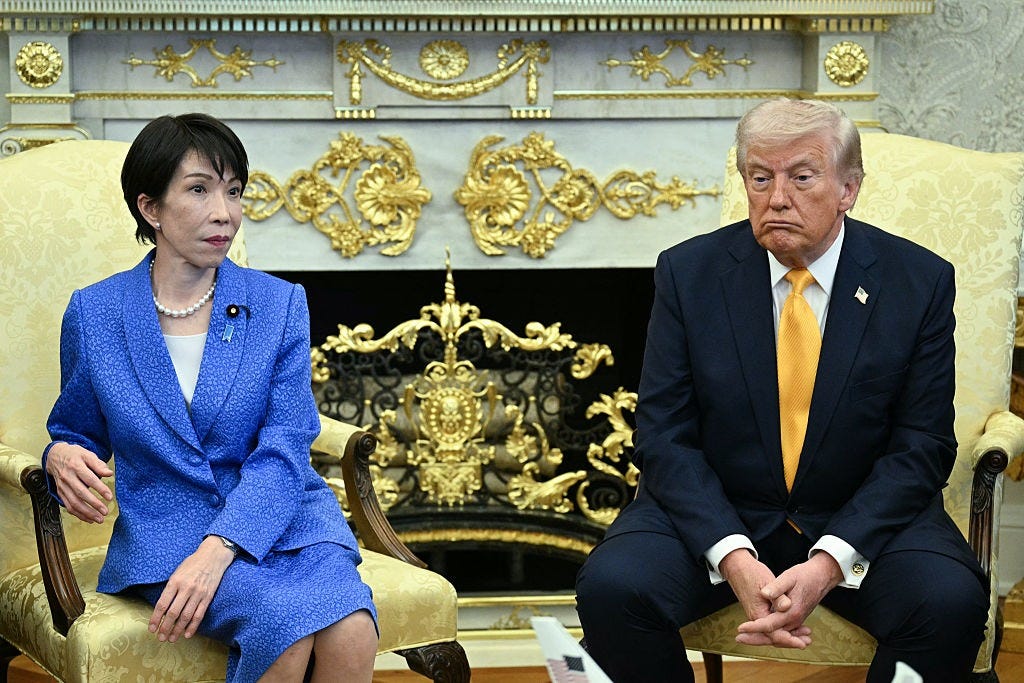
This is the second time the Trump administration has acted to bolster a country’s currency, after last year’s intervention to stabilize the Argentine peso. Clearly a political affinity with Donald Trump is helpful if one is interested in this sort of US bailout, though in the case of the yen there are other less overtly political reasons for the US to support it:
There are a variety of reasons why the U.S. wants a stronger yen. A rapid and disorderly decline in the currency could spill over into other assets, especially as the yen is a popular funding currency because of the gap in interest rates between Japan and the rest of the world, including the U.S.
The lure of this “carry trade” has been lessened by a small rise in Japanese interest rates, and may diminish further thanks to the U.S.-Japan intervention, but past crises have shown the risk of disorderly stampedes out of carry trades.
“The U.S. would be concerned about a rapid selloff in the yen that undermined global financial stability,” said Paul Cavey, who runs East Asia Econ, a consulting firm that provides data and analysis on the region’s economies.
For the U.S. in particular, if Japan chose to support its currency by selling some of its vast holdings of U.S. Treasurys, that could add to the pressure on U.S. bond yields and interest rates when they are already rising on fiscal concerns and uncertainty over Federal Reserve policy.
AFRICA
SUDAN
Rapid Support Forces commander Mohamed Hamdan Dagalo announced late last week that he’s mobilizing tribal forces in Sudan’s Darfur region to bolster the RSF’s ranks after the setbacks the group has suffered in the neighboring Kordofan region. This may also reflect a shift away from the RSF’s use of mercenaries, who cost more money than tribal levies and draw a high degree of international scrutiny. Whatever the specific cause the general conclusion seems to be that the RSF is running out of manpower. These levies are unlikely to make a substantive difference but they may exacerbate the inter-communal hostility that’s been fueled by this war.
ETHIOPIA
The fighting that broke out on Saturday in the western part of Ethiopia’s Tigray region, between federal security forces and Tigray People’s Liberation Front (TPLF) fighters, appears to have tapered off by Sunday evening and there’s no indication that it has sparked up again so far. Casualty figures are still not available, but the fighting definitely displaced hundreds (at least) of people over the border into Sudan. Most of these were civilians though there were wounded combatants among them as well.
SOMALIA
AFP reported on Monday that al-Shabab had seized control of the town of Teedaan in central Somalia’s Hirshabelle state. Residents contacted by the agency confirmed that the group had taken the town on Sunday after a full day of fighting with federal security forces and allied local militias. Teedaan sits along a major highway linking the Hiran region to other parts of Hirshabelle as well as to parts of neighboring Galmudug state. Logistically it is a significant gain for the jihadists, who could also establish a toll system on the highway as a revenue source.
EUROPE
UKRAINE
Russian and Ukrainian bombardments have killed at least 36 people in total over the past two days. On Monday, Ukrainian strikes killed at least 16 people in Russia and Russian-occupied Ukraine, including at least seven in one attack on the Black Sea resort community of Arkhipo-Osipovka. Russian attacks killed at least 11 people in Ukraine’s Dnipropetrovsk and Zaporizhzhia oblasts. Overnight into Tuesday, the Russian military killed at least four people in Ukraine’s Mykolaiv and Sumy oblasts while a Ukrainian drone strike on a warehouse near Moscow killed at least five.
SPAIN
While European Union member states continue to freak out over the migrant influx into the Spanish exclave of Ceuta last week, The Nation’s Stephen Zunes discusses the evidence of significant Moroccan involvement in organizing the incident:
The human wave that entered Ceuta, including the dozens who drowned trying to get around the border fence sticking out into the sea, were not such desperate refugees, however. Video footage indicates that virtually none of them were carrying bags or other personal belongings. There are also videos showing truckloads of young men, apparently organized by the Moroccan government, being ferried to the edge of Ceuta, as well as scenes of Moroccan border guards waving them through. It even appears that Moroccan intelligence agents were among the crowd in an apparent effort to get a better sense of border security and the Spanish response. Indeed, having tens of thousands of people simultaneously appear at the frontier undoubtedly required major logistical support.
This provocation appears to have been designed by the Moroccan regime to embarrass Spanish Prime Minister Pedro Sanchez in response to his efforts to warm relations with Morocco’s longtime geopolitical rival Algeria, a key supplier of natural gas made scarce as a result of the Ukraine and Iran wars and whose president he met with the previous week. The Moroccans orchestrated a similar cross-border influx in 2021 in retaliation for Spain’s allowing Western Sahara President Brahim Ghali, whose nation Morocco claims for itself, into the country for medical treatment.
Perhaps not coincidentally, this comes at a time when the American and Israeli governments have been furious at Spain’s Socialist government over its support for Palestinian rights and opposition to the Iran War.
AMERICAS
BRAZIL
The US State Department has revoked Brazilian ambassador Maria Luiza Ribeiro Viotti’s visa. The Brazilian government has been delaying the approval of Donald Trump’s ambassador-designate, Florida state legislator Daniel Perez. It also denied visas to two senior State Department officials last month due to the suspicion/likelihood that they were intending to engage in election fraud. The department is not expelling Viotti from the US and may restore her visa if/when Perez is allowed to take up his post.
VENEZUELA
Mauricio Claver-Carone, the Trump administration’s former Latin America envoy who more recently has been officially running a private equity fund and unofficially running the captive Venezuelan government, told Reuters late last week that he has quit that latter gig. Claver-Carone, who spent most of his time arranging Business Deals for US companies and Venezuelan grandees out of what I’m sure was a sense of pure altruism, appears to be the victim of infighting within Trump World, as former administration envoy to Venezuelan Richard Grenell reportedly badmouthed him to Donald Trump personally in a White House meeting early last month.
UNITED STATES
In US-related news:
Donald Trump somewhat hilariously groused about oil companies exploiting his war with Iran to jack up their profits on Tuesday. He’s not wrong, as oil company profits spiked to near-record levels last quarter. Even Saudi Arabia’s Aramco firm, whose ability to pump and export oil has been heavily constrained by the conflict, raked in a whopping $33 billion quarterly profit thanks to high oil prices. The hilarity stems from the fact that if Trump was really that bothered by these profits, or by high fuel prices, he could just, you know, end the war. Failing that he’s insisting that the oil companies are “going to give some of that back to the public and they better cut the retail price, the consumer price.” I suspect he’d settle for a nice donation to the Trump family coffers but who knows?
The Federal Bureau of Investigation is claiming that at least seven US states have recently experienced cyberattacks aimed at their water systems. Suspicion is unsurprisingly falling on Iran (which has been accused in past cyberattacks including some targeting water systems) as the culprit, though another theory suggests hackers posing as Iranians. Whatever is going on I’m sure Director Kash Patel and the boys will crack the case just as soon as he gets back from wherever his girlfriend is playing this week.
Finally, my AP cohost Daniel Bessner launched his new Substack newsletter, Imperialist Realism, on Monday with a piece on the intersection of American empire and grunge music:
The territory that is now Washington State was one of the last places vanquished by the American Empire. One of the final major wars between European-descended settlers and native peoples, the so-called Puget Sound War of 1855-1856, occurred in Washington Territory, and the settlers’ victory signaled the final conquest of the region.
This hardly exhausts the connections between the history of Washington and the history of American Empire. Even the few people today who are aware of the Puget Sound War probably don’t think much about Grays Harbor, a small county on the Olympic Peninsula, whose native tribes were victims of the same settler-colonial expansion that caused the war. Hardly anyone thinks about Grays Harbor.1
Millions of people, however, think about Grays Harbor’s most famous native: Kurt Cobain, whose life, art, and fate were tied to the Olympic Peninsula’s history in ways that have gone largely unnoticed. The connection between Cobain and a businessman named William Boeing, who first made his fortune in the region, is much more than incidental. It’s not too much to say that, without Boeing, there would be no Kurt Cobain. But who was Boeing? And how did he shape the Pacific Northwest?
Thx for the effort!! Good luck and quick recovery for your wife!
We all hope for a speedy recovery for her!