

PROGRAMMING NOTE: My voice has quit on me again, so given that tonight’s roundup is weighted toward excerpts anyway I am going to give it a rest and skip our usual voiceover. Those who need assistance should be able to use the text-to-voice feature in the Substack app.
TODAY IN HISTORY
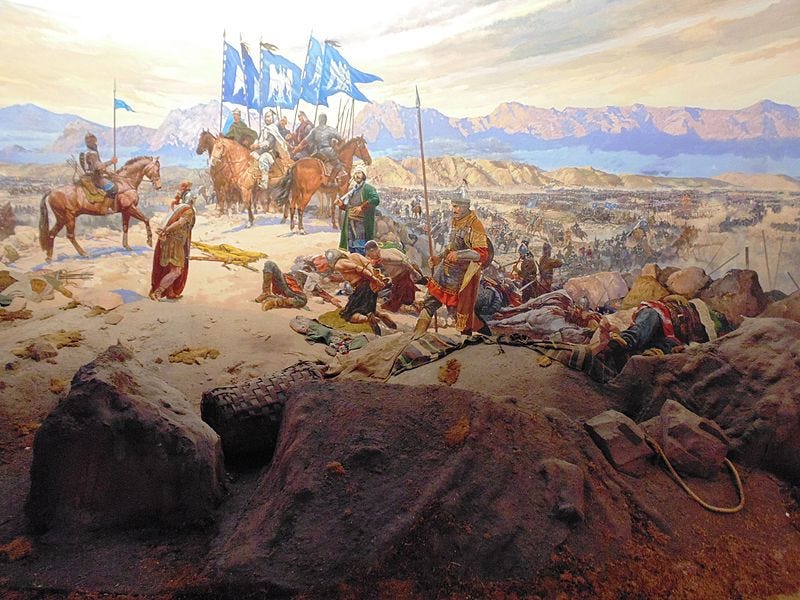
August 26, 1071: A Seljuk army inflicts a crushing defeat on Byzantine Emperor Romanos IV near the city of Manzikert. Arguably one of the most decisive battles in history, Manzikert and the imperial political chaos that followed allowed the Seljuks to pierce the Byzantine Empire’s Anatolian heartland. Although it survived (more or less) for nearly another 400 years, the empire never fully recovered. Manzikert is also important as the seminal event leading to the formation of the Crusading movement.
August 26, 1922: The Turkish army begins what’s known as its “Great Offensive,” the final push to oust an occupying Greek army from Anatolia. The offensive was successful and brought the 1919-1922 Greco-Turkish War, itself a theater of the larger Turkish War of Independence, to a victorious (from Turkey’s perspective) conclusion.
MIDDLE EAST
SYRIA
Although the Syrian Democratic Forces organization is moving forward with its own dissolution, Al Jazeera reports that there is still a great deal of work to be done before it and Syria’s Kurdish population can be considered fully integrated into the state:
[The Arab Center for Contemporary Syrian Studies’ Navvar] Saban said that SDF military fighters are being incorporated into the Syrian army under the command of the Defence Ministry, while the Asayish – the SDF’s affiliated security forces – and other local security bodies are being integrated into the Ministry of Interior. Civilian institutions and employees are also being transferred to relevant ministries.
“The formal merge has been completed, but creating a unified military culture and chain of command will take much longer,” he said.
There is also likely to be some apprehension from Syrian Kurds, with a deadly war still recent in their memories, and some mistrust towards Syria’s government. The government is led by figures formerly associated with now-disbanded rebel groups, including Hay’at Tahrir al-Sham, whose predecessor, al-Nusra Front, was once affiliated with al-Qaeda. Many of the former rebel groups had also fought the SDF, which was accused of cooperating with the al-Assad regime at times.
“Many Arab communities may welcome the return of the central institution [government], while Kurdish communities are likely to be more cautious,” Saban said. “They want peace. But they also need guarantees concerning the Kurdish language, education, political representation, and local security.”
