

You’re reading the web version of Foreign Exchanges. If you’d like to get it delivered straight to your inbox, sign up today and get 40% off on your first year:
TODAY IN HISTORY
August 25, 1580: An army under the Duke of Alba, Fernando Álvarez de Toledo, fighting on behalf of King Philip II of Spain, defeats an army under António, Prior of Crato, at the Battle of Alcântara, part of the War of Portuguese Succession. Both António and Philip were claimants to the then-vacant throne of Portugal, and this victory allowed Philip’s army to capture Lisbon and eventually led to Philip’s crowning as King of Portugal in March 1581. The crowns of Portugal and Spain were held in personal union (known as the “Iberian Union”) until the 1640-1668 Portuguese Restoration War.
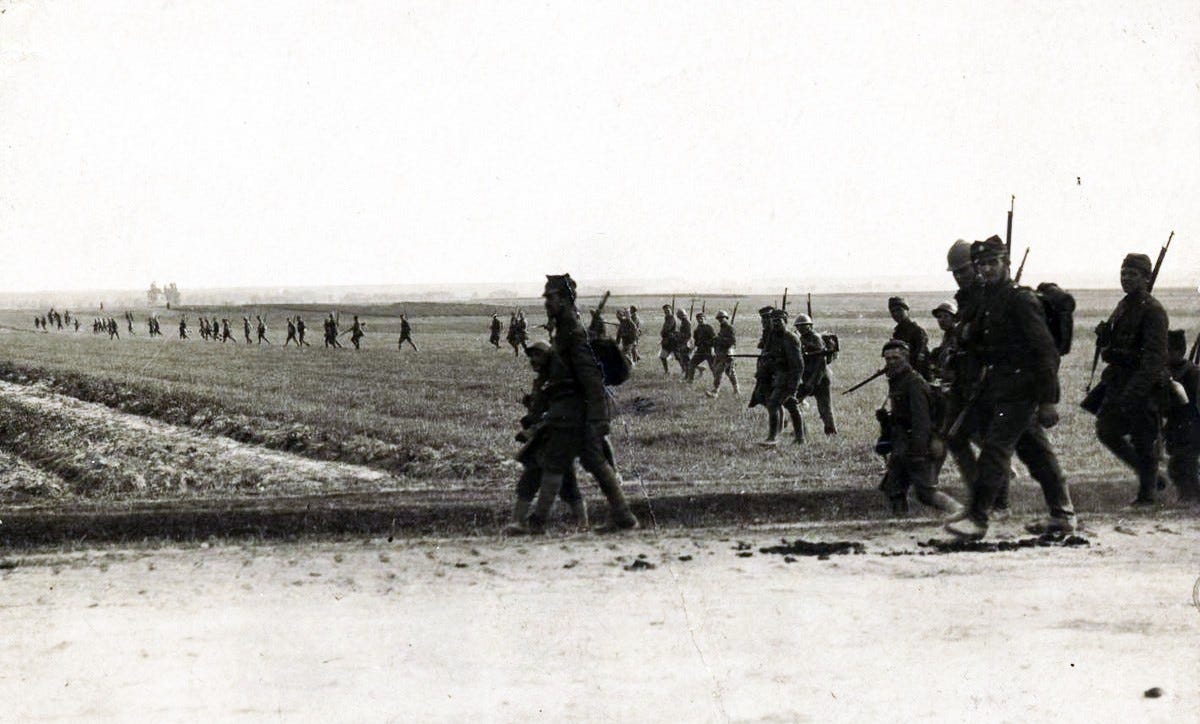
August 25, 1920: The two-week Battle of Warsaw ends with a surprising, arguably even miraculous (hence the moniker “Miracle on the Vistula”) Polish victory over the invading Russian Red Army. The costly defeat seems to have ended any Russian ambitions of a decisive victory in what is known as the Polish-Soviet War, and with Polish leaders having been similarly disabused of their chances for victory the two sides began peace talks in earnest in autumn 1920. An armistice was reached in October followed by the Peace of Riga in March 1921, in which Poland recognized Soviet governments in Belarus and Ukraine while those states ceded some 135,000 square kilometers of territory to Poland. That land reverted back to Belarus and Ukraine during and after World War II.
MIDDLE EAST
SYRIA
Syrian Democratic Forces (SDF) leader Mazloum Abdi announced the organization’s “dissolution as an independent military force” on Tuesday in a speech delivered in Damascus. This is the culmination of efforts to integrate the SDF into the Syrian government’s security forces under a deal the two sides reached earlier this year. The SDF was at one time the US government’s chief proxy in Syria, instrumental in efforts to combat Islamic State as well as to deny eastern Syria’s oil revenue to the Assad government. But as the US embraced the post-Assad Syrian administration its support for the SDF and its goal of Kurdish autonomy withered. In addition to integrating the SDF’s fighters, the Syrian government also agreed to protections for the Kurdish language and culture that are still manifesting.
LEBANON
Responsible Statecraft’s Janet Abou-Elias discusses the environmental toll that the Israeli military (IDF), with US support, is taking on southern Lebanon:
For two years, Israel’s war in Lebanon has been measured largely in a human toll: the dead, the wounded, the displaced. What has drawn far less attention is the destruction of the land itself.
Across southern Lebanon, a combination of incendiary munitions, systematic demolitions, and now aerial herbicide spraying has degraded large stretches of Lebanese territory to the point where it is difficult to farm, unsafe to inhabit, and in many places, unrecognizable.
American money and American weapons are behind nearly all of it.
ISRAEL-PALESTINE
The IDF killed at least four people in multiple attacks across Gaza on Tuesday, while three other individuals died of wounds suffered in previous incidents. One IDF strike reportedly “destroyed a warehouse storing nutrition supplies intended for children, pregnant women and breastfeeding mothers.” Meanwhile, local committees in the territory have begun warning parents not to let their children fly kites after the IDF declared such activity to be a capital offense.
Israeli security forces raided a training center in East Jerusalem operated by the United Nations Relief and Works Agency (UNRWA) on Tuesday. There doesn’t appear to be any rationale for this operation apart from expelling the agency from East Jerusalem altogether. Israeli officials insist that they’re converting the site into “a new educational and community complex” that will include schools, health facilities, recreational areas, and a mosque for the Palestinian community. We can probably assume that’s all bullshit, but it makes for a nice cover story. As a UN facility the training center should have been protected under international law.
IRAN
The Iranian economy is already showing signs of additional strain and “Maximum Pressure 2.0” hasn’t even gotten off the ground yet. The AP reports that “lines have grown outside gas stations” in Tehran of late as residents prepare for what may be steep hikes in the price of fuel, while the rial’s decline into the 2 million per US dollar range is increasingly pricing basic goods out of the reach of ordinary Iranians. Just like Maximum Pressure 1.0 and all the US sanctions that preceded it, the foremost victims of this policy are those ordinary Iranians—the same people whose rights and well-being US officials keep pretending to champion.
Leaving aside, as the Trump administration has, the pain that this economic warfare is causing the Iranian people, the operative question is will it achieve anything politically? Foreign Policy’s Hadi Kahalzadeh seems skeptical, particularly inasmuch as the administration seems to have given up on the idea of exerting economic pressure to induce concessions at the negotiating table and is now aiming for full on regime change/collapse. The Iranian government has had years to build the country’s resilience to US sanctions, and while the sanctions are stronger (and Iran’s economy is weaker) now, underlying data does not suggest that collapse is imminent or even likely. Iran’s domestic economy is still resilient enough to meet basic needs and its security establishment is still able to suppress dissent.
If conditions really deteriorate, Tehran retains the capacity to retaliate and try to pressure the US to let up. It also remains to be seen whether the administration can or will enforce sanctions against Iran’s two biggest foreign supporters, Russia and especially China.
In other items:
Donald Trump declared the Strait of Hormuz to be free of mines on Tuesday. If that sounds familiar, perhaps that’s because he also declared it free of mines last Tuesday. Presumably one of these weeks he’ll be right. Indeed, also on Tuesday the Omani Foreign Ministry announced that it had come up with a “proposed framework” with the Iranian government to manage traffic through the strait. Part of the proposal apparently includes a collaborative effort to de-mine the waterway. Should that deal fall through the Iranians have relied more on drones and missiles to control the strait than mines, so even if they are cleared the effect on ship traffic may not be huge.
The US Secret Service says that it is “aware” of a video that was broadcast on Iranian media threatening the life of Barron Trump and suggesting that there is a “$10 million reward” waiting for anyone who takes it. That video apparently ran over the weekend on Islamic Republic of Iran Broadcasting, which is state-run. CNN reports that it’s part of “a campaign of videos from Iran” that discuss killing Donald Trump and/or members of his family. It’s unclear how seriously to take this but it did run on state TV and Iranian threats to kill Donald Trump stretch as far back as the 2020 assassination of Quds Force commander Qasem Soleimani.
Pakistani officials are claiming that Monday’s visit to Iran by Pakistani military chief Asim Munir generated “significant progress” toward ending the war. I think it’s reasonable at this point to take a “believe it when you see it” approach to this sort of thing.
The US State Department is starting to return staff to its diplomatic outposts in the Middle East, specifically in Iraq, Israel, Lebanon, and Saudi Arabia. Those facilities were partially or wholly evacuated amid the Iran war. Reversing that decision suggests that the Trump administration isn’t planning to resume military action against Iran anytime soon, though the Iranian government also has a say on that front.
The Pentagon added 60 wounded service members to its Iran war casualty list last week in what an anonymous US “official” characterized as an “accounting trick” in comments to The Intercept’s Nick Turse. The official claimed that the Defense Department had been “slow-walking” the true casualty count for weeks to avoid public scrutiny. The department’s Defense Casualty Analysis System now lists 18 personnel killed and 758 wounded in the war, figures that Turse’s reporting strongly suggests are fictional and drastically undercount the real toll.
ASIA
MYANMAR
A new report from the UN human rights office concludes that the situation in Myanmar has reached a “new low,” painting “a picture of suffering, misery, and cruelty on multiple levels and across the country that is heartbreaking” according to UN High Commissioner for Human Rights Volker Türk. It cites “persistent” military violence against civilians and in particular the continued abuse of the Rohingya community by both the military and the Arakan Army rebel group, as well as the expansion of “illicit economies” like illegal mining operations and scam outfits that participate in human trafficking to source their workforces.
CHINA
According to Reuters, satellite imagery shows the appearance of “new installations” in the Chinese-claimed Paracel islands archipelago in the South China Sea. One of them apparently has the makings of a radar system that could be used “to support eventual installations on Antelope Reef” while another appears to be the early stages of an artificial island near the reef that could become an airstrip. Control of the Paracels is disputed by the governments of China, Taiwan, and Vietnam, but they are administered by China.
AFRICA
SUDAN
The Sudan Doctors Network has accused the Sudan People’s Liberation Movement-North of killing at least 27 people, including four children, in its most recent attacks on the Otoro community in Sudan’s South Kordofan state. The SPLM-N and the Otoro have been battling on and off over control of the town of Kauda since May. The Rapid Support Forces militant group, which controls most of South Kordofan and to which the SPLM-N is allied, attempted to broker a ceasefire in Kauda last week but that seems to have broken down almost immediately.
ZAMBIA
World Politics Review’s Liam Taylor writes that the unrest over Zambia’s recent presidential election may be doing lasting damage to the country’s democracy:
There are two competing narratives about Zambia’s recent election. In one, President Hakainde Hichilema swept to a second term on Aug. 13, while his opponent, Brian Mundubile, refused to accept the results and planned a foreign-backed insurrection. In another, Hichilema, an autocrat-in-the-making, stole the election and tried to assassinate Mundubile, the real winner.
The two versions of what happened are wildly incompatible—and also a sign of the times. Across Africa, as elsewhere, it has become de rigueur for competing political groups to claim victory and accuse the other side of violent plots.
In Zambia’s case, we may never know precisely how many votes each candidate received. The likeliest scenario is that Hichilema got enough to win, though not the 60 percent that the electoral commission claimed. Meanwhile, a former Cabinet minister lies dead, gunned down by security forces during a raid on a property linked to Mundubile.
The whole episode has tarnished the reputation of both candidates, shredding Hichilema’s image as a liberal reformer. It is also a strange turn of events for Zambia, long considered one of Africa’s more consolidated democracies.
EUROPE
RUSSIA
In Russia-related news:
Ukrainian drone strikes killed at least two people in the community of Afipsky in Russia’s Krasnodar Krai region on Tuesday while sparking a fire at a nearby oil refinery. Another strike wounded two people near the Zaporizhzhia nuclear power plant in Russian-occupied Ukraine. As ever, any strike in the vicinity of Europe’s largest nuclear power facility is inadvisable.
US Central Intelligence Agency director John Ratcliffe made an unannounced visit to Moscow on Tuesday. It’s unclear what he went there to discuss or with whom he discussed it, but Ratcliffe has been something of a diplomatic fixer for the Trump administration in recent months with visits to Venezuela to iron out a working relationship with Delcy Rodríguez and to Cuba to try to find some Delcy-esque figures in Havana. Presumably his reasons for traveling to Russia are not related to regime change. The Wall Street Journal suggests that he may have been there to “deliver a warning” regarding rumors that Russia may be preparing another mobilization for the Ukraine war and/or has “plans for testing the North Atlantic Treaty Organization’s resolve.” Maybe he went there to convince Russian officials to participate in Maximum Pressure 2.0 (see above) despite the country’s fairly close relationship with Iran.
Vladimir Putin issued a decree on Tuesday that will permit the Russian government to seize, at least temporarily, any “critical infrastructure” whose owners are deemed not to have adequately protected it from Ukrainian attack. Which would presumably be all of them, unless there are some private businesses in Russia that are packing their own air defense systems or electronic jamming gear or the like. This would include sites related to energy, telecommunications, transportation, and basically anything that Putin decides is “critical.”
UKRAINE
Euronews is reporting that the French government wants to put extra guardrails on Ukraine’s use of the €90 billion loan that it’s getting from the European Union. Any military acquisitions that Ukraine makes with that money must be at least 65 percent sourced from within the European Economic Area (the EU plus Iceland, Liechtenstein, and Norway), but Kyiv can request exemptions for items that just cannot be acquired from EEA sources. French President Emmanuel Macron is aiming to make those exemptions temporary, so that more of the money eventually comes back into the European (and especially French) defense industry.
AMERICAS
CANADA
The Canadian government announced retaliatory tariffs on some $20 billion in US products on Tuesday, matching the duties that the US is imposing on Canadian goods. They will take effect on September 8, barring a beyond-last-minute accord between the two countries. On the US side, Donald Trump is already threatening a new round of tariffs in retaliation for the Canadian retaliation. He also wants to rename Lake Ontario as “Lake America.” I would say that we’ve entered the stupid phase of this trade war but that would imply that there’s been a non-stupid phase.
UNITED STATES
In US news:
The US military killed four people in another boat strike on Tuesday, this one in the Caribbean. It has now extrajudicially executed more than 210 people since beginning this killing spree almost a full year ago.
Donald Trump has submitted his US-Saudi nuclear deal to the US Congress, triggering a 90 day review period. The legislature could vote in that time to block the agreement, but that block would be subject to a veto that would have to be overridden by two-thirds majorities in both the House of Representatives and the Senate. Nevertheless the arrangement remains in doubt because Trump is still holding to his post-facto insistence that Saudi Arabia normalize relations with Israel before the deal can proceed. There’s no indication that the Saudis are prepared to do that.
Finally, ProPublica reports that when he first took office Defense Secretary Pete Hegseth polled senior US military leadership on his plans to cut the Pentagon’s office for minimizing civilian casualties, thinking that he would find support for the idea. Apparently he found exactly the opposite:
Hegseth had bet senior officers would endorse his view that focusing on civilian security was “woke” and out of step with “maximum lethality,” current and former defense officials told ProPublica.
Instead, every commander rebuffed the idea.
The poll from early 2025, which has not been previously reported, cemented top-level military support for Civilian Harm Mitigation and Response, a relatively new program adopted after years of heavy civilian tolls in Iraq, Afghanistan and elsewhere. As part of its mission, CHMR (pronounced “chimmer”) stationed personnel within major regional commands. Officials tried to develop a picture of life on the ground in combat zones to aid decision-making on military strikes and avoid or minimize civilian harm.
In the poll, Hegseth gave commanders three options: cut 65% of staff but keep the effort operational, continue with only a small centralized office in Washington, or eliminate the program.
Nine commanders chose the first option to preserve the enterprise as much as possible, according to a memo reviewed by ProPublica. Leaders of two commands, one overseeing the nuclear arsenal and the other focused on cyber threats, declined all three options, asking to maintain the full program.
Hegseth of course “gutted” the office anyway.
If you weren’t able to join my livestream with Elizabeth Urban earlier this evening please check it out. Thanks to those who were able to make it!
I learn so much from your roundups. Thank you.