

You’re reading the web version of Foreign Exchanges. If you’d like to get it delivered straight to your inbox, sign up today and get 40% off on your first year:
LIVESTREAMING NOTE: I will be appearing on The Global Gambit with Pyotr Kurzin on Friday at 12 PM eastern. FX subscribers should get an email when the stream goes live but you can also watch it at this link.
PROGRAMMING NOTE: There is some possibility that I will be unable to write a newsletter again tomorrow, in which case we will catch up on Sunday again as last week.
TODAY IN HISTORY
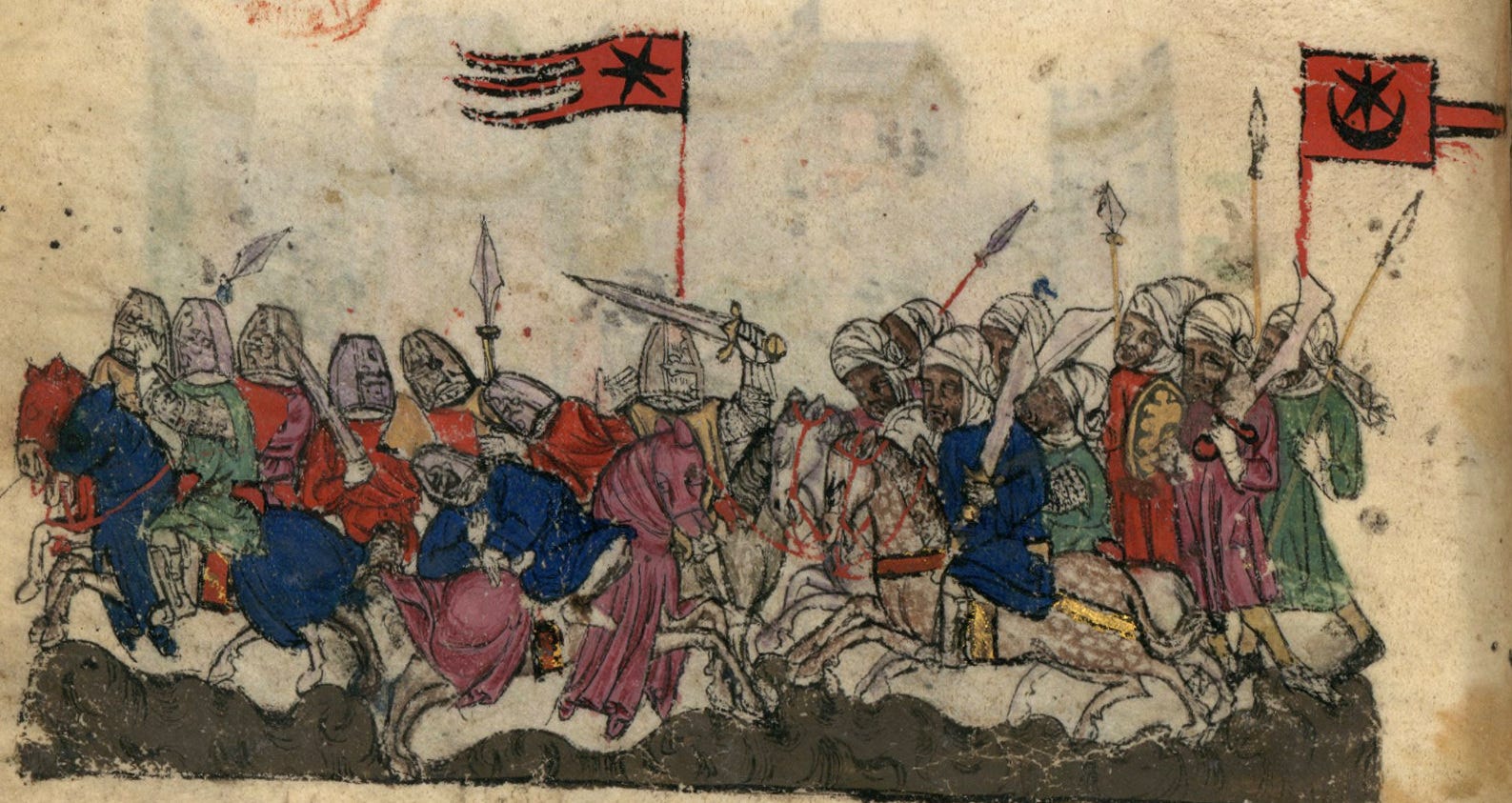
August 20 (give or take), 636: In one of the two great military victories of the early expansion of Islam, a caliphal army wins a stunning victory over the Byzantines in a six-day battle near the Yarmuk River (around the convergence of the modern borders of Syria, Jordan, and the occupied Golan). Despite being heavily outnumbered, the “Arabs” (for lack of a better shorthand) won thanks largely to better intelligence on the disposition of the Byzantine forces and the tactical genius of their field commander, Khalid ibn al-Walid. The Byzantines suffered heavy losses and made the strategic decision to retreat into Anatolia, effectively ceding Syria, the Levant, and eventually even Egypt to the caliphate.
August 20, 1988: A ceasefire brings the nearly eight year long Iran-Iraq War to an end. The war cost hundreds of thousands of lives and included some of the most appalling war crimes of the 20th century, all to achieve essentially a restoration of the prewar status quo (except for all the casualties, of course).
MIDDLE EAST
SYRIA
Syrian Foreign Minister Asaad al-Shaibani insisted on Thursday that “there was no intention” to establish a Turkish military presence at Abu Duhur airbase in northwestern Syria’s Idlib province. The Israeli military (IDF) bombed that facility earlier this week and then claimed that it did so in the interests of “preventing a Turkish military buildup in the area.” Israeli officials have continued to make threatening statements about preventing any sort of Turkish footprint in Syria.
LEBANON
The US Treasury Department blacklisted ten people accused of raising funds and/or laundering money on behalf of Hezbollah on Thursday. It also re-designated Hezbollah as a “specially designated global terrorist” group “for service to the Iranian regime under the command of Iran’s Islamic Revolutionary Guard Corps-Quds Force,” which seems like a procedural move intended to tie the organization to Iran as a matter of US policy.
ISRAEL-PALESTINE
The Israeli government has begun taking bids for the construction of housing tracts in the “E1” settlement in the West Bank. As regular readers may know, Israeli Finance Minister Bezalel Smotrich finally inaugurated the E1 project last year after decades of hesitation on the part of the Israeli government. The settlement, which will be situated just east of Jerusalem, is meant by design to the West Bank into northern and southern halves, isolate Jerusalem from the territory, and foreclose on any lingering possibility of forming a contiguous Palestinian state. The announcement of the tender has drawn a fair amount of international criticism but nothing beyond rhetoric so far.
Elsewhere, the IDF is finally acknowledging that its forces pumped hundreds of bullets into a car containing five year old Hind Rajab in Gaza in January 2024, killing the child along with several of her relatives. Rajab’s killing took on symbolic significance as a marker for the IDF’s killing of thousands of children in Gaza as part of the genocide, particularly after audio was released of a phone call she made to the Palestine Red Crescent Society from inside the vehicle. The IDF initially and absurdly insisted that it had nothing to do with her killing. It now says that it will open a “criminal investigation” into the incident, which based on precedent will likely determine that the killing was a tragic accident or something of that nature.
Also on Thursday, the Australian government summoned the Israeli ambassador in Canberra after the IDF decided not to pursue criminal charges in its April 2024 killing of seven World Central Kitchen aid workers and their Palestinian driver in Gaza. One of the aid workers was an Australian national. The ambassador, Hillel Newman, characterized that incident as a “mistake” on the IDF’s part.
YEMEN
Ansarullah claimed new drone strikes on Saudi Arabia’s Najran province on Thursday, one targeting Najran city’s airport and the other targeting an Aramco oil facility. There’s no word on any casualties or damage. The Yemeni government, meanwhile, claimed on Thursday that its forces had carried out 81 attacks on Ansarullah positions along the front line in Yemen over the course of the previous day, killing an unspecified number of the group’s fighters.
IRAN
Is the United States about to do things to the Iranian economy that have never been seen before in human history? That’s the general message that’s been coming out of the Trump administration for the past week, culminating in Donald Trump’s Wednesday social media missive about “ECONOMIC D-DAY.” Treasury Secretary Scott Bessent elaborated a bit in a CNBC interview on Thursday in which he previewed the imposition of the “toughest sanctions in history” on Iran. What those might entail or how much tougher they could possibly be than the sanctions that the US has already imposed on Iran remains to be seen and is arguably irrelevant, since the factor that will determine whether or not these measures actually compel the Iranian government to surrender or at least reduce its negotiating demands is whether or not the rest of the world goes along with them.
Trump threatened “TREMENDOUS Economic Consequences” for any country that does business with Iran in his Wednesday screed, without going into any detail, but basically this sounds like more secondary sanctions which is something the US has been doing for many years now. As such, countries that are aligned with the US and/or dependent on trade with the US will presumably go along with any new Iran sanctions as they’ve done with previous Iran sanctions. The UAE already seems to have signaled that it’s on board, though to be sure what the Emirati government says doesn’t always align with what it does (especially when it comes to sanctions on Iran). But is Russia going to cooperate? Is China? Why would they? And if they don’t, will the administration actually attempt to enforce sanctions against them? Does it even have the capacity to do so in a meaningful way? Notably, Bessent wouldn’t commit to even trying to enforce sanctions on China in his CNBC interview.
In other items:
The aircraft carrier USS George Washington arrived in the Arabian Sea on Thursday. The Pentagon hurriedly redeployed it from the Pacific to replace the USS Abraham Lincoln after news broke last week about the squalid conditions aboard that vessel. The Lincoln is apparently already heading back to the US, according to NBC News. Coincidentally, or not, the publisher of Stars and Stripes, Max Lederer, announced his retirement on Thursday. Stars and Stripes was one of the outlets that broke the story about conditions on the Lincoln and Lederer alluded to conflicts with the Trump administration in his resignation letter. Those conflicts run deeper than the Lincoln story but that may have been the final straw from the administration’s perspective.
Amid all the hostility in the US-Iran relationship, The Intercept’s Noah Hurowitz offered a heartwarming story earlier this week about cooperation between those two governments on the issue of deportation. A cache of emails shows that the US Immigration and Customs Enforcement agency, under orders from senior levels in the Trump administration, coordinated at least three deportation flights last year with Iranian authorities, even including specific individuals who were requested by Tehran. Among the deportees, according to Hurowitz, were “political activists and ethnic and religious minorities who had good reason to fear persecution upon arrival.” OK, maybe that’s not so heartwarming.
ASIA
AFGHANISTAN
The United Nations said on Thursday that the Afghan government has released the two UN staffers it detained earlier this month in Herat. The UN still apparently doesn’t know why they were detained but apparently they are not facing any further legal issues.
PAKISTAN
The Pakistani government summoned the US chargé d’affaires in Islamabad on Wednesday to protest a visit by US ambassador to India Sergio Gor to India’s Jammu and Kashmir territory earlier in the day. In addition to objecting to the visit itself, Pakistani officials also protested a comment by Gor, who referred to Kashmir as “an important part of India.” The Pakistani government doesn’t regard Kashmir as a part of India at all, let alone an important part, and Gor’s remark went against longstanding US policy regarding Kashmir’s final status as yet to be determined. The US has increasingly moved closer to India over the past several years but that trend has reversed itself in the second Trump term as it now seems to favor Pakistan, which makes Gor’s comment particularly sensitive from a diplomatic perspective.
BANGLADESH
The Bangladeshi parliament elected Mirza Fakhrul Islam Alamgir as president of Bangladesh on Thursday. The 78 year old Alamgir is the leader of the Bangladesh Nationalist Party, which along with its coalition partners holds a supermajority in the legislature so the vote was not in much doubt. The Bangladeshi presidency is primarily a symbolic post though the holder does have some obligations/powers as head of state and commander in chief of the country’s armed forces.
CHINA
The Trump administration designated US citizen Min Zin, who was arrested in China back in June on spying allegations, as “wrongfully detained” on Thursday. Zin heads a think tank focused on Myanmar and according to NOTUS was detained while attending “an academic conference” in China’s Yunnan province. He is the second US national to be designated as wrongfully detained by Beijing after seismologist Youlin Chen, who was arrested in 2024.
AFRICA
SUDAN
The Sudan Tribune, citing “security sources and a local official,” reported on Thursday that recent attacks by the Rapid Support Forces militant group had killed at least six people and displaced more than 1000 in Sudan’s North Kordofan state. The displaced began arriving in the state capital, El Obeid, on Thursday.
LIBERIA
Liberia has become the newest participant in the Trump administration’s “third country” human trafficking scheme, agreeing to take in up to 1200 people expelled from the US over the next year. The first trafficking flight arrived in Monrovia on Thursday containing 20 people, mostly from parts of Latin America. Liberian authorities claim that these individuals will not be detained and will be given the opportunity to apply for asylum or to leave the country. They’re also denying that they agreed to participate in this program for financial reasons, though the US did just happen to award Liberia $5 million this year for “migration management activities.” Just an interesting coincidence I guess.
MALI
Human Rights Watch is accusing Russian Africa Corps personnel of “summarily” killing nine civilians during an operation in central Mali’s Mopti region on July 10. According to HRW “more than 100 Africa Corps fighters rounded up at least 80 men and boys” in a Mopti village and then tortured and interrogated them on their alleged ties to militant groups. They shot six people who attempted to escape and executed three others. The village is under the control of the Jamaʿat Nusrat al-Islam wa’l-Muslimin (JNIM) jihadist group but residents told HRW that there were no jihadists present that day.
CAMEROON
Cameroonian President Paul Biya returned to that country on Thursday. While normally something like this would not warrant a mention, the 93 year old Biya had spent the previous 73 days in Switzerland on what the Cameroonian government has called “a short private stay.” While it is exceedingly likely that this private stay (which was not all that short) involved medical treatment of some kind, Cameroonian officials have kept mum on that subject. Cameroon currently does not have a vice president (the office was abolished in 1972 and only reinstated earlier this year), so there is no clear succession plan should something happen to Biya.
EUROPE
UKRAINE
Another massive Russian bombardment of Ukraine’s Kyiv region killed at least 18 people overnight and into Thursday. Meanwhile, former Ukrainian Defense Minister Mykhailo Fedorov’s push for new elections may be fizzling out, as protesters who have been demanding his reinstatement as minister now seem to be turning on him. Recent polling does indicate that a majority of Ukrainians oppose new elections in wartime, so despite the public following he seemed to gain after his sacking Fedorov may have overplayed his hand.
SERBIA
Serbian President Aleksandar Vučić said on Thursday that the country will hold its forthcoming snap parliamentary election on either October 18 or October 25. Vučić announced his resignation in late June, triggering early elections for both parliament and president (they’d been scheduled for next year), after months of anti-corruption/anti-government protests. He cannot run for president again due to term limits, but if his Serbian Progressive Party wins the parliamentary election he could make himself prime minister.
AMERICAS
BOLIVIA
Foreign Policy’s Nick Aspinwall reports on the promise and peril of Bolivia’s lithium reserves:
The Salar de Uyuni salt flat is the pride of Bolivia, spanning nearly 7,000 square miles and drawing thousands of tourists to its surreal bright-white landscape. It also lies atop a stockpile of lithium, a mineral crucial to the clean energy transition that’s long given hope to the country’s faltering economy.
Bolivia is home to roughly 20 percent of the world’s lithium deposits, mostly beneath Salar de Uyuni, but it produces less than 1 percent of global lithium. President Rodrigo Paz, who took office last year pledging measures to revive the economy, will be judged in part based on whether that number increases.
At Paz’s inauguration, he reiterated his campaign slogan of “capitalism for all” as the country moves away from two decades of left-wing rule. While prices have fallen from their peak in 2022, the metal is crucial to clean energy technology such as electric vehicle batteries and solar panels.
But any efforts to expand production will face fierce opposition from environmental advocates and Indigenous groups worried that further extraction will damage their livelihoods. In the towns scattered around Salar de Uyuni, people raise llamas and alpacas and grow quinoa, and they fear the lithium rush could contaminate the region’s groundwater and deplete its aquifers. Many migrated to Uyuni, the area’s largest town, to work in tourism. They worry lithium extraction will hurt that industry, too.
“We are the ones who are going to feel the impact,” said Edson Muraña, a tour operator who comes from a family of farmers. “We want this culture to exist. We don’t want it to disappear.”
BRAZIL
Sticking with this theme, the AP reports that Brazil is seeing a mining boom that brings with it similar concerns:
Foreign capital is rushing in. Nearly half of the 2,727 overall rare earth exploration applications — or 42% — in Brazil were made by subsidiaries of foreign mining companies or firms with foreign ownership stakes. Eleven of the 20 companies with the largest number of applications are backed by foreign investment, mostly from Australia, the U.S. and Canada.
The analysis reviewed all National Mining Agency records through June. Rare earth exploration applications have surged, with more than 86% filed in the past three years, including 268 in the first half of 2026, according to the agency’s public data.
But the mining, which in some cases could happen near reserves in the Amazon rainforest, also comes with major environmental risks. Indigenous communities are beginning to sound the alarm. It also raises questions about relations between the U.S. and Brazil, long trading partners, and Brazil and China, which have become closer in recent years.
UNITED STATES
Finally, Foreign Affairs’ Marc Lynch argues that we’ve reached a turning point for the United States in the Middle East:
The American Middle East is finished. The regional order that has prevailed since 1991 has been one of the many casualties of the U.S.-Israeli war with Iran. The American and Israeli failure to dislodge the regime in Tehran has proved the bankruptcy of decades of sanctions and violence. The inability of the United States to protect its Gulf allies from Iranian attacks or to keep the Strait of Hormuz open has fatally undermined the core security bargain that justified its network of military bases in the region. And Israel’s increasingly threatening posture and abandonment of any pretense of interest in reaching an accommodation with the Palestinians have ended Washington’s decades-long mission of bringing its Arab allies and Israel together into an enduring security partnership.
The United States’ primary goal for three and a half decades has been to lock its disparate allies into an order built around protecting Israel while containing, at first, Iran and Iraq, and more recently Iran and its nonstate allies. Far from being a deviation from that strategy, President Donald Trump’s war took it to its logical end, seeking to remove the Iranian threat by force in one fell swoop. As American leaders did before the 2003 invasion of Iraq and Israel has done in its wars against Hezbollah and Hamas, the architects of this war vastly exaggerated what military power could achieve, underestimated the capacity of adversaries to adapt, took for granted that allies would fall in line, and callously disregarded the lives of ordinary people. Washington’s misadventure was not an aberration so much as the ultimate expression of the inherent vice of its Middle East strategy.
At first, it may not look as though the war has had much effect on the alliances that form the American order. Facing an inconclusive war and an empowered Iran, the Gulf states may ramp up their arms purchases and their demands for renewed security guarantees, creating the illusion of continuity. But the old order is in fact giving way to something new. The 1956 Suez crisis is remembered today as the last gasp of British and French imperial power in the Middle East, but it took years to reach that inevitable end. American primacy will not disappear immediately, either, but long-building doubts about American power and purpose have passed their tipping point. The revelations of the Iran war and of the Israeli war in Gaza before it have already changed the calculations of U.S. allies and adversaries. Another round of fighting or the election of a different American president will not repair the rupture.
Lynch argues that there is a opening for the US to adopt a different approach and writes that “discarding its policy of support for autocrats, impunity for allies, and militarized containment of enemies might enable the United States to engage with the region in a healthier way—one that eventually could yield the durable stability Washington has claimed to want all along.”