

You’re reading the web version of Foreign Exchanges. If you’d like to get it delivered straight to your inbox, sign up today and get 40% off on your first year:
LIVESTREAMING NOTE 1: Please join Elizabeth Urban of Islamic History for the Curious and me next Tuesday (8/25) at 8 PM eastern for the second in our new monthly livestream series. This month I’ll be picking Elizabeth’s brain about pre-Islamic Arabia, a fascinating topic on which she tells me there’s been a good deal of interesting research in the years since I left grad school. We will then take your questions. Find us in the Substack app or bookmark the link so you won’t miss it!
LIVESTREAMING NOTE 2: My cohost Daniel Bessner and I are going to attempt to bring our weekly American Prestige livestream to Substack this Thursday (8/20) at 8 PM eastern though it remains to be seen whether I can make that work without screwing something up. Barring any unforeseen complications we should be joined by Séamus Malekafzali to talk about the potential for conflict between Israel and Turkey. There’s no link for this one yet because it will be streamed on multiple platforms but if it all works you should be able to find it at the appropriate time on the show’s Substack page.
TODAY IN HISTORY
August 18, 684 (or thereabouts): Simmering tribal rivalries within the Arab caliphate erupt into conflict at the Battle of Marj Rahit near Damascus, one of the key engagements of the caliphate’s second great civil war or “fitna.” The army supporting Umayyad Caliph Marwan I and consisting primarily of “southern” Arab tribal forces defeated a probably-larger force comprised of “northern” tribes that had thrown their support behind rival caliphal claimant Abdullah ibn al-Zubayr. Marwan’s victory stabilized his previously tenuous hold on Syria, and though he died shortly afterward his son and successor, Abd al-Malik, was then able to defeat ibn al-Zubayr and end the civil war.
August 18, 1487: The garrison defending the Granadan city of Málaga surrenders, ending a Castilian-Aragonese siege that had lasted over three months. Málaga was the Emirate of Granada’s second-largest city and its largest seaport, so losing it to the Catholic monarchs was a massive defeat—one from which, it turned out, the emirate would never recover. Frustrated by the city’s refusal to surrender—even after its leaders capitulated on August 13, the garrison held out for almost another week—King Ferdinand II of Aragon either executed or enslaved most of its remaining population.
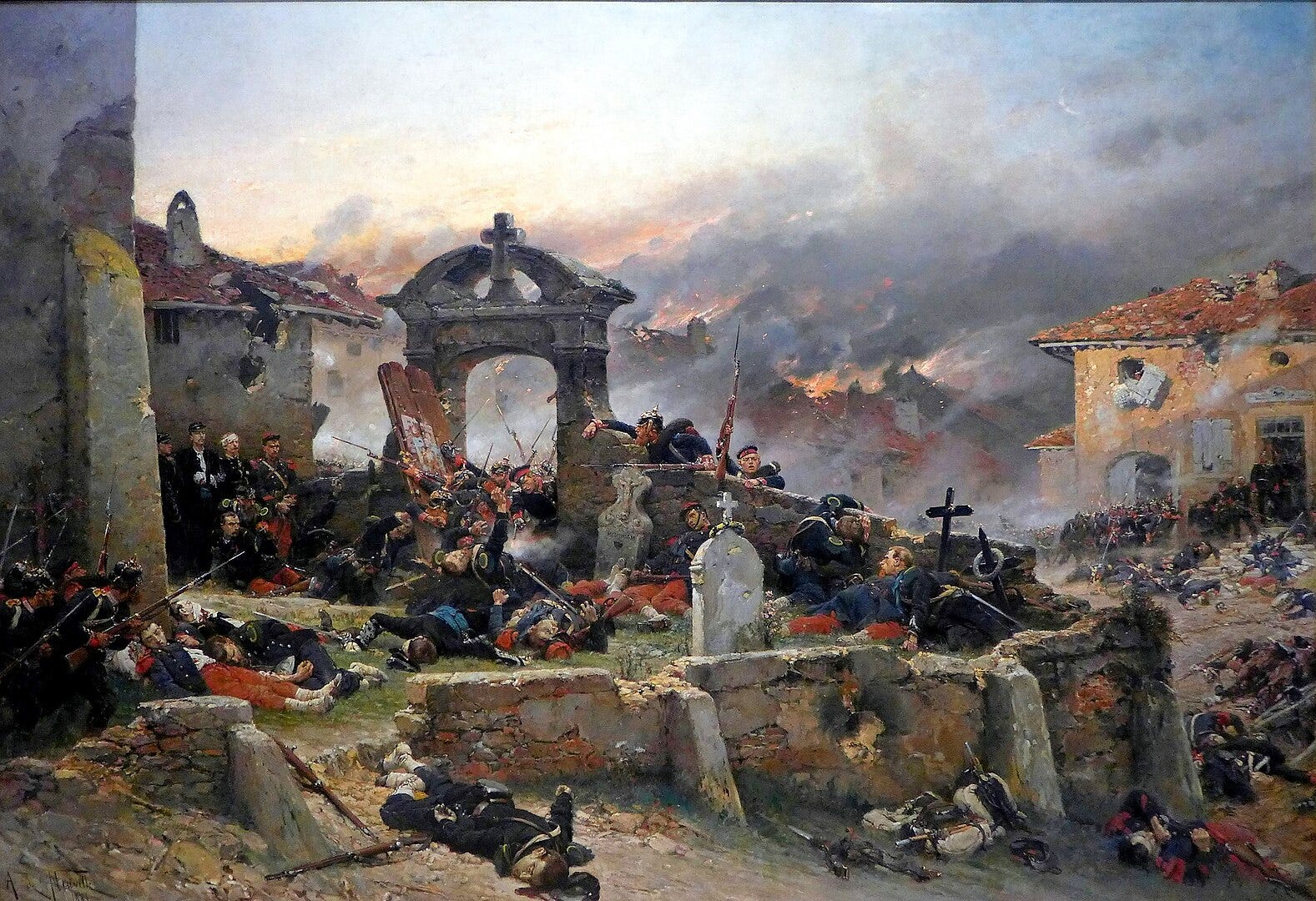
August 18, 1870: The French Army of the Rhine meets the Prussian First and Second armies under the command of King Wilhelm I at the Battle of Gravelotte in Lorraine. Tactically the battle was inconclusive—the Prussians outmaneuvered the French but the French were able to retreat in good order to Metz, and casualties were pretty even relative to the numerical disparity (the Prussians outnumbered the French by about 70,000 soldiers) between the two armies. But the Prussians were then able to besiege the French army at Metz, eventually emerging victorious in one of the most decisive engagements of the Franco-Prussian War.
MIDDLE EAST
SYRIA
The Israeli military (IDF) bombed the Abu Duhur airbase in Syria’s Idlib province on Tuesday. There were no casualties but there has been a fair amount of diplomatic fallout, with criticisms coming from (at least) the Egyptian, Qatari, Syrian, Turkish, and US governments. Israeli officials reportedly justified the strike to their US counterparts by arguing that they were “preventing a Turkish military buildup in the area,” an explanation that may not carry much weight with the Trump administration given that US-Turkish relations have been on something of an upswing of late (which is not to suggest that the US will do anything in response to this other than complain tepidly). It does appear to be the case that the Turkish military was rebuilding the mostly defunct facility though whether that is the precursor to the Turkish use of the base is unclear.
US envoy Tom Barrack, who was the first person to reveal that the IDF had carried out the attack (though realistically who else could it have been), cautioned that this airstrike could have been misinterpreted as an attack on Turkey, which had no warning that the strike was coming, and said that the US is trying to establish a “deconfliction mechanism” so that Ankara is at least aware of future IDF activity ahead of time. Israel and Turkey continue to tiptoe up to the point of conflict over their incompatible interests in Syria (among other sources of tension), so Barrack’s concern here is legitimate.
Elsewhere, the Syrian Interior Ministry is claiming that security forces arrested a “prominent” Islamic State figure who goes by the name “Abu Jihad al-Muhajir” (real name Hamza Abdullah Mohammad) near the city of Manbij. And International Atomic Energy Agency director Rafael Grossi is trumpeting the recovery of “a few tons of nuclear material” from two Syrian sites. He praised the Syrian government for its cooperation and in particular for disclosing one of the two sites, which I gather had hitherto not been known to the agency.
ISRAEL-PALESTINE
An IDF airstrike killed at least six people and wounded another 14 in Gaza on Tuesday, punctuating the demise of the “Board of Peace’s” Hamas disarmament plan. Israeli officials claimed that the strike, which hit “a small cafe” along Gaza city’s coast, targeted “Hamas commanders and several other militants.”
SAUDI ARABIA
Reuters reported on Tuesday that the Saudi government “has placed financial transfers to the United Arab Emirates under extra layers of regulatory oversight reserved for countries considered high-risk for illicit money flows.” This revelation follows reports in recent months of companies running into trouble trying to transfer money from Saudi Arabia to the UAE. The kingdom’s official policy is to align these sorts of restrictions with designations by the Financial Action Task Force monitoring group, which did have the UAE on its illicit financing “gray list” from 2022 to 2024. But the UAE isn’t on that list anymore and Reuters, citing a “Saudi insider,” is suggesting that this is more a shot across the UAE’s bow as the relationship between the two countries has been deteriorating.
IRAN
In terms of new developments since yesterday, the United Kingdom Maritime Trade Operations center reported on Tuesday morning that an “unknown projectile” had struck a commercial vessel while it was transiting the Strait of Hormuz and that there was a “crew casualty” (a death, presumably). The ship appears to have been in Omani waters when the incident took place, which suggests an Iranian attack of some sort. Later in the day UAE officials claimed that Iran had fired two ballistic missiles at that country (or at ships off its coast), to no evident effect. There’s been no comment from Iran on either incident to my knowledge, but the UAE has suspended all financial interactions with Iran indefinitely in response to the apparent missile attack.
Beyond these incidents the main story appears to be the ongoing disconnect between observable reality and whatever Donald Trump is imagining reality to be. In a social media post on Tuesday, Trump insisted that “the Hormuz Strait is open and operating” (there’s no metric that would support this claim) and that “all water mines have been removed or detonated” (it’s very doubtful that anybody has been able to verify that). He did acknowledge that “there are no talks or conversations going on, or scheduled, with the Islamic Republic of Iran,” so at least he’s not completely delusional.
The Washington Post reported on Tuesday that “the Pentagon is evaluating its military footprint in the Middle East.” According to “two people familiar with the ongoing analysis” it could decide “to pull back troops from the Persian Gulf” after the Iran war exposed the vulnerability of its bases in the region. Note that this is something that the Pentagon is considering of its own accord, leaving aside the very salient question of whether Gulf states actually want to continue hosting US forces on their soil.
ASIA
CAMBODIA
The Diplomat’s Lindsey Kennedy and Nathan Paul Southern argue that Cambodian “political elites” have turned their “crackdown” on scam operations (prompted by last year’s conflict with Thailand) into a way to consolidate power:
The border dispute that sparked the conflict goes back decades, but targeting and capturing scam industry infrastructure under the guise of combatting crime has been weaponized as a tactic by both sides since mid-2025, when the Thai military began bombing scam hubs on Cambodian soil. The Thai military framed this as an effort to contain a global security threat that generates huge illicit revenues while fueling corruption and instability, and declared the conflict to be, in part, a “war against scammers.” Cambodia initially accused Thailand of exaggerating the scale of the problem as a pretext for illegal incursions into its territory, but faced with a far stronger and better-equipped army, and under pressure from countries it relies on for military aid, the government swiftly changed direction, launching a comprehensive crackdown on domestic scam compounds.
At first, it looked like Cambodia’s political elites were cornered. To repair frayed relationships with the United States and China, they not only had to admit the scale of forced online criminality compounds operating with impunity across the country but potentially sacrifice an industry worth half the country’s GDP and pivotal in cementing complicit elites’ grip on power. But instead of losing their hold over the country, Cambodia’s ruling families have turned the scam crackdown to their advantage, leveraging this diplomatic rehabilitation project to boost Cambodia’s military might, commandeer billions of dollars’ worth of real estate built and funded by criminal investors, and consolidate authoritarian control.
NORTH KOREA
Donald Trump claimed on Monday that he recently had a “very positive” interaction with North Korean leader Kim Jong-un, who “responded” to Trump’s request for a conversation. There’s been no comment from North Korea and this could be another of Trump’s hallucinations but we’ll see. Trump ordered joint US-South Korean military exercises this week to be scaled down on Sunday, in part because he argued that they were unfairly hostile to Kim. South Korean officials now say that the exercises, which began on Monday, will wrap up on Friday instead of on August 27 as originally planned.
The Wall Street Journal reported on Tuesday that Trump is “pushing aides” to set up a meeting with Kim “as soon as this fall.” If Trump’s claim that Kim has already responded positively to his outreach is true then an encounter could happen around Trump’s trip to the Asia-Pacific Economic Cooperation conference in China in November. Talking is generally better than not talking, but hopes for the outcome of a new Trump-Kim summit should be tempered by the recognition that a) Trump is a lousy negotiator and b) his administration is incompetent diplomatically.
AFRICA
NIGERIA
An overnight attack on a village in central Nigeria’s Plateau state left at least 25 people dead according to Reuters. This appears to have been another instance of herder-on-farmer violence, a regular occurrence in this part of the country where those communities are in competition for land and other resources.
SOMALIA
Monday’s fighting between federal Somali security forces and forces loyal to former Southwest state governor Abdiaziz Laftagareen (possibly alongside al-Shabab jihadists) in the city of Baidoa left at least four civilians dead and another 98 wounded according to the AP. Somali authorities haven’t acknowledged any casualties apart from the deaths of roughly 30 of Laftagareen’s forces. On the subject of Laftagareen’s possible alliance with al-Shabab, this is apparently based on the fact that the group’s fighters attacked two Somali military positions near Baidoa while Laftagareen’s fighters were attacking the city itself. The timing fueled the government’s charges of collusion.
EUROPE
UKRAINE
An overnight Russian missile strike killed at least ten people in northeastern Ukraine’s Kharkiv oblast, while the Ukrainian military once again pounded the Moscow region with some 600 drones amid an overall barrage of some 800 drones across Russia. At least six people were wounded in those strikes but there are no reports of any deaths or major damage. A Ukrainian drone strike did kill one “nuclear specialist” and wounded 17 other people near the Zaporizhzhia nuclear power plant in Russian-occupied Ukraine. Any strike in the vicinity of that plant is cause for alarm.
The Nation’s Dan Storyev reports on the Ukrainian men who are trying to escape the country’s brutal and often corrupt conscription process:
In the early months of 2022, volunteers were lining up for the front. Not anymore. It is unclear how many are hiding, but estimates range from 2 to 6 million. This is not widely researched, and in the English-language press the dodgers issue is drowned out by pieces highlighting Ukraine’s innovation and heroism.
Many in Western capitals describe the war as a struggle between good and evil, a fight for the West’s freedom and security. The Kremlin has also demonstrated its utter disregard for civilian lives. Russian soldiers torture, murder, and rape on a mass scale.
To stop Putin’s onslaught, Kyiv is desperate for people. Success, for all the high-tech drones, remains dependent on bodies. “If two years ago commanders needed rockets, now they need people,” said Oleksandr Syrski, former Ukraine military chief.
Yet millions of Ukrainians don’t want to fight. Why?
I recommend if this is a topic of interest to you that you read the whole piece.
ICELAND
Voters in Iceland will participate in a referendum on August 29 on the subject of reopening accession talks (suspended back in 2013) with the European Union. Polling suggests that the country is evenly split, with 46 percent in favor and 46 percent opposed. Even if “yes” wins that’s not a guarantee that Iceland would join the bloc, as voters would eventually also get a vote on the specific accession arrangements once those are drawn up at the end of the process. But EU officials are hoping for both a “yes” vote and a smooth accession process, which they believe could reinvigorate internal support for EU expansion in general at a time when that concept isn’t exactly popular among the public and a fair number of EU member governments. They could try to tie Iceland’s admission, which would likely face few objections, to the admission of another state like Montenegro, whose accession could be a harder sell.
AMERICAS
COLOMBIA
World Politics Review’s James Bosworth reports that last week’s major earthquake in western Colombia has confounded the start of Abelardo de la Espriella’s presidency:
One problem for de la Espriella is that his security-focused agenda and his economic proposals conflict with each other. He has pledged to cut public spending to bring down Colombia’s debt, but there is no easy path to do so while also boosting funding for the military and police forces. It’s an increasingly common dilemma in Latin America that I’ve begun calling “guns vs. chainsaws”—a play on guns vs. butter, but using Argentine President Javier Milei’s favorite symbol for austerity. No president can increase military and security spending while meaningfully cutting the overall budget in a way that maintains social stability.
Then came the earthquake. De la Espriella rushed back to Bogota to take charge of the national response before traveling to the hardest-hit areas to demonstrate his hands-on approach. All of that has been positive for a media-savvy president who could potentially use the crisis to move past the political challenges that had plagued his transition. But there have also been stumbles. De la Espriella reportedly rejected a team of rescue workers from Mexico—some of the best in the world at post-earthquake missions—and the newly appointed head of Colombia’s disaster response agency said the country would only accept assistance from the United States, El Salvador, Ecuador and Israel. Critics accused de la Espriella of only bringing in support from governments that are politically aligned with him.
Even as the death toll from the earthquake grew, de la Espriella pressed forward with security operations, ordering strikes against various criminal groups and appearing to confirm an announcement by U.S. Secretary of Defense Pete Hegseth that the two countries would soon conduct joint operations against Colombian armed groups. To be sure, prioritizing the security agenda was de la Espriella’s initial plan, and leaders should be able to take on multiple challenges at the same time. But in the context of the country’s worst earthquake in decades, it felt a bit tone-deaf.
CANADA
Donald Trump has decided to suspend his plan to impose 50 percent tariffs on a wide range of Canadian products, following talks with Canadian Prime Minister Mark Carney on Tuesday. Those duties had been scheduled to take effect on Wednesday but Trump moved that deadline back three days because, according to him, there is a new “DEAL” in place between the two countries “subject to the finalization of documents.” Check back on Friday, I guess.
UNITED STATES
The Trump administration blacklisted International Criminal Court president Tomoko Akane and ICC senior lawyer Abdoulaye Seye on Tuesday. This is just the latest step in US Secretary of State Marco Rubio’s campaign to undermine the court.
Finally, Responsible Statecraft’s Dan Grazier looks ahead to the US Navy’s next massive boondoggle:
The first proposed Trump-class battleship now has a price tag: $23 billion.
This cost, as assessed by the Congressional Budget Office, will garner a lot of attention. But the primary concern for policymakers and citizens alike should be the complexity of the ship’s design.
The U.S. Navy has a poor shipbuilding record in the 21st century. The Zumwalt-class destroyer, the Littoral Combat Ship, and the Constellation-class frigate have been complete failures. The final verdict of the Ford-class aircraft carrier is not yet in, but when the ship’s crew can’t even rely on the sewage system to work properly, the case isn’t looking too good.
It becomes clear reading through the CBO’s report that Navy officials in Washington have learned nothing over the past 25 years from their shipbuilding mistakes. In typical Washington fashion, the new ship is being touted as “the fastest, the biggest, and by far 100 times more powerful than any battleship ever built,” as President Donald Trump put it. In practical terms, the ship will be armed with “antiair, land-attack, and antiship missiles, hypersonic missiles, nuclear cruise missiles, large lasers, and a rail gun (a weapon that uses electromagnetic energy to fire nonexplosive projectiles at hypersonic speeds),” according to the CBO.
All of these systems will require a tremendous amount of electrical power to operate. To meet this challenge, the new ship will also be nuclear-powered. The addition of a nuclear reactor will dramatically increase both the cost and complexity of the ship’s construction.
Building such an expensive and complicated ship at a time when the US shipbuilding industry can’t even keep up with the Pentagon’s current requirements is one thing. Hell, the US Navy can’t even maintain the electrical systems on its current destroyers, let alone this behemoth. But what makes this really absurd is that drone and missile technology has advanced to the point where these large naval vessels are nothing so much as sitting ducks that have to remain well out to sea for their own protection. On the bright side the project will of course achieve its main objective—enriching defense contractors.