

You’re reading the web version of Foreign Exchanges. If you’d like to get it delivered straight to your inbox, sign up today:
PROGRAMMING NOTE: We’ve had a bit of a crisis here at FX HQ as my normally sure-footed wife went out for a nature walk with some friends yesterday and wound up in the hospital with a broken ankle. I mention this here because there may be some impact to the newsletter this week as she’s going to need surgery and we are hoping that can happen in the next few days. Ideally the disruption will be minimal but I can’t know yet until we see how the medical appointments unfold. Tonight’s roundup may also be a bit shorter than usual and there will be no voiceover.
TODAY IN HISTORY
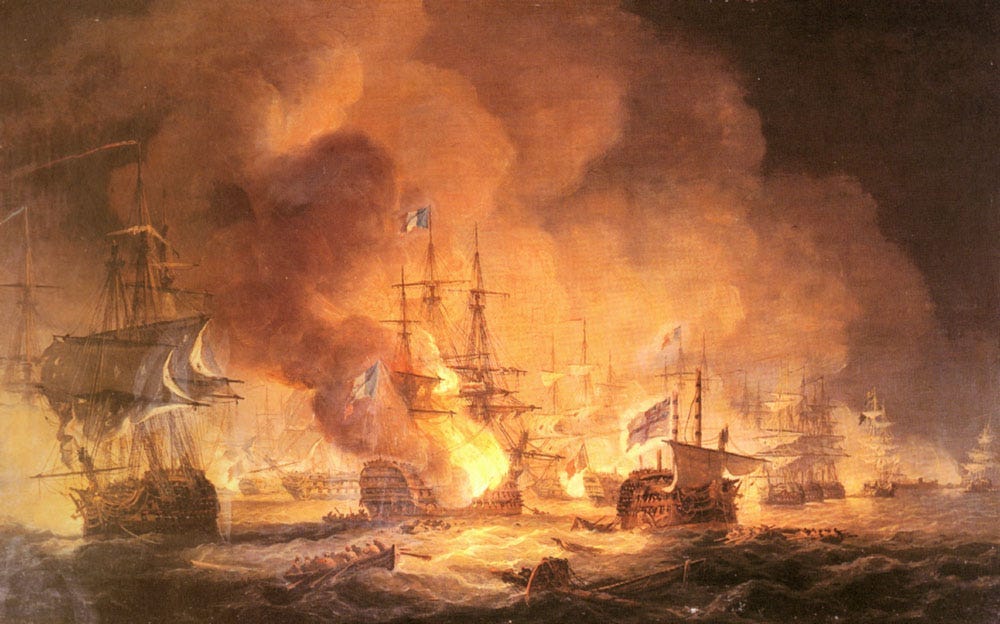
August 1, 1798: The French fleet that had accompanied Napoleon on his great eastern campaign is nearly wiped out by a British fleet in Egypt’s Abu Qir Bay in the somewhat inaptly named “Battle of the Nile.” A hitherto relatively obscure British admiral named Horatio Nelson managed to track Napoleon down in Egypt and completely outmaneuver the French fleet in the bay so that several of his vessels were able to attack the French ships of the line from their unprotected rear, and that was pretty much that. The French defeat was so total that not only did it doom Napoleon’s campaign to failure, it established British naval supremacy in the Mediterranean for the rest of the Napoleonic period.
August 1, 1927: The Nanchang Uprising marks the start of the Chinese Civil War. In a direct response to the Shanghai Massacre of April 12, in which Kuomintang forces purged Chinese Communist Party members from their ranks (and killed thousands of them, though the casualty figures are disputed), a CCP army captured Nanchang, home of the Revolutionary Committee of the Chinese Nationalist Party. This was one of several CCP uprisings around the country. Realizing they couldn’t hold the city against a counterattack, the CCP withdrew on August 5 and undertook what became known as the “Little Long March” south to Guangdong province. China’s People’s Liberation Army dates its founding to this uprising.
August 2, 338 BCE (or thereabouts): Philip II of Macedon defeats a Greek army organized by the cities of Thebes and Athens at the Battle of Chaeronea. The outcome effectively ended any chance of Greek resistance to a Macedonian takeover. After harshly punishing Thebes, Philip engaged in heavy diplomacy to win over Athens and Corinth and isolate Sparta. He managed to unite most of the Greek city-states behind him in what historians call the “League of Corinth,” which was one of the key preliminary steps in his grand plan to invade the Persian Empire. Philip didn’t live long enough to lead that campaign, but his son Alexander picked up where dad left off.
August 2, 216 BCE (or thereabouts): At the Battle of Cannae in southeastern Italy, the Carthaginian general Hannibal annihilates a much larger Roman army in what has often been regarded as the closest thing to a total military victory in history. Hannibal’s cavalry outflanked and completely encircled the Roman infantry in a pincer movement, then attacked from all sides. Of the 86,000 or so Roman soldiers who began the battle (to about 50,000 for Hannibal), Livy says that the Carthaginians killed 67,500 and that’s the low estimate. Polybius cites a death toll of over 85,000.
August 2, 1964: The USS Maddox, in North Vietnamese territorial waters, exchanges fire with several North Vietnamese torpedo boats. The Gulf of Tonkin Incident, as it came to be known, was the immediate trigger for the Vietnam War.
August 2, 1990: Iraq invades Kuwait, sparking a US military buildup that would eventually lead to the Gulf War and, as far as that conflict’s fans are concerned, nothing else whatsoever.
MIDDLE EAST
LEBANON
The Israeli military (IDF) claimed on Saturday that its forces had killed an unknown number of Hezbollah militants in an overnight incident on the Ali al-Taher ridge. That high point is located near the southern Lebanese city of Nabatieh and there has been fighting reported in that vicinity of late. The IDF claims that there is a Hezbollah command center beneath the hill. While the details here are minimal and unconfirmed these would mark the first known fatalities related to the IDF’s southern Lebanon occupation since July 15.
At Responsible Statecraft, Aurélie Daher argues that the US-Israeli effort to isolate Hezbollah within Lebanese politics and society has backfired:
The systematic, large-scale destruction of the country’s south and the massive killings of civilians did not produce Israel’s desired results. Tel Aviv had ideally hoped for a polarization of Lebanese society that would lead to a civil war, in which Shiites would come under fire from their compatriots — or, at the very least, for a majority of Lebanese to condemn and permanently exclude Hezbollah from governance.
The Israeli army’s brutal campaign had the opposite effect, adding fuel to Hezbollah’s fire rather than extinguishing it. In practice, the Israeli army has re-legitimized the Lebanese organization’s narrative that it has a special (if self-assigned) mission to defend the territory against the enemy to the south.
This represents an extraordinary failure for the pro-Israel position on the issue. In January 2025, the U.S. and Saudi Arabia (alongside Israel behind the scenes) had pressured the Lebanese political parties to elect President Aoun and Prime Minister Nawaf Salam, who were said to embody a “new era” for Lebanon. The new leadership promised, far and wide, that the United States was working to turn the Lebanese army into a military force capable of defending the country’s territory, which would render Hezbollah’s defensive rhetoric obsolete. They also tried to reassure skeptics by asserting that “diplomatic friendships” were enough to deter Israel’s potential trouble-making.
A year and a half later, the Lebanese army not only still lacked the resources to carry out its mission but was openly fleeing, on orders from Aoun himself, in the face of the Israeli advance in the spring of 2026. Hezbollah, which Tel Aviv claimed to have decimated in the fall of 2024, was back in action as early as March of the same year. And there were no signs of any external “friend of the Lebanese government” to keep Israeli military force in check.
ISRAEL-PALESTINE
In case you were wondering if there is in fact a deal in place to disarm Hamas and further the Gaza “ceasefire,” the IDF offered a pretty compelling case for the negative on Sunday when it killed at least 18 people across the territory. Israeli Energy Minister Eli Cohen told Israeli Army Radio that there is currently “no deal to halt attacks on Gaza,” though leaving aside whatever did or didn’t happen on Thursday and Friday it seems like the October “ceasefire” was supposed to cover that sort of thing. The IDF killed at least seven people in Gaza on Saturday and punctuated the day by destroying medical warehouses in Deir el-Balah.
IRAN
Donald Trump once again pivoted away from his own precipice on Saturday, declaring via social media that he’d called off what was supposed to be a massive US and Israeli attack on Iranian energy infrastructure. According to Trump the “perimeters of a deal has been agreed to,” and yes he used the word “has.” He may also have meant “parameters” but who can say, really. There were indications from Tehran on Sunday that Iranian and Omani officials may be close to a deal on restoring traffic through the Strait of Hormuz but beyond that there’s no indication of any other sort of deal whose perimeters has been agreed. Nevertheless, Trump said on Sunday that there will be some sort of US-Iran negotiation on Monday but didn’t say where or how it would take place or who would be participating.
The actual impetus for Trump’s about-face may have come from the Gulf Arab states, whose leaders undoubtedly feared their own infrastructure being subject to Iranian retaliation. Several outlets reported that Gulf officials were urging against escalation and Trump’s favorite Gulf official, Saudi Crown Prince Mohammed bin Salman, delivered that message directly in a phone call shortly before Trump made his announcement. The UAE apparently lobbied for escalation rather than postponement but one assumes that the Gulf consensus was more aligned with the Saudi perspective. Additionally, The Washington Post reported on Saturday that the head of the US military’s European Command, Alexus Grynkewich, had informed the Pentagon that a shortage of available naval destroyers meant that he would have to reduce the number of vessels currently deployed in the eastern Mediterranean to provide air defense to Israel. Maybe that was part of Trump’s thinking (I use the term loosely) as well.
ASIA
PAKISTAN
A suicide bomber killed at least 14 people on Sunday evening outside a police station in northern Pakistan’s Khyber Pakhtunkhwa province. The attacker targeted a group of protesters who were demanding greater levels of police and military action against violent insurgents. According to the Pakistan Institute for Conflict and Security Studies, Khyber Pakhtunkhwa experienced 154 “terrorism-related” deaths in July and that was more than twice the number recorded the previous month.
INDIA
CNBC’s Priyanka Salve and Raksha Murali highlight the deeper economic issues underlying the recent “Cockroach Janta Party” protests in India:
India’s youth unemployment crisis has become one of the biggest vulnerabilities for Prime Minister Narendra Modi’s government, exposing the gap between the country’s economic ambitions and the reality facing millions of young graduates.
The frustration erupted into the open this month after a leaked paper forced a retest of India’s ultra-competitive medical entrance exam, prompting nationwide student protests led by a viral, social media-focused youth movement called the Cockroach Janta Party.
While the exam scandal was the immediate trigger, economists say the demonstrations reflected something much deeper: a generation struggling to find secure, well-paying jobs despite spending years competing for an education.
AFRICA
SUDAN
The Sudanese military (SAF) killed at least 35 people in a drone strike in Sudan’s North Darfur state on Sunday, according to the Emergency Lawyers activist group. The strike apparently targeted a local court where people had gathered to hear cases in the village of Garra al-Zawaya, which is controlled by the Rapid Support Forces militant group. Elsewhere, new fighting between the Sudan People’s Liberation Movement-North and the Otoro tribe has reportedly caused “a wave of displacement” in Sudan’s South Kordofan state. The SPLM-N and the Otoro, or elements of it, have been battling in South Kordofan since at least May.
NIGERIA
Gunmen attacked a village in northwestern Nigeria’s Sokoto state overnight Saturday to Sunday, killing at least 12 people and abducting several women and children as well as rustling livestock. There’s no indication as to responsibility and this may be another instance of organized banditry, which is a frequent occurrence in that part of the country.
ETHIOPIA
Tigray People’s Liberation Front (TPLF) and federal Ethiopian forces battled one another in the western part of Ethiopia’s Tigray region on Saturday. It’s unclear how the fighting started or who started it, but tensions between the TPLF and the federal government have been escalating for months. Both sides are talking as if this may be a return to full scale war though that has yet to be seen. Details are slim but the fighting apparently spilled into Sudan and caused casualties among displaced Ethiopians along the border.
EUROPE
UKRAINE
A major Russian bombardment killed at least ten people in Ukraine’s Kyiv region on Saturday. Damage and casualties were widespread across the city and its environs. In Russia, a possible suicide bomber (authorities aren’t sure if she was aware that she was carrying a bomb) killed herself and at least two other people in a Moscow restaurant. A Russian general who was in the vicinity may have been the target, and it seems reasonable to assume that the incident was connected with the Ukraine war. On Sunday Ukrainian military strikes killed at least nine people across Russia including at least three in a long-range attack in the Udmurtia region. Russian strikes killed another five people in Ukraine.
SPAIN
At least 72 people have died amid the rush of migrants who attempted to cross from Morocco into the Spanish exclave of Ceuta on Thursday and Friday. Most appear to have drowned while trying to enter Ceuta by sea and the death toll is expected to rise as more bodies are washed ashore. Spanish authorities have expelled some 48,000 of the roughly 60,000 people who entered the exclave.
AMERICAS
UNITED STATES
Finally, though it’s not really part of our normal beat The Intercept’s Dylan Gyauch-Lewis reports on one of the more cartoonishly corrupt things Donald Trump has done so far in his second term:
For the low, low price of $100,000 a month, the ever-oxymoronic Truth Social is now selling direct access to its most important posts — or, in the firm’s preferred parlance, “truths” — to Wall Street. That’s an expedited lane to access statements and data from the president of the United States and other government officials, which have significant potential to move financial markets, ahead of us suckers in the general public.
This sort of product, called an Application Processing Interface, or API, is not a particularly unusual offering for a social media company in the abstract. But Truth API, which launched today, is uniquely positioned to fuel blatant presidential graft.
The move has been rightly called “brazen corruption,” “the president’s most desperate grift yet,” and a “clear and unacceptable pathway for corruption.” In a letter to the Securities and Exchange Commission, Sens. Adam Schiff and Elizabeth Warren called the offering “an outrageous abuse of the President’s office for his personal benefit that undermines everyday investors and the integrity of our markets, while enriching Wall Street and other wealthy insiders.” All of that is true, but Truth API doesn’t stop at creating a new pathway to funnel de facto bribes to Trump; it also seeks to functionally merge the provision of a public good with a for-profit company.
As she goes on to point out, presidential communications are public property according to the 1978 Presidential Records Act. Moreover, officials within the Trump administration use Truth Social as an unmediated press office, releasing statements and announcements on the site to curry favor with their boss. Those are rightly public property as well. Trump is privatizing access to public documents and selling it off for his own enrichment.
My best to your wife <3
Sending best wishes for a speedy recovery!