

You’re reading the web version of Foreign Exchanges. If you’d like to get it delivered straight to your inbox, sign up today:
TODAY IN HISTORY
April 7, 529: The Codex Justinianeus, the first section of Roman Emperor Justinian’s Corpus Juris Civilis, is completed. The Corpus Juris Civilis was meant to standardize and codify imperial law, which had fragmented into multiple codices and laws that didn’t necessarily cohere with one another. Justinian ordered a review and modernization of these law codes upon his accession as emperor. The Codex is the product of that effort. The Corpus Juris Civilis has influenced everything from canon law in the Catholic Church to the legal codes of the Ottoman Balkans and modern Greece to contemporary international law.
April 7, 1994: One day after Rwandan President Juvénal Habyarimana and Burundian President Cyprien Ntaryamira were assassinated when their aircraft was shot down before landing in Kigali (either by Hutu extremists or by the then-rebel Tutsi Rwandan Patriotic Front militia), Hutu génocidaires begin slaughtering Tutsi Rwandans en masse. The ensuing genocide left hundreds of thousands dead, including Twa Rwandans and some Hutu along with the Tutsi, with highest estimates putting the death toll at over one million. It finally ended in July, with the RPF seizing control of the country under current Rwandan President Paul Kagame.
INTERNATIONAL
The folks at OPEC+ held their monthly confab on Sunday and eight members then issued a statement announcing another round of production increases for May, to the tune of 206,000 barrels of oil per day. This is of course a response to the Iran war’s supply restrictions, but while it does appear to have flattened global oil prices out a bit the effect is likely to be mostly symbolic. That production increase represents a fraction of the supply gap created by Iran’s closure of the Strait of Hormuz, and several members of this group of oil exporters can’t actually increase their exports until the strait reopens. With the strait maybe opening at least for the next couple of weeks (see below) that should have a much bigger effect on oil prices.
MIDDLE EAST
LEBANON
This was just emerging as I was wrapping up tonight’s newsletter but Pakistani Prime Minister Shehbaz Sharif is claiming that the US-Iran ceasefire (see below) also covers Israeli operations in Lebanon. If this is true it would obviously be a major development, but is it? Israeli Prime Minister Benjamin Netanyahu is insisting that the ceasefire does not include Lebanon, and he may be in the stronger position to decide what the accord does and does not involve.
Haaretz reported on Tuesday that the Israeli military (IDF) has decided to halt its Lebanese offensive/occupation along its current line of advance, which is roughly ten kilometers south of the Litani River. We’re meant to believe that this was the limit that IDF commanders chose in their “approved operational plans,” though toward the end of the piece we learn from “a reserve officer currently fighting in Lebanon” that Hezbollah’s resistance has been surprisingly intense and the operation is “going less easily than we expected.” So it’s possible that the Israelis are cutting their advance short of the river because of that. Either way they’ve concluded that any intention of disarming Hezbollah is unrealistic despite repeated public statements—mostly but not entirely from Israeli political leaders—describing Hezbollah’s supposed weakness and setting disarmament as their goal.
Apparently the reason that the IDF has not bombed the Masnaa checkpoint along the Lebanese-Syrian border is because the governments of Lebanon and Syria appealed to the Trump administration to keep it open. The checkpoint is nevertheless closed, because Syrian officials closed it after the IDF threatened to attack it on Saturday.
ISRAEL-PALESTINE
The IDF killed at least ten people in a missile strike near a school-turned-shelter in central Gaza on Monday. “Medics and residents” claimed that members of an Israeli-backed militia attacked the shelter looking to abduct people inside. They met resistance and the IDF apparently struck the facility in support of the militia. Another IDF attack killed a World Health Organization contract worker on Monday, prompting the WHO to suspend its medical evacuation operations in the territory.
The “Board of Peace” is demanding that Hamas respond to its disarmament proposal by the end of this week. There was an expectation that the parties would meet in Cairo on Tuesday to discuss it but I have not seen any indication as to whether or not that meeting took place. “Abu Obeida,” the spokesperson for Hamas’s Al-Qassam Brigades, rejected disarmament in a statement on Sunday but that’s not necessarily the final word on the matter.
In Israel, the Knesset passed a bill last week making execution (by hanging) the default sentence for anyone convicted of terrorism. Since only Palestinians who attack Israelis are ever charged with terrorism in Israeli courts this creates a separate punishment framework for that community (Jewish Israelis who attack Palestinians are as a rule charged with lesser crimes). This happened while I was away and we don’t have a lot of space in this newsletter to dwell on all the implications, but I do believe there is a term for a system that establishes discriminatory legal tracks for specific communities. I just can’t quite put my finger on it.
IRAQ
Iraq’s Kataʾib Hezbollah militia has reportedly released US journalist Shelly Kittleson, one week to the day after it kidnapped her in Baghdad. In a statement it made Kittleson’s release conditional on her leaving Iraq, but in addition to that stipulation it sounds like some sort of prisoner exchange is underway with the Iraqi government. Details on that aspect are still unclear.
IRAN
I had a whole section written about what was likely to happen at 8 PM eastern time tonight, based mostly on Donald Trump’s Tuesday morning declaration that “a whole civilization will die tonight, never to be brought back again. I don’t want that to happen, but it probably will.” But then Trump hopped back on social media on Tuesday evening to announce that he’d accepted an ostensibly Pakistani proposal to “suspend the bombing and attack of Iran for a period of two weeks” provided that Tehran also agrees to reopen the Strait of Hormuz during that time. I say “ostensibly” because there’s some reason to believe that this was a US proposal that the Trump administration laundered through Pakistani Prime Minister Shehbaz Sharif to give it the appearance of impartiality.
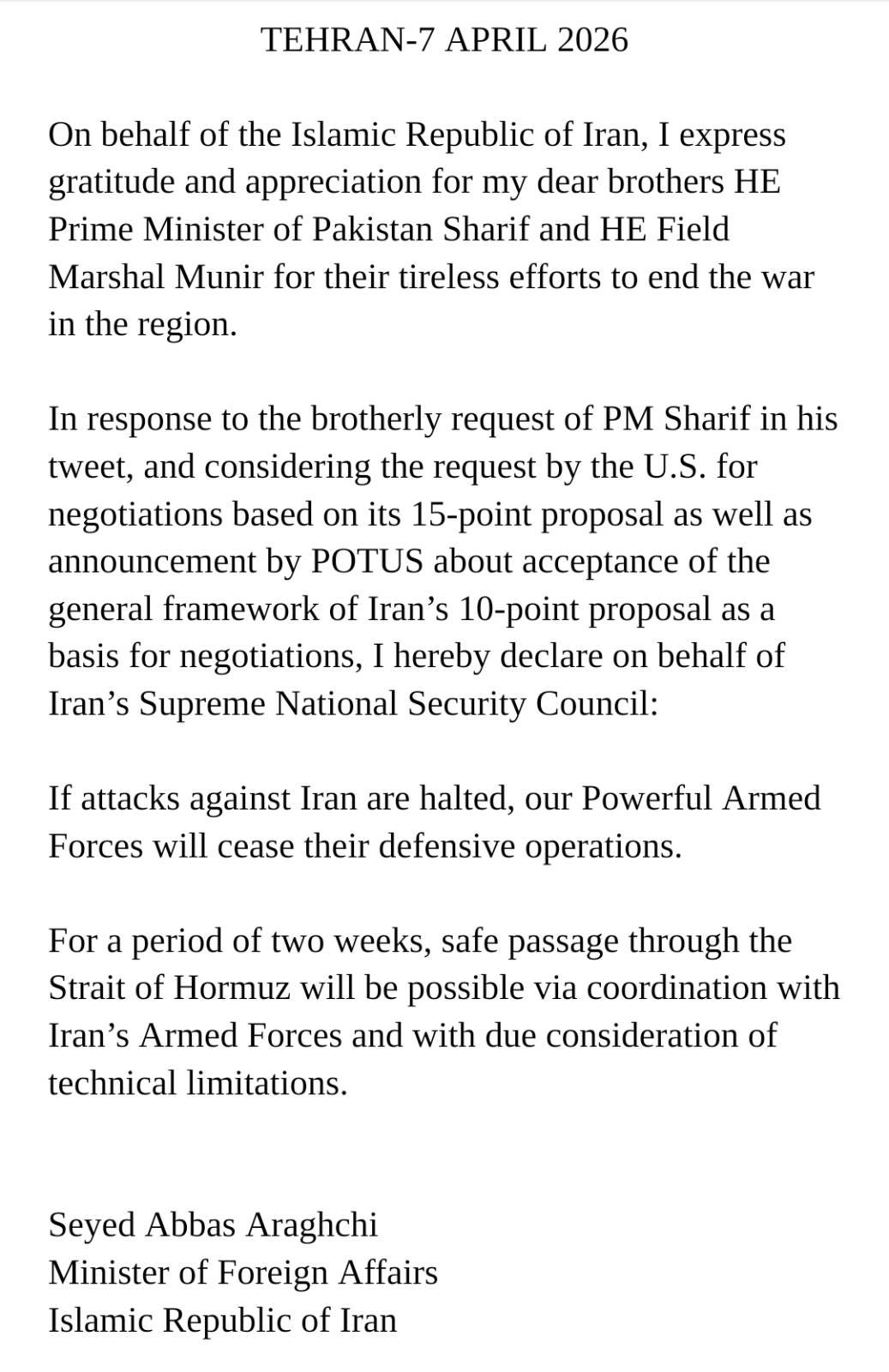
The other shoe dropped a short time later, when Iranian Foreign Minister Abbas Araghchi issued his own statement via social media:
Israel is apparently on board as well, though I doubt that Benjamin Netanyahu and company are particularly thrilled about this development and it is possible that they will try to spoil it over the next 14 days. As I mentioned above there are contradictory claims at this point about what is supposed to happen in Lebanon.
You may note that Araghchi was not really conceding unfettered access through Hormuz with that “possible via coordination” bit. Tehran still isn’t willing to forego the control it’s established in that waterway for a temporary ceasefire, even if its “control” will only be symbolic for the next two weeks. The AP reported that Iran and Oman are going to collect fees from ships transiting the strait for the next two weeks, which would be a remarkable development (and would indicate more than merely “symbolic control” of the strait) if it’s true but I’m going to take that with a grain of salt for now, until I see it more widely reported.
You may also note that Araghchi mentioned Trump’s “acceptance of the general framework of Iran’s 10-point proposal as a basis for negotiations,” which aligns with Trump’s statement but is being spun up by Iranian media into a claim that Iran “forced” Trump to “accept” the ten point proposal. That’s clearly not the same thing and Trump is apparently angry over the way that this is being reported by US media outlets. That’s definitely something to monitor.
Looking past this two week window…well, maybe it’s best not to do that yet. Obviously peace talks will be in order if this pause is going to turn into a full end to the war, and there are a lot of grievances that need to be addressed in a relatively short period of time. As Araghchi noted, in his statement on Tuesday evening Trump described Iran’s ten point peace proposal as “a workable basis on which to negotiate,” which seems positive though it still leaves everybody one dramatic mood shift away from being right back on the brink of something horrific. Still, I think this could be the sort of dramatic, season finale-esque outcome to the war that appeals to a TV personality, so maybe it will hold on that basis. Apparently there’s a plan to hold peace talks in Islamabad on Friday so we may have more clarity after that.
There were many other things that happened on Tuesday, including Russia and China vetoing a United Nations Security Council resolution on reopening Hormuz. I’m not sure it’s worth spending any time recapping these things given what’s just happened, so I’m going to leave it here for now.
ASIA
AFGHANISTAN
Pakistani and Afghan negotiators began a new round of peace talks in the Chinese city of Urumqi late last week. Afghan Foreign Minister Amir Khan Muttaqi described them as “useful” on Tuesday, which is not exactly high praise but at least they’re continuing. There is no ceasefire as yet and Afghan officials have been accusing the Pakistani military of repeatedly shelling civilian communities near the border.
INDIA
A new outbreak of violence in northeastern India’s Manipur state left at least four people dead on Tuesday, including two children. Manipur has been subject to clashes between the Meitei and Kuki communities off and on since 2023, though lately it’s been much more off than on. Tuesday’s violence involved a bombing in a predominantly Meitei district that killed those two children. Later, police killed two more people after a crowd reportedly stormed into their encampment.
MYANMAR
To I assume no surprise, Myanmar’s military-dominated parliament elected junta leader Min Aung Hlaing as the country’s new president on Friday. The only suspense in this process was over whether or not Min Aung Hlaing would want to step down as military commander to take the presidency. After staging a sham election to ensure that his Union Solidarity and Development Party would control parliament there was no question that the office was his if he wanted it.
VIETNAM
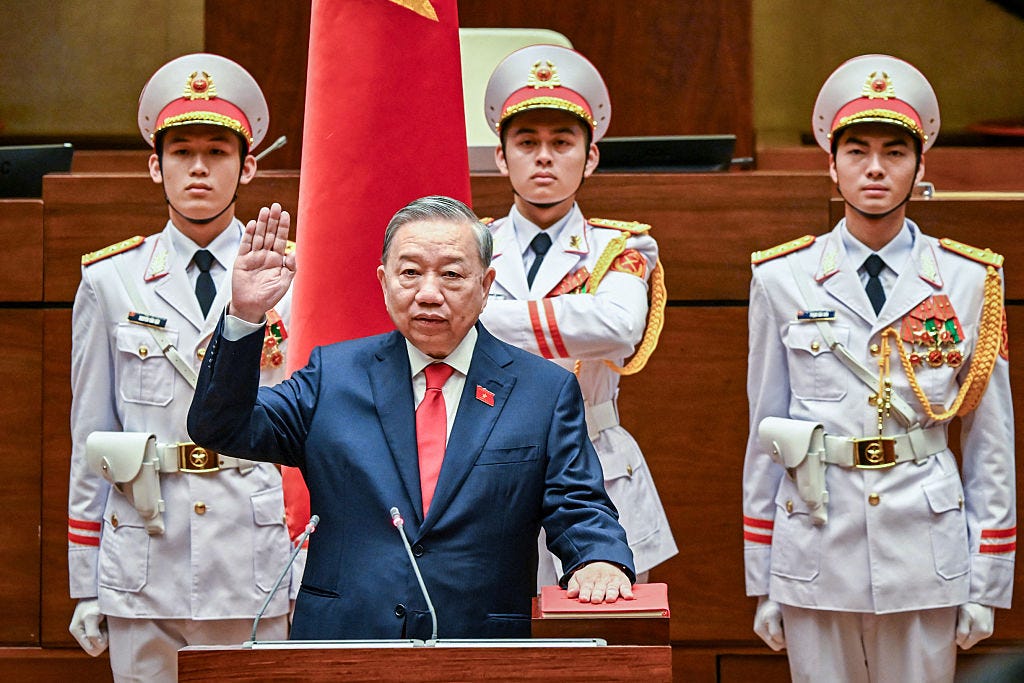
The Vietnamese National Assembly elected Communist Party leader Tô Lâm as the country’s new president on Tuesday. This is not unexpected but it is unusual, in that typically those positions have been held separately. In fact this is Tô Lâm’s second stint as president—his first, in 2024, ended when he took over party leadership and resigned the presidency. Holding both offices may allow him greater latitude to implement his bureaucratic and economic agendas, which have so far revolved around reducing the size of the Vietnamese government and strengthening its private sector.
AFRICA
SUDAN
The Sudanese Armed Forces once again reopened the road between Sudan’s North Kordofan state and the town of Dilling in neighboring South Kordofan on Monday. The SAF broke an extended Rapid Support Forces siege of Dilling in January but has had a hard time maintaining an open corridor amid continued RSF pressure.
Elsewhere, the UN reported on Tuesday that the RSF’s offensive in southeastern Sudan’s Blue Nile state has displaced at least 28,000 people since mid-January. Some 4000 people have been displaced in just the past ten days. Most of the displaced have wound up in the state capital, Ad-Damazin, taxing that city’s available food and water.
BURKINA FASO
Burkinabè junta boss Ibrahim Traoré gave an interview to state media on Thursday in which he said that “people need to forget about the issue of democracy.” Certainly Traoré has forgotten about it, inasmuch as he’s foregone any semblance of a political transition and earlier this year dissolved all of the country’s political parties. Arguing that outside actors had tried to “impose” democracy on Burkina Faso, Traoré cited Libya as proof that “democracy kills” and concluded that it “isn’t for us.” It’s unclear whether military rule is for them either, especially given that Traoré’s first three years in power saw nearly triple the number of deaths due to jihadist violence as occurred in the three previous years under the preceding civilian government. But I digress.
Traoré remains broadly popular both within Burkina Faso and across parts of Africa, due to an anti-imperialist streak that has earned him comparisons to former Burkinabè leader Thomas Sankara. One major difference between them is that Sankara is remembered as an effective leader and I’m not sure it’s possible to make the same case about Traoré (at least not yet).
CAMEROON
The Cameroonian parliament approved a constitutional amendment on Saturday creating a vice presidency. Cameroon hasn’t had a vice president since the office was abolished in 1972, but with President Paul Biya now a vibrant 93 years old it’s not terribly surprising that he or the people around him are thinking about succession. The new VP will be appointed by Biya and serve at his pleasure, which has raised criticism that this will consolidate more power in the executive branch. If whoever gets the job has to succeed Biya, who was just elected to another seven year term in October, that person will in theory be barred from running for president in the 2032 election. Of course, that prohibition could be removed by then.
EUROPE
RUSSIA
A Ukrainian drone strike killed three people, a child and his parents, in western Russia’s Vladimir oblast on Tuesday. Ukrainian strikes also killed at least two people in Russian controlled parts of Ukraine’s Kherson and Zaporizhzhia oblasts. The Ukrainian military has continued to strike Russian energy-related targets and claimed to have struck the Novorossiysk oil port in the Black Sea on Monday, damaging a Russian naval vessel.
UKRAINE
Russian strikes killed at least four people in the Ukrainian city of Nikopol and four more people in the city of Kherson on Tuesday. This was one day after Russian attacks killed at least three people in the southwestern city of Odesa, and a couple of days after the Russian military claimed to have fully seized Ukraine’s Luhansk oblast. The Russian military has made that claim repeatedly but by most accounts there is still a small portion of the province (encompassing two villages) that is in Ukrainian hands.
Ukrainian President Volodymyr Zelensky is agitating for an (Orthodox) Easter ceasefire on energy-related attacks, but so far there’s no indication that the Russians are interested. Zelensky may be more interested in reaffirming Russian intransigence than in actually achieving a ceasefire, but regardless of his priorities he at least comes away from this looking comparatively magnanimous.
AMERICAS
HAITI
Criminal insurgents killed at least 70 people in attacks on multiple rural villages in Haiti’s Artibonite province on Sunday, according to the human rights group Defenseurs Plus, which is also reporting that some 6000 people were displaced. The violence began on Sunday morning and in some areas continued throughout the day into Monday. Haitian authorities have released much lower death tolls.
Meanwhile, the first Chadian security forces have deployed to Haiti under the UN’s new “gang-suppression force,” which is supposed to take over for a more ad hoc Kenyan-led police deployment that has so far failed to bring Haiti’s gang insurgency under control. That deployment never came close to meeting its personnel or funding targets and the hope is that with firmer UN backing this force will fare better. The Chadian government has committed 800 personnel to the operation but there doesn’t seem to be any clarity in terms of which countries will provide the rest of the force.
UNITED STATES
Finally, The Wall Street Journal reports that the Iran war has reopened fissures within NATO:
President Trump has expressed “disgust” with European allies for not joining the U.S.-Israeli war against Iran, and has mused with aides and journalists about pulling out of the North Atlantic Treaty Organization, the 77-year-old alliance that won the Cold War and, until recently, underpinned the West.
For their part, European leaders have come out staunchly against a war they weren’t consulted on, and which they see as both illegal and ill-advised. After a year in which Trump placed tariffs on European products, scrapped most U.S. support for Ukraine, repeatedly mocked European leaders and threatened to seize the Danish territory of Greenland, they and their voters are in no mood to help out.
At stake in the growing conflict is the future of NATO, which for decades has kept Europe safe and allowed it to prosper. Until recent weeks, Trump’s main complaint about NATO had been about burden-sharing—that European nations weren’t pulling their weight in the continent’s joint defense.
Now, with European members of NATO sitting out the war, Trump is questioning whether defending Europe serves U.S. interests at all if Europeans don’t help American military interventions in the Middle East or elsewhere.
The implication: The U.S. role in NATO is a favor to Europeans, and it needs a quid pro quo to be worth America’s while.
One important thing to keep in mind here is that the framing is fictitious, and I’m not even talking about that “kept Europe safe and allowed it to prosper” gloss. With minimal exceptions European NATO members have been happy to allow the US military to use bases on their territory to attack Iran, which cannot be classified as either “staunch” opposition or “sitting out the war.” Spain has been the only country to consistently refuse participation in the conflict, though there have been isolated refusals by a few other member states. But reality matters far less than Trump’s warped perspective, and in his mind they are opposing his war.