

You’re reading the web version of Foreign Exchanges. If you’d like to get it delivered straight to your inbox, sign up today:
TODAY IN HISTORY
April 25, 775: An Armenian rebellion against the Abbasid Caliphate is cut short at the Battle of Bagrevand. Many of the leading Armenian families that supported the uprising suffered greatly in its aftermath and the Abbasids began encouraging migration from other parts of their empire into the southern Caucasus. This policy helped to remake the region of Caucasian Albania, which more or less corresponds to modern Azerbaijan.
April 25, 1846: A small detachment of US soldiers is resoundingly defeated by a much larger Mexican contingent in what became known as the Thornton Affair, after the US commander Captain Seth Thornton. This was the first military engagement of the Mexican-American War, which ended in February 1848 with Mexico’s surrender, including its recognition of the US annexation of Texas and the cession of the territory that includes the modern states of California, Nevada, and Utah as well as parts of Wyoming, Colorado, New Mexico, and Arizona.
April 25, 1898: The US Congress declares war on Spain retroactive to the imposition of a US naval blockade on Cuba on April 21. This marks the start of the Spanish-American War, which ended in August with Spain’s surrender and the cession of Guam, the Philippines, and Puerto Rico to the US along with a renunciation of Spain’s claim on Cuba.
April 26, 1803: At around 1 in the afternoon a hail of some 3000 rock fragments, weighing around 37 kilograms in total, rains down upon the town of L’Aigle in France’s Normandy region. A French scientist named Jean-Baptiste Biot was dispatched to catalog and study the event by the French Academy of Sciences. His fieldwork determined conclusively that the fragments were of extraterrestrial origin, establishing near-definitive proof for the hitherto widely questioned existence of meteors. Biot’s work at L’Aigle birthed an entirely new field of study, meteoritics, and was the first of many significant scientific contributions he would make in his career.
April 26, 2005: Under considerable international pressure due to its suspected involvement in the February 14 assassination of then-Lebanese Prime Minister Rafic al-Hariri, the Syrian government withdraws the last of its occupation forces from Lebanon. Syria had invaded Lebanon in May 1976 during that country’s civil war, in support of Maronite and conservative Muslim factions and in opposition to the Palestine Liberation Organization and leftist militias. Tensions later emerged between the Syrians and some Maronite leaders, including former Lebanese President Michel Aoun. Initially the Syrian military presence in Lebanon was legitimized by the Arab League under the auspices of a peacekeeping force, but by the mid-1980s the Arab League had stopped renewing its mandate and the Syrian presence in Lebanon could be considered a full-fledged military occupation.
INTERNATIONAL
A new report from the Stockholm International Peace Research Institute (SIPRI) finds that global military spending hit a collective $2.9 trillion last year, breaking the record set all the way back in 2024. Amazingly the US actually spent less than it did the previous year, owing to the absence of new military aid to Ukraine. But massive increases in military spending across Europe, including by Russia and Ukraine, and across Asia, including by China and Japan, more than made up the difference.
MIDDLE EAST
LEBANON
The Israeli military (IDF) killed at least four people in two airstrikes in southern Lebanon’s Nabatieh province on Saturday. Both strikes took place north of the Litani River, outside of the zone in which the IDF has decreed it will operate with impunity. On Sunday the IDF issued evacuation orders for seven towns north of the river as it prepared to retaliate for a Hezbollah attack that had killed one Israeli soldier earlier in the day. It proceeded to kill at least 14 people and wound 37 more. That made it the single deadliest day since the start of Lebanon’s ostensible ceasefire on April 16.
ISRAEL-PALESTINE
The IDF killed at least four people in multiple incidents across Gaza on Sunday. Those attacks capped off a busy “ceasefire” weekend for the Israelis, who killed at least 13 people on Friday. Local officials in Gaza say the death toll under the “ceasefire” has now topped 800.
The Palestinian Authority held municipal elections in the West Bank and in Gaza’s Deir al-Balah community on Sunday. Turnout was low—around 56 percent in the West Bank and 23 percent in Deir al-Balah—but authorities seemed pleased that the vote happened at all and characterized it as a sort of dry run for a potential presidential and/or parliamentary election. PA President Mahmoud Abbas’s Fatah party seems to have been the big winner, despite his and its overall unpopularity. Its candidates apparently ran unopposed in much of the West Bank. Hamas’s favored list (the party itself officially boycotted the vote) won only two of the 15 council seats that were up for grabs in Deir al-Balah.
IRAN
To I assume no great surprise, US envoys Steve Witkoff and Jared Kushner did not wind up meeting with Iranian representatives in Pakistan over the weekend, as the Trump administration had teased on Friday. In fact the two men never left the US. Donald Trump tried to portray this to reporters as though he’d called off the talks, but in reality Iranian Foreign Minister Abbas Araghchi left Pakistan and thus rendered the Witkoff-Kushner trip pointless. Trump said via social media that if the Iranians want to talk they can pick up a phone, while blaming the “tremendous infighting and confusion within their ‘leadership’” for the lack of diplomacy during his ceasefire. He’s made repeated assertions about chaos in Tehran without offering any evidence to support them. It is a convenient way for him to frame his own diplomatic failures.
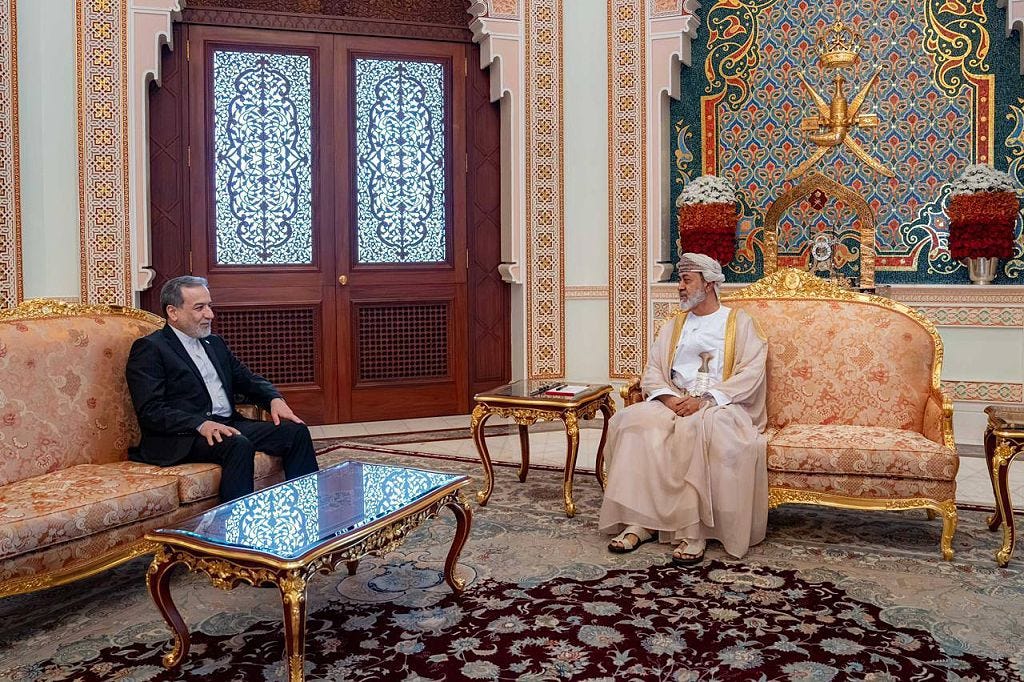
Iranian state media is claiming that the Islamic Revolutionary Guard Corps has begun “reverse engineering” undetonated US munitions. Who knows if this is actually true, but it would be in keeping with the rest of this boneheaded conflict if it wound up advancing Iran’s missile program instead of degrading it. Meanwhile, US state media Axios is reporting that Araghchi conveyed to the Pakistanis a proposal to reopen the Strait of Hormuz and end the war, while tabling nuclear issues for future negotiations. One assumes that the Trump administration won’t go for this because US officials feel that the war, or at least the current US naval blockade, is their best chance of extracting nuclear concessions from Tehran.
ASIA
AFGHANISTAN
The Afghan Foreign Ministry is assuring the 1100 or so Afghan nationals who are currently stranded in Qatar by the Trump administration’s xenophobia that they need not worry about returning home. As we noted a few days ago, the administration is offering those Afghan nationals a choice between returning to Afghanistan or being relocated to the Democratic Republic of the Congo. All of them should be eligible for US visas under the program that aimed to protect Afghans who worked with the US military between 2001 and 2021 from reprisals by the Taliban, but the administration scrapped that program last year and they’ve remained in Qatar. The Taliban insists that they will face no violence if they go back to Afghanistan but there’s not much reason to believe that and it’s unclear how many would actually agree to return. That said, there do not seem to be many (or any) takers for moving to the DRC either.
MALAYSIA
The Wall Street Journal reports that the US search for non-Chinese sources of rare earth metals has turned in part to Malaysia:
The Pentagon’s push to get its hands on the rarest of the rare-earth elements leads all the way to this small port city [Kuntan] in Malaysia.
Here, Lynas Rare Earths, an Australian company, has begun pumping out heavy rare earths, the elusive kind that China dominates.
“No one had made a separated heavy rare earth outside of China in 20 years,” said Amanda Lacaze, Lynas’s chief executive. The company’s chief operating officer, Pol Le Roux, said it had actually been 30 years.
When China cut off exports of heavy rare-earth elements during trade tensions last year, automobile factories in the U.S. and Europe were forced to stop production. Now, Lynas is at the vanguard of an effort by the U.S. and allies to prevent Beijing from using its monopoly power to squeeze the rest of the world.
The Pentagon is opening its wallet in unusual ways to ensure supplies. In March 2026, Lynas announced a preliminary $96 million deal in which the Pentagon would purchase Lynas’s rare earths.
And Las Vegas-headquartered MP Materials, backed by billions of dollars in U.S. government support, is planning its own refinery for heavy rare earths that is set to come online later this year.
AFRICA
SUDAN
Drone strikes killed at least seven people in El-Obeid, the capital of Sudan’s North Kordofan state, on Saturday, according to the Sudan Doctors Network. It described a series of attacks specifically targeting residential parts of the city. El-Obeid is under military control, so while there’s been no claim of responsibility it’s safe to assume that the strikes were carried out by Rapid Support Forces militants.
MALI
A coordinated offensive involving Tuareg rebels from the Azawad Liberation Front (FLA) and jihadist militants from Jamaʿat Nusrat al-Islam wa’l-Muslimin (JNIM) struck multiple locations across Mali on Saturday, killing a still-unknown number of people including Malian Defense Minister Sadio Camara. He was killed in an attack on the town of Kati, located just north of the Malian capital Bamako and the site of the country’s largest military base. Bamako’s airport was also among Saturday’s targets, along with major towns and cities primarily in northern Mali where the FLA operates. It’s still difficult to assess the aftermath and in some places the fighting hasn’t ended, for example in the strategically important northeastern town of Kidal.
To my knowledge this is the first case of JNIM and Tuareg rebels collaborating on a major military operation but there is a prior relationship there—one of JNIM’s constituent organizations, Ansar Dine, emerged amid the 2012 Tuareg uprising to which the FLA also traces its origins. JNIM leader Iyad Ag Ghali was a prominent participant in that rebellion and in the 1990-1995 Tuareg rebellion. It’s unclear what this collaboration might mean moving forward but what is clear is that neither the Malian junta nor its Russian Africa Corps auxiliaries were prepared for this assault. That could undermine the junta’s legitimacy with Malians and, more importantly, among the lower ranks of the Malian military.
EUROPE
UKRAINE
Russian and Ukrainian airstrikes killed at least 16 people in total over the weekend, including at least nine in the Ukrainian city of Dnipro. Ukrainian attacks killed at least one person in Crimea, at least three people in Russian-occupied Luhansk oblast, and at least one in Russia’s Belgorod oblast. There are also reports of at least two people killed in Ukraine’s Chernihiv oblast and at least one in Zaporizhzhia oblast, which would bring the total number of deaths to at least 17. This weekend marked the 40th anniversary of the nuclear disaster at Ukraine’s Chernobyl power plant, which prompted new calls from the International Atomic Energy Agency for repairs to that site’s protective outer dome. A Russian strike damaged it over a year ago.
BULGARIA
Responsible Statecraft’s Ventzislav Marinov and Almut Rochowanski argue that media coverage of presumptive new Bulgarian Prime Minister Rumen Radev, that attributes his party’s recent electoral victory to his supposed anti-Europe/pro-Russia sentiments, is missing the mark:
Radev, who served as Bulgaria’s president from 2017 until earlier this year, has called for Europe to start talking to Russia, but this hardly amounts to being “Putin’s proxy.” He trained at U.S. Air Force Squadron Officer School, obtained a master’s degree at the Air War College, and, as commander of Bulgaria’s air force, oversaw NATO interoperability. A former fighter pilot with the rank of general, his pragmatic approach to making peace with Russia may reflect a veteran’s wariness of war.
Radev is nominally from the center left, but in practice has come across as a “milquetoast neoliberal.” His electoral manifesto reads blandly centrist, as if written by AI.
Under the opportunistic gaze of foreign policy elites in Brussels, Berlin or Washington, Bulgaria’s elections were all about geopolitics, about the single-minded focus on the war with Russia. But while matters of war, peace, security, and Bulgaria’s place in the world played into voters’ decisions, they did so for reasons centered on their own lives and communities.
For example, how can strong majorities of Bulgarians support EU membership and yet vote for a candidate who has been portrayed as an EU-skeptic? Perhaps it is because the gains from EU membership have been distributed unequally, between the cities and the countryside, between the elites and average citizens.
AMERICAS
COLOMBIA
A bombing targeting a bus in Colombia’s Cauca department killed at least 20 people and wounded at least 36 others on Saturday. Authorities are attributing it to the ex-Revolutionary Armed Forces of Colombia (FARC) “Central General Staff” faction. This was the deadliest of a recent spate of violent incidents in Cauca and other parts of southwestern Colombia—according to the AP “more than two dozen incidents [have been] reported in the past three days.” Another ex-FARC faction is also believed to be contributing to the spree.
UNITED STATES
As you’ve no doubt heard, a gunman attacked the White House Correspondents Dinner in Washington on Saturday night but was subdued by security forces before he could cause serious harm (one US Secret Service officer was shot in his bulletproof vest but appears to be doing well). This isn’t something that’s really on the radar of this newsletter but I felt I should mention it at least. I gather that the Trump administration is attempting to paint the attacker as a far left, “anti-Christian” zealot, but reporting by Ken Klippenstein suggests that he was in fact a practicing Christian who was motivated in part by outrage over a recent social media post in which Donald Trump portrayed himself as Jesus.
Elsewhere, the US military blew up another boat in the eastern Pacific on Friday, killing at least two people. It blew up yet another on Sunday, killing at least three people. US Southern Command has now extrajudicially executed more than 185 people since beginning this spree in early September.
Finally, TomDispatch’s Alfred McCoy places the Iran war into a historical context of imperial decline:
Writing more than 2,000 years ago, the Greek historian Plutarch gave us an eloquent description of what modern historians now call “micro-militarism.” When an imperial power like Athens then, or America now, is in decline, its leaders often react emotionally by mounting seemingly bold military strikes in hopes of regaining the imperial grandeur that’s slipping through their fingers. Instead of another of the great victories the empire won at its peak of power, however, such military misadventures only serve to accelerate the ongoing decline, erasing whatever aura of imperial majesty remains and revealing instead the moral rot deep inside the ruling elite.
There is mounting historical evidence that America is indeed an empire in steep decline, while President Donald Trump’s war of choice against Iran is becoming the sort of micro-military disaster that helped destroy successive empires over the past 2,500 years — from ancient Athens to medieval Portugal to modern Spain, Great Britain, and now the United States. And at the core of every such ill-fated war-making decision lay a problematic leader, often born into wealth and prestige, whose personal inadequacies reflected and ramified the many irrationalities that make imperial decline such a painful process.
During that demoralizing downward spiral, imperial armies, so lethal in an empire’s ascent, can err by plunging their countries into draining, even disastrous “micro-military” misadventures — psychologically compensatory efforts to salve the loss of imperial power by trying to occupy new territories or display awe-inspiring military might. Although such micro-militarism often chose targets that proved strategically unsustainable, the psychological pressures upon declining empires are so strong that they all too often gamble their prestige on just such misadventures. Not only did such disasters add financial pressures to a fading empire’s many troubles, but in a humiliating fashion, they also invariably exposed its eroding power while exacerbating the destabilizing impact of imperial decline in the capitals of empire (whether Athens, Lisbon, Madrid, London, or Washington, D.C.).
In our moment, when the bombs stop falling and the rubble is finally cleared from the streets of Tehran and Beirut, the impact on U.S. global power of such a de facto defeat will become all too clear — as alliances like NATO atrophy, American hegemony evaporates, legitimacy is lost, global disorder rises, and the world economy suffers.