

You’re reading the web version of Foreign Exchanges. If you’d like to get it delivered straight to your inbox, sign up today:
TODAY IN HISTORY
April 21, 43 BCE: In the followup to April 14’s Battle of Forum Gallorum, Mark Antony’s army is again defeated by a Roman consular army led by Aulus Hirtius with the support of Octavian at the Battle of Mutina. Conveniently for Octavian, Hirtius died during the battle, and when his fellow consul Pansa died the following day of wounds suffered at Forum Gallorum, Octavian was left to claim sole credit for the victory. The newly empowered Octavian soon turned on the Senate and later allied with Antony under the framework of the Second Triumvirate.
April 21, 1526: An army led by a Timurid prince named Babur defeats the Lodi Sultanate at Panipat and lays the foundation for the Mughal dynasty.
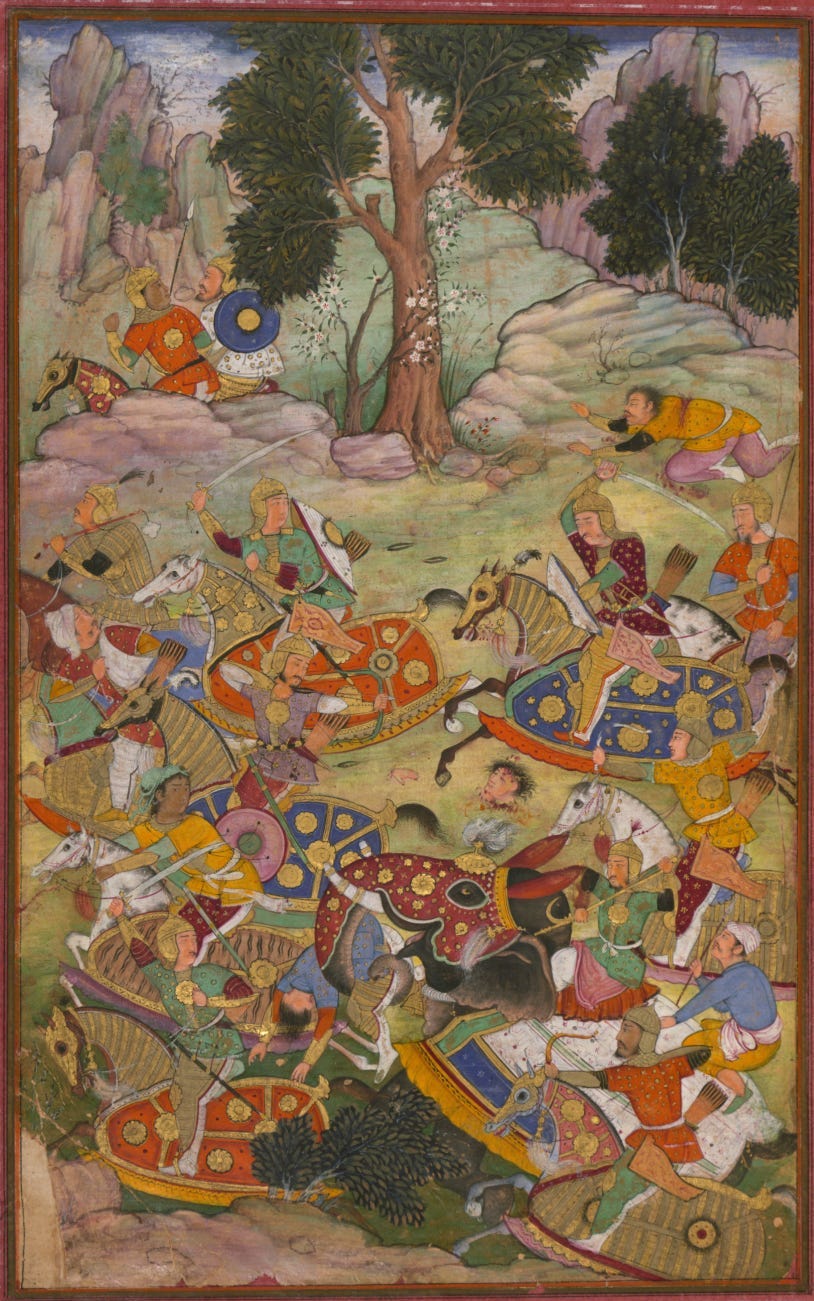
April 21, 1802 (probably): A Saudi-Wahhabi army/mob sacks the city of Karbala.
MIDDLE EAST
LEBANON
Hezbollah fired a number of rockets and drones into northern Israel on Tuesday, calling it a response to multiple Israeli violations of the Lebanese ceasefire. The Israeli military (IDF) has continued to carry out attacks despite the ceasefire, claiming self-defense. It’s also continuing to demolish homes and entire villages along the Lebanese side of the border. It of course accused Hezbollah of violating the ceasefire on Tuesday and responded by carrying out a strike on the launcher that the group used to fire those rockets.
The IDF has punished two soldiers involved in vandalizing a statue of Jesus in a southern Lebanese village. As you may have seen, over the weekend an image circulated online of an Israeli soldier smashing the statue, which appeared to have been removed from a crucifix, with a sledgehammer. Both the hammerer and the photographer have been removed from combat duty and will be jailed for 30 days, while another six soldiers who observed the incident and did not stop it may also face some form of discipline. It is not an exaggeration to say that their punishment probably would have been lighter, or even nonexistent, if they’d taken that sledgehammer to a Lebanese person, but this sort of thing causes problems for the Israeli government’s Christian Zionist support base in the US so the IDF had to make a show of retribution.
ISRAEL-PALESTINE
Israeli settlers and soldiers killed two Palestinians, one a 14 year old, in the West Bank village of Al-Mughayyir on Tuesday. Local officials reported that Israeli soldiers entered the village and began shooting at a school, while Israeli officials said that an IDF reservist opened fire after rocks were thrown at his vehicle. Israeli forces also killed at least two people in separate incidents in Gaza.
Donald Trump’s “Board of Peace” has reportedly been in talks with DP World, a logistics firm based in Dubai, about “managing supply chains and infrastructure projects” in Gaza. The firm would be tasked with overseeing the operations of many other companies in a reconstruction process that remains on hold while the board attempts to advance the Gaza “ceasefire” and in particular Hamas’s disarmament. In the meantime, The National reported on Tuesday that four of the 13 members of the Palestinian technocratic committee that is supposed to be managing Gaza’s day to day affairs have tried to resign over the fact that the Israeli government won’t even allow them to enter the territory much less take up their duties. The board’s Gaza envoy, Nickolay Mladenov, has rejected those resignations.
The Norwegian Refugee Council has published a new report on the role that sexual violence is playing in the displacement of Palestinians in the West Bank:
This report documents gender-based and sexualised violence perpetrated by Israeli settlers against Palestinians in Area C of the West Bank in contexts where Israeli forces were present and did not prevent or halt the violence, nor effectively investigate the abuses. In these circumstances, such violence is not occuring in isolation. It operates within a coercive environment that contributes to the forcible transfer of Palestinian communities.
The research results of this report found at least 16 cases of conflict-related sexual violence attributed to Israeli settlers and soldiers. These cases form part of a broader pattern of sexualised harassment, intimidation and humiliation, much of which remains underreported. Taken together, the evidence shows how sexualised violence is used to pressure communities, shape decisions about remaining or leaving their homes and land, and alter patterns of daily life.
Over 70 percent of displaced Palestinian families identify the threat of violence toward women and children, including sexual violence, as “the decisive reason” behind their decisions to relocate.
UNITED ARAB EMIRATES
Donald Trump told CNBC on Tuesday that he may offer a “financial lifeline” to the UAE in the form of a currency swap. The Wall Street Journal reported on Sunday that Emirati officials had approached the Trump administration about a potential currency swap to cushion the economic blow of the Iran war. The conflict has impacted the UAE’s energy sector and has undercut Dubai’s image as a safe haven for business and travel. Implicit in their pitch is the idea that the US got them into this war and therefore it should bail them out if necessary, along with an apparent threat to start conducting business in the Chinese yuan rather than the US dollar. Right now the currency swap discussions are preliminary, but given that the UAE is fully paid up with the Trump Family one assumes that if they do ask for the swap they will get it.
IRAQ
Joel Wing at Musings on Iraq says that Kurdistan Democratic Party leaders (the Barzani family, essentially) are upset that the rival Patriotic Union of Kurdistan party outmaneuvered them to retain control of the Iraqi federal presidency. Although the KDP has been ascendent in recent years, PUK leader Bafel Talabani has been building relationships with smaller Kurdish parties and with key political figures in Baghdad that have strengthened his party’s position both at the federal level and within the Kurdistan Regional Government. The Barzanis, meanwhile, have largely ignored Baghdad and the election of PUK member Nizar Amedi as president, despite a KDP boycott of the vote, shows that they are losing influence in the Iraqi capital.
Elsewhere, the AP reported on Tuesday that the Iranian government has given its affiliated Iraqi militias greater autonomy in terms of carrying out attacks against US interests amid the war. This is similar to what they’ve done with regional military commanders inside Iran. It helps to explain why a large percentage of the attacks against Gulf Arab states have been traced to Iraqi, rather than Iranian, soil. It may also make Iraq the new locus for the conflict if the US-Iran ceasefire holds (more on that in a moment). The Gulf states and/or the US could decide to step up attacks on the militias under the assumption that it won’t threaten the ceasefire, which would likely prompt more attacks by the militias in return.
IRAN
Schrödinger’s peace talks are still off at the moment, though that could change quickly so if they’re back on by the time you read this I apologize. Despite a slight uptick in optimism on Monday evening, a full day later there’s still no indication that the Iranian government is willing to participate in another round of talks in Pakistan and consequently US Vice President JD Vance and the rest of his negotiating team remain in the US. A “US official” said something to The New York Times about the Iranians failing to respond to a “written proposal” outlining US negotiating positions, which struck me as a little odd initially but in hindsight looks like it was laying the groundwork for a major development later in the day.
That major development? Well, despite the lack of movement on talks it does not appear that the shooting war will be resuming anytime soon. Donald Trump announced via social media on Tuesday evening that he had acquiesced to what he said was a Pakistani government request to extend the soon-to-expire ceasefire indefinitely. This is supposed to allow time for the Iranians, who according to Trump are “seriously fractured,” to submit their own “unified proposal.” There’s no indication that the Iranians were working on a proposal but that NYT report I mentioned above makes more sense if you see it as the administration establishing a narrative basis for Trump’s announcement. There’s also no reason to actually believe that this was a “Pakistani request” but I digress. I don’t expect the Iranians to reject this extension but I will note that at time of writing—hours after Trump’s post—they still had not offered an official comment on it.
The US blockade of Iran will remain in place in the meantime. Iranian officials have been suggesting that they won’t resume negotiations until the blockade is lifted, so this presents something of a quandary in terms of how to move things forward. The US Navy is continuing to pursue and board suspected blockade runners, though an analysis of maritime traffic by Lloyd’s List suggests that at least some vessels are getting through. Even so, the possibility exists that the blockade (or rather blockades, including the Iranian hold on the Strait of Hormuz) will eventually spark a return to full-on war even if neither side necessarily intends that. The diplomatic track would appear to be in limbo for the time being. Maybe the US and Iranians could come to some sort of arrangement to ease their blockades (even unofficially) and open some space for negotiation that way. Something’s got to give, because both the economic upheaval and the logistical challenges of maintaining the US blockade mean that the current state of affairs can’t actually last indefinitely (even if Trump thinks it can).
In other items:
It’s also conceivable that Trump’s ceasefire extension is fake and that he’s trying to set up a “surprise” attack, though it seems that the Iranians are fully aware of that possibility so the element of surprise probably isn’t there.
The Trump administration added another 14 entries to its Iran sanctions list on Tuesday, targeting individuals and entities allegedly connected to Tehran’s arms procurement efforts.
CNN reported on Monday that Trump’s Friday social media spree was not only false, it offended Iranian officials so much that it undermined diplomatic efforts to end the war. Even “some Trump officials” have “privately acknowledged to CNN that the president’s public commentary has been detrimental to talks, noting the sensitivity of the negotiations and the Iranians’ deep mistrust of the US.” The media narrative about Friday’s chaos has focused on supposed divides within Iranian leadership, which may well be overblown. But to the extent that there are such divides, Trump’s online blabbering would have only discredited the officials with whom the administration has been negotiating and strengthened the position of those officials who oppose talks.
ASIA
AFGHANISTAN
Shawn VanDiver, the founder of the organization AfghanEvac, told AFP on Tuesday that the Trump administration is offering Afghan nationals who aided the US military during the 2001-2021 Afghanistan war a choice between returning home or accepting resettlement in the Democratic Republic of the Congo. Hundreds of Afghan nationals remain stranded in Qatar and the administration suspended the program under which they were supposed to be vetted and then given visas to relocate to the US after one participant in that program shot and killed two US National Guard personnel last year. It can probably be assumed that they will not opt to move to the DRC, which means returning them to Afghanistan despite the threat they may be facing from the Taliban authorities there.
MYANMAR
New Myanmar President Min Aung Hlaing is inviting the country’s various rebel groups to engage in a new round of peace talks, giving them a deadline of July 31 to RSVP. Two of those groups, the Karen National Union and the Chin National Front, have already told him to get bent so this process is not off to a great start.
JAPAN
Japanese Prime Minister Takaichi Sanae lifted the country’s ban on exporting lethal military equipment on Tuesday, opening the door to foreign arms sales. That ban had been in place since 1976 and limited previous Japanese military deals to non-lethal materiel only. Now anything is fair game, though legally only 17 countries are currently eligible to purchase Japanese arms. The Japanese and Australian governments recently concluded a $7 billion deal under which Mitsubishi Heavy Industries will build several warships for the Australian Navy, so this rule change will clear the way for that arrangement and likely many more to come.
AFRICA
SUDAN
A new United Nations report alleges that an element of the “Libyan National Army” known as the Subul al-Salam Battalion has “facilitated the transfer of recruits, including Colombian mercenaries, weapons and fuel” into Sudan on behalf of the Rapid Support Forces militant group. Subul al-Salam operates mainly in southeastern Libya’s Kufra district, positioned opposite Sudan’s northwestern border, and its backing helped the RSF drive the Sudanese military (SAF) out of the “triangle area” along the Egyptian, Libyan, and Chadian borders last year. Its control of “crucial facilities, including an airport” has made it an important node in the international network that’s been supporting the RSF.
NIGERIA
Nigerian authorities have charged six people in connection with the apparent coup plot that they foiled last year and are searching for a seventh suspect, former state minister Timipre Sylva. These six, including a retired army major general, are among 16 people who were arrested last year amid reports of an attempt to overthrow President Bola Tinubu. Nigerian officials revealed the plot earlier this year while announcing plans to bring treason and terrorism charges against the suspect.
EUROPE
RUSSIA
The European Council blacklisted two Russian entities, the media outlet Euromore and the “Foundation for the Support and Protection of the Rights of Compatriots Living Abroad,” on Tuesday. It’s accusing both of perpetuating Russian “disinformation.”
UKRAINE
Russian military commander Valery Gerasimov claimed on Tuesday that his forces have seized some 1700 square kilometers of Ukrainian territory so far this year. There’s no way to verify this and according to Reuters “pro-Ukrainian maps indicate Russia has taken around 600 square km this year.” I’m not sure what “pro-Ukrainian maps” they’re using. According to Gerasimov the advance has brought the Russian military closer to the “fortress belt” of cities in Ukraine’s Donetsk oblast. The Russians are already occupying parts of at least one of those cities, Kostiantynivka and they may be just a few kilometers from two others, Kramatorsk and Sloviansk.
The Ukrainian government reopened the Druzhba pipeline on Tuesday, restoring the flow of Russian oil to Hungary and Slovakia (well, maybe—the Ukrainians apparently bombed a Russian pumping facility on the same pipeline on Tuesday and it remains to be seen how that might affect its operations). The pipeline has been shut down since a Russian attack damaged it in January, though outgoing Hungarian Prime Minister Viktor Orbán had accused the Ukrainians of deliberately cutting off the oil and was using that claim as a justification for blocking the first disbursement of the European Union’s two year, €90 billion loan to Kyiv. The timing of the pipeline’s reopening, just after Orbán’s election defeat, is curious, but regardless the disbursement is now expected to be made within the next two months and should cover around two-thirds of Ukraine’s financial requirements for the year.
ROMANIA
Romanian Prime Minister Ilje Bolojan is aiming to lead a minority government now that the Social Democratic Party (PSD) has quit his coalition. Moreover it doesn’t sound like he’s rethinking the austerity program that prompted the PSD to withdraw, arguing that his “reforms” are essential to securing billions of euros in EU funding. Romania technically isn’t due to hold another election until 2028, but Bolojan will have to present his new PSD-less cabinet to parliament for confirmation within 45 days and he’s likely to face at least one no-confidence motion before then. He’ll need to survive those votes to avoid a snap election—one that the far-right Alliance for Uniting Romanians would be expected to win handily.
AMERICAS
MEXICO
The Intercept’s Nick Turse reports that two US embassy “staff members” who died in a car accident in Mexico’s Chihuahua state on Sunday were working for the Central Intelligence Agency:
The American personnel died in a vehicular crash in the mountains of the Sierra de Chihuahua following a drug raid, alongside two Mexican officials, including Román Oseguera Cervantes, the director of the Chihuahua State Investigation Agency.
U.S. Ambassador to Mexico Ronald Johnson announced the deaths of the Americans on Sunday, referring to them in a post on X as “two members of staff from the United States Embassy.”
The State Department refused requests for additional information on the Americans’ activities or the agencies that employed them. Mexican President Claudia Sheinbaum said during a Monday press conference that she was unaware of “any direct work between Chihuahua state and personnel from the U.S. embassy.”
Two U.S. government officials who spoke to The Intercept on the condition of anonymity said the CIA has been running covert operations in Mexico, working alongside vetted Mexican state-level police forces and other government agencies. The sources said the Americans died after a raid on a synthetic drug lab.
Sheinbaum’s government has now reportedly opened an investigation into the operation and the role these CIA personnel may or may not have played in it. Chihuahua state officials are insisting that the CIA personnel were not involved in the raid and only turned up at the raid site after the fact for some sort of “training” reason.
CUBA
Cuban Foreign Ministry official Alejandro García del Toro said on Monday that reasonably high level US and Cuban delegations met in Havana earlier this month to try to calm bilateral tensions. He didn’t say when this meeting took place but did say that it included assistant secretaries of state on the US side and deputy foreign ministers on the Cuban side. The Cuban government is trying to negotiate an end to the US energy embargo on the island.
UNITED STATES
The Trump administration set up an online portal earlier this week for companies pursuing refunds for tariffs they paid under the regime that the US Supreme Court struck down in February. Potentially over $160 billion could be refunded, with Walmart and Target in line to get the biggest payouts.
Finally, The Guardian has spoken with several survivors of the US military’s War on Speedboats:
A group of Ecuadorian fishers have described how they were attacked in a double drone strike and then detained at gunpoint by soldiers on a US-flagged patrol vessel, in a rare first-hand account by victims of Donald Trump’s militarized campaign against alleged drug-trafficking boats off South America.
At least 178 people have been killed in US military airstrikes in the Caribbean and Pacific since the offensive began in September, according to a tally by the Washington Office on Latin America (Wola).
The US has provided no evidence that any of the vessels were involved in drug trafficking, and legal experts and rights groups say the attacks amount to extrajudicial killings as they apparently target civilians who do not pose any immediate threat. The White House insists the killings are lawful.
The Don Maca, a 35-ton fishing vessel that worked with six smaller boats, was about 200 miles (320km) north-west of the Galápagos Islands, when it disappeared on 26 March. About a week earlier, it had departed from Manta, a port city in south-western Ecuador that has become a focal point in the country’s escalating “war on drugs”.
Its 20 crewmen, all from nearby communities including San Mateo, Santa Marianita and Jaramijó, insist they were fishing when they were attacked.
That US patrol boat deposited them in El Salvador, where officials in Donald Trump’s favorite Central American police state questioned them and then turned them over to UN personnel. They were eventually repatriated and none was ever charged with a crime, even though the US military was so certain that they were trafficking drugs that it tried to kill them.