

You’re reading the web version of Foreign Exchanges. If you’d like to get it delivered straight to your inbox, sign up today:
TODAY IN HISTORY
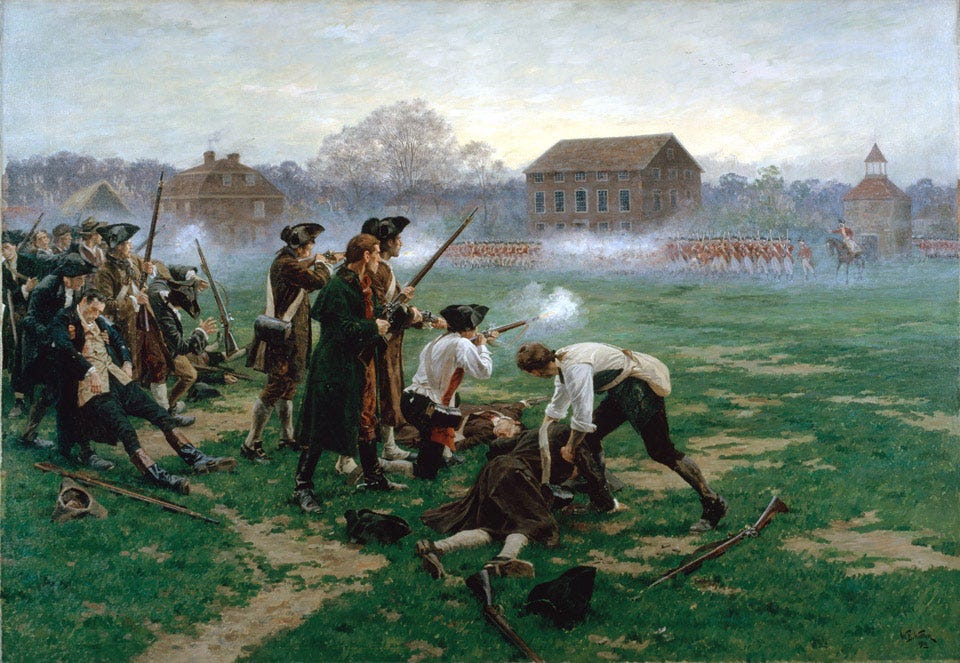
April 18, 1775: Dozens of American Patriot riders fan out across the Massachusetts Bay colony to warn “Minutemen” militia fighters that a British army is approaching. The nighttime ride was crucial in alerting the militia and enabling their victories at the ensuing Battles of Lexington and Concord, the first major engagements of the American Revolution. The event gave birth to the legend of Paul Revere, the Boston silversmith and engraver who was one of the operation’s planners, and has been memorialized as “Paul Revere’s Ride” in the title of a famous 1861 poem by Henry Wadsworth Longfellow.
April 18, 1897: The Ottoman Empire declares war on Greece, marking the official start of the Greco-Turkish War (which had unofficially begun the previous month). Fought primarily over control of the island of Crete, which had repeatedly revolted against Ottoman rule, the war ended in mid-May with a decisive military victory for the larger and better armed Ottoman army. Then the European Great Powers intervened. The Treaty of Constantinople, negotiated primarily by the Powers, gave the Ottomans a few limited territorial conquests but forced the empire to return most of the Greek territory it had seized and to recognize Cretan autonomy. Under the guise of that autonomy, the island moved further and further into the Greek orbit, finally becoming part of Greece in the 1913 settlement to the First Balkan War.
April 18, 1938: Action Comics debuts with issue #1, published by National Allied Publications as an anthology meant to replicate and complement the success founder Malcolm Wheeler-Nicholson had achieved when he began publishing Detective Comics the previous December. The first story in the issue was called “Superman,” from writer Jerry Siegel and artist Joe Shuster, and marks the first appearance of their character by that name. The story was an instant success, arguably birthing the modern superhero genre (Detective Comics wouldn’t introduce its famous star, Batman, until the following year), and today Action Comics #1 is regarded as the most valuable comic book ever published (a near-mint copy sold for over $3 million in 2014).
April 19, 1775: Two military engagements between British regulars and American colonial militia in the Massachusetts towns of Lexington and Concord mark the start of the American Revolution. The British force succeeded in destroying some cannons and ammunition at Concord but was driven back into Boston by the militia. A large (15,000 man) militia army recruited from across New England then surrounded and besieged the city, which the British evacuated the following March.
April 19, 1943: The Warsaw Ghetto Uprising, the largest World War II Jewish revolt against Nazi rule, begins in occupied Poland. Nazi forces entered the Ghetto to effect another mass transfer of Jews to the Treblinka death camp, similar to the previous year’s Grossaktion Warsaw, but met with armed resistance. They began a month-long suppression campaign that included the systematic torching of homes and other buildings within the Ghetto. The uprising ended on May 16 with the Nazis having killed outright or transferred (to death camps) some 56,065 Jews according to official German figures.
MIDDLE EAST
LEBANON
Hundreds of thousands of displaced civilians have either returned to southern Lebanon or are considering it, amid the US-imposed ceasefire that took effect on Friday. Some have apparently already returned only to find that the Israeli military (IDF) has destroyed their homes and villages so thoroughly that it’s impossible for them to stay. The IDF has continued that destruction and has carried out several attacks despite the ceasefire, under its typical justification of “self-defense.” As it has done in Gaza, it’s facilitating continued violence by establishing a new “yellow line” in southern Lebanon. As in Gaza, the line demarcates what is essentially a free fire zone for Israeli soldiers, where anyone found on the wrong side of the line or even approaching the line can be treated ipso facto as a threat and thus a legitimate target. Also as in Gaza, the location of the line is opaque to civilians and may not even be completely fixed, making it a generalized excuse for killing.
A French soldier serving with the United Nations peacekeeping mission in Lebanon was killed and three other UN personnel were wounded in an attack in southern Lebanon on Saturday. The UN is assessing that a non-state actor was responsible, presumably Hezbollah, though it hasn’t determined that conclusively as yet. Hezbollah is denying involvement.
ISRAEL-PALESTINE
The IDF killed two people in separate “yellow line” incidents in Gaza on Saturday then gunned down another person in northern Gaza’s Jabalia area on Sunday. Their identities are unclear, but it does appear that two men whom Israeli soldiers gunned down in northern Gaza’s Shujaʿiyah area on Friday were working for UNICEF as water deliverymen.
According to Al Jazeera, satellite imagery shows the IDF expanding the military facilities on its side of Gaza’s “yellow line,” most prominently in the southern Rafah area. This is a curious thing to do if the Israeli government is prepared to withdraw from more territory in Gaza as the current “ceasefire” progresses. It would make more sense if the Israelis are planning to remain in those facilities for the long term—or indefinitely, even.
IRAN
It may or may not come as a surprise that pretty much everything Donald Trump asserted in his extended “peace is upon us” social media spree on Friday turns out to have been bullshit. As it happens Iranian officials had not suddenly given in to all of his demands. What a surprise. By Friday evening (in the US) it was clear that even the opening of the Strait of Hormuz, as announced by Iranian Foreign Minister Abbas Araghchi earlier in the day, was not actually happening, and on Saturday Iranian forces made that very clear by firing on at least two ships that were attempting to transit the strait. The Islamic Revolutionary Guard Corps declared the strait closed until the US lifts its naval blockade on Iran, basically resetting this whole situation back to where it had been prior to Araghchi’s announcement but with a bit more bad blood built up on both sides of the conflict. Then on Sunday the US Navy fired upon and detained a cargo vessel that apparently attempted to run the blockade, amid reports that it’s been planning to start boarding suspected Iranian vessels.
It’s hard to know what to make of a day in which the Iranian government made a major announcement that it rescinded within hours while the president of the United States regaled reporters with tales of Iranian concessions that were apparently never made. The Wall Street Journal suggested that the “Hormuz is open/no it’s not” drama reflected a breakdown of Iranian leadership. Araghchi, in this narrative, opened the strait on his own initiative only for the IRGC to overrule him and close it. The apparent incoherence seems to have sparked a fair amount of confusion within Iran. On Saturday Iran’s Supreme National Security Council offered an attempt at clarification, saying that the decision to open the strait was contingent on the US “observing the ceasefire on all fronts.” Trump wrecked that understanding by a) refusing to lift the blockade and b) spewing his nonsense on social media.
It’s still unclear whether Trump himself realized that his posts were bullshit (another WSJ piece argued that they were part of some sort of “negotiating strategy” somehow meant to pressure Iranian officials into making concessions) but he’s spent the past two days reacting like somebody who really believed that the Iranian government surrendered and then double crossed him. He’s now back to threatening the destruction of Iran’s civilian infrastructure, which if you recall is where we were 12 days ago. Even so he’s sending negotiators back to Pakistan on Monday for another attempt at diplomacy. At this point it’s unclear whether the Iranians will reciprocate. Iranian media reported on Sunday that Tehran has made no decision regarding those talks, and the previous day Deputy Foreign Minister Saeed Khatibzadeh told the AP that “maximalist” US demands were making further talks difficult.
“No decision” is not an outright no. But even if the Iranians do send a team to Pakistan, the chances of reaching a deal with an overmatched and disempowered US negotiating team that has to report to what appears to be a mentally compromised president seem pretty low. Maybe there’s still an opening to simply extend the ceasefire, but even that seems like a long shot given how much the process has broken down over the past three days.
ASIA
CHINA
The Diplomat’s Yi-Chuan Chiu outlines what the Chinese government is hoping to get out of the forthcoming Donald Trump-Xi Jinping summit on the subject of Taiwan:
At the summit, Beijing is expected to underscore that U.S. support of Taiwan will disrupt China-U.S. “strategic stability,” while cross-strait peace can be achieved without U.S. involvement. A grand deal over Taiwan or a fundamental shift of Washington’s One China policy is unlikely and would be difficult to sustain. However, Trump’s incoherent personal language over Taiwan or a delay of Taiwan-U.S. arms sales would constitute gains for Beijing.
Beijing’s main goal for the Trump-Xi summit would be to sustain the fragile stability in China-U.S. relations after both countries agreed on a truce in their trade war. Washington is so far interested in keeping the trade truce and has signaled that Trump will not seek confrontation during the summit.
However, China hopes that this cooperative tone will extend beyond trade. Chinese Foreign Minister Wang Yi claimed in March that 2026 would be a “big year” for Sino-American relations and that “unnecessary disruptions” should be cleared. This partly explains why Beijing has been avoiding publicly denouncing the U.S. attack on Iran. Trump’s ambivalence over Taiwan presents an opening for Chinese officials to persuade the U.S. president that further U.S. support for Taiwan will disrupt their broader relationship.
JAPAN
Dozens of NATO representatives visited Tokyo on Thursday for talks on improving the bloc’s relationship with Japan. World Politics Review’s Elliot Waldman argues that both parties are being drawn together by concerns over their respective relationships with the United States:
For NATO, a closer relationship with Japan makes sense for a few reasons. For starters, the Trump administration has threatened to invade Greenland and is openly threatening to withdraw from the alliance. Technically, the U.S. president can’t pull out of NATO without approval from Congress. But as commander-in-chief of the U.S. Armed Forces, there is a lot that Trump can do to make America’s exit from NATO a de facto reality, such as withdrawing or reducing the U.S. troop presence in key theaters. In that context, seeking other partners with whom they could potentially share the burden of collective defense is a prudent call for NATO member states.
For Japan’s part, it has historically relied on the U.S. security umbrella for its defense. Given Trump’s recent behavior, however, officials in Tokyo are also worried about whether they can count on the U.S. to be a steadfast ally in the long term, even if they don’t say so publicly.
One major byproduct of these concerns is that European states and Japan are trying to expand their domestic arms industries. That could create new opportunities for joint investment and development projects.
(Foreign Exchanges readers can sign up for WPR’s free newsletter here and try out an all-access subscription free for 30 days, then $35 off—$77/year—after that.)
AFRICA
SUDAN
The Sudanese military (SAF) announced on Saturday that it has opened an apparently major offensive across Sudan’s North and South Kordofan states. Initial operations focused on four areas in North Kordofan, and according to the military they “resulted in significant losses of life and equipment for the [Rapid Support Forces or RSF].” Fighting in the Kordofan region has generally emphasized drone strikes over ground action in recent months so this is a significant development even though it’s far too early to tell how it will play out.
Elsewhere, the US Treasury Department announced on Friday evening that it was blacklisting three people and two entities allegedly involved in hiring Colombian mercenaries for the RSF. All three individuals are Colombian nationals and the entities are both connected to a retired Colombian military officer.
DEMOCRATIC REPUBLIC OF THE CONGO
The Congolese government and the M23 militant group announced a new agreement on Sunday, under which they will hold a prisoner exchange within ten days while also working together to facilitate greater humanitarian access to parts of the eastern DRC. The deal emerged out of a multi-day negotiating session in Switzerland, held under primarily Qatari mediation, during which the parties also reached a general agreement on establishing ceasefire monitoring mechanisms.
EUROPE
RUSSIA
The Trump administration extended its waiver on Russian oil sanctions for another 30 days on Friday, just two days after Treasury Secretary Scott Bessent claimed that waiver would not be renewed. It applies to any Russian oil that was loaded onto a tanker as of Friday and is of course another attempt at keeping global oil prices down even as the Iran war looks like it’s spinning up again.
UKRAINE
A Russian bombardment killed at least two people in the Ukrainian cities of Chernihiv and Kherson overnight. According to the Ukrainian military the Russians fired 236 drones in this barrage. On a related note the Ukrainians reportedly struck a drone manufacturing facility in the Russian city of Taganrog, sparking a fire and wounding at least three people. The extent of the damage is unclear.
BULGARIA
Bulgarian voters headed to the polls for their country’s eighth parliamentary election since April 2021 on Sunday, and early indications suggest that this one might actually be somewhat decisive. Exit polling gives the Progressive Bulgaria party, established by former President Rumen Radev after his resignation back in January, a bit over 38 percent support. That would be a far higher percentage than any single party has won over the previous seven elections, and while it might not work out to a sole parliamentary majority it could mean that Radev would only need the support of one additional party instead of having to form an unstable minority government or multi-party coalition.
AMERICAS
ARGENTINA
El País reports that Argentine President Javier Milei’s economic miracle is starting to look somewhat less miraculous:
In a scenario constructed from the official statistics promoted by the government, Javier Milei’s Argentina is a happy world: poverty is falling to its lowest level in the last seven years, economic activity is reaching record highs, and fiscal balance is being maintained. But, simultaneously, more and more people say that their present situation doesn’t align with the successes touted by the far-right president, a disconnect pointed out not only by his detractors but even by figures of economic orthodoxy aligned with his policies. Are the official figures false? No, but they are averages that fail to capture an unequal and fragmented socioeconomic reality. And they coexist with other, also official, data, such as the rise in unemployment. Or the acceleration of inflation, whose containment had been Milei’s main achievement and which now remains above 3% per month. In this context, social discontent is spreading, fueled by corruption scandals: almost all opinion polls indicate that the president’s approval rating is at its lowest point.
Indeed, economic activity is at record highs, having risen 1.9% in the last year. However, this does not appear to translate into equivalent well-being. According to a report by the consulting firm Analytica, when the data series is adjusted for population — a more representative metric of well-being — current levels are 6.8% below the peak reached in 2011. At best, activity levels per capita have returned to the pre-pandemic average, the report notes.
PERU
Peruvian officials have counted 93 percent of the votes cast in last Sunday’s/Monday’s presidential election, but they may not be ready to announce official results until the middle of next month. That’s going to be a tight turnaround given that the runoff is scheduled for June 7. Perennial candidate Keiko Fujimori’s place in that contest seems to be assured, as she’s “winning” the first round with around 17 percent of the vote. But the race for second place is very tight, with leftist Roberto Sánchez now around 13,600 votes ahead of right winger Rafael López Aliaga. Given the narrow margin, the race could come down to a review of thousands of challenged ballots—hence the delay.
NICARAGUA
The US State Department blacklisted Nicaraguan Vice Minister of the Interior Luis Roberto Cañas Novoa on Saturday, over alleged human rights abuses. He’ll be barred from entering the US.
UNITED STATES
Finally, TomDispatch’s Steve Fraser sees in Donald Trump the “perfect amalgam” of US imperialism abroad and repression at home:
Democracy and civil liberties, thought to make up the essence of the homeland’s civic religion, can’t survive the imperial drive. Today, violations of the most basic rights to free speech, privacy, a fair trial, and the right to vote are appalling and commonplace. Immigrants, often here because they couldn’t survive the ravages of American capitalism in their homelands, are treated like outlaws. The most basic constitutional requirement — the exclusive right of Congress to declare war — is ignored with impunity (and had been long before Trump took over). The imperial state, the surveillance state, and the authoritarian state are hollowing out what’s left of the democratic state.
Imperialism does massive and fatal damage abroad. The wars in Gaza and Iran are the latest bloodbaths for all to see. Less visible are the wages of imperialism at home. An equation might clarify the historical record: The Imperium = land, labor, resources, power, and wealth. The Homeland = cultural brutalization, dispossession, fear, misogyny, racism, repression, slavery, tyranny, and war.
Donald Trump turns out to be a purveyor of both imperialism (notwithstanding his promises to “stop wars” and refrain from “forever wars”) and its toxic outcome. Conjoined in his person is the perfect amalgam of America’s imperial history of aggressive aggrandizement and the ubermensch cruelty that history has instilled in the American psyche.
Great update. Near-mint copy of Action #1 also sold for $15 million in January 2026.