

You’re reading the web version of Foreign Exchanges. If you’d like to get it delivered straight to your inbox, sign up today:
PROGRAMMING NOTE: I am feeling much better but my voice has not recovered from my cold and so, with apologies, I will have to forego tonight’s voiceover.
TODAY IN HISTORY
April 10, 1815: Indonesia’s Mount Tambora volcano begins the largest eruption in human history with an explosion that was heard 1200 miles away and knocked roughly a full mile off of the volcano’s elevation. The subsequent year, 1816, is known as “The Year Without a Summer” because of the ensuing volcanic winter. The climate effects caused worldwide famine and may have, among other things, contributed to westward migration in the United States and the invention of the bicycle.
April 10, 1998: The governments of the UK and Ireland as well as Republican and Unionist forces in Northern Ireland sign the Good Friday Agreement, ending the Northern Ireland conflict, AKA “The Troubles.” The agreement recognized Northern Ireland as part of the UK but also left open the possibility of Irish reunification if majorities in both Northern Ireland and the Republic of Ireland were ever in favor. It also allowed the people of Northern Ireland to claim British or Irish citizenship, or both if they preferred. The freedom of movement enabled by the fact that both the UK and Ireland were members of the European Union helped to facilitate the agreement, and maintaining it has been a challenge post-Brexit.
April 11, 1241: A Mongolian army defeats King Béla IV of Hungary at the Battle of Mohi. While Béla survived the battle he temporarily lost control of his kingdom to the Mongols, who were able to sack the city of Pest and occupy most of Hungary. But they withdrew in early 1242, as their leader Batu had to return east to defend his interests amid the succession of a new Great Khan. Béla was able to regain control and the Mongols wouldn’t seriously threaten Hungary again for over 40 years.
April 11, 1713: Five separate treaties are signed between the various participants in the War of the Spanish Succession, becoming the first of several accords that would come to be known as the Peace of Utrecht. The war, fought between the Habsburg and Bourbon claimants to the throne of Spain, ended with a qualified Bourbon victory that saw French King Louis XIV’s grandson, Philip V, ratified as Spanish king but only on the condition that he renounce his place in the French line of succession, thus preventing a merger of the two kingdoms. Because it enshrined the demand that the French and Spanish crowns remain separate, Utrecht is regarded as a significant milestone in the development of both the nation-state and the “balance of power” concept in geopolitics. Britain is generally thought to have benefited the most from the peace, as it secured naval supremacy over its continental rivals and forced the French monarchy to recognize the Hanoverian dynasty’s accession to the British throne and drop its support for the rival Stuart dynasty.
April 11, 1814: The Treaty of Fontainebleau ends the War of the Sixth Coalition and forces the defeated French Emperor Napoleon into his first (and, as it turned out, temporary) exile on the island of Elba. Having forced the surrender of the French army at Paris on March 31, the victorious coalition decreed that it would no longer deal with Napoleon as the ruler of France and forced his abdication. Napoleon attempted to step down in favor of his son, but the treaty stipulated that neither Napoleon nor any member of his family should continue to rule France. A restoration of the pre-revolution French monarchy under Louis XVIII followed, though his reign was interrupted when Napoleon returned from exile on March 20, 1815 and began the “Hundred Days” epilogue to his career.
April 11, 1979: The Tanzania People’s Defense Force, along with a group of Ugandan opposition fighters called the Uganda National Liberation Front, seizes Kampala and forces Ugandan dictator Idi Amin to flee into exile after over eight years in power. Amin sought sanctuary first in Libya and later in Saudi Arabia, where he lived until his death in 2003. His time in power is remembered mostly for its brutality toward ethnic minorities and political opponents, with estimates of the number of people killed on Amin’s orders ranging from around 100,000 at the lower end to upwards of 500,000 at the higher end.
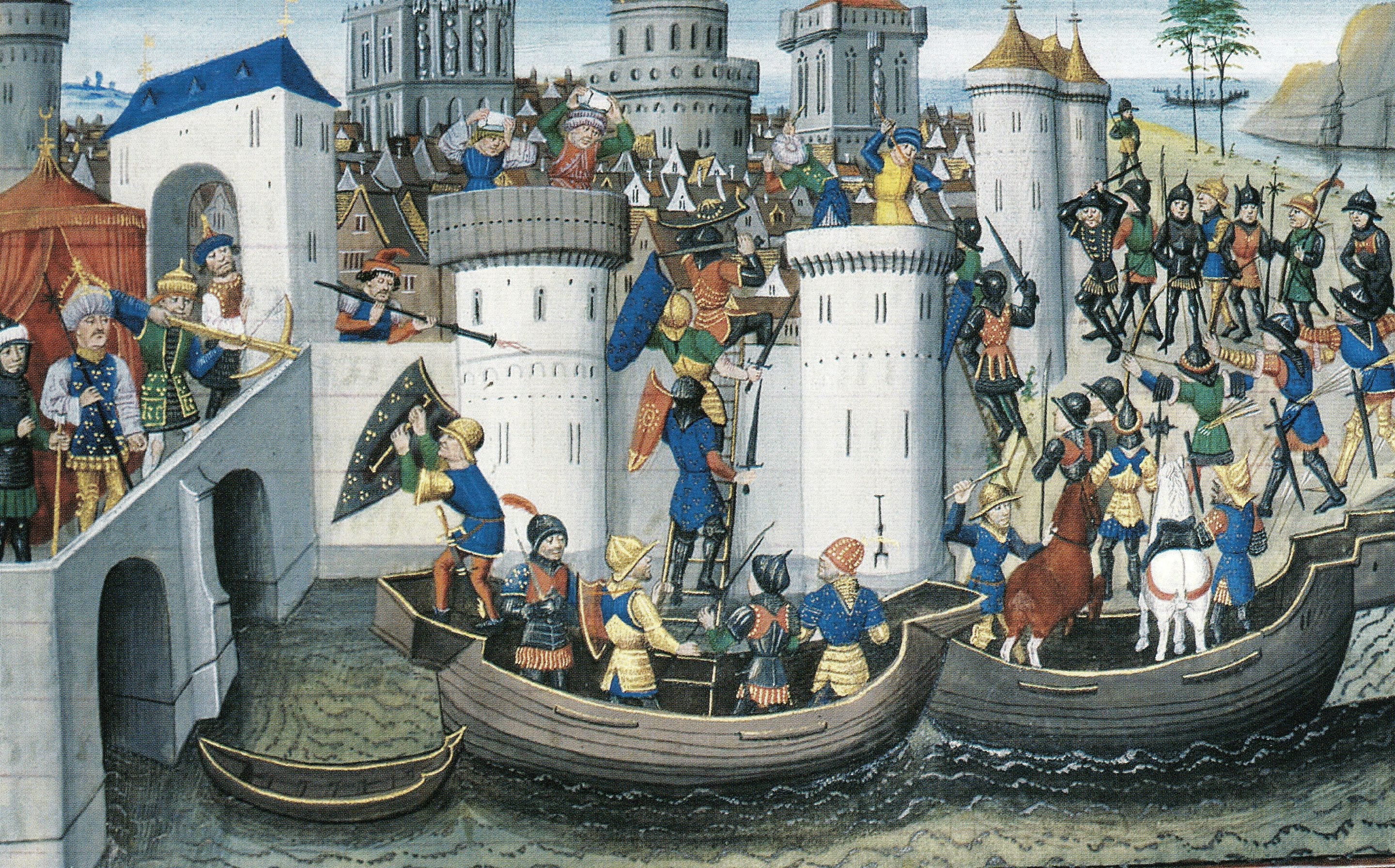
April 12, 1204: The army of the Fourth Crusade sacks Constantinople, temporarily doing away with the Byzantine Empire. In many respects the true culmination of the Crusading enterprise, the Fourth Crusade can either be viewed as a deliberate plot against the Byzantines or the unplanned result of a military campaign going completely off the rails—this is still a matter of some debate among historians. What is indisputable is that the Byzantine Empire, though it managed to reconstitute itself and retake Constantinople under the Palaiologos family in 1261, never really recovered from this event.
April 12, 1861: Batteries from the new “Provisional Forces of the Confederate States” open fire on Fort Sumter, in Charleston Harbor, kicking off the American Civil War. The garrison commander, Major Robert Anderson, agreed to surrender and evacuate the fort the following day. Two US soldiers were killed the day after that when some ammunition in the fort exploded during a ceremonial salute to the US flag, but they were the only two fatalities connected with the battle. The fort remained in Confederate hands until they evacuated it in 1865 during William T. Sherman’s war-ending Carolinas campaign.
MIDDLE EAST
IRAN
Before we talk about anything else I suppose we should start with the fact that Saturday’s US-Iran negotiating session in Islamabad did not produce an agreement. This was not surprising. The Trump administration has been negotiating with Iran (at least according it its definition of “negotiate”) on and off for two years now without making any discernible progress, so the notion that the two sides were going to settle all of their grievances in one marathon session was fanciful to say the least. What is a bit surprising is that when the talks ended without a deal, the US envoys simply declared failure and went home.
Tuesday’s ceasefire opened a two-week, potentially extendable, window for negotiations, which suggested at least a brief negotiating process rather than a one-or-done moonshot. But this is in keeping with the Trump administration’s overall approach to negotiations (that definition I mentioned earlier), which involves issuing ultimatums and walking away rather than doing the difficult work of trying to find common ground. Chalk that up to laziness, stupidity, arrogance, or any other trait you want, but whatever the reason it’s not an effective way to conduct diplomacy—especially not after you’ve just spent six weeks losing a war badly enough that you’re now hoping to end it.
According to lead US “negotiator” JD Vance, the talks failed over the Iranians’ failure to provide “an affirmative commitment that they will not seek a nuclear weapon and they will not seek the tools that would enable them to quickly achieve a nuclear weapon.” They’ve committed to the former, both verbally and in writing, so many times at this point that I’ve lost count. So we can assume that the failure was on the subject of “tools,” and specifically that Iran refuses to accede to the Trump administration’s demand that it fully halt its uranium enrichment program. That demand has not shifted an iota over these two years, which brings us back to that refusal to negotiate as that term is properly understood. Iranian sources told The New York Times that Vance and company went to Islamabad looking for submission, not discussion, and when they didn’t get that they were either unwilling or unable to change their approach.
The insistence on “zero enrichment” is and always has been silly. A limited, well-monitored enrichment program isn’t a major proliferation risk and it’s certainly less of a proliferation risk than an entirely unmonitored nuclear program. One has to assume that the Trump administration’s refusal to budge from that position is because a) they don’t understand it or b) they don’t want a deal. “Both” is also possible, particularly in a presidential administration that lacks cohesion and is led by a man whose brain flickers on and off seemingly minute by minute. But there may be another layer here, namely that Vance is lying. Other sources mention several points of disagreement aside from just the nuclear issue, chiefly the ongoing Israeli slaughter in Lebanon and the future status of the Strait of Hormuz.
Speaking of Hormuz, Donald Trump announced on Sunday that the US Navy is now blockading it, and the rest of Iran with it. Moreover he’s apparently planning to chase down and intercept any vessel that pays Iran’s toll to transit the strait. Yes it takes a real military genius to retaliate for Iran’s closure of the strait by double closing it, but the point is of course to interdict Iran’s own oil exports (squeezing China in particular, one assumes) and to demonstrate that the US can play this game too. I don’t expect it will have much of an impact on the Iranians but it may foreclose on further negotiations given that it is, in its own way, an act of war—even though the Iranians apparently left Islamabad believing that there would be further talks. Trump is also reportedly considering a “range” of other options from a full resumption of the war to “limited” airstrikes that would probably lead to a full resumption of the war in short order, though it’s possible that he’ll give this blockade time to see if it somehow forces the Iranians to surrender.
In other items:
The Islamic Revolutionary Guard Corps responded to Trump’s blockade order by threatening to fire on any military ships approaching the strait. As it happens, the US Navy sailed two destroyers into the strait on Saturday, as talks were taking place, on what Central Command called a “mine clearing operation.” There are some problems with this story, starting with the fact that destroyers don’t clear mines (there’s a whole different class of ship for that). They can participate in mine clearing operations but the fact is that they weren’t in the strait long enough for anything like that to have taken place, possibly because they were chased out by the Iranians. Maybe they dropped off a few minesweeping drones, but that’s a token effort at best. It might be better to classify this as a “freedom of navigation” mission, but demonstrating that one can traverse the strait with armed naval vessels under a ceasefire does not mean that one can sail an oil tanker through it with no ceasefire in place.
It’s been about five weeks since Iran was on the verge of running out of ballistic missiles and The Wall Street Journal reports that US intelligence agencies believe that Tehran still possesses thousands of them. “More than half” of its missile launchers are thought to have been destroyed, damaged, or buried but many of those can be repaired and/or recovered.
One interesting story that has emerged in recent days is the role that China has been playing in this war, which seems to be more extensive than previously thought. The New Arab reported on Saturday that there was “a Chinese delegation” in Islamabad “to assist Pakistani mediation” in the talks. Had there been a settlement they could have been involved in negotiating it, for example serving as a guarantor for any concessions offered to Iran. Behind the scenes, The New York Times reported on Saturday that China may have sent a shipment of portable air defense systems to Iran. There’s no evidence that they’ve been used but if there has been a shipment they could come into play should open hostilities resume. The Independent alleged that China is also selling rocket fuel components to Iran. But this puts China in an awkward spot if the negotiations are over and the US is going to start blockading Iranian oil shipments, as Beijing is likely to feel that. The US assumption is probably that China will pressure Iran into making concessions, though you know what they say about assuming things. If the war resumes the Chinese government could find itself in another difficult position, supporting Iran even as Pakistan—a client state whose military uses Chinese- and co-produced arms—is supplying weapons to Saudi Arabia and could be pulled further into the conflict because of their alliance.
LEBANON
The Lebanese government revealed on Friday that the initial round of “peace talks” with its Israeli counterpart will take place in the US on Tuesday. I put “peace talks” in quotes because the Israeli government is likely to come to them demanding that Lebanon join it in waging war on Hezbollah so “peace” may not be the focus. Lebanese officials have been pushing for a ceasefire ahead of those talks but the Israeli government definitively ruled that out on Saturday and then punctuated its refusal by killing at least 18 people including three emergency workers. The Israeli military (IDF) also killed at least 13 Lebanese soldiers on Friday. An IDF airstrike killed a seven year old child who was attending her father’s funeral on Sunday. He’d been among the roughly 350 people the IDF killed during its massive barrage on Wednesday.
The possibility of some form of internal conflict in Lebanon appears to be growing, after Hezbollah leader Naim Qassem criticized the government’s decision to enter into negotiations on Friday and Lebanese authorities began deploying army units around Beirut. If they decide to join the Israelis their first move could be an attempt to expel Hezbollah from the city.
ISRAEL-PALESTINE
Gaza’s “ceasefire” quietly hit the six month mark on Friday, and the IDF commemorated the milestone by killing at least seven people across the territory the following day. I’m not sure what else needs to be said there, thought on the humanitarian front it’s probably worth noting that the continued lack of proper shelter and sanitation has caused a major rat infestation within the territory’s tent cities, raising serious health concerns. Looking ahead, Donald Trump’s “Board of Peace” is reportedly scrambling to find funding after receiving what Reuters said was “only a tiny fraction of the $17 billion pledged for Gaza.” Amid all the discussion about disarming Hamas I’m not sure anybody predicted that a lack of money could be the thing that dooms Trump’s enterprise.
Elsewhere, a reserve IDF soldier/settler killed a Palestinian man near the West Bank city of Ramallah on Saturday. There is no indication that the killer was acting in an official capacity, though admittedly the line between settler and soldier is not terribly clear when it comes to Israeli activity in the territory. And Israeli Prime Minister Benjamin Netanyahu expelled Spanish representatives from the Gaza “ceasefire” coordination center in Israel on Friday, citing the Spanish government’s repeated criticisms of Israeli policy and the IDF’s activities. Spanish Prime Minister Pedro Sánchez has been a vocal critic of the Gaza genocide and the Iran war.
ASIA
AFGHANISTAN
Gunmen killed at least 11 people in Afghanistan’s Herat province on Friday. There’s no confirmation as to responsibility, but given the location and the fact that the victims appear to have been Shiʿa it’s reasonable to speculated that this was an Islamic State operation.
PAKISTAN
Baluch separatists opened fire on a Pakistani Coast Guard patrol boat operating in the Arabian Sea on Sunday, killing three of its personnel. The Baluchistan Liberation Army claimed responsibility, calling the incident “a new development in the BLA’s military strategy.”
CHINA
The Chinese government is reportedly suspending sulfuric acid exports starting next month. China is one of the world’s largest sulphuric acid exporters, producing the substance as a byproduct of metals processing. Beijing is aiming to conserve domestic supplies because sulphuric acid exports from the Persian Gulf, where it’s produced as a byproduct of oil and gas refining, are unreliable at best due to the Iran war. Sulphuric acid is used in manufacturing phosphate fertilizers as well as multiple industrial processes, so these supply restrictions could be very significant.
AFRICA
SUDAN
The Sudan Tribune is reporting that a senior Rapid Support Forces commander based in Sudan’s North Darfur state has defected to the Sudanese Armed Forces due to “internal friction” within the RSF. Basically it sounds like he got passed over for a promotion and was mad enough to quit the organization, though the report also notes that Arab tribal grandee and RSF foe Musa Hilal may have encouraged him to defect and there are allegations of nepotism regarding the family of RSF boss Muhammad Hamdan Dagalo that contributed to his decision.
Human Rights Watch issued a new report a few days ago accusing the SAF and its affiliated militias of having “arbitrarily detained, tortured, and otherwise ill-treated civilians in areas under their control.” The mistreatment is especially prevalent in areas that have recently come under SAF control and involves civilians accused of “collaborating” with the RSF, often on the basis of some perceived (or misperceived) allegiance or even something as flimsy as ethnicity. HRW says it is aware of at least two deaths in military custody under these circumstances and the actual figure is presumably higher than that.
LIBYA
Despite reports of a movement attempting to undermine US envoy Massad Boulos’s plan for reunifying Libya, the first part of that plan came to fruition on Saturday when the Lebanese Central Bank announced that both of the country’s rival legislatures (the House of Representatives in the east and the High Council of State in the west) had approved a joint national budget. This is Libya’s first genuinely national budget since 2013, so this is no minor feat although there’s still a ways as far as reunification is concerned. Interestingly the Iran war may have hastened this agreement, as oil prices are up and while the eastern government and its “Libyan National Army” control most of Libya’s oil facilities it’s the western government that has most international recognition.
BENIN
Beninese voters elected a new president on Sunday, with incumbent Patrice Talon having decided to respect the country’s two term limit and step aside. Results are not yet available but Talon’s finance minister and chosen successor, Romuald Wadagni, was expected to win, particularly after opposition parties failed to win a single seat in January’s parliamentary election. He’ll be the first president elected since the Beninese parliament lengthened the presidential term from five to seven years in November.
NIGERIA
The Nigerian military carried out an airstrike on a crowded market in northeastern Nigeria’s Yobe state on Saturday night that according to Reuters may have killed more than 200 people. The rationale for this strike is unclear though it came shortly after an apparent Boko Haram attack in neighboring Borno state so this may have been a very misguided attempt at retaliation. The market is located near the Borno state border.
DJIBOUTI
To I assume no surprise, early results from Friday’s Djiboutian presidential election show that incumbent Ismaïl Omar Guelleh eked out a narrow victory with just under 98 percent of the vote. Condolences to anybody who’d bet on the other guy. The 78 year old Guelleh has been in power for 27 years now, and counting.
EUROPE
UKRAINE
With their Easter (Orthodox) ceasefire in place on Sunday, the Ukrainian and Russian governments spent the holiday accusing one another of violating it. Several times, in fact—Ukrainian officials claimed a whopping 2299 Russian ceasefire violations while the Russians accused their Ukrainian counterparts of 1971. These appear to have been confined to the front line so at least Ukrainian (and Russian) cities were more or less spared. The Kremlin likewise rejected any extension of the ceasefire unless Ukrainian leaders accept their demands, including the cession of territory in Ukraine’s Donbas region. On a more positive note, the two sides did exchange 175 prisoners each on Saturday, even as Russian strikes killed at least two people in Odesa prior to the ceasefire taking effect.
HUNGARY
Proving that the JD Vance Bump really works, Hungarian Prime Minister Viktor Orbán’s Fidesz party was resoundingly defeated in Sunday’s election by the opposition Tisza party, ending his 16 year reign. Orbán conceded defeat with around 60 percent of the vote counted and Tisza ahead of Fidesz by a healthy 52 percent to 38 percent margin. Tisza leader Péter Magyar will be in line to succeed Orbán, with the main lingering question being whether his party will win a supermajority as projected. Orbán’s defeat is a major blow to the European and US far-right and to the Russian and Israeli governments, as he’s supported both within the European Union.
AMERICAS
PERU
Exit polling has Keiko Fujimori, as expected, “winning” Sunday’s Peruvian presidential election with somewhere around 16 percent of the vote. If that proves accurate she’ll be heading to another runoff—her fourth in a row—on June 7. Leftist Roberto Sánchez is polling in second place, which would be a bit of a surprise though again that assumes the polling holds up once the results are counted.
COLOMBIA
The Colombian government raised its tariffs on Ecuadorian products to 100 percent on Friday, reciprocating a step the Ecuadorian government took a day earlier. Ecuador recalled its ambassador from Colombia one day prior to that so it’s safe to say that bilateral relations are at something of an ebb right now.
UNITED STATES
Finally, Foreign Affairs’ Christina Knight and Scott Singer argue that the only way to develop artificial intelligence safely is if the US and China work together:
As artificial intelligence increasingly defines economic and strategic competition between the United States and China, the technology also creates extreme risks that transcend national borders. An individual could potentially use an AI model or a combination of models to engineer a dangerous pathogen, launch autonomous cyberattacks on power grids or hospital networks, or create and disseminate realistic deepfakes that erode public trust—regardless of whether that individual lives in Dalian, Dallas, or Delhi. Neither the United States nor China benefits from an AI race in which a model from either country could cause catastrophic harm anywhere.
Chinese models present particularly acute vulnerabilities. DeepSeek’s open-source large language model, R1-0528, for example, lacks many of the safeguards that are built into U.S. systems. It accepts malicious instructions 12 times more often than leading U.S. models do, according to U.S. government research. Its models are also significantly more vulnerable to attackers: standard jailbreaking methods—techniques to bypass a model’s built-in safety controls—elicit harmful responses 94 percent of the time versus just eight percent of the time for comparable American systems. This risk increases when a Chinese model powers many autonomous agents, such as the now viral OpenClaw, which can browse the web and access databases at scale without human oversight.
As the two dominant powers in transformative AI, Washington and Beijing will determine whether it creates widely shared benefits or generates dangerous new risks. When great powers develop high-risk technologies, open communication channels are essential to prevent misunderstandings that could lead to disaster. During the height of the Cold War, for example, U.S. scientists shared information with the Soviet Union about technologies to prevent unauthorized nuclear use. Deciding when to share information related to critical technologies requires careful discretion about what to disclose and what to withhold. But even the most intense rivals can find ways to effectively cooperate.
The United States and China must collaborate to manage the growing risks of AI while they compete for technological supremacy. A prudent U.S. risk mitigation strategy does not mean slowing down innovation. Instead, it means working with Beijing to come to an understanding of safety research priorities, to coordinate testing for vulnerabilities and implementing safeguards, and to jointly establish best practices to contain truly global risks. China, meanwhile, needs to invest in the technical capacity that makes engagement on AI safety worthwhile. Working together is necessary, and with the right approach, it is feasible. By focusing on how to look for risks rather than the specifics of what they find, Washington and Beijing can compete fiercely on AI while still mitigating the most extreme dangers it presents to the world.