

You’re reading the web version of Foreign Exchanges. If you’d like to get it delivered straight to your inbox, sign up today:
PROGRAMMING NOTE: I got a late start on Sunday, and since most of the weekend’s news revolved around the Iran war anyway I’m going to do an abbreviated “brief” version of our regular roundup.
TODAY IN HISTORY
July 18, 1195: The Almohad Caliphate defeats a Castilian army at the Battle of Alarcos in southern Spain. The victory strengthened the Almohads’ position in Iberia, though political unrest back in their North African heartland limited their ability to capitalize on their success.
July 18, 1290: English King Edward I (or Edward “Longshanks”) issues his Edict of Expulsion, forcing an estimated 16,000 Jews out of England. Edward, financially broken by wars on the Continent, cut a deal with English nobles in which he traded the expulsion of the Jews for the right to levy new taxes (the chance to seize abandoned Jewish property must also have appealed to him). But he was also building on a long tradition of English antisemitism, much of it the product of his father’s reign. The edict’s ban on Jews living in England lasted until Oliver Cromwell lifted it in 1657.
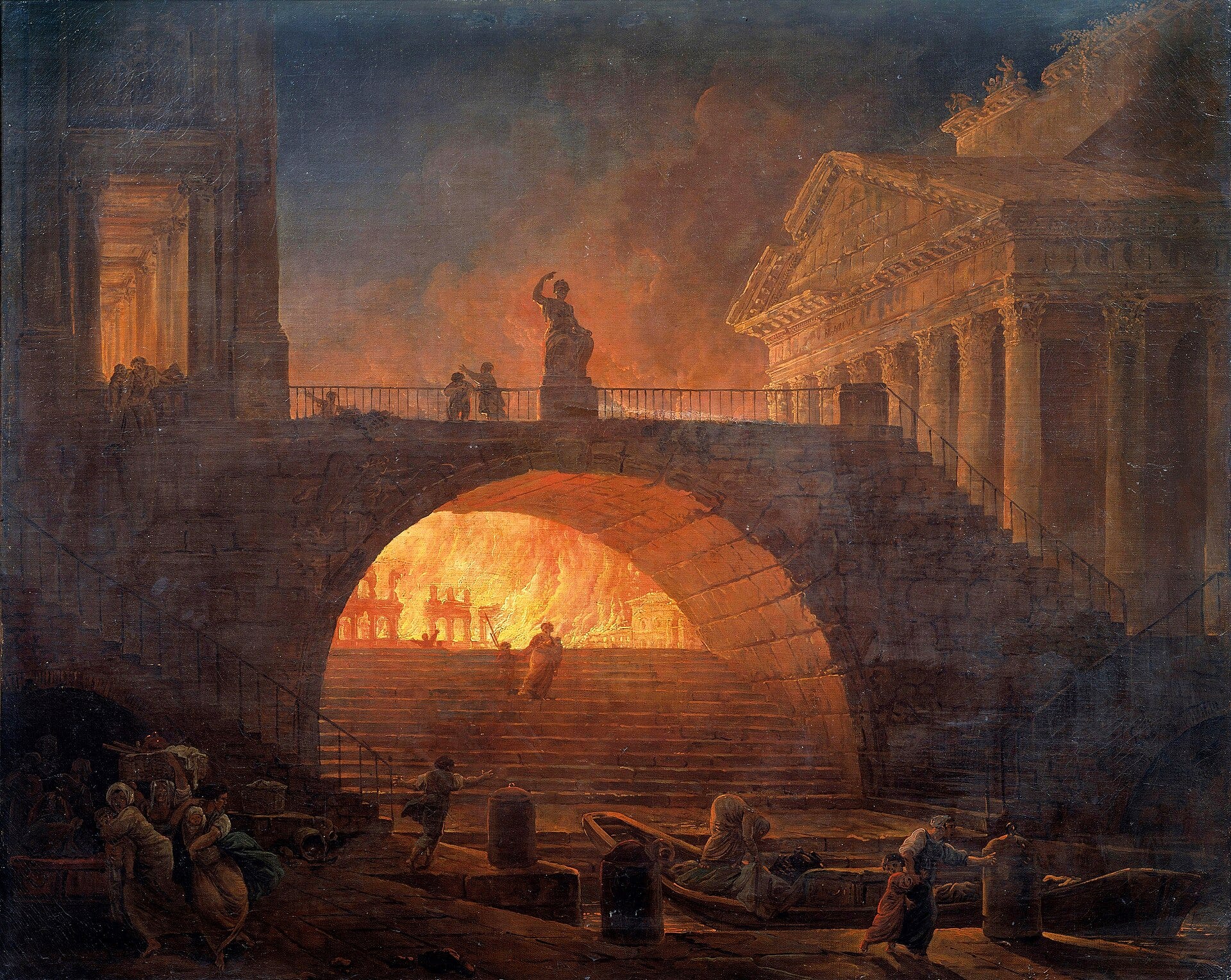
July 19, 64: The Great Fire of Rome ignites in the area around the Circus Maximus under uncertain circumstances. The conflagration would continue to rage for six days before subsiding, only to reignite and rage for another three days. Emperor Nero blamed the fire on Christians, and one theory has Nero starting the fire himself in order to rebuild Rome to his own tastes. The more mundane but also more plausible theory, which seems to have a fair amount of support among contemporary scholars, is that the fire started accidentally and spread quickly due to high winds.
July 19, 711: An Arab-Berber army defeats the Visigoths at the Battle of Guadalete, probably in what is now far southern Spain. Although hard facts about this engagement are difficult to come by, we can probably assume that it took place, the Muslims possibly invited to invade amid a Visigothic succession dispute. We can definitely assume that the Muslims won, because they wound up conquering most of the Iberian peninsula afterward.
July 19, 1864: The Third Battle of Nanjing ends with a decisive Qing victory and the final eradication of the rebel Taiping Heavenly Kingdom. The battle, which ended after the death of rebel leader Hong Xiuquan and saw the Taiping forces lose perhaps as many as 100,000 men (double that if you include losses incurred over the course of the entire siege, which began in March), was the last major engagement of the Taiping Rebellion.
TOP STORIES
IRAN
At least three and probably four US military personnel were killed this weekend in incidents in Jordan and Iraq. On Friday night into Saturday morning, Iranian strikes targeted a number of US-used military facilities in the Persian Gulf—including in Saudi Arabia, in what may have been the first Iranian attack on that country since the war resumed earlier this month—and in Jordan. A drone and missile attack on Muwaffaq Salti airbase in Jordan left two US personnel dead and a third missing. The US military announced on Sunday that it had recovered unidentified remains on the base that are probably those of that missing person, but that’s not confirmed yet. The third/fourth death occurred in northern Iraq on Saturday, during what US officials called the “controlled detonation” of explosive material in the wreckage of a downed Iranian drone.
The Pentagon is now acknowledging 17 US military deaths in this war, likely soon to be 18, though as we’ve noted in the past its casualty figures are suspect. The Iranian government says that US attacks since the conflict resumed have killed at least 50 people. Iranian Deputy Foreign Minister Kazem Gharibabadi declared the US-Iran “Memorandum of Understanding” to be “suspended” on Saturday, which seems like a significant understatement. Saturday also brought another written statement purportedly from Iranian Supreme Leader Mojtaba Khamenei, who accused Donald Trump of violating the MoU and threatened an escalation in Iran’s response. However it was the US that seemed to ratchet things up on Sunday in response to the deaths on Friday night into Saturday.
Iranian strikes have been intensifying in the Gulf in recent days, hitting what appears to be civilian infrastructure in Kuwait and expanding, as I mentioned above, to include Saudi Arabia once again. This has paralleled intensifying US strikes on civilian infrastructure in Iran. Iran’s Fars news agency suggested on Saturday that the United Arab Emirates could be targeted next if those US attacks continue. The Iranians have also been heavily targeting Jordan, which given its location and the fact that it hosts US air defense assets could be in part preparation for renewed strikes on Israel (should the war get to that point).
MALI
The Malian army suffered another major setback on Saturday, when Azawad Liberation Front (FLA) rebels and Jamaʿat Nusrat al-Islam wa’l-Muslimin (JNIM) jihadists ambushed one of its convoys in northern Mali’s Gao region. The insurgents killed at least 50 soldiers and took another 24 captive, according to AFP. On Sunday the Malian military claimed that it had retaliated via airstrikes targeting “three terrorist positions” that “neutralized” an unspecified number of militants. There’s no confirmation of any of that and Mali’s military government is probably not the most reliable or impartial source for that sort of news.
UKRAINE-RUSSIA
Ukrainian airstrikes killed at least nine people across Russia overnight Friday into Saturday. Two of those strikes hit warehouse facilities for Russia’s largest online retailer, Wildberries, and one of those killed seven employees. Early Sunday morning the Russian military began an intensive bombardment of Kyiv that killed at least six people and wounded “dozens” of others, while additionally killing at least two people in other parts of Ukraine. A Russian strike also hit a commercial cargo ship that had left Ukraine’s Odesa seaport, killing at least five people on board. Eight crew members were rescued but several more remain missing.
UPDATE: That Odesa attack killed at least ten people at latest count.
Elsewhere, Volodymyr Zelensky indicated on Saturday that he may be making some new “decisions” with respect to the Ukrainian military in the near future. Zelensky’s recent decision to fire Mykhailo Fedorov has led to protests in Kyiv by supporters of the former defense minister who’s been credited with implementing Ukraine’s long-range strike strategy. Fedorov was reportedly feuding with Ukrainian military commander Oleksandr Syrsky, and if there’s a “decision” for Zelensky to make in the near future, it could involve replacing Syrsky at a minimum.
ELSEWHERE
The Israeli military (IDF) killed at least nine people in Gaza on Saturday, including at least three children in an airstrike on an apartment building in Gaza city. It’s now killed at least 1127 people in Gaza since the “ceasefire” went into effect in October.
In southern Lebanon, some sort of explosive device killed one Lebanese soldier and wounded two others on Saturday when their vehicle apparently drove over it. The IDF is unsurprisingly insisting that the device must have been planted by Hezbollah but there’s no independent confirmation of that and Lebanese authorities are still investigating the incident.
Hungarian President Tamás Sulyok agreed to leave office on Saturday, when he signed into law a broad constitutional amendment that the country’s parliament had passed several days earlier. The headline element of that amendment ended Sulyok’s term immediately, roughly three years ahead of schedule, claiming a “serious loss of confidence” given the fact that his presidency was backed by former Prime Minister Viktor Orbán and his Fidesz Party. Current PM Péter Magyar wants to put his own president in office. Sulyok didn’t have much recourse, though he could have delayed the amendment’s adoption by sending it to the Hungarian Constitutional Court for review had he desired.
Voters in São Tomé and Príncipe headed to the polls on Sunday for a presidential election in which incumbent Carlos Vila Nova is seeking reelection despite having cut ties with his former party, Independent Democratic Action (ADI), last year. ADI’s Nito Abreu appears to be his main challenger.
The Wall Street Journal reported on Sunday that the Turkish government “is in talks” to sell or transfer its Russian-made S-400 air defense system to the UAE. There have been murmurs about this scenario for some time now, since Donald Trump intimated at the NATO summit earlier this month that he was amenable to selling F-35 aircraft to Ankara. The US military does not want the F-35 and S-400 operating in close proximity for fear that the latter could reveal details about the former and share those with the Russian military. So if Turkey does pass its S-400 along to the UAE that would remove a major obstacle to an F-35 sale.
Finally, Truthout’s Kourosh Ziabari describes the environmental damage stemming from the Iran war so far:
The U.S.-Israeli war on Iran opened with the most intensive bombing campaign in modern history. Some 23,800 airstrikes were carried out in a span of 39 days, and one of its most consequential impacts was the environmental damage inflicted on Iran’s ecosystems. A June 17 memorandum of understanding halted the hostilities, but [Donald] Trump notified Congress last week that he was resuming military action. Bombings are becoming a new norm, damaging Iran’s land, air, and water.
From toxic acid rain blanketing the Tehran metro area after Israel bombed the Iranian capital’s oil depots on March 7, to the emission of a substantial volume of greenhouse gases in the early phases of the campaign, the war has caused serious environmental degradation in a country reeling from a range of climate-related crises, water stress, and air quality issues. While international media have failed to consistently cover the negative environmental impacts of the war, environmental nonprofits, academic institutions, and climate advocates have documented extensive damage, only a portion of which has been understood to date.
According to a study by the Climate and Community Institute, 5 million metric tonnes of greenhouse gases were emitted due to the attacks on Iran in [the] first 14 days of the war, which the nonprofit estimated exceeded Iceland’s carbon pollution over an entire year.
These emissions were caused by the destruction of homes and buildings, incineration of fuel used in combat, and the production of military equipment deployed by the warring parties, representing $1.3 billion in climate damage, the study added. Researchers have also warned that health hazards in Iran will increase as a result.