

If you’re interested in history and foreign affairs, Foreign Exchanges is the newsletter for you! Sign up for free today for regular updates on international news and US foreign policy, delivered straight to your email inbox, or subscribe and unlock the full FX experience:
Hi everybody and Happy Thanksgiving to those of you who were celebrating it yesterday! This missive is actually a day late because ours was one of the many houses that lost power on Thursday due to the heavy storms that affected much of the eastern US. So rather than wishing you a belated happy holiday and delicious meal I’ll wish you all a great weekend instead. I am, as ever, thankful for all of you who read and support this newsletter, since without you it would not exist. I will be back to our regular schedule on Tuesday barring any unexpected developments between now and then. Take care until then!
November 23, 1248: The Muslim military commander in the city of Seville, Axataf, surrenders the city to King Ferdinand III of Castile (later Saint Ferdinand) in the capstone of the so-called “Early Reconquista.” Fueled primarily by the retreat of the Almohad Caliphate back to North Africa, the 20 years from 1228 to 1248 saw Christian kings conquer the entire Iberian Peninsula save for the Emirate of Granada, which was reduced to the status of Castilian vassal. Things remained more or less frozen that way until 1482, when Ferdinand and Isabella began the campaign that eventually eliminated Granada and left all of soon-to-be Spain in Christian hands.
November 23, 1733: Slaves on the island of Saint John, in the Danish West Indies, revolt against their overseers and plantation owners in one of the earliest slave insurrections in the Americas. The uprising began at a Coral Bay plantation and the insurrectionists were in short order able to seize control of the fort in that town. The revolt spread to other plantations in Coral Bay and from there across the island. Danish officials requested assistance from the French colony of Martinique, and in April 1734 an armed French-Swiss detachment arrived from that island to put down the uprising. This force was successful, finally capturing the last of the rebelling slaves in late August. The Danish government finally abolished slavery in its island colonies in 1848.
November 23, 1934: British and Ethiopian (Abyssinian) officials discover an Italian-Somali fortress in the town of Walwal, which is well beyond the designated borders of Italian Somaliland and thus is regarded as a provocation by those same British and Ethiopian officials. The ensuing “Abyssinia Crisis” led into the 1935-1937 Second Italo-Ethiopian War and the Italian annexation of Ethiopia.
November 24, 1642: Dutch explorer Abel Tasman and his crew sight an island off the southeastern coast of Australia. They were the first Europeans to locate what they named Van Diemen’s Land, after Dutch East Indies governor Anthony van Diemen. Tasman’s mission was to locate the famed “Province of Beach,” a land with allegedly vast gold deposits that Europeans—based on a misreading of Marco Polo’s travelogue (possibly fueled by some creative license on the part of Polo himself) and a vast overestimation of the size of Australia—believed would be found south of the Solomon Islands. Van Diemen’s Land eventually became a British colony, which in 1856 changed its name to Tasmania. Today it is part of Australia.
November 24, 1859: Charles Darwin’s On the Origin of Species is published. Its theory of evolution by natural selection became a fundamental tenet of modern biology.
November 25, 1120: The White Ship sinks after striking a rock off the coast of Normandy en route to England. What made this particular shipwreck notable is that the vessel was carrying William Ætheling, the only legitimate son of King Henry I of England, as well as Henry’s illegitimate son Richard of Lincoln. This meant that when Henry died in 1135 his only heir was his daughter Matilda, which was problematic because she was married to the Count of Anjou, Geoffrey Plantagenet. Oh, and also because she was a lady. English nobles didn’t like Geoffrey but they really didn’t like the idea of being ruled by a woman, and in this case the true royal line would have passed through Matilda, not her husband. They decided instead to make Henry’s nephew, Stephen of Blois, their new king. This kicked off a civil war known as “The Anarchy,” essentially pitting Norman England against Norman Normandy. That war (1135-1153) ended in a compromise, the Treaty of Wallingford, which left Stephen as king but ensured the succession of Matilda’s son, the future Henry II.
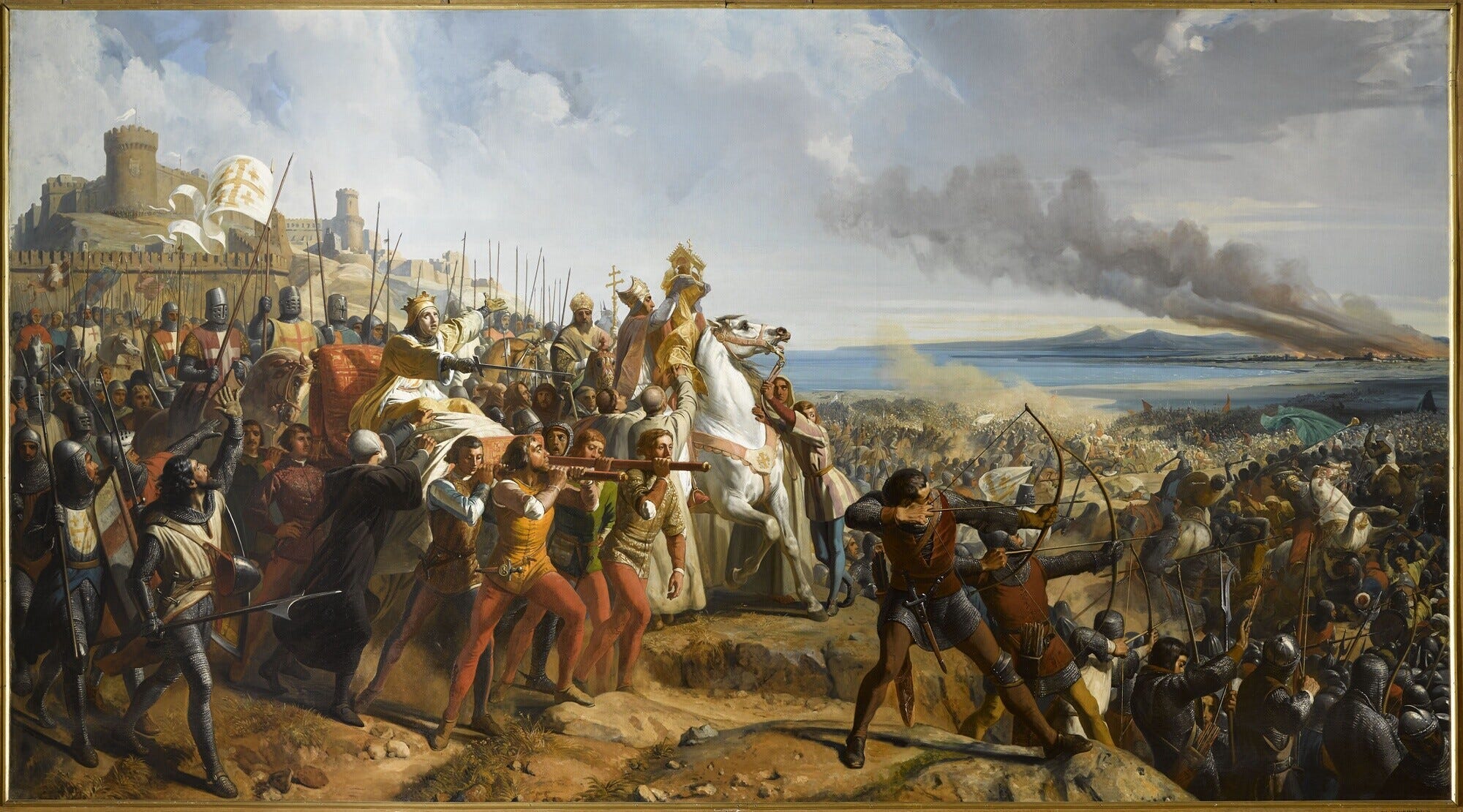
November 25, 1177: A Crusader army under King Baldwin IV of Jerusalem nearly annihilates a larger Muslim force under Saladin at the Battle of Montgisard. Baldwin’s victory forced Saladin to retreat to Egypt accompanied by only around ten percent of the soldiers he’d brought with him and thus thwarted Saladin’s first attempt to capture Jerusalem.

November 25, 1491: The Treaty of Granada marks the surrender of the last Islamic emirate on the Iberian peninsula. Nasirid Sultan Abu Abdullah Muhammad XII (“Boabdil” to the Christians) agreed to hand Granada over to King Ferdinand of Aragon and Queen Isabella of Castile. The victorious monarchs agreed, for their part, to protect Muslim property rights and freedom of worship, and to ensure that Muslims living under their jurisdiction would be ruled according to Islamic law and would not be forced to convert to Christianity. Boabdil’s departure to North Africa on January 2, 1492 marked the final end of the “Reconquista.” Following a revolt by Granadan Muslims in 1499, Ferdinand and Isabella repudiated the treaty and expelled any Muslims who refused to convert.
November 25, 1510: Portuguese forces under Afonso de Albuquerque capture the port city of Goa from the Bijapur Sultanate for the second time. Goa became the capital of Portuguese India, a colonial possession that survived in one form or another from the early 16th century until 1961, though it lost most of its towns and cities in the 17th and 18th centuries.
November 26, 1939: The Russian village of Mainila is struck multiple times by artillery shells, which Soviet authorities blamed on the Finnish military. In reality the Red Army had staged an attack on the village as a justification for tearing up the USSR’s non-aggression treaty with Finland. This staged assault became the justification for a long-planned Soviet invasion of Finland that kicked off the “Winter War.” That conflict ended in March 1940 with Finland agreeing to make some territorial concessions to the Soviets—either more than Moscow wanted or much less than it was hoping to gain, there’s some academic debate about this. There’s a bit more consensus that, regardless of outcome, the Red Army struggled to a surprising degree in confronting the far weaker (on paper, anyway) Finnish military. Among other ramifications of this conflict, the Red Army’s difficulties helped convince Adolf Hitler that the Soviet Union was vulnerable to invasion, which needless to say didn’t quite turn out the way he’d assumed it would.
November 26, 2008: Ten members of the Pakistani terrorist group Lashkar-e-Taiba begin a four day killing spree of bombings and shootings across the Indian city of Mumbai. When it ended on November 29, at least 174 people had been killed (including nine of the attackers) and over 300 more wounded. The attack continues to affect relations between India and Pakistan to the present day.
November 27, 602: A very disaffected Byzantine army under a general named Phocas executes Emperor Maurice, but only after forcing him to watch the execution of six of his sons. They seem nice. This mutiny set in motion the events that led to the 602-628 Byzantine war against the Sasanian (Persian) Empire, as almost immediately after Phocas became emperor the Byzantine governor of Mesopotamia, Narses, declared a rebellion. He appealed to the Persians—whose emperor, Khosrow II, had been crowned in part due to Maurice’s aid—for help, and there’s your war. The lengthy conflict saw the Persians conquer the Levant and Egypt before they overextended themselves in a failed siege of Constantinople. That gave the Byzantine Emperor Heraclius, who overthrew Phocas in 610, an opening to counterattack and restore the status quo ante bellum, while Khosrow’s disenchanted nobles ousted him in favor of his son, Kavad II. The conflict battered the two great empires, which worked to the benefit of a new regional power that was just beginning to emerge in western Arabia.
November 27, 1095: During the Council of Clermont, Pope Urban II issues his call for what we now know as the First Crusade. There is disagreement in the surviving sources about what, exactly, Urban said. But all seem to agree that he railed against Christian-on-Christian violence in Frankish Europe and called on Frankish Christians to channel their violent impulses into a war against “the Turks” in defense of Christian peoples to the east.