

If you’re interested in history and foreign affairs, Foreign Exchanges is the newsletter for you! Sign up for free today for regular updates on international news and US foreign policy, delivered straight to your email inbox, or subscribe and unlock the full FX experience:
This is just a reminder that FX is on its annual spring break and will be back to our regular schedule on Tuesday. In the meantime “Week in Review” writer Ashley Gate should be sending out an update on the Iran war tomorrow so please keep an eye out for that. Thanks for reading!
March 30, 1282: Sicilians rebel against the rule of Charles I of Anjou, sparking the War of the Sicilian Vespers. The conflict took its name from the evening prayers on Saturday, March 30, the day before Easter. Sometime during or after that service, a group of Sicilians had an unfriendly encounter with a group of Frenchmen in Palermo. Resentments over Sicily’s relatively low status within Charles’ Mediterranean empire erupted into a six week massacre of Frenchmen on the island. A 20 year war ensued, at the end of which the Angevins retained control over their mainland Italian kingdom, Naples, but Sicily came under the control of Aragon.
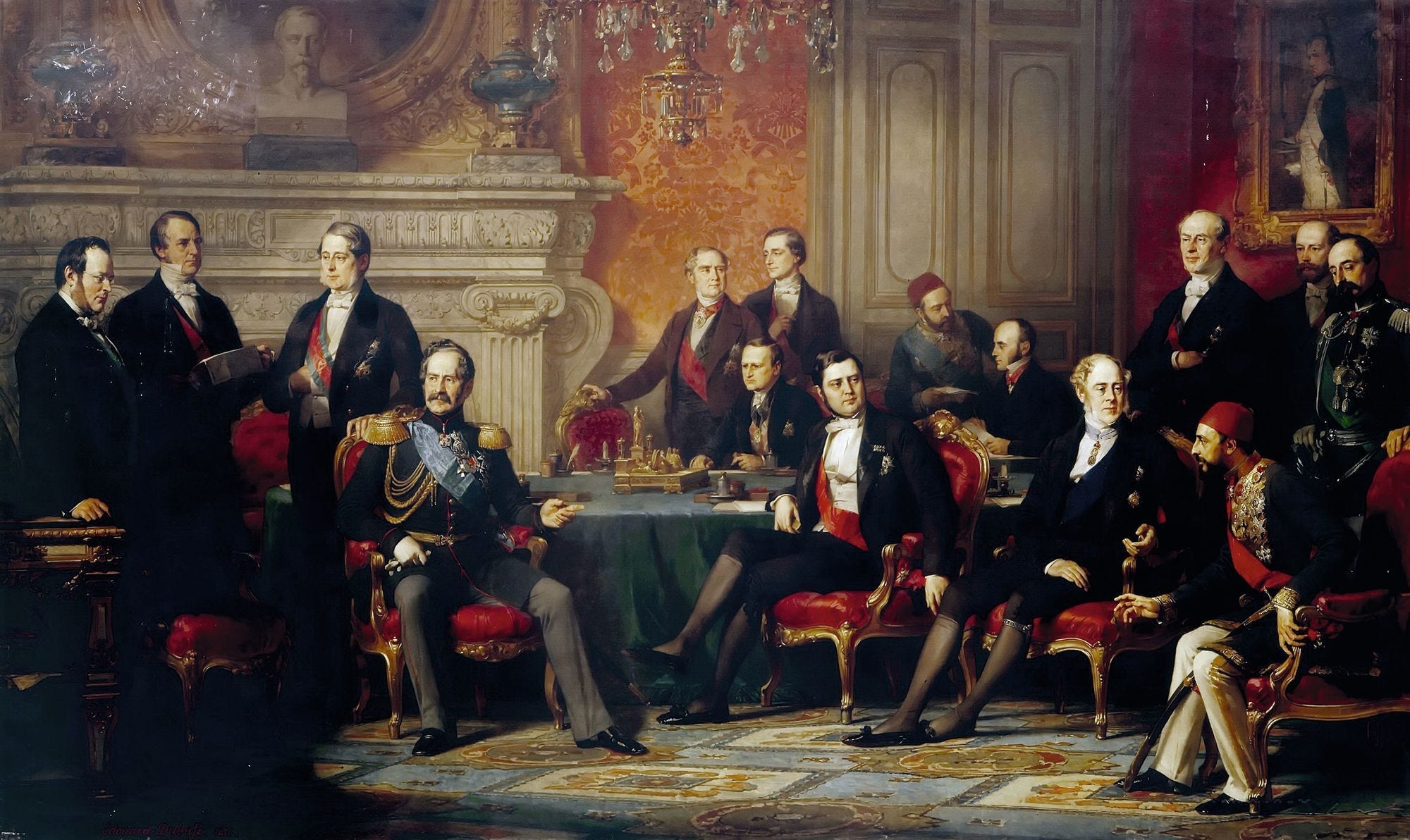
March 30, 1856: Representatives of Austria, France, the Ottoman Empire, Prussia, Russia, Sardinia, and the United Kingdom sign the Treaty of Paris, ending the 1853-1856 Crimean War. The war was a serious Russian defeat, and the terms reflected that. The Black Sea was designated as neutral territory, barring all warships—but especially Russian warships—from its waters. Russia was also forced to give up territory in the Danube region and forfeited to France any claim it had as being the protector of Christian subjects in the Ottoman Empire.
March 30, 1867: US Secretary of State William Seward and Russian minister Eduard de Stoeckl agree on a sale price of $7.2 million for the US to purchase Alaska. The sale would be finalized in a treaty that was ratified by the US Senate that October. The Russians had realized they couldn’t hold on to Alaska in the event of a US migration there (a la the California Gold Rush), and the Russian government needed the cash. Reception in the US wasn’t uniformly positive, but the whole “Seward’s Folly” sentiment has been exaggerated in the contemporary consciousness and for the most part the US public seems to have supported the acquisition.
March 30, 1912: Sultan Abd al-Hafid of Morocco and French diplomat Eugène Regnault sign the Treaty of Fez, making Morocco a French protectorate. Abd al-Hafid signed the treaty with a French army encircling the city, so you might say he was well motivated to agree to a lopsided arrangement that looked more like a colonial capitulation than a protectorate along the lines of Egypt’s relationship to Britain. Of course, in fairness, Egypt’s relationship to Britain looked increasingly like a colonial one by this point too. The treaty was not well received by the Moroccan public. Riots broke out the following month in Fez, and concessions made to Spain in the Rif (or “Spanish Morocco”) helped fuel the Rif War, which ended in 1927, between Spain and the Berber tribes of the region.
March 31, 1146: At the Council of Vézelay, charismatic monk Bernard of Clairvaux issues his call for a new crusade to support the suddenly beleaguered Christian principalities in the Levant. In attendance was King Louis VII of France, who took up the cross on the spot for what we now know as the Second Crusade. Suffice to say it did not end well.
March 31, 1492: The proto-Spanish monarchs Ferdinand of Aragon and Isabella of Castile issue the Alhambra Decree, expelling all Jews from their kingdoms by the end of July. The decree’s goal was two-fold. One, the expulsion of practicing Jews was meant to eliminate their influence on the region’s conversos, those who had converted from Judaism to Christianity. Two, the terms of the expulsion—which required those being expelled to finance their own relocation—were made deliberately onerous in order to encourage more Jews to convert to Christianity as an alternative. Isabella seems to have been the driving force behind the decree, likely influenced by her new confessor, future cardinal and grand inquisitor Francisco Jiménez de Cisneros.
March 31, 1854: The United States, in the person of Commodore Matthew Perry, and Japan, amid the waning years of the Tokugawa Shogunate, sign the Convention of Kanagawa, which permits US ships to use the Japanese ports of Hakodate and Shimoda. Kanagawa, negotiated almost literally at gunpoint with Perry threatening to turn his warships loose on Edo, marks the “opening” of Japan to Westerners after a period of near-isolation that stretched back to the early 17th century. Over the next several years Japanese officials would sign a lopsided commercial treaty with the US along with similar capitulations to France, Russia, and the United Kingdom. Internal Japanese discontent with these arrangements helped weaken the Shogunate and contributed to the Meiji Restoration in 1868.
April 1, 1939: The Spanish Civil War comes to its official end when Nationalist leader Francisco Franco announces the surrender of the remaining Republican forces. The March 28 fall of Madrid to Franco’s besieging army had rendered the war pretty much over at that time, so this announcement was a bit anti-climactic. Franco went on to rule Spain, quite brutally as it happens (check out the “White Terror” if you’re unfamiliar, it’s got a very appropriate name), until his death in 1975.
April 1, 1941: An anti-British military coup in Baghdad ousts King Faisal II’s regent, Abd al-Ilah, as well as his prime minister, Nouri al-Saeed, and restores a pro-Axis (not pro-Nazi, necessarily, but definitely friendly with the Germans) former prime minister, Rashid Ali al-Gaylani, to power. Concerned that their empire was about to be severed by a pro-German government in the Middle East, Britain moved in to reverse the coup. The subsequent Anglo-Iraqi War lasted about a month and ended with Gaylani fleeing the country and Abd al-Ilah back in charge in Baghdad.
April 1, 1976: Steve Jobs, Steve Wozniak, and Ronald Wayne co-found Apple, Inc. If you’ve never heard of Wayne that’s because less than two weeks later he sold his 10 percent stake in the company to the other two for what wound up being $2300. Apple is now worth trillions of dollars, so I think we can all agree he made a smart decision.
April 2, 1917: US President Woodrow Wilson speaks to a joint session of Congress to ask for a declaration of war against Germany. Wilson made his case for war by appealing to idealistic notions of spreading democracy along with anger over German u-boat attacks on US shipping and fears provoked by the discovery of the Zimmerman Telegram. Congress declared war on April 6.
April 2, 1930: Following the death of Ethiopian Empress Zewditu, her regent and designated heir, Ras Tafari Makonnen, assumes the throne under the regal name Haile Selassie. Over the next 44 years and among other things, Haile Selassie oversaw the adoption of Ethiopia’s first and second constitutions, abolished slavery, and made the country a charter member of both the Organization of African Unity (precursor to the African Union) and the United Nations. He also oversaw a failed effort to integrate Eritrea that sparked a 30 year war of independence. And he’s the central figure in the Rastafari movement. Haile Selassie was overthrown in a military coup in September 1974 and was executed (though the subsequent Derg government claimed that he died of natural causes) about a year later.