

If you’re interested in history and foreign affairs, Foreign Exchanges is the newsletter for you! Sign up for free today for regular updates on international news and US foreign policy, delivered straight to your email inbox, or subscribe and unlock the full FX experience:
This is just a reminder that FX is on a break from The News and will be back to our regular schedule on Tuesday. Thanks for reading!
June 29, 1444: Albanian rebel leader Skanderbeg (George Castriot) defeats a considerably larger Ottoman army at the Battle of Torvioli by outmaneuvering the Ottomans and striking their forces from behind. This was one of the first major engagements in Skanderbeg’s 1443-1468 rebellion and his surprising victory earned him significant support from Hungary and the papacy. He was for a time able to win independence for an Albanian principality under the “Albanian League,” but a few years after his 1468 death the Ottomans were able to reconquer the region.
June 29, 1613: The Globe Theatre in London is destroyed when, during a performance of William Shakespeare’s Henry VII, a stage cannon malfunctions and sets the structure on fire. Only one person was hurt, apparently. The structure was rebuilt the following year but was closed down for good (or at least until its 1997 revival) by Puritan authorities during the First English Civil War.
June 29, 1881: Sudanese religious leader Muhammad Ahmad declares himself to be the Mahdi and begins to establish an independent political entity, kicking off the 18 year long Mahdist War against the British Empire.
June 30, 1520: During La Noche Triste (“the Night of Sorrows”), Hernán Cortés and his forces are driven out of Tenochtitlan by the Aztecs. He regrouped and returned the following year to besiege and ultimately capture the city.
June 30, 1934: On the “Night of the Long Knives,” Nazi leaders purge their party’s original paramilitary wing, the SA or Sturmabteilung, including its leader Ernst Röhm, and target party opponents like German Vice Chancellor Franz von Papen. Estimates of the death toll range from a low of 85 to a high of somewhere around 1000.
July 1, 1097: The army of the First Crusade defeats a Seljuk army at the Battle of Dorylaeum. The outnumbered Seljuks caught the vanguard of the Crusader army by surprise but were eventually worn down as the day went on and the rest of the Crusaders kept rolling in to relieve their comrades. Leading the Crusader vanguard, Bohemond of Taranto was able to hold out for several hours against a larger Turkish force in what was arguably the First Crusade’s signature moment prior to its conquest of Jerusalem. The victory cleared the Crusaders’ path to Antioch.
July 1, 1569: Polish and Lithuanian nobles agree to the “Union of Lublin,” creating the Polish-Lithuanian Commonwealth under the rule of Polish King/Lithuanian Grand Duke Sigismund II Augustus (d. 1572). In essence Lublin was a compromise between Lithuanian and Polish nobles, the former agreeing to a stronger union and the latter agreeing to increase support for the Lithuanian nobility in the Livonian War against Russia. The new commonwealth also eased concerns about Sigismund’s poor health and the fact that he had no heir apparent—the formal union ensured that the two polities would remain joined after his death and the institution of an elected monarchy solved the problem of succession. The Commonwealth survived until it was absorbed by Austria, Prussia, and Russia in three 18th century partitions.
July 1, 1968: The “Treaty on the Non-Proliferation of Nuclear Weapons” is signed by 62 countries. Nowadays that list has grown to 191 signatories. The Non-Proliferation Treaty (NPT) has prevented the spread of nuclear weapons ever since, except for all the times—India, Israel, North Korea, Pakistan, South Africa—it hasn’t done that.
July 1, 1997: The United Kingdom turns control of Hong Kong over to China, ending 156 years of colonial governance. The handover had been negotiated in the 1984 Sino-British Joint Declaration and was timed to coincide with the end of a 99 year lease the UK had negotiated for control of the New Territories region back in 1898. Under that declaration the Chinese government agreed to allow Hong Kong to maintain its own separate system of governance for 50 years after the transfer, but Western governments (the US in particular) have accused Beijing of violating that term through, for example, the Hong Kong’s 2020 security law. This handover is often characterized as the final end of the British Empire, though the UK government still holds some colonial possessions to the present day.
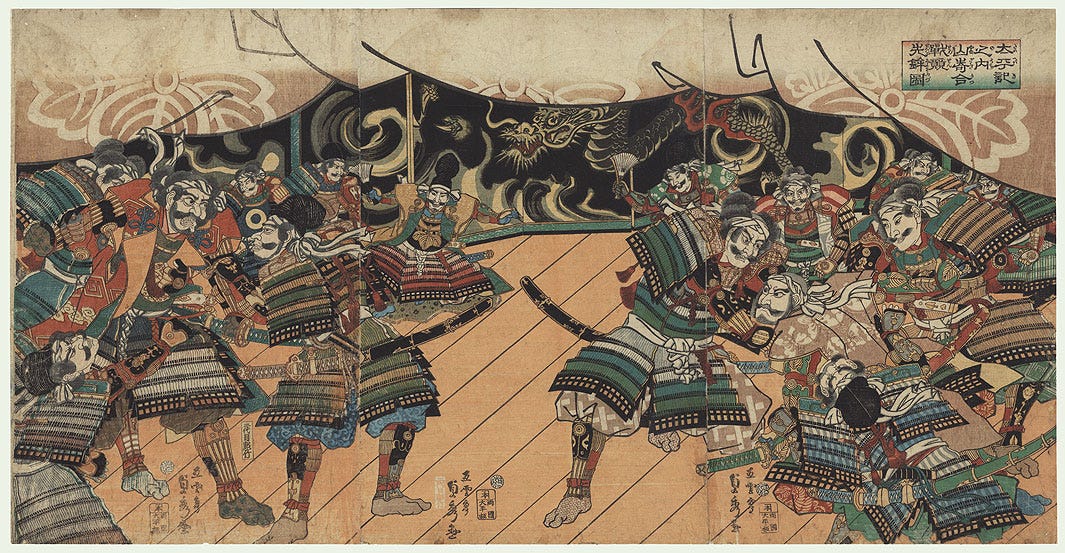
July 2, 1582: Two vassals of the deceased Japanese daimyō Oda Nobunaga, Akechi Mitsuhide and Toyotomi Hideyoshi, meet at the Battle of Yamazaki, with Hideyoshi’s army emerging victorious. Hideyoshi thus exacted vengeance for Mitsuhide’s rebellion, during which Nobunaga had committed suicide on June 21. Effective political authority passed from the Oda clan to the Toyotomi clan, where it resided until Tokugawa Ieyasu took it from them in 1600.
July 2, 1853: Citing the Ottomans’ supposed failure to protect Christian religious sites as a pretext, Russian Tsar Nicolas I sends an army across the Pruth River to occupy Moldavia and Wallachia, both nominally still Ottoman territories. Nicolas assumed that the European powers would not begrudge him a little annexation, as a treat. He was wrong, and the Crimean War ensued.