

If you’re interested in history and foreign affairs, Foreign Exchanges is the newsletter for you! Sign up for free today for regular updates on international news and US foreign policy, delivered straight to your email inbox, or subscribe and unlock the full FX experience:
Reminder that I took a short respite over the weekend but will be back to our regular schedule tomorrow. Thanks for reading!
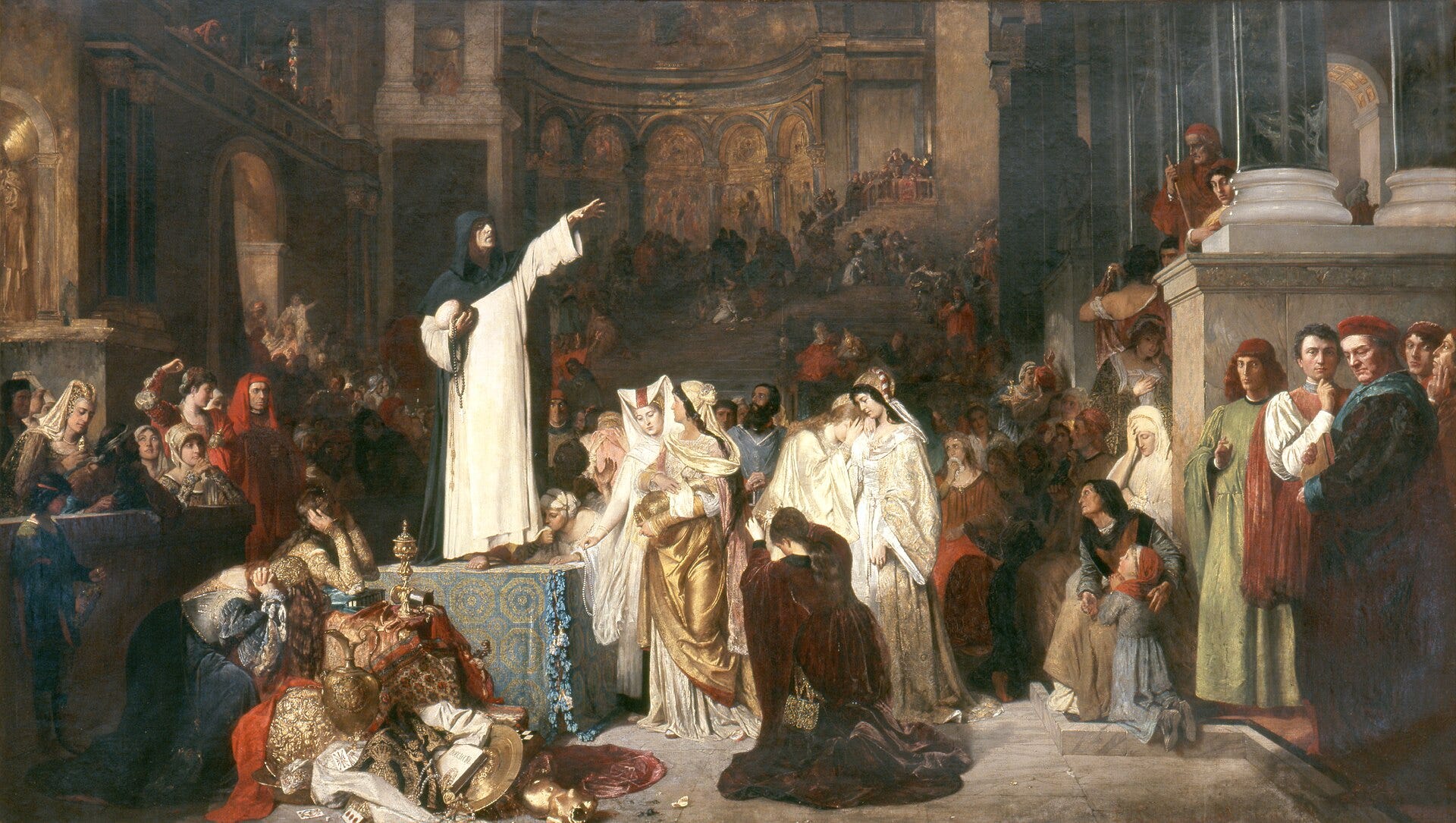
February 7, 1497: In the infamous “Bonfire of the Vanities,” Dominican friar Girolamo Savonarola burns thousands of luxury items, including books, in a huge public bonfire in the city of Florence, Italy. Savonarola had arrived in Florence in 1490 and became widely known for his bombastic preaching against what he felt were the immoralities of the Renaissance and of the city’s leading family, the Medicis. This was not his first “bonfire of vanities” but it is the best known and so is generally regarded as the bonfire. Unfortunately for Savonarola, he became so well-known that Pope Alexander VI—noted fan of both the Renaissance and immorality—excommunicated him in May 1497 and in 1498 executed him on heresy and sedition charges.
February 7, 1992: The 12 member states of the European Community—Belgium, Denmark, France, Greece, Ireland, Italy, Luxembourg, the Netherlands, Portugal, Spain, the United Kingdom, and West Germany—sign the Maastricht Treaty, deepening European integration and helping to create the European Union. The EU now consists of 27 member states, while one of these founding dozen, the UK, has very famously quit the bloc.
February 8, 1250: A Crusader vanguard under the command of Robert I, Count of Artois, attacks the Egyptian city of Mansurah in the Nile delta. In doing so he exceeded his orders, which had been to cross the Nile, establish a camp, and wait for the rest of the Crusader army under Robert’s brother, French King Louis IX, to join him. This proved to be a fatal mistake, as the ensuing Battle of Mansurah saw the Fatimid army nearly annihilate Robert’s vanguard and prevent Louis’ army from advancing once it had crossed the river. The now-depleted Crusader force remained stymied in their camp until late March, when the arrival of Fatimid reinforcements forced them to retreat back over the river. Their situation did not improve after that.
February 8, 1904: The Imperial Japanese Navy launches a surprise attack against elements of the Russian Pacific Fleet at Port Arthur (modern Lüshunkou, in China), damaging several ships including the Russian battleship Tsesarevich. The initial night attack was less successful than Japanese commanders had hoped, and after a second engagement the following day they withdrew. This was the opening strike in the Russo-Japanese War, which was formally declared on February 10. Russian and Japanese interests overlapped in Korea and Manchuria and the two empires had been unable to find a way to coexist. The war ended in September 1905 with a decisive Japanese victory that shifted the balance of power in eastern Asia and sent Russia into a political tailspin (which in turn affected the balance of power in Europe).
February 8, 1963: Former deputy Iraqi Prime Minister Abdul Salam Arif leads a coalition of Baathists, Nasserists, and other pan-Arab elements in a coup against the Iraqi government of Abd al-Karim Qasim that later became known as the “Ramadan Revolution.” Arif had been Qasim’s deputy when the latter led the 1958 coup that toppled the Hashemite monarchy, but the two men fell out fairly quickly as Arif’s pan-Arabism clashed with Qasim’s skepticism of the concept (and particularly of its most prominent variant at the time, Nasserism). Arif and his supporters, with the approval and possibly support of the US government, ousted and executed Qasim. This is the second of three mid-20th century coups that eventually brought the Baath Party to power in Iraq. Arif and Baath Party leader Ahmed Hassan al-Bakr had their own falling out after this event and Bakr eventually ousted Arif’s brother and successor, Abdul Rahman Arif, in 1968.
February 9, 1234: The Siege of Caizhou ends in victory for the combined Mongol-Song Dynasty besieging army and the end of the Jin Dynasty. The Mongols and the Jin, who ruled northern China, had been at war essentially since Genghis Khan first invaded the region in 1211 and Emperor Aizong of Jin had fled to Caizhou following the Mongol conquest of Kaifeng in February 1233. He sought aid from the Song, who ruled southern China, but they opted instead to ally with the Mongols in what proved to be a pretty big mistake. When it became clear that he would not be able to escape the siege, Emperor Aizong took his own life and thus brought the Jin line to a close. After their victory, the Song attempted to retake areas in northern China that they’d lost to the Jin the previous century but were driven off by the Mongols, who eventually eliminated the Song altogether in 1279.
February 9, 1943: US Army Major General Alexander Patch confirms that Japanese forces have retreated from Guadalcanal, marking the end of the six month long Guadalcanal Campaign. Japan’s retreat allowed the US to establish bases on Guadalcanal and the island of Tulagi to support further Pacific operations. The US victory is regarded as one of the major turning points in World War II’s Pacific Theater, helping to put Japan on the defensive.
February 9, 1964: The Beatles make their first of many appearances on The Ed Sullivan Show, drawing a then-record 73 million viewers. The appearance significantly raised The Beatles’ profile in the US and is generally held to mark the start of the 1960s “British Invasion” of the US music and pop culture scene.