

If you’re interested in history and foreign affairs, Foreign Exchanges is the newsletter for you! Sign up for free today for regular updates on international news and US foreign policy, delivered straight to your email inbox, or subscribe and unlock the full FX experience:
Happy New Year! I hope that 2026 has gotten off to a positive start for all of you! In my case it has not, as I have definitely contracted this mutant flu that is sweeping across the US. I believe I’m on the upswing now, but over the past 12 hours I’ve lurched from feeling OK to feeling the worst I’ve felt yet to feeling pretty good and now back to just OK. There’s also the unfortunate complication that I’ve become Patient Zero for everybody else at FX headquarters, so things are just not functioning too well around here at the moment. This is already more information than you wanted but the upshot is that I don’t think I can promise to get back to the regular grind on Sunday as planned, but I also don’t want to rule it out. “Stay tuned” is the best I can do, sorry.
December 31, 1229: King James I of Aragon enters the city of Medina Mayurqa (modern Palma de Mallorca), completing the Aragonese conquest (or “reconquest,” if you must) of the island of Mallorca. An Aragonese army had besieged the city for three months before finally gaining victory.
December 31, 1907: New York Times owner Adolph Ochs holds the first ever Times Square ball drop to ring in the new year. Ochs had been organizing New Years Eve festivals since 1904, when he did so to celebrate the opening of the Times’ new offices at One Times Square, but decided in 1907 to enhance his usual fireworks show with something bigger and more spectacular. The ball drop has become an annual event save for the years 1942 and 1943, when wartime blackouts were in effect.
December 31, 1992: Czechoslovakia is officially dissolved, with the Czech Republic and Slovakia each going their separate ways under the terms of an act passed by parliament in late November. The so-called “Velvet Divorce” (named after the 1989 Velvet Revolution and to highlight the lack of violence involved) became inevitable when the Slovak National Council declared independence on July 17. Prior to that, negotiations between Czech and Slovak national groups had discussed the possibility of adjusting the nature of their federation, though as the Czechs pushed for a tighter federation and the Slovaks a looser one, there wasn’t much common ground to be had.
January 1, 1001: As was the case with Christmas, January 1 tended to be a popular day for crowning medieval monarchs. There are way too many of those to list here, and anyway most of them turned out to be fairly unimportant. One that was relatively significant was the crowning of Stephen I, the very first king of Hungary. Stephen had been ruling Hungary since 997, but prior to 1001 the ruler of Hungary went by the title “Grand Prince of the Hungarians,” reflecting the fact that they were elected by and subject to the Hungarian nobility. Stephen sought the title of king to demonstrate his authority over the nobles and to put him on par with other national leaders in Europe. He was probably crowned by Pope Sylvester II on January 1, 1001, although thanks to some ambiguous chronicling there’s an outside chance it actually happened on Christmas Day 1000.
January 1, 1801: The Acts of Union, parallel bills passed in the British and Irish parliaments the previous summer, come into effect, creating the United Kingdom of Great Britain and Ireland. The Irish and English crowns had been in personal union since 1542, when the Crown of Ireland Act elevated the Lordship of Ireland into a full Kingship, and that personal union continued when the English crown became the British crown after the 1707 Act of Union merged England and Scotland. So the 1800 Acts of Union merged two kingdoms that were already ruled by the same person. The 1919-1921 Irish War of Independence ended the union for most of Ireland and is the reason why it’s now the United Kingdom of Great Britain and Northern Ireland.
January 1, 1804: The Haitian Revolution ends when new President Jean-Jacques Dessalines declares Haiti’s independence from France. As with royal coronations, January 1 has also been a popular date for national independence days. In addition to Haiti, this is also Independence Day for Brunei (1984, from the UK), Cameroon (1960, from France and the UK), and Sudan (1956, from Egypt and the UK).
January 1, 1959: The Cuban Revolution ends with dictator Fulgencio Batista fleeing for the Dominican Republic hours after the rebel capture of Santa Clara. Revolutionary forces then entered the cities of Havana and Santiago de Cuba, with revolutionary leader Fidel Castro finally reaching the Cuban capital on January 8 after an extended victory march. Castro’s relationship with the United States went from chilly to hostile as The Gang in Washington began to fear that the revolution would spark other communist uprisings in the Americas. When the new Cuban government nationalized US-owned oil refineries on Cuban soil in August 1960, the US government responded by expanding its embargo on arms exports to Cuba to cover just about everything else. That embargo remains in effect to the present day.
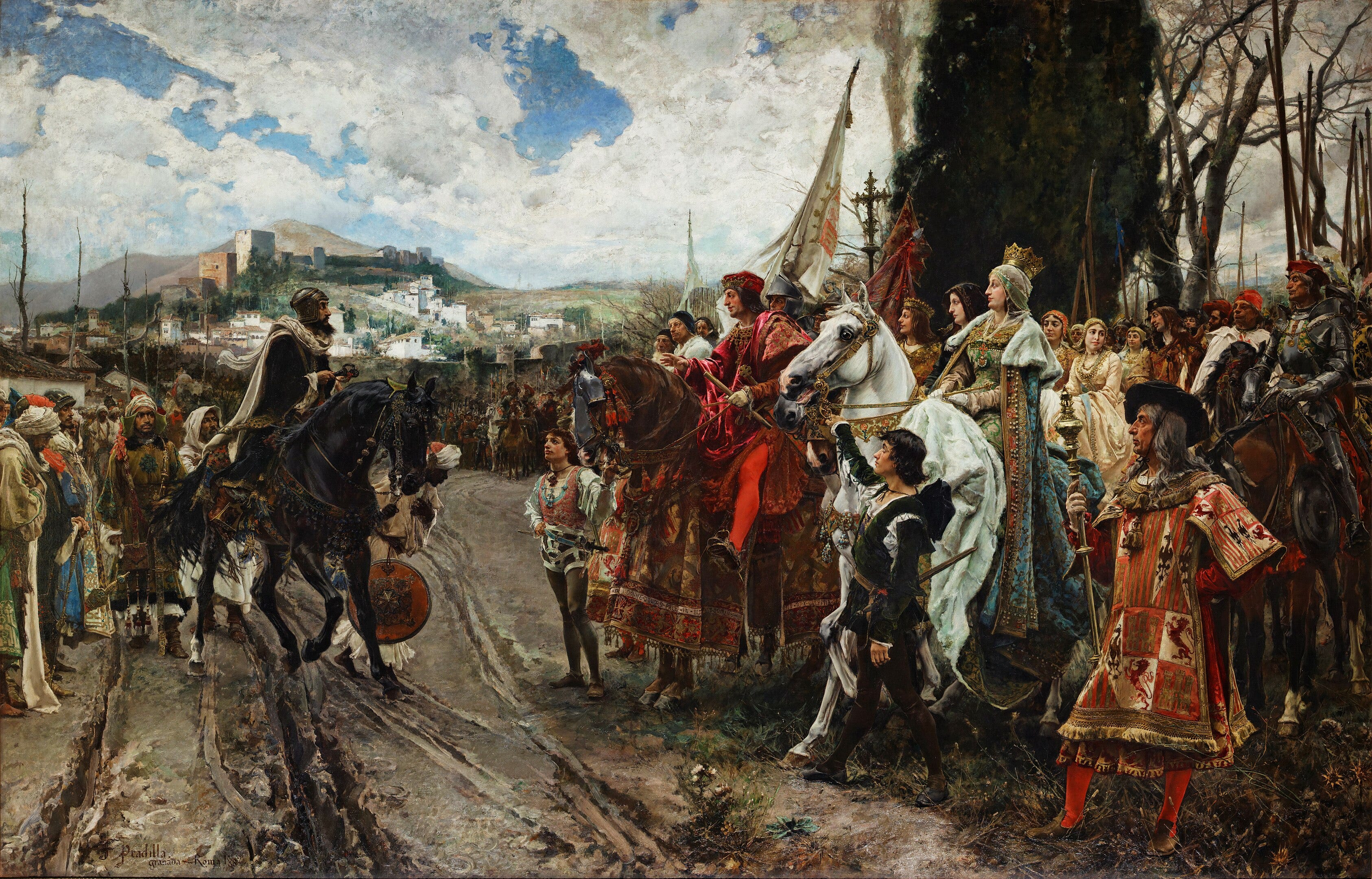
January 2, 1492: The rulers of the Emirate of Granada surrender their polity to the proto-Spanish monarchs King Ferdinand II of Aragon and Queen Isabella I of Castile. Said surrender had been negotiated the previous November so this event was purely a formality, but it is treated as the official end date of the so-called Reconquista.
January 2, 1680: Sunan Amangkurat II, ruler of the Javanese Mataram Sultanate, personally (with a little help) executes rebel leader Trunajaya while the latter is in the custody of the Dutch East India Company (VOC). Trunajaya was a claimant to the throne of the island of Madura, located just off of Java’s northeastern coast, and had raised a rebellion against Sunan Amangkurat I in 1674 as the leader of a group of predominantly eastern Javanese nobles who were outraged at the brutality of Amangkurat I’s reign. Amangkurat II appears to have had some early sympathy for Trunajaya and the disaffected nobles, but by the time he succeeded his father in 1677 he was fully opposed to their uprising. While initially very successful—even seizing the Mataram capital of Plered in 1677—Trunajaya’s campaign ultimately faltered after the VOC intervened and he was captured in late December 1679.
January 2, 1963: Despite being outnumbered roughly five to one, a unit of around 350 Việt Cộng fighters defeats a joint South Vietnamese-US force at the Battle of Ấp Bắc in South Vietnam’s Định Tường province, withdrawing only when it began to run out of ammunition. The battle was the first VC victory in a pitched battle against the South Vietnamese military and as such was both a substantial morale boost to their war effort and a major embarrassment for the South Vietnamese government.