
Happy (early) New Year! Foreign Exchanges is on its annual holiday break. We’ll be back to regular programming on January 4, I hope (more on that in a second). This will be my final pitch for support to GiveDirectly’s Rwanda campaign. You can make a donation to the effort or subscribe to the newsletter, save 20% on your first year, and donate 50% of your subscription payment to GiveDirectly at this link:
So my plan at this time is still to resume the newsletter on Sunday. However, I did not plan on having a 102 degree fever as of a couple of hours ago so we may be in a wait and see situation at this point. If this is the flu, which I assume it is, hopefully it will be brief—I am vaccinated (sorry Secretary Kennedy)—and it won’t affect my schedule. If that changes I will of course let you all know.
December 27, 537: Byzantine Emperor Justinian I and Patriarch Menas of Constantinople inaugurate the newly-built Hagia Sophia as the imperial capital’s patriarchal cathedral. Believed to have been the largest building in the world when it was built, the Hagia Sophia is regarded as the pinnacle of Roman architecture. The emperors Constantius II and Theodosius II had previously built churches on the same site, but Justinian’s structure is the one that has more or less survived to the present day. The Hagia Sofia was repurposed as a mosque by the Ottomans, then as a museum by the Republican Turkish government, and has now reverted to its previous status as a mosque.
December 27, 1918: The Greater Poland Uprising begins in the city of Poznań. Polish nationalists took advantage of the abdication of German Kaiser Wilhelm II in November to stake a claim on formerly Polish territory that the Allies had planned to leave in German hands following World War I. Their uprising forced the parties to reconsider their postwar plans and greatly influenced the construction of the new Polish state that emerged under the Treaty of Versailles.
December 27, 1945: The International Monetary Fund is established in Washington, DC, as one of the two institutions (along with the World Bank) emerging from the 1944 Bretton Woods Conference to underpin a new postwar international financial system. Envisioned by economist John Maynard Keynes as a fund from which member states could draw money to help weather economic crises, thanks to the influence of US Treasury official Harry Dexter White the IMF was instead created as a global lending institution with the power to impose rigid austerity measures on client states, supposedly to ensure that they repaid their IMF loans on time. Views on its impact vary slightly between “has made a useful contribution to the world economy” and “has underpinned a destructive system of colonialism-by-other-means.”
December 27, 1979: The Soviet-Afghan War begins when Soviet soldiers seize control of government buildings in Kabul and execute Afghan leader Hafizullah Amin. The Soviets installed a government led by the less radical Parcham faction of the People’s Democratic Party of Afghanistan (as opposed to Amin’s Khalq faction), hoping to fend off a full-blown rebellion in an increasingly unstable Afghanistan, but the intervention had the opposite effect and united a hitherto fragmented opposition against the Soviets.
December 28, 1659: An army of the nascent Maratha Empire, under its founder Shivaji, defeats a substantially larger Adilshahi army at the Battle of Kolhapur. Shivaji had begun carving territory out of the Adilshahi Sultanate of Bijapur several years earlier, and his victory at Kolhapur continued the early growth of what would become India’s dominant political entity prior to the arrival of the British.
December 28, 1836: Mexican ambassador Miguel Santa María and Spanish representative José María Calatrava sign the “definitive treaty of peace and friendship between Mexico and Spain,” more simply known as the “Santa María–Calatrava Treaty,” in Madrid. Under the treaty’s terms, the Spanish government agreed to recognize the independence Mexico had won during its 1810-1821 revolution and to stop making attempts to reconquer its former colony.
December 28, 2006: Somali forces under the provisional “Transitional Federal Government” and their Ethiopian allies enter Mogadishu. The Somali capital had been under the control of the Islamic Courts Union since June, the ICU having been the first entity to fully consolidate the city since the collapse of the Somali Democratic Republic in 1991. The Ethiopian military invaded Somalia that same month to bolster the rival TFG (along with substantial US support), and by December the ICU was crumbling and on the run. It dissolved the following month, but a jihadist faction called al-Shabab survived and began an insurgency against the Somali government that has continued to the present day.
December 29, 1170: Four knights who believe they are acting on orders from English King Henry II assassinate the Archbishop of Canterbury, Thomas Becket, in Canterbury Cathedral. Becket and Henry had struggled through a series of major disagreements over the extent of the king’s authority over the Catholic Church in England. A final dispute over the coronation of Henry the Young King in June allegedly prompted King Henry to exclaim “Will no one rid me of this turbulent priest?” and that statement supposedly convinced at least these four knights that their king wanted Becket dead.
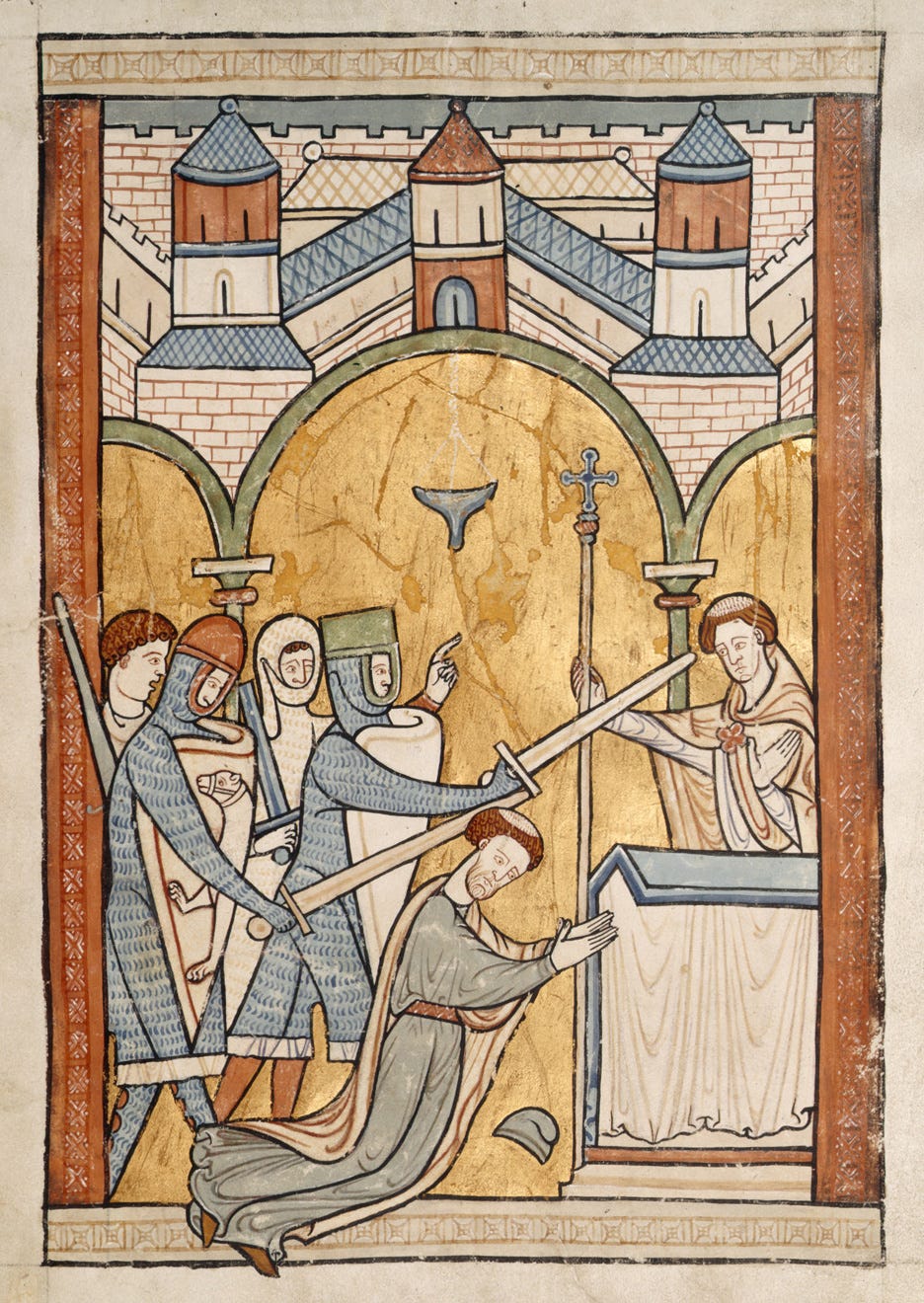
Whether Henry actually said this, or something like it, is a matter of some debate, but whatever he said it’s thought to be unlikely that he intended it to result in Becket’s murder. It may be noteworthy that Henry didn’t arrest the four knights, nor did he punish them in other ways—by, say, confiscating their estates. On the other hand, he didn’t put in a good word on their behalf with Pope Alexander III, who excommunicated the lot of them and later sent them on Crusade as penance. It seems reasonable to conclude that Henry didn’t necessarily want Becket killed but that he wasn’t exactly bereft when it happened—though he distanced himself from the murder after the fact.
December 29, 1911: The Qing dynasty, which had ruled China since 1636, gives way to the Republic of China as Sun Yat-sen is named China’s first provisional president (he formally took office on January 1, 1912). Outer Mongolia also declares its independence from China and names Bogd Khan (d. 1924) as its new ruler. Commemorated annually as Mongolian Independence Day.
December 29, 1928: The Chinese National Revolutionary Army concludes its “Northern Expedition” with the surrender of the Beiyang government. The Beiyang administration was internationally recognized as the legitimate government of China in the wake of the 1911 revolution (see above). In two phases, beginning in July 1926, the Kuomintang’s NRA campaigned against Beiyang and a number of regional warlords in order to unite China under KMT control.
December 30, 1066: A mob in the city of Granada bursts into the royal palace, seizes and crucifies ruler Badis al-Muzaffar’s Jewish vizier, Joseph ha-Nagid, and finally marches through the city slaughtering hundreds or perhaps thousands of Jewish residents. The Granada Massacre, as it’s called, appears to have been borne of little more than anti-Jewish animus directed toward the powerful vizier. It shows that even in the “Convivencia” period, considered a golden age for religious tolerance and coexistence in Europe, people weren’t necessarily all that tolerant.
December 30, 1460: Amid England’s Wars of the Roses, a Lancastrian army defeats an army led by Richard, Duke of York, at the Battle of Wakefield. Richard was killed and his army decimated, though this did not end the Yorkist claim to the English throne and thus didn’t end the civil war. The Lancastrians were subsequently able to free King Henry VI from Yorkist control at the Second Battle of St. Albans in February, but Richard’s son Edward managed to hold on to London and had himself declared King Edward IV in March. The Wars of the Roses continued until the victory of Henry Tudor, or Henry VII if you prefer, in the 1480s.
December 30, 1906: The All-India Muslim League is founded on the final day of the All-India Muhammadan Educational Conference in the city of Dhaka (in modern Bangladesh). The League’s advocacy for a Muslim majority state in British South Asia was instrumental in convincing the UK government to partition its colony into predominantly Muslim Pakistan (which at the time included Bangladesh) and predominantly Hindu India in 1947.
December 30, 1922: The “Treaty on the Creation of the Union of Soviet Socialist Republics” is adopted, marking the formal birth of the USSR. The new state was a legal merger of the Russian Soviet Federative Socialist Republic (which at the time included the future Central Asian SSRs), the Transcaucasian Soviet Federative Socialist Republic (a union of Armenia, Azerbaijan, and Georgia), the Ukrainian Soviet Socialist Republic, and the Byelorussian Soviet Socialist Republic. All were already de facto united, but the treaty made it official.
Thanks for reading! Before you go, please consider making a donation to GiveDirectly or subscribing to the newsletter and sending half of your subscription payment to support their Rwanda campaign: