

I hope those of you who celebrated yesterday had a very Merry Christmas! Foreign Exchanges is on its annual holiday break. We’ll be back to regular programming on January 4. In the meantime, please join our effort to raise money for GiveDirectly’s Rwanda campaign, either by making a donation or subscribing to the newsletter. Save 20% on your first year and donate 50% of your subscription payment to GiveDirectly at this link:
December 23, 962: A Byzantine army under the empire’s eastern military commander, Nikephoros Phokas, enters and sacks the city of Aleppo. Once an important Byzantine city, Aleppo was captured by the invading Arabs in 637. This 962 sack was emblematic of the Byzantine Empire’s military resurgence in the 10th century and is arguably the most dramatic of Nikephoros’s many victories as one of the greatest Byzantine generals. More than any of those other victories, this is the one that helped propel him to the throne the following year.
December 23, 1916: Britain’s ANZAC forces defeat the Ottomans at the Battle of Magdhaba in the Sinai. The British victory secured its earlier capture of the city of Arish and began (slowly), their advance northwards along the eastern Mediterranean coast.
December 24, 1144: The governor of the cities of Mosul and Aleppo, Imad al-Din Zengi, conquers the city of Edessa, capital of the Crusader County of Edessa. Count Joscelin II, who found himself without allies thanks to internal struggles within both the Byzantine and Jerusalem courts, made friends with the Muslim ruler of Diyarbakır, Kara Arslan, against the increasingly powerful Zengids. He brought his army out of Edessa to come to Kara Arslan’s aid…at which point Imad al-Din slipped in behind him and besieged the city in late November. His forces took Edessa after undermining its walls. The capture sent a panic through Christendom that spawned the Second Crusade, which… didn’t go very well. In case you were wondering, Joscelin abandoned the city when he learned it was under siege and tried to hold on to what was left of his county. He briefly retook Edessa in 1146 after Imad al-Din’s death but lost it in a matter of weeks to the latter’s son and heir, Nur al-Din Zengi. The Zengids finally took him prisoner in 1150 and he died in 1159 after several years in captivity.
December 24, 1814: The US and UK sign the Treaty of Ghent, ending the War of 1812 and restoring everything to status quo ante bellum. On the one hand, the war achieved nothing and cost thousands of people their lives and thousands more their livelihoods. On the other hand, the United States got a national anthem out of it. So overall I guess you could say it was a wash.
December 24, 1951: A unified Libya declares its independence under King Idris I. Libya’s three provinces—Cyrenaica, Fezzan, and Tripolitania—were still technically Italian colonies at the time, but they’d come under British and French administration in the wake of World War II. Commemorated annually as Libyan Independence Day.
December 25, 336: The first recorded celebration of Christmas in Rome. This is not to say it was the first Christmas, or the first time Christmas was celebrated on December 25, or even the first time Christmas was celebrated on December 25 in the city of Rome. But it is the earliest record of a Christmas celebration by what could be considered the official Christian Church.
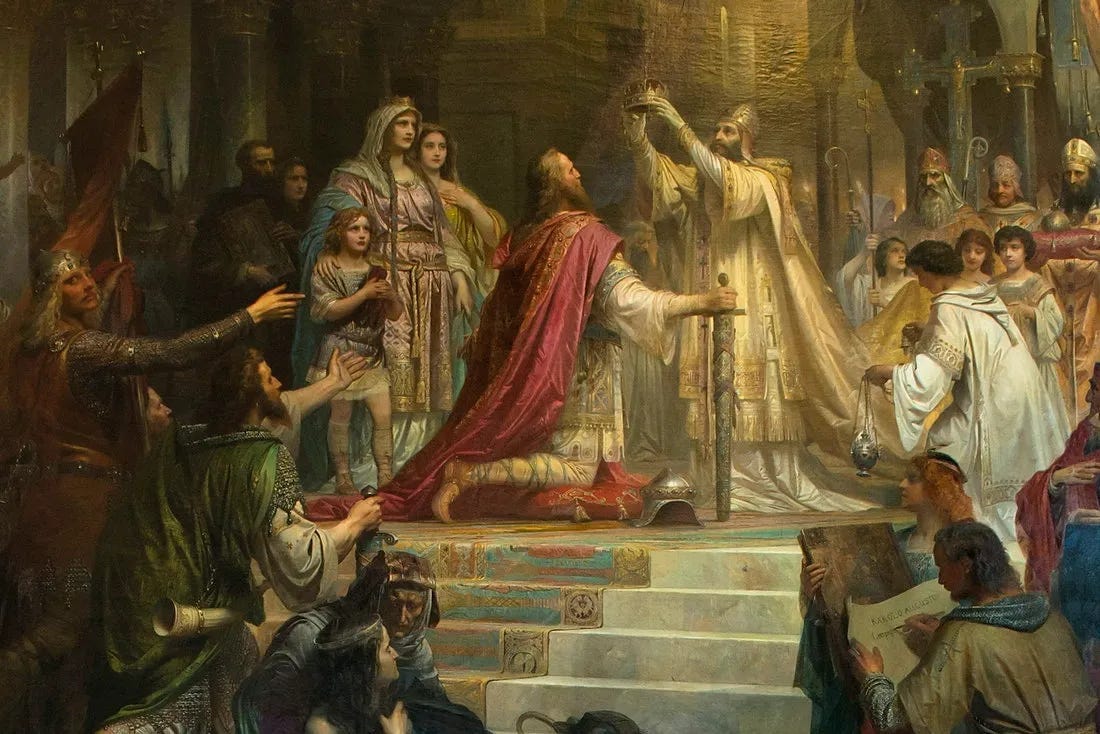
December 25, 800: As you might expect, a lot of Christian monarchs over the centuries have chosen Christmas as their coronation date. Perhaps the most famous of these occurred in 800, when Pope Leo III crowned Charlemagne “Emperor of the Romans” during Christmas mass at St. Peter’s Basilica. Traditionally it was believed that Leo did this as a surprise, in order to butter up the Frankish king (who ironically wasn’t particularly happy about being crowned). But this seems like a stretch, and most scholars nowadays tend to believe that Charlemagne knew what was coming and feigned surprise in order to appear humble.
December 25, 1100: We don’t need to get into all the various Christmas coronations, like William the Conqueror’s in 1066, but one other of interest happened in 1100, when Baldwin of Boulogne was crowned King Baldwin I of Jerusalem at the Church of the Nativity in Bethlehem. Baldwin was the brother of Godfrey of Bouillon, who was in every meaningful way king of Jerusalem but who eschewed the title of “king” in favor of “defender of the Holy Sepulchre,” arguing that Christ was the only true king of Jerusalem. High-minded religious rationales aside, Godfrey probably turned down the title in an attempt to soothe resentments among the other leaders of the First Crusade. Baldwin had no such concerns, so he accepted the title and therefore was, in an extremely technical sense, the first Crusader king of Jerusalem.
December 26, 1492: Christopher Columbus orders the construction of a fortress, Puerto de la Navidad (“the Port of Christmas”), on the northern coast of modern Haiti. The fort was the first Spanish settlement in the Americas and was built with lumber from the wreckage of Columbus’s flagship, the Santa María, which had run aground two days earlier. Although he professed no concerns about the settlement’s safety, on his second voyage Columbus returned to find the whole thing razed to the ground, along with a nearby village, and all the Spanish personnel dead. The fort’s location was eventually forgotten and, while archeologists seem to have a general sense of where it was located, the precise site remains unknown.
December 26, 1990: The Slovenian government announces the results of the country’s December 23 independence referendum, in which voters overwhelmingly opted to leave Yugoslavia. Commemorated as “Independence and Unity Day” in Slovenia.
December 26, 1991: The Soviet Union officially dissolves in a vote by the Supreme Soviet. The vote took place in compliance with the Belovezha Accords, signed earlier that month by the leaders of Belarus, Russia, and Ukraine, which declared the USSR kaput and created the “Commonwealth of Independent States” in its place. That agreement was then followed by the Alma-Ata Protocol, signed on December 21, in which the leaders of 11 of the USSR’s 15 republics (the Baltic states and Georgia were the holdouts) declared their membership in the new CIS. The breakup hastened and exacerbated the economic meltdown that attended the former Soviet states’ transition to “Shock Doctrine” capitalism.
Thanks for reading! Before you go, please consider making a donation to GiveDirectly or subscribing to the newsletter and sending half of your subscription payment to support their Rwanda campaign: