

If you’re interested in history and foreign affairs, Foreign Exchanges is the newsletter for you! Sign up for free today for regular updates on international news and US foreign policy, delivered straight to your email inbox, or subscribe and unlock the full FX experience:
This is just a reminder that FX is on its annual spring break and will be back to our regular schedule on Tuesday. Thanks for reading!
April 3, 1559: The Treaty of Cateau-Cambrésis ends the Italian War of 1551-1559, the last in a series of Italian conflicts between France and the Habsburgs, with a Habsburg victory. French King Henry II was forced to forfeit his claims on any Italian territory, but for France the war hadn’t been a total bust. The abdication (and then death, in 1556) of Holy Roman Emperor Charles V resulted in the Habsburg realm being split, with Philip II inheriting Spain and its empire while Ferdinand I inherited Austria and control of the Holy Roman Empire. This ended France’s primary national security concern, its potential encirclement by a unified Habsburg Empire. The wars wound up solidifying Habsburg control over much of what would later become Italy, with independent Venice, Genoa, Florence, the Papal States, and several other small polities sandwiched in between imperial possessions in northern Italy, which were brought into the Holy Roman Empire, and in southern Italy, which were controlled by the Spanish Habsburgs.
April 3, 1948: The United States government enacts the Foreign Assistance Act of 1948, AKA “The Marshall Plan,” earmarking $12 billion to the reconstruction of war-torn Europe. This helped quickly rebuild post-war European economies, though its impact has probably been overstated in subsequent American mythologizing. This in turn helped limit the kind of struggling that might have allowed dastardly leftists to gain political traction in Western Europe and laid part of the groundwork for NATO.
April 4, 1841: US President William Henry Harrison dies just one month after his inauguration and after a nine day bout with what modern research has suggested might have been typhoid or paratyphoid fever caused by the presence of raw sewage in the White House’s water supply. Obviously Harrison had no time to build a presidential legacy of his own, but his death and the accession of Vice President John Tyler on April 6 forced a reckoning with a bit of legal ambiguity: whether a vice president would actually become president upon succession or simply assume the “Powers and Duties of the said Office,” which is all that’s stipulated in the US Constitution. Harrison’s cabinet and Supreme Court Chief Justice Roger Taney concluded that, if Tyler took the oath of office, he would become president. This established a precedent that governed all subsequent cases of US presidents dying in office and was eventually codified in the 25th Amendment, ratified in 1967.
April 4, 1949: Founding members Belgium, Canada, Denmark, France, Iceland, Italy, Luxembourg, the Netherlands, Norway, Portugal, the United Kingdom, and the United States signed the North Atlantic Treaty, creating NATO (pending ratification by a majority of the signatories). Those original 12 states have grown to 31, so far, with the admission of Finland just a couple of days ago. This expansion has, I’m told, had no negative consequences whatsoever.
April 4, 1959: The French government creates the autonomous Mali Federation, consisting of Senegal and French Sudan. Exactly one year later, French authorities agreed to grant the federation its independence, effective June 20, 1960. The aggregated state collapsed within two months, in August 1960, leaving in its wake the independent nations of Senegal and Mali. Through all that, Senegal recognizes April 4 as its Independence Day—referring to April 4, 1960, not 1959, but April 4 nevertheless.
April 5, 1722: Dutch explorer Jacob Roggeveen, in search of a very large and very hypothetical southern continent dubbed “Terra Australis” or at least of the equally hypothetical “Davis Land,” finds instead a place he dubbed “Easter Island” after the day upon which he found it. Roggeveen’s expedition never did find either of those other places, probably because they don’t exist. But it did stumble upon a few other islands of note, including Bora Bora and Samoa, before reaching port at Batavia (modern Jakarta) later in 1722.
April 5, 1818: A rebel army commanded by José de San Martín and Bernardo O’Higgins defeats a royalist force led by Chilean Governor Mariano Osorio at the Battle of Maipú. The royalists lost around 2000 men, roughly double the casualties incurred by the rebels. Among the more decisive battles of the Spanish-American Wars of Independence, Maipú effectively secured the liberation of Chile, which meant that the Argentine-Chilean army was free to begin moving north to liberate parts of southern Peru.
April 5, 1879: The Chilean government declares war on Bolivia and Peru, kicking off the War of the Pacific. The war’s causes are still debated to some extent but certainly included disputes over control of rich nitrate deposits in the Atacama Desert and a growing competition for economic and political dominance in the southeastern Pacific Ocean. Chile emerged victorious over the Bolivian-Peruvian alliance in 1884, seizing parts of southern Peru as well as the entire Atacama and leaving Bolivia landlocked.
April 6, 46 BCE: At Thapsus, which today is in Tunisia, Julius Caesar’s army decisively defeats a somewhat larger Republican force commanded by Metellus Scipio along with a unit of allied Numidian cavalry under the command of King Juba I. Around 10,000 of the Republican soldiers are believed to have been killed, many after they’d surrendered despite orders from Caesar to treat captives well. Thapsus is known for a few things. It marked the beginning of the end of Republican resistance to Caesar in North Africa, for one thing. It’s also the last time war elephants were put to heavy use in combat in the Roman world, mostly because the Republicans deployed them in large numbers and if anything they proved to be more trouble than they were worth. Most significantly from Caesar’s perspective, the battle led ultimately to the suicides of both Cato the Younger (who was at Utica and opted to kill himself as Caesar’s army was approaching) and Metellus Scipio (who killed himself when Caesar’s naval forces stopped him from fleeing to Hispania. These were two of Caesar’s most prominent political opponents and their deaths were significant in his efforts to consolidate power in Rome.
April 6, 1250: The Battle of Fariskur ends the ill-fated Seventh Crusade. French King Louis IX (the future Saint Louis) and the remainder of his army fled their defeat at Mansurah and attempted to withdraw north to their fortress at Damietta, only to find that Egyptian ruler Turanshah had already dispatched forces north to block their path. With no way to move, Louis kept his army encamped for two months while sending out feelers to Turanshah about trading Damietta for Jerusalem, the expedition’s ultimate objective. But Turanshah had no reason to entertain any sort of deal given that the Crusaders were in an untenable position. Louis finally ordered a mad dash for Damietta, but his army was intercepted and easily defeated.
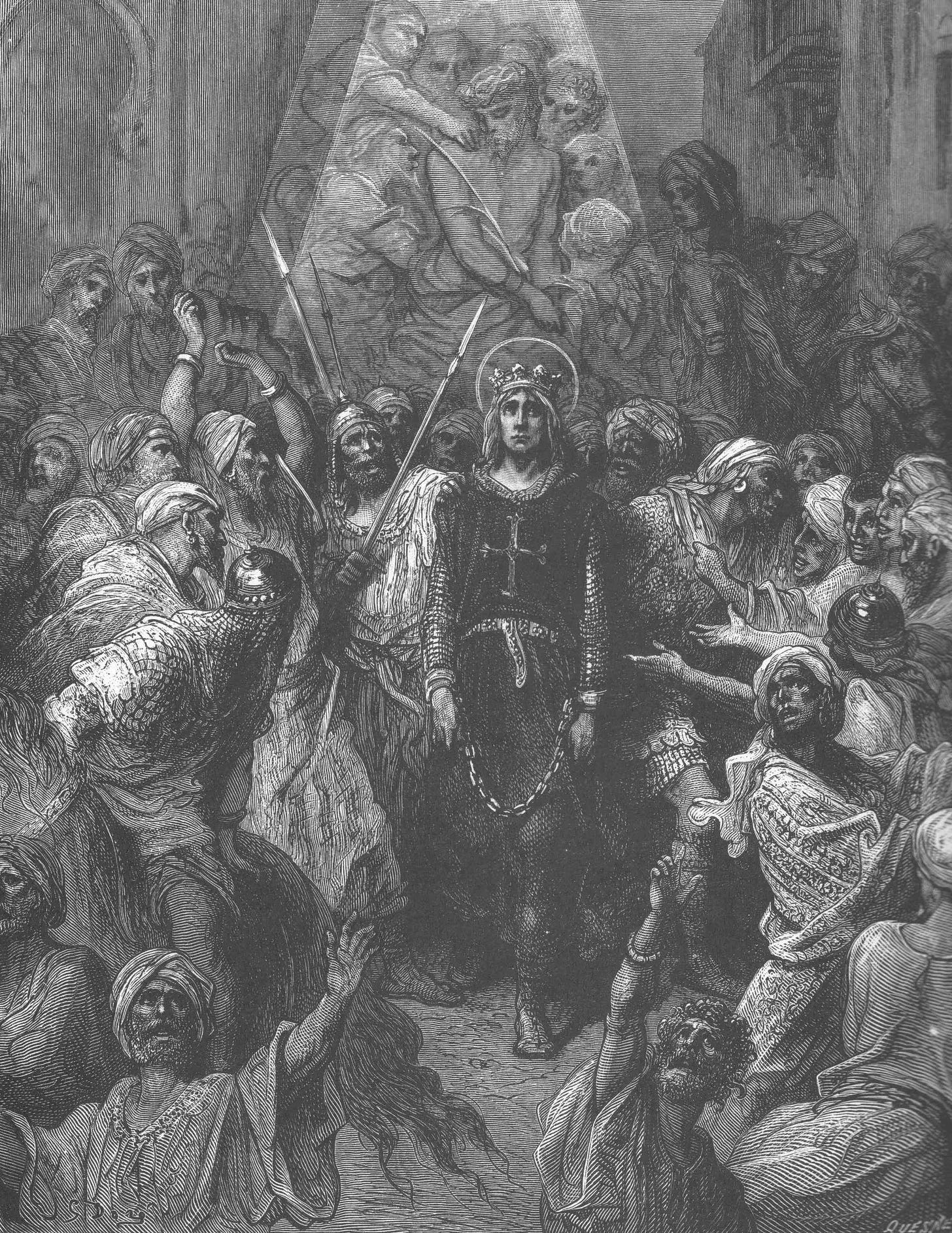
Turanshah took most of the leading Crusaders prisoner and exchanged them for a sizable ransom and the return of Damietta. He kept Louis in hopes of gaining an even more sizable ransom, but he was overthrown by his slave soldiers (the Mamluks) about a month after the battle and Egypt’s new rulers were content to free Louis for a more modest payment. He spent the next few years as the de facto ruler of Jerusalem, the Mamluks too embroiled in internal conflict to pay him much mind, before returning to France in 1254.
April 6, 1896: The Games of the First Olympiad, AKA the first modern Olympics, open in Athens. The ancient Olympic Games, believed to have begun in the early 8th century BCE, were discontinued either by Roman Emperor Theodosius I, in the 390s, or by Theodosius II, in the 420s. French educator Pierre de Coubertin (d. 1937) was the driving force behind their revival, which led to the creation of the International Olympic Committee in 1894 and the first modern Games two years later. The IOC recognizes 14 nations as having participated but there’s no conclusive record as to which 14 they were. The most commonly cited list is problematic because it includes Australia, which was still five years away from federalization and thus nationhood.