
This column is free to everyone. To receive more in depth analysis of US foreign policy and international affairs, sign up for Foreign Exchanges’ email list today! And please consider subscribing to support the newsletter and help it continue to grow:
Sovereignty is a cherished concept for the military rulers of the Sahel, and for the millions who support their rule. Between 2020 and 2023, juntas overthrew civilian governments in Mali, Burkina Faso, and Niger. The new military governments then expelled Western forces, particularly French troops but also, in Niger’s case, American ones. The juntas also rebuked the Economic Community of West African States (ECOWAS), a regional bloc that tried to pressure them into restoring civilian rule. The military governments have further asserted themselves in the economic sphere, confronting powerful foreign firms to demand greater royalties and greater control over gold, uranium, and oil.
This new Sahelian “sovereigntism” has paralleled some trends in nearby countries, including Chad and Guinea and even civilian-ruled Senegal, where an opposition victory brought a reformist president and prime minister to power in 2024. As the meaning of sovereignty is debated and contested worldwide, from Ukraine to Iran and beyond, the Sahel is on the frontlines of negotiating what it means for a country to truly rule itself. But the ultimate test, for the Sahelian juntas and the civilian administration in Senegal, lies in how much freedom they can assert vis-à-vis powerful multilateral lenders, above all the International Monetary Fund (IMF). So far, both the Sahelian juntas and the IMF seem content with maintaining familiar patterns, while in Senegal, the IMF’s disciplinarian approach is threatening to hamstring and divide that country’s leaders.
The Economics of Sovereigntism
The economic picture in the Sahel and Senegal is mixed. On the one hand, the Sahel’s military rulers inherited endemic poverty and widespread violence. Year after year, the Sahelian countries languish near the bottom of the Human Development Index—in 2023, Burkina Faso ranked 186th out of 193 countries, Mali 188th, Niger 189th, and Chad 190th. Senegal fared little better, at 169th. The Multidimensional Poverty Index shows that in Burkina Faso, over 38 percent of people live in “severe multidimensional poverty”; figures are also grim for Mali (45 percent), Niger (55 percent), and Chad (64 percent), while the picture is better in Senegal (22 percent).
In swaths of Mali, Niger, and Burkina Faso, jihadist attacks have been part of the fabric of life for a decade or more. Insurgents exercise shadow governance, extort villagers and travelers, and repeatedly attack state security forces. Even national capitals have been targeted, both before and after the coups—in January 2026, Islamic State brazenly attacked the international airport in Niger’s capital, Niamey; in late April, Jamaʿat Nusrat al-Islam wa’l-Muslimin (the Group for Supporting Islam and Muslims, JNIM) and the Azawad Liberation Front (FLA) launched coordinated attacks across much of Mali, killing the country’s defense minister among many others and seizing a number of towns and military bases. In addition to the human losses caused by insurgents, the economic losses have been considerable. Insurgency complicates everything from agriculture to transportation. Starting in September 2025, for example, a JNIM blockade choked off most fuel supplies to Mali’s capital Bamako, lasting for months. An even more severe siege may now be imposed.
On the other hand, by certain measures the Sahelian economies are booming. During the 2010s, there was rapid albeit uneven growth. Senegal, Mali, Burkina Faso, and Niger all took hits during COVID-19, and coup years brought economic instability and sanctions. Yet growth has rebounded: in 2024, according to the World Bank, overall growth of gross domestic product reached 4.8 percent in Burkina Faso, 5 percent in Mali, 6.1 percent in Senegal, and 10.3 percent in Niger.
This growth is largely driven by “extractives”—gold, uranium, oil, and/or natural gas, as well as lithium, manganese, and other minerals. The Sahelian countries have agriculture and some manufacturing and services, but extractives are the focus of economic and political energy. In Senegal, for example, President Diomaye Faye’s pledges for transformation rest partly on whether the Greater Tortue Ahmeyim liquid natural gas project, which has already hit some snags since its launch in 2024, meets expectations. Senegal also has a growing gold sector.
Invoking sovereignty, and drawing on longstanding grievances about how profits are distributed, the military regimes of the Sahel have confronted multinational firms. For example, Mali implemented a new mining code in 2023, permitting the state to own up to 30 percent in mining projects, with another 5 percent reserved for Malian investors. Mali’s military authorities assertively targeted Canada’s Barrick Gold in particular, detaining executives and confiscating some $400 million worth of gold; ultimately, Barrick committed to paying some $430 million and has resumed operations in Mali. Disputes over mines, profits, and resources have also occurred in Burkina Faso and Niger.
Despite the risks for multinationals, the Sahelian countries continue to attract new investments in gold and other extractives. Even the Trump administration is trying to get in on the action, with the recently appointed “Senior Bureau Official” for Africa, Nick Checker, traveling to the Sahel to court the authorities there, promising to respect their “sovereignty.” Meanwhile, rising resource revenues are allowing the military regimes to redistribute some wealth—potentially shoring up their popularity even as insecurity rages.
All of this brings us to the question of the IMF. Exercising sovereignty vis-à-vis French troops and multinational mining companies has been surprisingly easy. But what about the international financial institutions (IFIs) that have profoundly shaped the Sahel’s economic structure and destiny since the 1980s? To answer that question, a quick historical overview is in order.
The IFIs and the Sahel: A Brief History
In West Africa and beyond, the World Bank and the IMF are heavily associated with the “structural adjustment” programs of the 1980s and 1990s. A September 1989 article in the IMF’s magazine Finance & Development laid out the core elements:
The structural policies in most countries will need to include exchange rate action, reform of the exchange and trade system, liberalization of domestic pricing and marketing policies, financial sector reform, restructuring of public enterprises, reductions in labor market rigidities, strengthening of public investment programming, restructuring of the tax system and public expenditure, and improvements in interest rate policy. To complement the structural policies, balanced fiscal and monetary policies will need to be implemented.
For critics, structural adjustment destabilized African economies and immiserated their people by floating and devaluating currencies, exposing developing economies to chaotic influxes of foreign capital, and, above all, cutting state services and public sector employment. The evidence is strong that structural adjustment not only caused economic harm (see also here), but also undercut the social contract between states and citizens, leaving the latter with fewer protections even as the advent of multi-party democracy in the 1990s promised greater freedom.
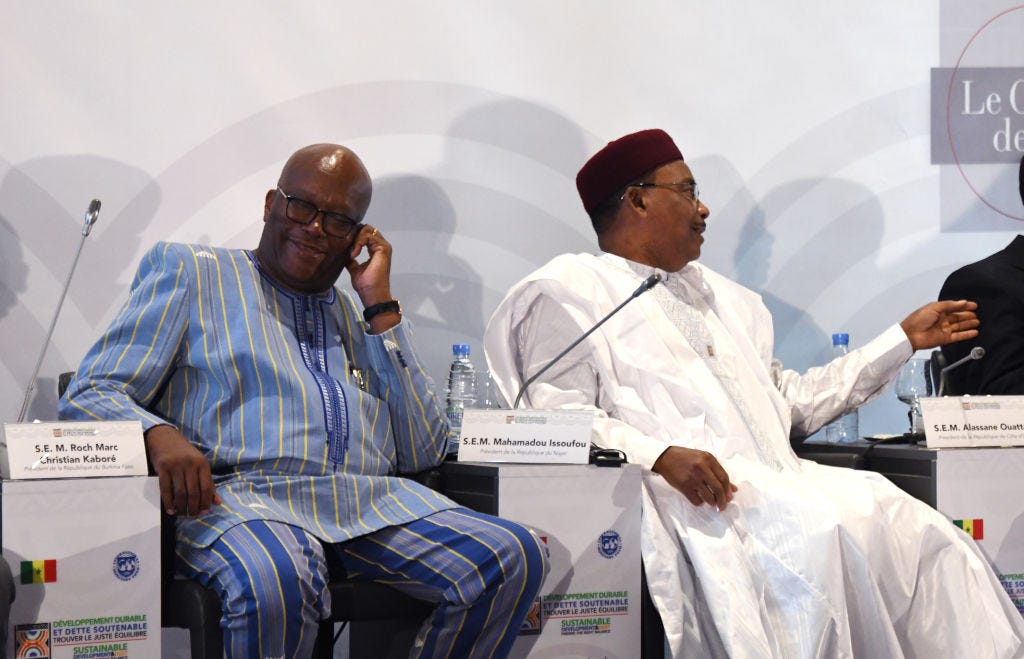
Across the Sahel, structural adjustment overlapped and interacted with the rise of a new “political class”: technocratic, managerial elites who transitioned from professional perches in the 1980s into party politics in the 1990s. Some of the leaders overthrown in the coups of the 2020s—Mali’s Ibrahim Boubacar Keïta and Burkina Faso’s Roch Kaboré—had front-row seats for structural adjustment in the 1980s, when Keïta was a development consultant for the European Union and Kaboré headed Burkina Faso’s International Bank. Even many left-wing Sahelian thinkers were borne along by the winds of change: one was Mohamed Bazoum, who would later be overthrown in the Nigerien coup of 2023. The Nigerien essayist and political scientist Rahmane Idrissa recalls encountering Bazoum, then a Marxist, as his high school philosophy teacher. But by 1991, Bazoum
was speaking earnestly of democratic change, political rights and freedoms — he was being what the French would call républicain, i.e., a liberal with a strong sense of the rights of a citizen. That was new. But what struck me most was that Marx was conspicuously absent. I soon realised that Bazoum’s transformation was part of a wider pattern: people were suddenly taking up all sorts of stances that hadn’t even seemed to exist the year before. Like him, some committed intellectuals evolved from ‘comrades’ to ‘citizens.’
As the “Washington Consensus” became the dominant economic paradigm in the world, prioritizing “free trade” and trim government budgets, the Sahel became “neoliberalized” economically and also politically. Privatization and austerity in the economic sphere paralleled the rise of amorphous, personalized parties in the political sphere.
Since the 1990s, the IFIs have gone through rhetorical shifts and have taken on new stated priorities, especially poverty reduction, but the underlying frameworks have largely remained the same. In the Africa of the 2020s, the “economic reform” programs underway in countries such as Nigeria and Ethiopia strongly resemble the structural adjustment programs of forty years ago.
To return to our main question, then, how have the military regimes of the Sahel and the IFIs—particularly the IMF—approached each other? And what is the relationship like in Senegal, where a populist new leadership has promised sweeping economic change that will benefit ordinary citizens?
The Juntas and the IMF
The Sahelian coups of the 2020s led various lenders, bilateral and multilateral, to suspend or curtail loans and aid to Mali, Burkina Faso, and Niger. The World Bank, for example, paused payments to Mali in 2021 as the military deepened its grip there. The Sahelian juntas have faced a web of sanctions and suspensions that sought, unsuccessfully, to compel them to give power back to civilians. The military leaders consistently defied even the toughest sanctions, such as those imposed by ECOWAS on Mali in early 2022 amid a showdown over the transition timetable.
The IMF, however, has had more continuity than change in its relations with the Sahelian countries. In 2025 and 2026, for example, the IMF has made or approved several significant disbursements: a $129 million bailout to Mali, approved in April 2025; disbursements to Burkina Faso totaling $157.5 million, covering the period 2026-2027; and a likely disbursement of $91 million to Niger.
What does the IMF expect from the Sahelian countries? Here one must read between the lines of the IMF’s dry, technical, and often euphemistic language. The repeated use of words such as “prudence” and the recurring valorization of the “private sector” in IMF documents point to the Fund’s continued neoliberal emphasis. One representative passage from a 2025 report on Mali reads:
With fiscal revenues curtailed, aid flows sharply reduced, and uncertainty high, Mali is forced to “do more with less.” This means calibrating fiscal tightening that protects growth and shield the poor, stepping up domestic revenue mobilization, improving the quality of spending, and avoiding policy missteps that could exacerbate the situation and jeopardize future growth prospects. Over the medium term, the authorities’ highly aspirational development vision calls for a bold reform agenda, including strengthening governance and the business climate, enhancing public investment management, spurring private sector dynamism, attracting foreign investment, and diversifying the economy. Meeting these needs entails clearing structural bottlenecks, managing risks, and re-engaging development partners for concessional support.
The IMF nods to the poor, but the ultimate emphasis is on “fiscal tightening” and “the business climate.” The IMF urges the Sahelian countries to reduce deficits and prioritize reforms that appeal to foreign investors and external funders. It does not call for slashing all public expenditures, but it does call for substantial streamlining.
The same report continues, “A sustainable, growth-friendly adjustment requires boosting domestic revenue mobilization, and, on the expenditure side, ‘doing more with less’ by curbing waste, improving spending efficiency, prioritizing high-impact social programs, and rationalizing costly subsidies.” On the surface, this makes sense—waste and inefficiency are bad. But who determines what it means to be effective, efficient, and rational? Does “curbing waste” mean firing public sector employees? If the subsidies are “costly” for the state, who bears the costs when they are cut?
Buried in the document are the specific recommendations: “targeted hiring freezes, attrition-based staffing, and a unified, performance-based pay scale” within state-owned firms, as well as “phasing out broad subsidies on fuel and electricity in favor of targeted social transfers.” The IMF seeks to steer Sahelian authorities towards lean, investor-friendly “reforms”; predictability and “efficiency” matter most. Notably, amid the fuel blockade imposed by jihadists, Mali has already cut some subsidies on fuel as recently as March.
The IMF appears dispassionate concerning military rule and the question of human rights. While many other major Western institutions and donors took (again, unsuccessfully) a moralizing line towards the Sahelian juntas, seeking to discipline them by withholding aid, the IMF prioritizes its version of economic stability. Indeed, the Fund’s attitude towards the juntas seems considerably friendlier than its posture towards civilian-ruled, largely democratic Senegal.
The IMF and Senegal’s Would-Be Reformers
From 2012 to 2024, Senegal’s president was Macky Sall, a petroleum engineer turned career politician. Under Sall, and especially during his first term from 2012 to 2019, Senegal’s economy grew strongly, but critics—such as the prominent economist Ndongo Samba Sylla—saw Sall’s “Emergent Senegal” policy framework as hollow. In a 2022 interview, Sylla commented that the plan was “just a list of infrastructure projects. It has mainly benefited French companies.” Sylla added that amid Senegal’s heavy indebtedness, “We pay the current debt by issuing new debt. Since independence, that has been the development model of Senegal.” Under those pressures, “Our government’s logic is that they ‘lack funding’, so they have to make the country attractive for foreign investors and capital.”
Throughout Macky Sall’s presidency, meanwhile, rising stars of the opposition repeatedly found themselves in the crosshairs of the legal system—three times, court cases kept a key opposition figure from running for president. Sall won re-election easily in 2019. At the end of his second term, he appeared reluctant to leave power; he postponed elections, but then backtracked under domestic and international pressure. His preferred successor, then-Prime Minister Amadou Ba, lost decisively to Diomaye Faye, a reformer and (at the time) close ally of Sall’s most vociferous opponent, Ousmane Sonko. Blocked from running for president due to legal battles connected to allegations of rape and disturbing public order, Sonko instead became Faye’s prime minister.
Sonko, Faye, and their political party—African Patriots of Senegal for Work, Ethics and Fraternity, or PASTEF—emerged as a political force in the 2010s. With backgrounds in the civil service, Faye and especially Sonko made names for themselves by denouncing corruption (including in the petroleum and gas industry) and calling for a fundamentally new economic model for Senegal.
Sovereignty, especially economic sovereignty, has been a key concern for Sonko and PASTEF, both before and after coming to power. In a 2025 speech reflecting on the life of Frantz Fanon, Sonko said, “The colonizer left but the debt remained. The colonial administration withdrew but unequal agreements stuck. The governors disappeared but the injunctions of international financial institutions took over.” After taking office, Faye and Sonko scored several quick wins on political sovereignty, sending some French troops packing while eliciting, from French President Emmanuel Macron, contrition over a 1944 massacre by French forces in Senegal.
Yet in the economic sphere, the transformative ambitions of Faye and Sonko (who are, to complicate matters, now at odds with one another) have been impeded, even thwarted, by the IMF. Upon taking office, Faye’s government audited various sectors, including public finances, and revealed massive, “hidden debt” of some $7 billion under the previous administration. In response, the IMF suspended a $1.8 billion loan in October 2024, just six months after Faye came to power. Since then, Faye’s government has been negotiating with the IMF, with Sonko decrying the kinds of conditions the Fund wants to impose. Those conditions include the IMF’s perennial favorites: budget austerity, and especially cutting subsidies. The IMF has also broadly favored plans to raise taxes, although institutionally it prefers cuts. “Ambitious revenue mobilization,” the Fund warns, should be subject to “cautions projections.” Overall, the Fund urges “a balanced approach [that] would help preserve high-impact investment and well-targeted priority spending, which are essential to maintain credibility and safeguard growth.” The references to “balanced” and “well-targeted” scan, to me, as euphemisms for austerity.
Senegal faces what the economist Abdoulaye Ndiaye describes as three broad paths: paying the debt no matter the cost, defaulting, or turning to new, non-Western lenders. The government has, according to recent reporting from the FT, started down that third path, “covertly borrow[ing] hundreds of millions of dollars from international institutions that it has not publicly disclosed.” Senegal faces fraught choices, both on the international scene and domestically; Sonko is threatening to resign from government if Faye defers to the IMF on debt restructuring. A meeting between Senegalese officials and the IMF in Washington in April appeared to bring little progress, all as Senegalese authorities proclaim that they are offering “total transparency” about the country’s debt. Back home, rising costs have sparked some protests, all as the approach of the 2027 elections could bring the final break between Sonko and Faye.
Amid this turmoil, one cannot help but be struck by the IMF’s relative friendliness to the military-ruled countries of the central Sahel, in comparison to its frosty, disciplinarian attitude towards Senegal.
Sovereigntism’s Limits
Where does this leave sovereigntism in the Sahel and West Africa? Its limits are defined by who dictates governments’ budgets. The sweeping changes that the Sahelian countries have made in the military and political spheres—ending long-running Western security deployments, training programs, and more—have been paralleled by a large degree of continuity in the their relations with the IMF. The juntas have asserted themselves vis-à-vis foreign energy and mining firms, but have been status quo actors when it comes to public spending.
One wonders where the bulk of new royalties from gold, uranium, and oil will really flow, and whether ordinary Sahelians will end the decade any better than they began it. The juntas, all three of which plan to remain in power through at least 2030, have been normalized by the IMF and, increasingly, by the United States. Meanwhile, a reform program in Senegal faces the growing prospect of defeat at the IMF’s hands. There are major lessons here about where power ultimately lies.