

This column is free to everyone. To receive more in depth analysis of US foreign policy and international affairs, sign up for Foreign Exchanges’ email list today! And please consider subscribing to support the newsletter and help it continue to grow:
In early September, The New Humanitarian’s Obi Anyadike reported that the Nigerian government and Boko Haram had agreed to a ceasefire in June 2026 and were considering extending the deal. Boko Haram is the broad name for an insurgency that has troubled Nigeria since 2009, especially in the northeastern part of the country. “Boko Haram” is a nickname given by outsiders. The group was known by various monikers throughout its history, including, after its full transformation into a jihadist rebellion, as Jama‘at Ahl al-Sunna li-l-Da‘wa wa-l-Jihad (JAS), which we might loosely translate as “the Group of Real Sunnis Who Preach and Fight.” In 2016, Boko Haram split over ideology, power, and personalities, as well as over who would control the group’s relationship to Islamic State’s central leadership. Since 2016 — including in the context of this reported ceasefire — “Boko Haram” now often refers to JAS, but can also refer to the insurgency as a whole, depending on the speaker. The other faction, Islamic State West Africa Province (ISWAP), is widely considered more sophisticated, but JAS still matters militarily.
If the deal exists and holds, it would likely be better, overall, than not having a deal. Reductions in violence are worthwhile to save lives and allow for economic rejuvenation; limited negotiations can open space for broader negotiations; and containing one threat could give Nigerian authorities more space to deal with other crises. With that said, this particular deal could come with a host of risks and challenges that Nigerian authorities would need to manage with tremendous care.
A Deal for What?
Within this bifurcated insurgency, and within Nigeria’s long-running and multifaceted security crisis, a deal with JAS would be significant but not in and of itself enough to restore order. According to Anyadike and his sources, Nigerian authorities hope to give themselves some breathing room to address other priorities, including the fight against ISWAP. Also important is that the reported deal originated in negotiations over ransoming victims of a mass kidnapping by JAS. Such kidnappings have been commonplace in Nigeria, often flummoxing the authorities or necessitating costly and delicate rescues or ransoms, all while panicking citizens and undermining the basic functioning of schools, a regular target. A ceasefire offers the authorities partial reprieve from a highly disruptive and reputationally damaging pattern of kidnappings.
Meanwhile, Anyadike contextualizes the deal within a much longer, well-known Nigerian history: “Buying off opponents has also been the traditional approach of the Nigerian political establishment, from ending the insurgency in the oil-rich Delta in 2009, to ongoing attempts to try and contain bandit violence in the northwest.” If negotiating with one of the most hardline groups in the world seems unusual, in many ways the reported payoff at the heart of the deal is a very familiar maneuver in Nigeria and elsewhere.
There is, moreover, a political shadow hanging over the reported deal. Anyadike does not say whether the authorities’ pursuit of a deal relates to the approach of general elections in January/February 2027, but he alludes to the issue: “President Bola Tinubu,” he writes, “has instead announced the beefing up of an overstretched army — an initiative related to elections early next year in which public safety will be a key issue.” Does Tinubu, who received the lowest vote share of any elected Nigerian president in history in 2023, plan to trumpet military expansion publicly while cutting deals in private, all in order to smooth his path to reelection?
Although Tinubu hails from Lagos State, Nigeria’s commercial hub in the far southwest, the north has long been key to his electoral strategy. After serving as Lagos’ governor from 1999-2007, Tinubu spent years laying the groundwork to build the All Progressives Congress (APC), a coalition of opposition parties that coalesced in 2013 and that is more or less a partnership between the north and the southwest. That coalition propelled the APC to a dominant position in 2015, when its candidates won the presidency and a majority of governorships. That coalition wobbled in 2023, but Tinubu held enough of the north to win a plurality of the overall vote and to meet the required constitutional threshold of at least 25% of the vote in at least two-thirds of the states. Tinubu’s vice president hails from Borno, the northeastern state most affected by the Boko Haram/ISWAP insurgencies. Tinubu won 54% of the vote in Borno in 2023, one of his few outright victories in the far north. Holding Borno could be critical to his re-election, as could a diminution (however temporary) of overall violence in the months leading up to the national vote. Borno is one of just twelve states (out of Nigeria’s thirty-six) where Tinubu will be appearing in person to campaign this time.
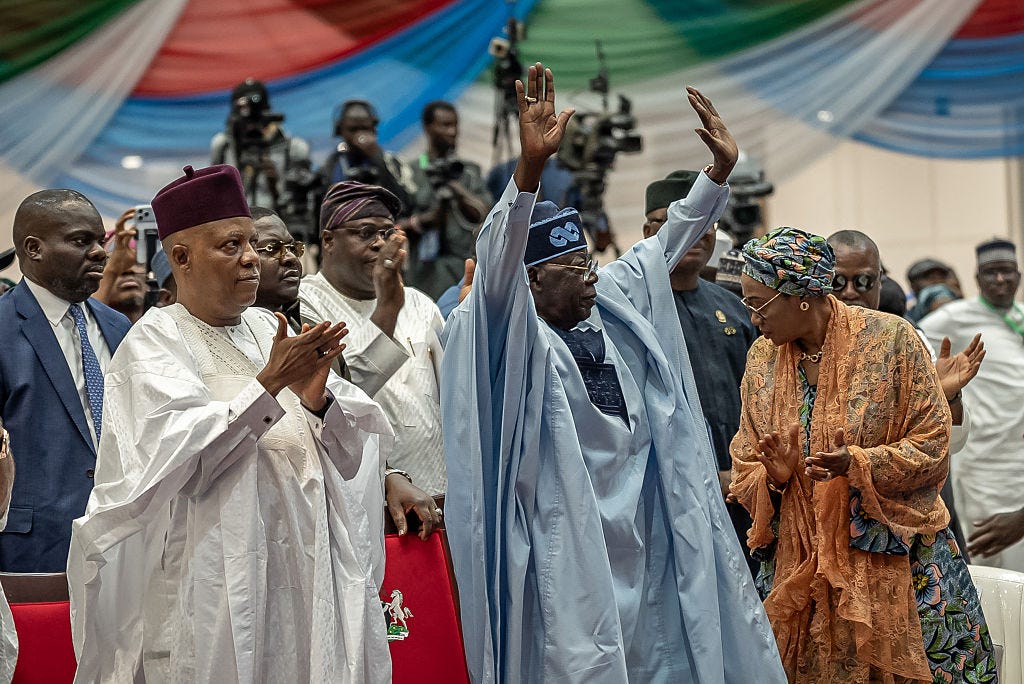
If Tinubu has in mind an election-related ceasefire, there are reasons to be cautious. In Burkina Faso, again according to The New Humanitarian’s exclusive reporting, the administration of President Roch Kaboré pursued a ceasefire with jihadists to facilitate the conduct of the 2020 elections. Kaboré won re-election, but violence soon resumed and escalated, paving the way for a coup that overthrew his government in 2022 as soldiers disgusted with battlefield losses turned on their civilian leader. Tinubu, who faced an alleged coup plot in September 2025 — perhaps the most serious plot since Nigeria exited military rule in 1999 — faces threats other than losing the election.
A Matrix of Risks
The comparison with Burkina Faso is just one of many that might be drawn with the Sahel region, which abuts Nigeria, and beyond. In the history of the region, there are four recurring risks associated with dialogues and ransoms. First, a deal in one place can push militants to attack elsewhere. In Algeria, a 1991-2002 civil war wound down in a complex manner involving massive violence by the security forces and militants, but also a reconciliation and amnesty initiative; as militants found themselves isolated within Algeria’s new political and security order, the remaining hardliners increasingly targeted the Sahel. Approximately a decade later, Mauritania’s dialogues with imprisoned jihadists, which paralleled efforts to enhance internal security, contributed to pushing remaining hardliners to seek their fortunes in Mali and beyond. In the present scenario, Nigeria’s gains could be losses for Niger, Chad, and Cameroon, countries that have already been affected on and off by Boko Haram factions.
Second, today’s ceasefire or hostage deal could pave the way for tomorrow’s massive attack. In Mali, a United Nations expert report concluded that a reported $50 million ransom payment to jihadists in Jama‘at Nusrat al-Islam wa-l-Muslimin (the Group for Supporting Islam and Muslims, JNIM) helped enable a devastating set of attacks on military and government targets in April 2026. Anyadike’s interlocutors suggest that JAS may take advantage of the current ceasefire to grow more powerful: “Two sources who told The New Humanitarian about the deal warned that Boko Haram may be using the ceasefire to strengthen its position, potentially by moving ‘equipment’ into the Mandera mountains.”
Third, public discussion of a deal can create opportunities for hardliners to outflank those who negotiate, criticizing them publicly and siphoning off recruits. In Mali in 2020, both the civilian government of President Ibrahim Boubacar Keïta and the leadership of JNIM said they were willing to talk. That development was positive for Mali and the Sahel might look more stable today had a military coup in August 2020 not interrupted some momentum towards dialogue in Mali — yet at the same time, there were downsides to the dialogue, including the way the local Islamic State affiliate harped on it to enhance its position within its intra-jihadist competition with JNIM. In Nigeria, would-be negotiators within JAS could find themselves vulnerable to critics from inside their own faction, from ISWAP, or elsewhere.
Fourth, a botched deal can breed deeper mistrust between governments and militants. Attempted dealmaking throws open the door, on both sides, to various intrigues, rumors, and machinations by spoilers. A failed deal can lead to intensified violence and make the next round of negotiations harder. Mali in 2020, and Burkina Faso the same year, both furnish examples of limited dialogues that collapsed into more brutal conflict. If the best case scenario for Nigeria involves containing JAS while stepping up the campaign against ISWAP — perhaps aiming to bring them to the negotiating table too — then the worst case scenario could involve even bleaker levels of insecurity on the heels of a broken ceasefire.
A Controversial Deal, and a Controversial Report
Anyadike’s reporting has generated intensive conversation within and beyond Nigeria. Assessing whether violence has declined because of a ceasefire is not easy: the Armed Conflict Location and Event Data Project notes that JAS’ attacks have indeed fallen in recent months, but that the drop began before June. Meanwhile, JAS has denied Anyadike’s report: a top judge for the group, as HumAngle’s Aliyu Dahiru reports, called the story a “lie.” JAS’ statement does not end the conversation, of course: the leadership could itself be lying, perhaps in order to avoid the exact reputational risks for militants that I mentioned above. Dahiru goes on to add that “Sources familiar with the events told HumAngle that a small Boko Haram team may have agreed to the government’s request without first securing approval from the group’s leadership. The concession was made during negotiations for the release of the captives.”
Various Nigerian commentators and analysts, some of them directly familiar with the negotiations, have also weighed in; the veteran analyst Fulan Nasrullah argues that negotiators for JAS would not have gotten out in front of the group’s leadership, while saying that a deal was negotiated with JAS leadership but diverging from Anyadike on whether the ceasefire is likely to be extended. Even just reading Anyadike’s report, HumAngle’s report, and Nasrullah’s commentary, one gets a flavor of the many claims and counterclaims jostling for audiences’ attention and credence. Consider then how this rumor-laden environment could feed back into the tense internal debates within the Nigerian government and within JAS over whether and how to pursue a ceasefire, and one quickly sees how easily any deal could break down.
One basic and longstanding problem in both analyzing Boko Haram and devising policies to counter it is this issue of the information environment itself. Policymakers, intelligence agencies, analysts, researchers, journalists, NGOs — many people claim to have insider sources within Boko Haram’s factions. But who speaks for the groups? Who can commit to a deal? Who lies? Who says one thing to one audience and another thing to a different audience? Alongside his reporting on the present, Anyadike has written a chronicle of past dealmaking efforts, which Nasrullah has also questioned and critiqued at length in his analysis linked above. From both Anyadike’s chronicle and Nasrullah’s critique emerges a sense of just how much mistrust runs through the whole saga: ultimately, after all, these negotiations come back to questions of paying people off, helping officials win and hold power, empowering Nigerians and non-Nigerians in insider bureaucratic power struggles, and more. Thinking about why negotiations never worked is a window into understanding, ultimately, why the insurgency stands at seventeen years and counting, and has proven capable of reproducing itself across generations.
What Next for Nigeria?
There are less than three months to go before presidential elections in January. Nigeria is in grim shape, as can be seen in the security crisis and in the rising poverty — all despite Tinubu’s “economic reform program,” which has been celebrated by international investors while imposing new hardships on ordinary people. Coming into office with weak legitimacy and failing to make meaningful improvements for the mass of citizenry, one might expect Tinubu to go down badly in his bid for re-election. Instead, the president may stitch together a complex and successful strategy amid a stale and fragmented roster of challengers and a demoralized electorate. The trends in the northeast, in terms of violence and voting, are just one part of that picture — but a ceasefire, if it exists, could well be part of “muddling through” in the near-term only to face the same entrenched problems of insecurity and precarity on the other side of the elections.
At the same time, there is something refreshing about seeing serious, public discussions about the merits and demerits of negotiations. The swagger and spectacle of the War on Terror, including Nigeria’s own domestic version of it and the version that Donald Trump has intermittently tried to export there, have not completely blotted out a capacity for thinking about non-violent options — which are desperately needed after nearly two decades of brutal but grossly ineffective military operations against militants. I will end by hoping that a ceasefire is more than just a tool in Tinubu’s electoral arsenal, that JAS has a flexible posture behind the scenes, and that some degree of war fatigue will push both the government and the militants to find a path towards sustainable peace.