

You’re reading the web version of Foreign Exchanges. If you’d like to get it delivered straight to your inbox, sign up today:
In lieu of a normal roundup I’m going to focus on the US-Israeli war with Iran and save other stories for tomorrow/Tuesday. The tone is also going to be a bit different from my usual writing. Please bear with me as there’s a lot to cover and I’m doing this on the fly.
When he hopped on to social media early Saturday morning to announce the start of another US/Israeli military attack on Iran, Donald Trump made a little verbal slip. In referring to the possibility of US casualties in this campaign, he said “the lives of courageous American heroes may be lost, and we may have casualties. That often happens in war.” You’re not supposed to refer to these sorts of things as “wars” when you’re the president of the United States, at least not at their outset, because by law wars have to be declared by Congress. Presidents have leeway to engage in military action prior to a congressional vote but only in self-defense, which was plainly not the case here even if one were to stretch that term beyond all comprehension.
I note this not to advance some insipid procedural argument, as many prominent members of the Democratic Party has been fond of doing over the past two days in a desperate attempt to avoid saying anything meaningful. I note it because it’s an indication, if one were needed, that Donald Trump is an exceedingly stupid person who by virtue of his stupidity can’t manage to stick to the typical obfuscatory political language that past presidents have used. Even George W. Bush, no genius himself, didn’t make this slip—he used the word “war” two times in his speech to mark the invasion of Iraq, both times in reference to Saddam Hussein’s moral shortcomings rather than to what he’d just ordered the US military to do.
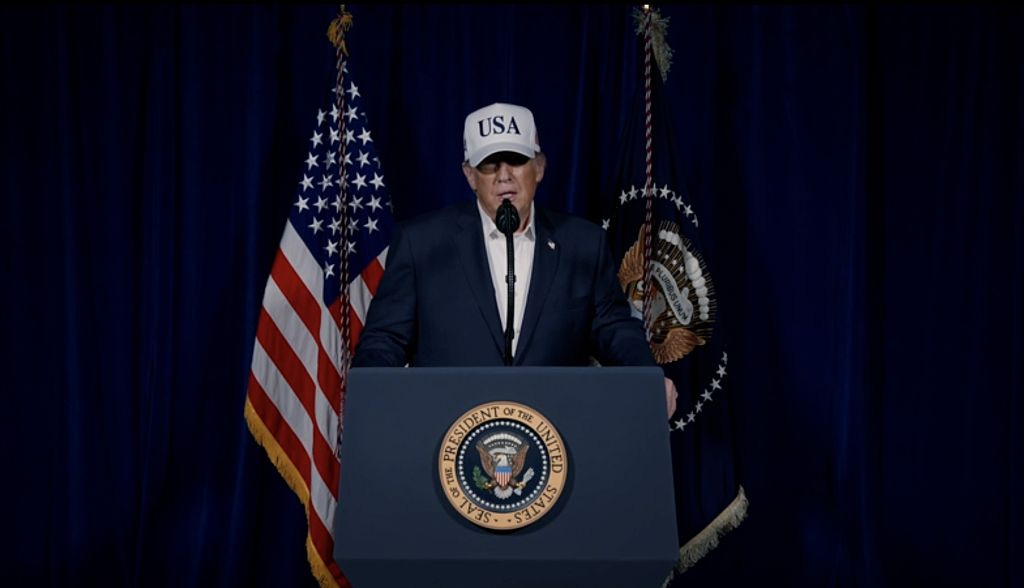
Sometimes Trump’s stupidity can be funny or even revealing, as when he blurts out in public something that people in his administration would prefer to keep private. But in general it’s not comforting to be led into war by a dullard. And yet here we are. That’s just a random thought I had on Saturday. Anyway let’s try to unpack this situation.
What’s Happened So Far?
As you are no doubt aware, the US and Israeli militaries launched another attack on Iran on Saturday morning (Tehran time). As I write this, on Sunday evening in the eastern United States, the Iranian Red Crescent Society says that US and Israeli strikes across 24 Iranian provinces have killed at least 201 people and wounded 747 others. Those figures have not been updated since Saturday and are surely out of date by now but I do not have anything more current to offer at this time. The largest portion of those deaths occurred in one early attack—let’s generously call it an errant one—that struck a girls’ elementary school in the southern Iranian city of Minab. The death toll in that incident now stands at 165 according to Iranian media, though it has steadily risen over the past two days while the overall death toll has remained the same, so clearly there is a disconnect between those figures.
Among the dead is Iranian Supreme Leader Ali Khamenei, also apparently killed in an early Israeli salvo. According to Donald Trump, US and Israeli attacks have killed 47 other Iranian leaders, though he hasn’t named all of them and I have no idea how he’s defining “leader” so that could mean anything. We do know a few of them, though, like security adviser Ali Shamkhani, Iranian military chief of staff Abdolrahim Mousavi, Defense Minister Aziz Nasirzadeh, and Islamic Revolutionary Guard Corps commander Mohammad Pakpour. Aside from Shamkhani, whose role was more unofficial these days, they will be replaced. Anyway, more on Khamenei in a moment.
In contrast with the Iranian response to last year’s “12 Day War,” in which its forces attempted to overwhelm Israeli air defenses with massive barrages of drones and missiles, this time around Tehran has maintained a steady but fairly moderate stream of strikes that have killed at least nine Israelis at last count. The Iranians have instead focused significant firepower on the Gulf Cooperation Council states (Bahrain, Kuwait, Oman, Qatar, Saudi Arabia, and the UAE), starting initially by attacking US military facilities in those countries but eventually expanding their targeting beyond that to include civilian sites. I’ll discuss that in more detail as well, but the upshot right now is that those attacks have killed at least three people in the UAE and one person in Kuwait. Al Jazeera is running a tracker, though I don’t know how frequently they’re updating it. Three US service members have been killed—the details have not been made public yet as far as I know—and an Israeli or US attack killed at least two Iraqi militia fighters on Saturday.
Latest Developments
There are a few things that have happened on Sunday that I feel we should note but that I can’t fit anywhere else in this post:
Quite a number of protests over Khamenei’s killing have broken out in cities outside of Iran. The most significant appear to have taken place in Iraq, where police used riot control weapons to stop a crowd from entering Baghdad’s “Green Zone” and marching on the US embassy, and in Pakistan, where security forces have killed at least 23 people in protests in several cities. Demonstrators in Karachi marched on the US consulate in that city and in Skardu they set fire to a United Nations office.
The IRGC claimed on Sunday to have successfully attacked the USS Abraham Lincoln, an aircraft carrier parked in the Arabian Sea. The US military’s Central Command has denied that claim and I haven’t seen any independent sources verifying what the IRGC alleged.
Israeli officials are claiming that “projectiles” were fired into Israel from southern Lebanon on Monday morning. An Israeli retaliation is already underway though I don’t have any details beyond that.
The Israeli government announced the closure of all checkpoints into Gaza on Sunday, ostensibly for security reasons. It is insisting that Gaza now has plenty of food because of increased humanitarian aid shipments under the current ceasefire. But the Israelis have never met their humanitarian obligations in that framework and their assertion that there’s enough food in the territory is not backed by any evidence.
What’s the Goal?
One of the common refrains in the weeks leading up to this war was “what does Trump want?” A nuclear deal? A “bigger” deal? Regime change? Two days into the war the answer is: who knows? Does Trump himself know? I have my doubts. Let’s sample his comments since the shooting started:
In his war-opening remarks, Trump told “the great, proud people of Iran” that “the hour of your freedom is at hand.” He called on them to “take over your government, it will be yours to take.” This is regime change rhetoric, though it’s putting the actual work and risk of changing regimes on the Iranian people rather than on US forces. Khamenei was among the first Israeli targets, which reinforces that these operations were meant to topple the Iranian government.
By Saturday evening Trump had given an interview to Barak Ravid at Axios in which he floated the idea of halting the war as it was barely getting started. Explaining that he had several “off ramps” from the conflict, Trump said that he could “go long and take over the whole thing, or end it in two or three days and tell the Iranians: ‘See you again in a few years if you start rebuilding [your nuclear and missile programs].’” Hopefully no Iranians decided to take Trump up on his call to overthrow their government, because a few hours later he was already talking about making a deal with that same government.
On Sunday, Trump told The Atlantic that Iranian leaders—whoever those are at the moment (we’ll get to that”)—“want to talk, and I have agreed to talk, so I will be talking to them.” So negotiations it is?
Also on Sunday, Trump told The Daily Mail that the war has “always been a four-week process. We figured it will be four weeks or so. It's always been about a four-week process so — as strong as it is, it’s a big country, it'll take four weeks — or less.”
Trump then hopped back on social media with another address in which he said that the war will continue until “all objectives are achieved.” What are those objectives? Trump suggested they were about Iran’s supposed threat to the US, a concept that rests on Iran’s possession of nuclear weapons and intercontinental ballistic missiles. Iran doesn’t have either of those things nor is there any evidence it’s anywhere close to developing them. Also US forces are apparently trying to sink Iranian naval vessels.
Amid these remarks, Ynet’s Nahum Barnea reported on Sunday that “through a mediator, apparently Italy, [Trump] suggested reaching a ceasefire agreement today or tomorrow. Iran rejected the idea outright.” This is incoherent to the point of madness. How are Iranian leaders supposed to interpret this? Should they negotiate, thinking that there is in fact a way out of this conflict short of total defeat? Or should they assume that this is an existential conflict against enemies that will stop at nothing less than their destruction, and act accordingly?
One thing that may be happening here is that Trump, still very high on his own supply after removing Nicolás Maduro from power in Venezuela, is hoping to do something similar in Iran by leaving the bulk of the current power structure intact under a willing agent a la Delcy Rodríguez. The problem with this is that Iran isn’t Venezuela. For one thing, a single person outside the Supreme Leader’s office could have a very difficult time wrangling all the levers of power in the Iranian state. For another thing, the Iranian establishment has been steeping in hostility to the United States since 1979. It’s far from clear that there’s anyone with any credibility in that establishment who would turn around and do Donald Trump’s bidding in Tehran.
How Is Iran Responding?
As I noted the Iranians have heavily bombarded GCC member states over the past two days, primarily relying on drones that seem to have little trouble penetrating regional air defenses. They even struck friendly Oman on Sunday, though Iranian Foreign Minister Abbas Araghchi demurred from that incident and suggested that the strike had been carried out by a military unit that had lost contact with central authorities and was operating autonomously.
Initially these attacks focused on US military facilities in the GCC states (along with at least one French facility in the UAE and possibly UK bases on Cyprus) but they quickly expanded beyond that. The logic seems to be that if Iran can make this conflict painful enough for the Gulf states they will pressure the Trump administration to end it. The Gulf states reportedly lobbied the administration against war ahead of time (although a sketchily-sourced Washington Post piece claims that the Saudis were privately encouraging Trump and company to attack) and that accomplished nothing other than maybe delaying the war a bit, so it’s unclear whether they could really have any meaningful impact now.
Additionally, there’s a fine line between causing the Gulf states enough pain that they’ll advocate for a ceasefire and causing them so much pain that they decide to support the US or even get involved in the conflict themselves. The Iranians seem to be dancing right up to that line, if they haven’t crossed it already. This has certainly upended the past couple of years of intra-Gulf diplomacy that had put Iran and the Saudis, at least, on somewhat better terms. The Iranians may feel that’s no great loss since the diplomacy didn’t really help them in any way. The GCC states probably feel likewise.
The Iranians also appear to be closing, or trying to close, the Strait of Hormuz, something they’ve long threatened to do if faced with an existential conflict. The IRGC announced the strait’s “closure” on Saturday and at least three tankers reported coming under fire in the vicinity on Sunday. The Iranians don’t have to physically close the strait or even sink a ship to achieve this aim. All they have to do is raise the threat of an attack to such a level that shipping companies and especially insurers are no longer willing to take the risk. Closing the strait could spike global oil prices. The group of eight core OPEC+ member states agreed to a hefty 206,000 barrel per day production increase on Sunday, higher than an expected 137,000 bpd increase, but that won’t kick in until April so it’s not going to have much short term impact on the oil market.
Post-Khamenei Iran
As I mentioned above, Khamenei appears to have been one of the Israeli military’s (IDF) first targets. In fact, according to The New York Times, US intelligence on Khamenei’s whereabouts prompted the IDF to launch its initial attacks ahead of the schedule that US and Israeli leaders had previously worked out. As you might expect the reaction to his killing has been mixed. Khamenei was not universally beloved inside Iran and certainly was not outside Iran, and so there have been scenes of celebration—muted within Iran but more boisterous among members of the Iranian diaspora. There have also been demonstrations of large-scale public mourning and protests against his killing in Tehran, Mashhad, and other Iranian cities (as well as some cities outside of Iran: see above).
It could be argued that one effect of this war so far has been to give an 86 year old cancer patient the martyr’s death he might otherwise not have achieved (during Ramadan, even). How that plays out remains to be seen. His death seems on the surface to have hardened Iranian resolve to continue fighting, though that could be a public posture only.
With Khamenei gone, by Iranian law interim authority passes to a three-person council including President Masoud Pezeshkian (himself having apparently survived his own Israeli assassination attempt), Chief Justice Gholam-Hossein Mohseni-Eje’i, and one member of Iran’s Guardian Council—in this case Alireza Arafi. That structure could remain in place for some time, if needed, but Araghchi told Al Jazeera on Sunday that the succession could take place in as soon as “one or two days.” That seems ridiculous under the circumstances but what do I know? As far as who might be selected there is no obvious candidate. Arafi might have the inside track given his appointment to the interim council but that’s speculative at best. He’s not a hugely prominent figure and there would be questions about whether he’s capable of leading Iran through this crisis.
Outside these formal mechanisms there are other prominent figures who may have taken on increased prominence after the past couple of days and who may see that prominence grow if the next Supreme Leader takes on more of a figurehead role. Significant among these is Supreme National Security Council Secretary Ali Larijani, a deeply establishment figure who’d recently returned to Khamenei’s graces after some time in disfavor. Larijani is sometimes described as “pragmatic” in terms of his willingness to engage diplomatically with the West and if Trump is looking for the Iranian Delcy Rodríguez Larijani is one person he might target. But there’s nothing in Larijani’s record to suggest that he would be willing to play the role of compliant US viceroy in Tehran if that offer were presented to him.
Beyond Larijani, it may be worth noting that the CIA reportedly produced an assessment prior to the war that if Khamenei were to be killed he “could be replaced by hardline figures from the Islamic Revolutionary Guard Corps.” This would probably involve a Supreme Leader figurehead with the IRGC operating nominally underneath him but with expanded real authority. It would almost certainly not benefit US interests, but does that matter to anyone in Washington?
What Happens Now?
There is of course the possibility that the Islamic Republic could topple altogether in favor of some unspecified alternative like a restoration of the Pahlavi dynasty. I don’t think it’s worth dwelling on those scenarios unless one starts to look plausible. Right now, with Trump’s insistence on not using US ground forces and none of the protesters having yet heeded his call to get out there and take down their government, full regime change doesn’t seem terribly likely.
But again I have to ask, does that matter to anyone in the US? Or to anyone in Israel, for that matter? US Senator Lindsey Graham (R-SC), the regime change fanatic who’s been waxing rhapsodically about the freedom of the Iranian people for several weeks now, argued in an NBC News interview on Sunday that “it’s not [Trump’s] job or my job” to establish a new Iranian government if they manage to remove the current one. The lesson that he and the other war mongers who surround Trump seem to have taken from the botched US invasion of Iraq seems to be that the war was fine, but the mistake the US made was trying to stand up a new government and getting bogged down in the fallout. So their aim here may be more regime collapse than regime change, strictly speaking.
That’s probably fine with the Israelis, who have left a trail of wreckage across the Middle East over the past two and a half years and never once looked back. Functioning, friendly, compliant states are nice but broken states are perfectly acceptable (as long as the chaos doesn’t boomerang) and easier to create. What’s especially useful about this is that some of the same targets one might strike to encourage popular uprisings—police stations, border guard outposts, that sort of thing—are also useful targets to strike if all you want to do is collapse society.
How Did We Get Here?
The logic, if you can call it that, behind the decision to go to war rests on two principles: an alleged imminent threat from Iran against Israel and/or the US, and Iran’s supposed unwillingness to compromise in nuclear talks. Laura Rozen does an excellent job of picking these arguments apart at her Diplomatic newsletter so I would encourage you to read her piece in full, but in the main a Saturday briefing from the administration a) alleged that the Iranians were planning to attack first and so the US and Israel decided to preempt them and b) argued that Iran’s missile program had become intolerable. The administration offered no evidence for a) and b) is nothing more than a supposition, not nearly compelling enough to justify what is obviously an unprovoked war of choice.
As to the negotiations, there have been multiple pieces published in the past two days recounting their supposed breakdown and Trump’s supposed frustration with Iranian positions. They all start from the assumption that the US was negotiating in good faith and not as a ruse before war, which I think gives the benefit of the doubt to an administration that hasn’t earned it. At any rate the Iranians surely have to consider the possibility that they were strung along for the second time by this administration when deciding whether or not to entertain any further “negotiations” with it.
I think Rozen makes a very good point when she argues that any US frustration with Iran’s negotiating positions may have been borne out of the fact that the two US negotiators, Steve Witkoff and Jared Kushner, didn’t understand them and they were the only people at the table for the US. Neither has any relevant background in international negotiations or nuclear issues, and so they didn’t understand why, for example, the Iranians didn’t accept a US offer to provide them with reactor fuel in lieu of a uranium enrichment program (how could they trust that arrangement?) or how significant it was that the Iranians offered a years-long suspension of enrichment activity followed by a commitment not to stockpile any enriched uranium. Nor did they have any technical staff who could have explained these things to them. They didn’t see the words “zero enrichment” in the Iranian proposal and they reported that back to Trump, who also doesn’t know anything about these matters beyond whatever version of Baby’s First Nuclear Talks briefing he’s gotten from the ideologues in his administration.
Final Thoughts
Well, OK, not “final” because this is probably going to go on for a while. And that’s actually my main thought as I wrap this up. Most of the analysis that’s been written up and otherwise promulgated online and on cable news over the past two days has focused on what’s happening in the here and now. Who died today? What did the US and Israel destroy? How is Iran responding? Has it been effective? But this war could reverberate throughout the Middle East and beyond for years or decades to come, with effects nobody can possibly predict in this moment. So I’ll offer one short-term and one longer-term thought to close out.
Over the short term, barring a ceasefire in the next couple of days it seems very likely that this either has become or will become a war of attrition between Iran’s missile (and to a lesser extent) drone stockpile and the US military’s stocks of air defense interceptors. The depletion of those stocks was one of the cautionary notes that US Joint Chiefs of Staff Chair Dan Caine reportedly conveyed to Trump in the lead up to the war. If they’re exhausted, Iran’s missile strikes could become significantly more dangerous and lethal for US forces. On the other hand, Iran has a large number of missiles but those missiles need to be stored somewhere and launched from somewhere, and the US military has reportedly been targeting those sites to minimize the missile threat. I don’t know which way this will go but it is one big thing to watch.
Longer term, at some point the rest of the world, or some coalition of the willing within it, is going to have to reckon with the lawlessness and impunity that permit Israel and the United States to run roughshod over anyone and everyone, or watch these two countries set the entire planet on fire. I don’t know if it will happen now, ten years from now, or beyond, but the status quo seems untenable. I’ll leave it there.