

You’re reading the web version of Foreign Exchanges. If you’d like to get it delivered straight to your inbox, sign up today:
Happy Valentine’s Day to those who celebrated!
TODAY IN HISTORY
February 14, 1876: Alexander Graham Bell files a patent application for the telephone on the same day when Elisha Gray filed a patent caveat for a similar technology. The US Patent Office later informed Gray of the conflict and he withdrew his caveat, which was less an application than a notification of an intent to file an application and therefore wasn’t as far along as Bell’s claim. Gray later won a court decision finding that the information in his caveat was leaked to Bell and some of it appeared in the latter’s application, but nevertheless Bell became known as the inventor of the telephone and Gray, uh, didn’t.
February 14, 1943: The World War II Battle of Sidi Bouzid begins.
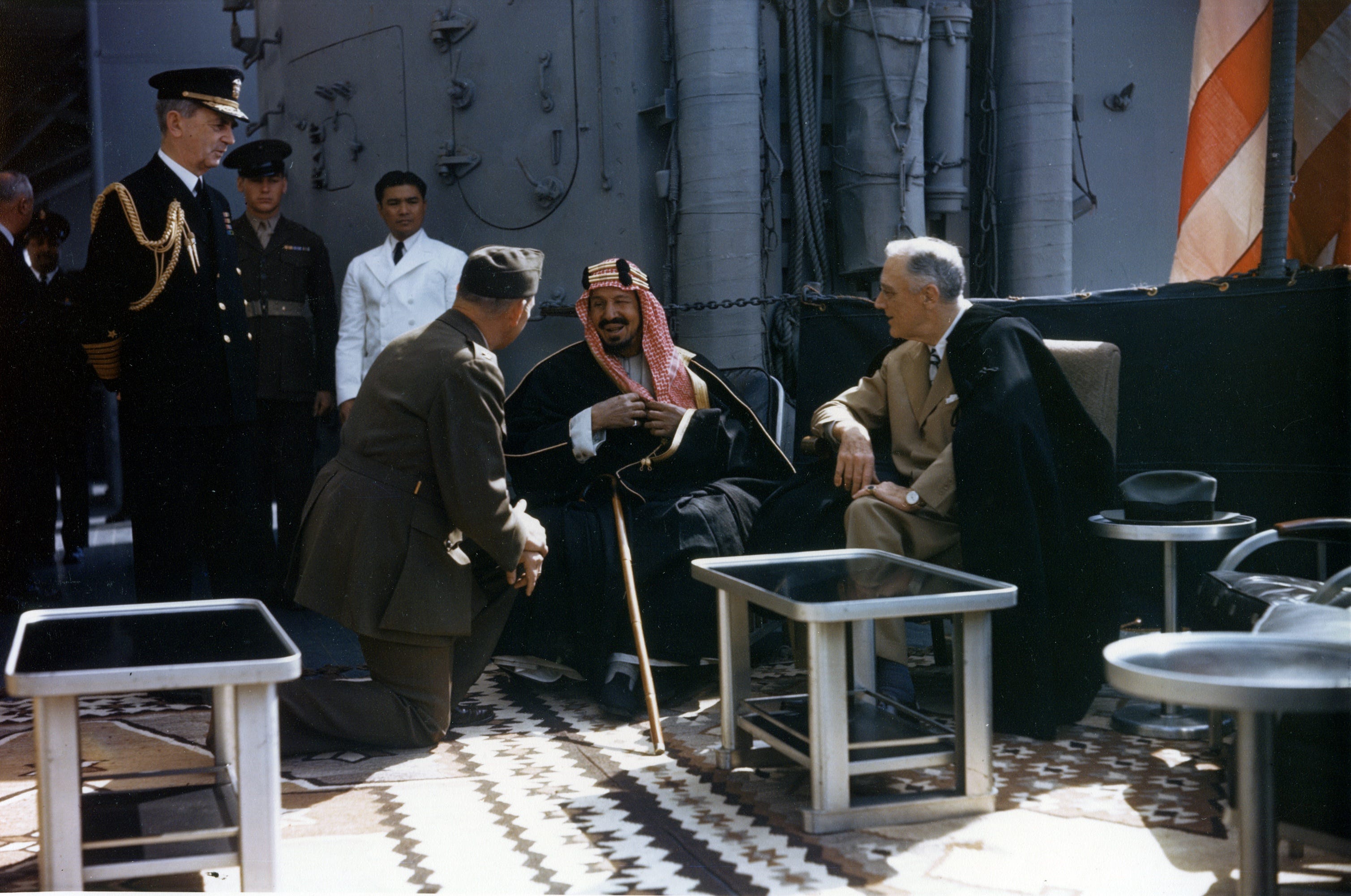
February 14, 1945: Franklin Delano Roosevelt hosts Saudi King Abdulaziz ibn Saud aboard the USS Quincy in the Mediterranean. Roosevelt was sailing home from the Yalta Conference and took the occasion to hold face-to-face meetings with several regional leaders. This one was the first meeting ever between a Saudi royal and a US president. The agreement they concluded (which offered US military protection to the Saudis in return for US access to Saudi oil) created the basic contours of a US-Saudi relationship that has survived (albeit with some rough patches) to the present day.
February 15, 1942: The World War II Battle of Singapore ends with the Japanese conquest of the British colony. Virtually the entire 85,000-man British force defending Singapore was lost—5000 killed or wounded and the remaining 80,000 captured. It was one of the largest surrenders in British military history and interestingly was not celebrated by Japan’s Nazi allies. Adolf Hitler apparently saw the Japanese victory as a defeat for white people the world over, and ordered Foreign Minister Joachim von Ribbentrop not to send congratulations to Tokyo.
February 15, 1989: Soviet forces complete their withdrawal from Afghanistan. This date has been annually commemorated in Afghanistan as “Liberation Day.”
MIDDLE EAST
SYRIA
The US military’s Central Command acknowledged on Saturday that it carried out airstrikes against “more than 30 Islamic State targets in Syria between February 3 and February 12.” CENTCOM has been ramping up its anti-IS airstrikes since the IS attack that killed two US soldiers and a translator back in December. This intensification may also be a prelude to an eventual US withdrawal from Syria.
LEBANON
The Israeli military (IDF) killed at least four people in an airstrike in eastern Lebanon on Sunday. Israeli officials later claimed that they were targeting Palestinian Islamic Jihad personnel. It’s unclear if all four of the casualties were PIJ members.
ISRAEL-PALESTINE
The IDF killed at least 11 people across Gaza on Sunday, according to civil defense officials in the territory. Israeli officials say that they were retaliating for a ceasefire violation involving “several armed terrorists who took cover under debris east of the yellow line and adjacent to IDF troops, likely after exiting underground infrastructure in the area.” Which apparently explains why they bombed, for example, a displaced persons encampment. The IDF has now killed over 600 people under the current ostensible ceasefire.
In other items:
Doctors Without Borders (MSF) says that it suspended “non-essential work” at Nasser Hospital in Khan Younis on January 20 due to the presence of “armed men, some masked” in the facility. The NGO is citing concerns regarding the “management of the structure, the safeguarding of its neutrality, and security breaches” as well as “a pattern of unacceptable acts, including the presence of armed men, intimidation, arbitrary arrests of patients, and a recent situation of suspicion of movement of weapons.” The IDF has justified its systematic targeting of Gaza’s medical facilities since October 2023 by claiming that they’re used by Hamas and other armed factions, but to my knowledge MSF has not made these complaints in the past. Officials in the territory’s interior ministry have reportedly acknowledged the presence of “armed members of certain families” inside medical facilities recently and have talked about taking unspecified “legal action” against anyone violating those sites’ neutrality. MSF is in the final weeks of its Gaza operations anyway, since the Israeli government has proscribed the organization.
Donald Trump declared via social media on Sunday that his forthcoming “Board of Peace” meeting will include the announcement of some $5 billion in pledges for Gaza’s reconstruction as well as the unveiling of the territory’s “international stabilization force.” There’s no indication as to the source of these pledges, nor is there much detail on the stabilization force apart from comments from the Indonesian government a few days ago. Rebuilding Gaza is expected to cost well into the tens of billions of dollars and that’s without factoring in the massive amounts of graft that may accrue under Trump’s seemingly oversight-free “Board of Peace” structure. So $5 billion, while a nice sum, is really a drop in the bucket.
The Israeli Cabinet voted on Sunday to advance a “land registration” program for the West Bank that will further the de facto annexation of that territory. This measure will introduce a “settlement of land title” procedure to the territory for the first time since Israel seized it in the 1967 Six Day War. As I understand it this will allow the Israeli government to declare certain parts of the territory open to registration, giving anyone with a property claim in those areas a chance to produce paperwork demonstrating their ownership. These processes are of course designed to reject Palestinian ownership claims, in which case the property in question reverts to Israeli state control. The likely upshot could be the Israeli takeover of vast parts of the Oslo Accord’s “Area C,” which designates West Bank territory that was left under Israeli administration. That’s the easiest part of the territory on which the Israelis could implement this scheme.
IRAN
The second round of US-Iranian nuclear talks will take place in Geneva on Tuesday, the same day that the next round of US-Russian-Ukrainian peace talks is scheduled to begin in the same city. US envoys Jared Kushner and Steve Witkoff will participate in the former in the morning and the latter in the afternoon, which probably means that neither session will make any significant progress but what do I know?
ASIA
CHINA
The Chinese Foreign Ministry’s Hong Kong office summoned the heads of the Australian, UK, US, and European Union diplomatic delegations on Saturday to complain about their comments regarding the recent sentencing of businessman Jimmy Lai. The Hong Kong High Court convicted Lai back in December on charges related to his political activism and sentenced him on Monday to 20 years in prison—technically less than the life sentence he could have received, though as Lai is 78 years old the distinction may not matter. The case has drawn an outpouring of criticism from Western governments and there is some possibility that Donald Trump will push for Lai’s release when he visits China later this year.
NORTH KOREA
Among the other momentous (more or less) things that might take place at this month’s Ninth Congress of the North Korean Workers’ Party, 38 North’s Rachel Minyoung Lee wonders if Kim Jong-un might be about to assume the title of “president.” Apparently the North Korean government began rather conspicuously referring to Kim as “head of state” in September 2024, which hearkens back to the country’s 1972 and 1992 constitutions and their descriptions of the office of president. Kim’s grandfather, Kim Il-sung, held that title from 1972 through his death in 1994, when Kim Jong-il dropped the title and Kim Yong-nam, as “President of the Presidium of the Supreme People’s Assembly,” held the nominal head of state role.
The status of head of state was conferred on Kim Jong-un in 2019 when Kim Yong-nam stepped down, but it’s the specific return of the language “head of state” in referring to Kim Jong-un that seems to have people speculating about his intentions. It’s unclear if the adoption of the president title—assuming that Kim does adopt it—will mean anything in terms of how the North Korean government functions and ultimately the whole thing may turn out to be fairly trivial. But as North Korean speculation goes this story struck me as at least more interesting than yet another thinkpiece about whether or not Kim is setting his daughter up to succeed him someday.
OCEANIA
VANUATU
The Trump administration is reportedly attempting to quash a pending climate-related United Nations resolution:
The United States is urging governments to pressure Vanuatu to withdraw a United Nations draft resolution supporting a landmark International Court of Justice (ICJ) ruling that countries have a legal obligation to act on climate change.
A US State Department cable seen by Al Jazeera on Saturday says that the Trump administration “strongly objects” to the proposed resolution being circulated by the Pacific island nation of Vanuatu in support of last year’s ruling by the ICJ – the UN’s top court.
The Associated Press news agency, which also reported on the cable, said that it was circulated to all US embassies and consulates this week, shortly after Vanuatu announced it was putting forward the draft UN resolution for consideration.
“We are strongly urging Vanuatu to immediately withdraw its draft resolution and cease attempting to wield the Court’s Advisory Opinion as a basis for creating an avenue to pursue any misguided claims of international legal obligations,” a copy of the cable seen by Al Jazeera states.
As a Pacific island state that is facing an existential threat from sea level rise, Vanuatu has an obvious rationale for pushing this resolution. But the US has its own equally important rationale for opposing it, which is upholding Donald Trump’s status as coal’s man of the year or whatever. It’s a huge honor and obligation.
AFRICA
SUDAN
According to the Sudan Doctors Network, a Rapid Support Forces drone strike hit a medical facility in southeastern Sudan’s Sennar state on Sunday, killing at least three people and wounding seven others. Sennar is adjacent to Blue Nile state, where the RSF and its Sudan People’s Liberation Army-North allies have been on the offensive since late last month.
BURKINA FASO
AFP is reporting that a series of jihadist attacks in northern Burkina Faso has left at least ten people dead over the past four days. Most recently insurgents attacked a military unit in northwestern Burkina Faso’s Sourou region on Sunday, and that came one day after an apparently large scale assault on the city of Titao, capital of the country’s North region and another attack on a military outpost in the East region. Specific casualty figures from each of these incidents seem not to be available.
NIGERIA
Gunmen swarmed through three villages in western Nigeria’s Niger state on Saturday morning, killing at least 46 people at latest count. The assumption at this point seems to be that they were criminal bandits rather than jihadists.
EUROPE
EUROPEAN UNION
US Secretary of State Marco Rubio visited the Munich Security Conference on Saturday, where he more or less delivered the Good Cop version of the same speech that Vice President JD Vance delivered in the same forum last year. While Rubio couched his message in rhetoric about the historical connection between the US and Europe and their “intertwined” destinies, in contrast with Vance’s more belligerent tone, fundamentally he still emphasized the white supremacist and xenophobic specter of “civilizational erasure” that underpins the Trump administration’s basic worldview. I don’t see much reason to dwell on this bullshit although I will note that Rubio’s softer tone does not seem to have worked on the European audience. The “civilizational erasure” bit drew particular scorn in European media and in EU foreign policy director Kaja Kallas’s remarks to the MSC on Sunday.
RUSSIA
The governments of France, Germany, the Netherlands, Sweden, and the UK issued a joint statement on Saturday concluding that Russian opposition figure Alexei Navalny’s February 2024 death was not accidental. Western governments have assumed that the Russian government murdered Navalny in prison so this isn’t what you’d call breaking news, but the statement went so far as to offer a cause of death—poisoning with epibatidine, the toxin found in poison dart frogs. This is apparently based on an analysis of samples taken from Navalny’s body. The Russian government unsurprisingly rejected the claim and the Trump administration appears to be taking a “that’s nice but not really our business” approach, which to be as fair as possible may be in order to preserve their ability to mediate peace talks with Ukraine.
AMERICAS
COLOMBIA
Colombian President Gustavo Petro says that he has agreed to a proposal from the National Liberation Army (ELN) rebel group to let an “independent commission” assess the organization’s role, or lack thereof, in the drug trade. ELN leader Antonio García claimed in a video that the group released last month that the ELN is not involved in drug trafficking, which needless to say is not how the Colombian government (or Petro personally) has traditionally seen it. In fact Petro has said that he will not reenter peace talks with the ELN—a previous round of talks collapsed last year—until it gives up trafficking. The nature of the “independent commission” has yet to be worked out.
UNITED STATES
Finally, at The Conversation, Jonathan Levy, Howard Frumkin, Jonathan Patz, and Vijay Limaye pick apart the Trump administration’s case for eliminating climate regulations:
The Trump administration took a major step in its efforts to unravel America’s climate policies on Feb. 12, 2026, when it moved to rescind the 2009 endangerment finding – a formal determination that six greenhouse gases that drive climate change, including carbon dioxide and methane from burning fossil fuels, endanger public health and welfare.
But the administration’s arguments in dismissing the health risks of climate change are not only factually wrong, they’re deeply dangerous to Americans’ health and safety.
As physicians, epidemiologists and environmental health scientists, we’ve seen growing evidence of the connections between climate change and harm to people’s health. Here’s a look at the health risks everyone face[s] from climate change.