

You’re reading the web version of Foreign Exchanges. If you’d like to get it delivered straight to your inbox, sign up today:
TODAY IN HISTORY
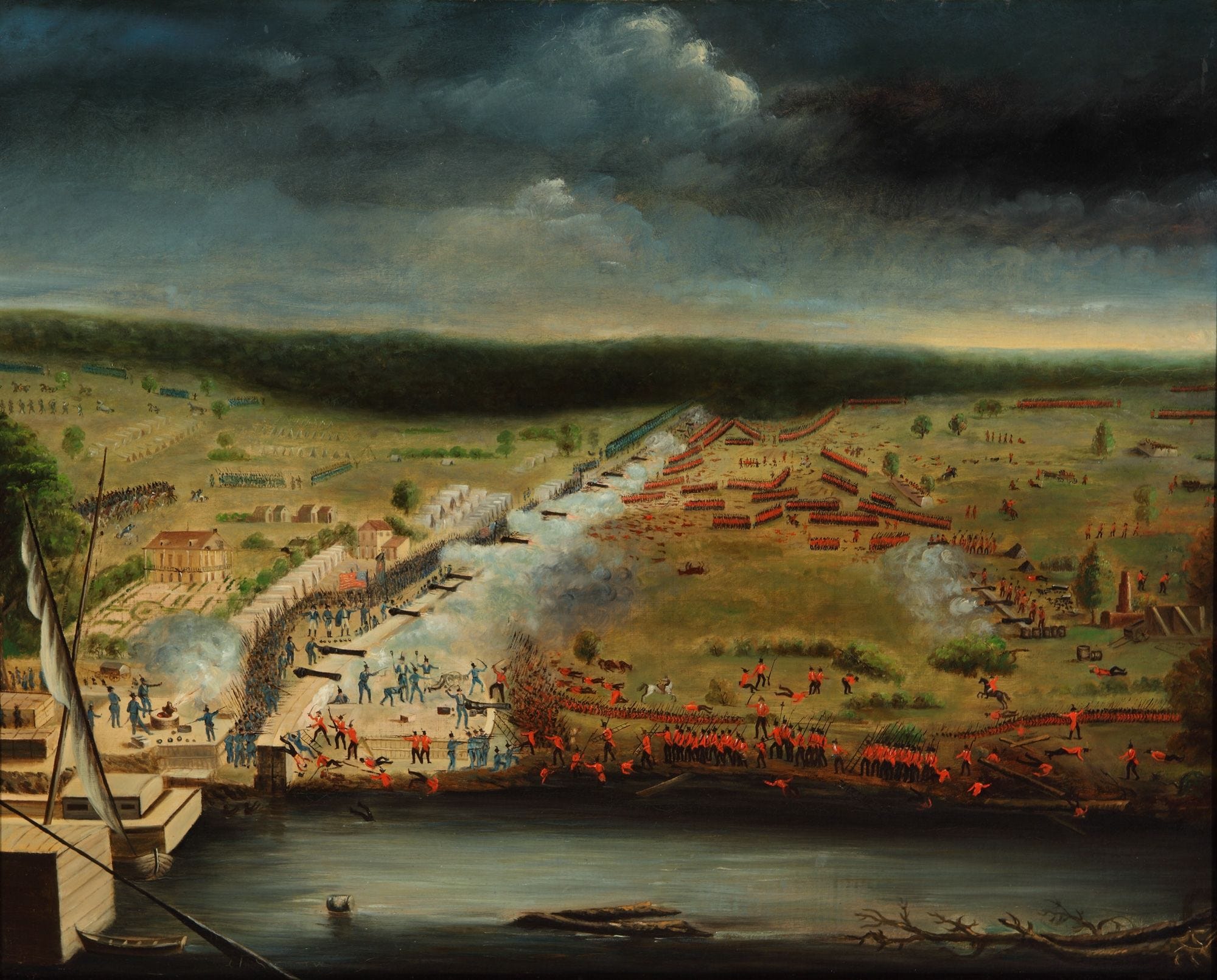
January 8, 1815: US forces commanded by Andrew Jackson defeat a larger British army in the Battle of New Orleans. Regarded in US collective memory as the climax of the War of 1812, even though it took place more than two weeks after the Treaty of Ghent officially ended that conflict, the battle is mostly noteworthy for its effect on American morale. Jackson’s victory allowed Americans to believe that what had otherwise been a fairly dismal war for the US (plans to annex Canada were quashed and British forces sacked Washington DC) had ended with a rousing US victory. The battle also made Jackson into a national hero, a status he parlayed into a two term presidency starting with the 1828 election.
January 8, 1926: Abdulaziz ibn Saud is crowned king of the Hejaz, adding that kingdom to his original dominion in the Nejd. This was the result of a 1924-1925 war between the Saudis and the Hashemite rulers of the Hejaz, their second such conflict. The British government, which had been paying Ibn Saud to leave the Hashemites alone but decided to stop doing that in 1923, opted not to intervene and thereby ensured a Saudi victory. This personal union lasted for six years and became the nucleus of the Kingdom of Saudi Arabia. In 1932, Ibn Saud unified the Hejaz and the Nejd (as well as al-Hasa, east of the Nejd) into a single state, to which he later added Asir, Najran, and Jizan after a 1934 war with Yemen.
MIDDLE EAST
SYRIA
Fighting between government security forces and Syrian Democratic Forces fighters continued in and around Aleppo through a third straight day on Thursday, and yes I just basically copied the opening sentence to yesterday’s newsletter there. The heaviest activity has involved the predominantly Kurdish neighborhoods of Sheikh Maqsoud and Ashrafiyah and according to state media has displaced somewhere around 16,000 people from those areas so far. At least 21 people have been killed and I have not seen any breakdown of their identities.
The government and SDF have clashed periodically over the past year as they’ve simultaneously tried, and failed, to reach agreement on incorporating the latter’s fighters into the former’s security establishment, but this latest round of fighting seems to be a bigger threat to the negotiating process than past outbreaks. Outside interference from Turkey (supporting Damascus) and Israel (supporting the Kurds/SDF), though limited to rhetoric so far, doesn’t seem to be helping to calm things down. US officials are reportedly in discussions with both parties to try to tamp things down but so far it’s not working.
LEBANON
The Lebanese army declared on Thursday that it has completed the first phase of its project to disarm non-state groups (mainly though not exclusively Hezbollah) by securing all arms south of the Litani River, which is about 30 kilometers north of the Israeli border. As far as whether that’s actually true your guess is as good as mine, but if Lebanese officials were hoping that the announcement would buy them a reprieve from daily Israeli airstrikes the answer appears to be “no,” as Benjamin Netanyahu stressed his demand for Hezbollah’s full disarmament. The second phase of this project will involve securing all arms in the area between the Litani and Awali Rivers, which is another ~30 kilometers to the north.
ISRAEL-PALESTINE
The Israeli military (IDF) killed at least 13 people, including five children, in attacks across Gaza on Thursday according to the territory’s civil defense officials. At one point the IDF carried out a strike in what it said was retaliation for a rocket launch (the apparent rocket landed inside Gaza). Meanwhile, The Wall Street Journal reports on the latest Israeli restrictions on humanitarian aid:
Throughout the two-year war, Israel and humanitarian groups have clashed over the amount and type of aid allowed into the territory and who could distribute it.
Now, new rules have led to a deadlock between the two sides, putting at risk access to aid and services for Palestinians trying to rebuild their lives out of the wreckage of the conflict.
Israel is insisting aid groups hand over details about their staff working in Gaza or it will strip them of their right to operate in Israel, which would severely limit their access to the enclave. Dozens of organizations, including large-scale international humanitarian groups, have declined to do so, arguing that sharing the data could put their workers at risk. They say Israel hasn’t given them assurances the data won’t be misused and want to know why it is needed, as well as how it will be used and stored.
Israeli officials are trying to brush this off by arguing that the 37 organizations they’ve proscribed only account for around 1 percent of the aid entering the territory. But that elides the fact that several of these organizations—like Doctors Without Borders—don’t “bring in” aid, they instead perform invaluable work inside Gaza. Or did, at least, before they were banned.
YEMEN
The case of Southern Transitional Council leader Aidarous al-Zubaidi’s mysterious disappearance appears to have been solved, as the Saudi-led “Homeland Shield” coalition backing Yemen’s internationally recognized government reported on Thursday that he’s now taking refuge in Abu Dhabi. According to the coalition Zubaidi, who failed to board a scheduled flight to Riyadh for negotiations on Tuesday night, instead boarded some sort of vessel on Wednesday night that carried him from Aden to the port of Berbera in the quasi-independent Somaliland region. He and UAE officials later flew to Mogadishu and from there on to his present location. Somali officials say they are investigating that leg of the trip.
Having been charged with treason by the nominal Yemeni government Zubaidi’s status as head of the STC—which remains a going concern despite the events of the past several weeks—is at best questionable and it sounds like the Riyadh meeting that he skipped has focused in part on appointing new leaders for the hitherto UAE-backed separatist group. That will presumably come with a greater degree of Saudi authority and an end to any talk of secession.
SAUDI ARABIA
At Foreign Policy, Marc Lynch discusses the impact that the Saudi-UAE rift, which has made itself very manifest in Yemen (see above), is having regionally:
The confrontation was more than a local scrimmage. Saudi and Emirati media figures launched ferocious propaganda wars. Emiratis blasted Saudi Arabia for supporting the Muslim Brotherhood and bullying a smaller neighbor. Saudis lambasted the UAE as anti-Islamic and pro-Israel and recklessly backing secessionists across the region. The language of mutual recrimination and accusation between longtime allies recalled the worst of what they used to say about Qatar during their joint 2017-21 blockade.
The stakes this time are just as high. The confrontation is about more than Yemen. And it’s more than just an ordinary squabble among Gulf allies. The Saudi move against the UAE represents not just an effort to restrain Emirati adventurism but to balance against an increasingly reckless and threatening Israel. The potential regional alignment lines were laid out clearly by the Saudi foreign minister’s sudden trip to Cairo, where Egyptian officials affirmed their total support for Riyadh’s views on Libya and Sudan after more than a decade of closer alignment with and economic dependence on the UAE.
That’s a dramatic shift in regional order—and one that puts the region at a crossroads at a moment when Iran is reeling from another wave of domestic protests and when the United States’ role remains unclear.
IRAN
Thursday night reportedly saw a major protest emerging in Tehran after calls from Reza Pahlavi, son of former Iraniah Shah Mohammad Reza Pahlavi. It’s difficult to know how major because the emergence of the demonstration coincided with a nationwide lost of internet and phone service. Purely a coincidence I’m sure. If Pahlavi were able to claim leadership of what has to this point been a mostly grassroots effort that could raise the stakes for the Iranian government, since he does represent an alternative (whether it’s a “legitimate” alternative I leave to the reader to decide) to the Islamic Republic. But again without communications it’s hard to say much more about this.
ASIA
INDIA
According to Reuters, the Indian Finance Ministry is lifting restrictions on Chinese firms that aim to bid on Indian government contracts. Those restrictions were imposed in the wake of deadly fighting between Chinese and Indian border personnel in 2020 and effectively barred Chinese participation in the bidding process. Their removal speaks to the significant improvement in bilateral relations over the past several months.
CAMBODIA
The Diplomat’s Luke Horn has more detail on the extradition of Prince Group chair and alleged scam kingpin Chen Zhi from Cambodia to China:
The Cambodian government has been under increasing pressure to resolve the Prince issue since October, when the United States declared the conglomerate a “transnational criminal organization,” seized a record $15 billion in assets, and indicted Chen, 37, to appear in a federal court in Brooklyn.
A statement by Cambodia’s Interior Ministry confirmed that Chinese-born Chen, Xu Ji Liang, and Shao Ji Hui were extradited at the request of Chinese authorities and that this had been achieved “within the scope of cooperation with combating transnational crime.”
It said: “This operation was carried out on 6 January 2026, following several months of joint investigative cooperation between the relevant authorities of the Kingdom of Cambodia and the People’s Republic of China.”
The Interior Ministry added that Chen’s Cambodian citizenship had been revoked by a royal decree, issued by King Norodom Sihamoni in December.
AFRICA
SUDAN
At Foreign Affairs Alex de Waal warns of the regionalization of the war in Sudan:
The longer the fighting continues, the greater the risk that it becomes a regional conflagration. The war is already entangling Sudan’s African neighbors. The RSF’s supply lines run through Chad, Libya, Somalia, and South Sudan—and may yet involve Ethiopia and Kenya. Its constituency of recruits among rural populations, especially historically nomadic communities, stretches westward across Sahelian Africa. Since the fall of El Fasher, there have been reports of cattle-herding Arab groups crossing the borders from the Central African Republic and Chad, aiming to seize the newly vacated lands. And the Sudanese war is also intermeshed with the volatile situation between Eritrea and Ethiopia, which threatens to devolve into a major war of its own.
By convening the Quad [the US, Egypt, Saudi Arabia, and the UAE], Washington has correctly recognized that the road to ending Sudan’s war runs through the Gulf. But what few have fully grasped is that the conflict itself is international in ways that are new and different from previous Sudanese conflicts. Today, the territorial nation-state in Sudan—and in many parts of Africa and the Middle East—is rapidly being eclipsed by borderless fiefdoms run by warlords who answer to foreign patrons with deep pockets. And that has made this war, despite its deep unpopularity among the Sudanese themselves and the misery and hardship it has brought to tens of millions of people, much harder to contain. Without more decisive engagement from the highest levels of the Trump administration, there is now a serious risk that Sudan’s war tips the Horn of Africa, the Nile Valley, and the Sahara-Sahel region into a vast arena of anarchy.
SOMALIA
The Somali government is denying US claims that it looted and shut down a World Food Program warehouse in Mogadishu. The Trump administration cited that alleged incident in announcing earlier this week that it is shutting down Somali aid programs, though the practical effect may not be that great given the overall shuttering of most US foreign aid under the Trump administration. The Somali Foreign Ministry is insisting that the aid that had been stored at that warehouse is still property of the WFP and has not been confiscated. The warehouse itself was apparently demolished but Somali officials are saying that it was done in the context of “expansion and repurposing works at the Mogadishu port.” The WFP told the AP that it had 75 metric tons of food in that facility and later issued a statement saying that it had “retrieved 75 metric tons of nutritional commodities.” The reason for that awkward wording is unclear.
EUROPE
RUSSIA
Another oil tanker that was heading for Russia came under drone attack in the Black Sea on Wednesday. There’s been no report of any casualties but the vessel did have to change course and request assistance from the Turkish Coast Guard. It has apparently dropped anchor off of the Turkish port town of İnebolu. There’s no indication as to the attacker but the Ukrainian military has been making increasing use of naval drones to target Russian shipping in the Black Sea in recent weeks.
GREECE
Protesting farmers blocked major roads across Greece on Thursday over demands for higher levels of government support and in opposition to the emerging European Union-Mercosur trade agreement. These demonstrations have been going off and on since November, initially driven by the demand for more support amid rising costs of production. But with the Italian government dropping its objection to the Mercosur deal earlier this week, potentially paving the way for its adoption, farmers in Greece and across Europe are worried about the potential influx of South American agricultural products into the European market.
AMERICAS
VENEZUELA
The looting of Venezuela’s oil reserves has begun in earnest, as three Chevron-chartered tankers are already steaming toward the US carrying Venezuelan crude. Two more tankers are waiting to be loaded and another six are apparently on their way to Venezuela. The Trump administration is extracting an initial haul of between 30 and 50 million barrels of oil from its new subsidiary and expects to control Venezuelan oil sales “indefinitely” after that. Apparently Donald Trump is expecting to use Venezuelan oil to bring the “US oil price” down to $50 per barrel, though given that oil is a globally traded good it’s unclear how he aims to affect just the US price specifically.
The Venezuelan government released a large number of prisoners on Thursday in an apparent concession to international sentiment. Many/all of these people have been characterized as “political prisoners,” though Venezuelan authorities have consistently denied holding anyone who could be so characterized. Spanish-Venezuelan activist Rocío San Miguel was the first confirmed release.
GREENLAND
Reuters is reporting that the Trump administration may offer cash payments to Greenlanders in an attempt to entice them to support annexation or some approximation of it. This is at least somewhat more palatable than simply buying the country from Denmark out from under the people living there, but whether it would actually work is another question. The administration has apparently been kicking this idea around for some time but it’s come up from an initial $10,000 payout to something in the neighborhood of $100,000, which would cost around $6 billion in total assuming every single Greenlander were eligible.
Something else of note in that Reuters piece is that the administration is apparently considering the idea of Greenland joining a Compact of Free Association relationship with the US, similar to the Marshall Islands, Micronesia, and Palau. That would fall short of annexation but it would presumably require Greenland to become independent of Denmark.
UNITED STATES
Finally, The Intercept’s Nick Turse reports that the US military is has taken a decidedly hands off approach to the survivors of its boat attacks:
The United States left the survivors of a recent boat strike to die at sea, formally abandoning search efforts Friday.
Their presumed deaths are the result of attacks by U.S. forces on three boats in the Pacific Ocean on December 30. After striking one vessel and killing three civilians, crew members of the other boats, according to U.S. Southern Command, “abandoned the other two vessels, jumping overboard and distancing themselves before follow-on engagements sank their respective vessels.”
The unspecified number of survivors who leapt into the Pacific faced nine-foot seas and 40-knot winds, Kenneth Wiese, a spokesperson for the Coast Guard Southwest District, told The Intercept.
The Coast Guard called off the search for those people on Friday citing a “declining probability of survival.” A U.S. government official, who spoke on the condition of anonymity because they were not authorized to speak to the press, said the men are now presumed dead.
The United States has been attacking boats in the Caribbean and the Pacific since September, killing at least 117 civilians in 35 attacks — including at least five people on December 30. The total death toll is now unknown, with U.S. Southern Command’s latest tally of attacks and fatalities omitting known strikes and casualties.
Turse’s reporting actually forced the Pentagon to acknowledge that the December 30 strike killed 11 people, not three, meaning the official death toll is now 123.