

You’re reading the web version of Foreign Exchanges. If you’d like to get it delivered straight to your inbox, sign up today:
PROGRAMMING NOTE: No voiceover tonight, sorry. I may have been able to get back to writing yesterday but I still cannot talk for more than about 2 minutes tops without hacking up a lung so you’re going to have to bear with me on this front for a few more days. Hopefully the Substack app’s text-to-voice feature is working but if it is not please contact Substack support directly as I do not have any control over those sorts of technical issues.
TODAY IN HISTORY
January 3, 1521: Pope Leo X issues a bull, titled Decet Romanum Pontificem, in which he excommunicates Martin Luther. Leo had threatened to excommunicate Luther in a bull issued the previous year, the Exsurge Domine, that Luther made a show of burning in defiance. Leo presumably expected that Luthor’s excommunication would undermine the latter’s criticisms of the Catholic Church. With the benefit of hindsight I think we can conclude it didn’t quite work out that way. Luthor’s excommunication remains in effect despite appeals by Lutherans over the last few decades to lift it.
January 3, 1868: Japanese Emperor Meiji issues an edict declaring an end to the powerful Tokugawa Shogunate and a restoration of the authority of the emperor—marking the “Meiji Restoration.” Although the last Tokugawa Shōgun, Tokugawa Yoshinobu, had resigned in November 1867 it was this edict that really marked the political end of the shogunate and the establishment of a centralized imperial government. Tokugawa Yoshinobu would subsequently lead an unsuccessful rebellion against the Meiji Restoration that began in late January.
January 3, 1919: In the lead up to the Paris Peace Conference, Arab Revolt leader Faysal b. Hussein and Zionist activist Chaim Weizmann conclude an agreement under which Faysal agrees to support a Jewish homeland in Ottoman (soon to be British) Palestine while Weizmann agrees to support the creation and development of an Arab state under Faysal’s father, King Hussein of the Hejaz.
January 4, 1878: The Battle of Sofia, part of the 1877-1878 Russian-Ottoman War, ends with a Russian victory and the Ottoman loss of the city. In the course of the battle the Ottoman Orkhanie Army was completely destroyed, a loss the empire couldn’t afford to put it very mildly. The capture of Sofia and the Russian victory in the war secured the autonomy (and effective independence) of Bulgaria after five centuries under Ottoman control.
January 4, 1951: A combined Chinese-North Korean army enters Seoul, having forced the South Korean army, the United Nations Command, and most of the city’s population to evacuate the previous day. Their defeat in what’s known as the Third Battle of Seoul brought the US/UN force close to evacuating the Korean Peninsula altogether, but in the long run the outcome proved somewhat detrimental to the Chinese-North Korean war effort. UN support for South Korea intensified and the People’s Volunteer Army found itself overextended and vulnerable to counterattack. Which is what happened—the UN Command recaptured Seoul in “Operation Ripper,” which started in early March and ended about a month later.
MIDDLE EAST
SYRIA
The French and UK militaries conducted a joint air operation overnight targeting an alleged Islamic State weapons cache near the Syrian city of Palmyra. The facility was apparently not located near any populated areas and there’s been no indication of casualties to my knowledge.
Elsewhere, the Syrian government and the Syrian Democratic Forces held another meeting on Sunday to discuss incorporating the latter into the former’s security apparatus. They apparently made no progress. The parties had previously agreed to complete that incorporation by the end of 2025 so unless they’ve decided to use the Julian calendar they’ve missed their deadline. Tensions on this front continue to simmer and occasionally bubble over, as they did late last month in Aleppo.
LEBANON
The Israeli military (IDF) killed at least two people in a drone strike in southern Lebanon on Sunday. It claimed that the target was a Hezbollah operative.
ISRAEL-PALESTINE
The IDF killed at least three Palestinians in Gaza’s Khan Younis area on Sunday, which I offer as evidence that very little seems to have changed inside the territory. The main effect of the “ceasefire” continues to be merely slowing, rather than stopping, Israel’s wholesale decimation of Gaza’s civilian population. To that end, the Israeli government proscribed 37 humanitarian organizations, including Doctors Without Borders, at the start of 2026, over their failure to provide authorities with lists of their “Palestinian employees.” That failure may have something to do with the IDF’s penchant for killing aid workers—at least 579 of them since the October 7 2023 attacks, according to the United Nations.
Israeli Defense Minister Israel Katz insisted in comments last month that the IDF “will never leave all of Gaza,” which certainly should have repercussions for the ostensible ceasefire framework if he’s taken at his word. He pledged to establish “Nahal” brigade outposts in parts of northern Gaza that were once occupied by Israeli settlements. Nahal is a military-paramilitary hybrid unit that includes settler elements, and while Katz insisted that these outposts would be purely for defense he would obviously be planting the seeds for the restoration of those settlements. Drop Site published a piece with Forensic Architecture last month analyzing satellite imagery that shows the IDF both destroying existing infrastructure and building new military outposts across the ~58 percent of Gaza it currently occupies. The upshot is that there’s no evidence that it’s planning to leave or even reduce its geographic footprint in the territory anytime soon.
YEMEN
Saudi-backed Yemeni forces consolidated their recapture of eastern Yemen’s Hadhramaut province from the separatist Southern Transitional Council on Sunday, for example by increasing their presence in the provincial capital Mukalla. It would also appear that they have retaken neighboring Mahrah province. At least 80 STC fighters have reportedly been killed since the Saudi offensive began on Friday, with scores more wounded and captured, and there are indications that the Saudis aren’t going to stop there. The nominal Yemeni government, which serves at the pleasure of the Saudi monarchy, is now accusing the STC of trying to close off access to the city of Aden and its armed forces are now moving toward the de facto southern Yemeni capital. The Saudi government has invited the STC and other parties to a conference on southern Yemen but it’s unclear whether that will take place before the government has retaken Aden from separatist fighters.
IRAN
Significant protests have gripped multiple cities across Iran for about a week and they have involved sporadic incidents of violence that have left at least 12 people dead (civilians and members of Iranian security forces) so far. Iranian civil NGOs are citing slightly higher death tolls as well as hundreds of arrests amid the government’s crackdown efforts. The primary cause is, unsurprisingly, economic and in particular the value of the Iranian rial, which cratered to a record low after the UN reimposed nuclear-related sanctions in September and has only gone down since then—it’s well below 1.3 million per dollar at this point.
So far I haven’t seen anything in these demonstrations to indicate that they’re materially different from past economic-driven incidents of unrest in terms of threatening the Iranian government, but this is certainly something to monitor. There’s very little that Iranian officials can do to pump the rial’s value up at this point and that means there’s every reason to believe that the unrest will continue. In the absence of any way to address the protesters’ grievances the government’s impulse will be to intensify its crackdown, in which case the ensuing violence may serve to intensify the unrest and around and around they’ll go.
In the meantime, again unsurprisingly, Benjamin Netanyahu has been pitching Donald Trump on another round of airstrikes and Trump has threatened military action in response to the crackdown. I think the situation in Venezuela probably takes that off the table for the time being, but it’s also worth noting that another Israel-US attack may actually be the one thing that could most reliably stop these protests in their tracks as Iranians rally against the foreign threat. One might think that would run counter to US and Israeli aims.
ASIA
INDIA
Police killed 14 Maoist Naxalite fighters in “two separate incidents” in India’s Chhattisgarh state on Saturday. There’s not much left of the Naxalite uprising these days but the Indian government has been promising to eradicate it completely by the end of March so these sorts of “incidents” are likely to recur frequently between now and then.
MYANMAR
Myanmar’s ruling junta held the first phase of its big “democracy is back” general election late last month and, in a real shocker, the military-backed Union Solidarity and Development Party is already cruising to a potential landslide victory. It’s won 87 of the 96 seats in the lower house of Myanmar’s parliament whose races have been called in what I think we have to say above all else is a very simple and believable outcome. There are a few first phase races that still haven’t been called and there will be two more phases to the election before it’s concluded, but something tells me that the USDP’s early success is going to be replicated in those later contests. The junta is claiming a turnout rate of a bit over 50 percent so far, which is just high enough to give the vote the imprimatur of legitimacy and thus also very simple and believable.
THAILAND
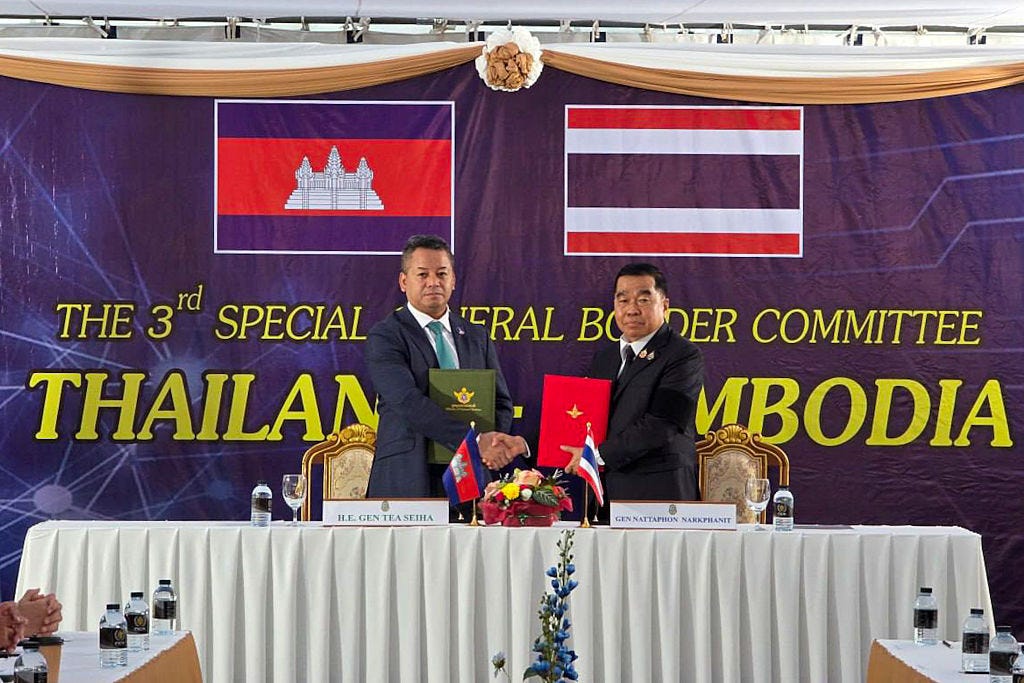
The Thai and Cambodian governments signed a new ceasefire on December 27, ending the second major outburst in their 2025 border conflict after the previous ceasefire had collapsed on December 8. The Chinese government appears to have taken the lead in mediating this second attempt at a ceasefire and hosted the foreign ministers of both countries a couple of days after the initial agreement for additional negotiations. So far the deal is holding, and the Thai government on Wednesday released the 18 Cambodian soldiers it had been holding since the initial outburst in July so that’s probably a good sign from a durability standpoint. That said, on Saturday the Cambodian government issued a demand for the withdrawal of Thai forces from areas that it claims as Cambodian territory, so clearly the underlying border tension hasn’t diminished.
AFRICA
SUDAN
AFP reported on Sunday that new actions by the paramilitary Rapid Support Forces group and the Sudanese Armed Forces killed at least 114 people over the past week in Sudan’s North Darfur state. The biggest single incident here appears to have been an SAF drone strike on the RSF-controlled town of Al Zorg that killed at least 51 people on Saturday. RSF fighters, meanwhile, killed at least 63 people in and around the village of Kernoi amid what AFP called an advance “westward towards the border with Chad.” Over 7000 people have been displaced from Kernoi and another nearby village by that advance. An apparent SAF drone strike also killed an RSF “security adviser” near the capital of Central Darfur state, Zalingei, on Thursday. And the Sudanese military is claiming that it’s recently captured several South Sudanese nationals fighting with the RSF in North Kordofan state. It’s apparently going to demand some clarification from Juba.
GUINEA
In another electoral stunner, Guinean junta leader Mamdi Doumbouya won last month’s presidential election with somewhere in the neighborhood of 86 percent of the vote. That result may be genuine inasmuch as Doumbouya does still seem to be popular nationally and the junta had blocked any credible opposition candidates anyway. This was the first election in Guinea since the 2021 coup that put Doumbouya in power and will allow the junta to recast itself as a civilian government.
NIGERIA
Donald Trump decided on Christmas to make good on his threat to attack Nigeria, ordering the US military to strike alleged Islamic State targets in northwestern Nigeria’s Sokoto state in “coordination” with Nigerian authorities. We’re told that the strike killed “multiple” IS fighters though I haven’t seen any attempt at putting an actual number to that claim.
Maybe that’s because the target doesn’t make much sense. The decision to attack Sokoto (and apparently also Kwara state, though it’s unclear if that was intentional) has raised some eyebrows. The Trump administration claimed that it struck two IS camps in the province. But residents of the village of Jabo, where some of those US strikes apparently hit (without casualty), later claimed that it’s been two years since they’d seen any sign of jihadists in their area. Observers of Nigeria’s jihadist struggle may note that the main concentration of IS fighters in the country is in the northeast, specifically Borno state, and not in the northwest. Those familiar with the fabricated charges of “Christian genocide” that motivated Trump’s initial threat may note that Sokoto is nowhere near Nigeria’s “middle band” where most violence involving Christians takes place. Sokoto’s population is almost entirely Muslim.
Sokoto is allegedly home to the shady “Lakurawa,” but so little is known about that faction that it can’t be conclusively stated that it’s even a single coherent organization let alone that its allegiance is definitively with IS. There’s even still some possibility that the very term “Lakurawa” represents a misclassification (or deliberate overhyping) of local bandits by Nigerian authorities. Nigerian officials apparently suggested the targets, so whether they were legitimately IS-related or not I imagine the main aim was to demonstrate their willingness to cooperate with Trump and forestall any unilateral US military action.
EUROPE
UKRAINE
According to Donald Trump, peace between Russia and Ukraine is “closer than ever.” He said that last Sunday, so make of it what you will. He did meet with Volodymyr Zelensky and spoke by phone with Vladimir Putin that day so at least the issue was fresh in his mind. A new sticking point seems to have emerged in those discussions as Zelensky is now asking for a 60 day ceasefire in order to organize a referendum on Trump’s peace plan and especially the territorial concessions it obliges Kyiv to make, while the Russians have consistently rejected any ceasefire prior to a peace deal.
A major controversy also emerged when Putin complained to Trump the following day that a Ukrainian drone strike had targeted his Dolgiye Borody residence in Russia’s Novgorod oblast. Trump seemed quite perturbed by the thought that the Ukrainians might have tried to assassinate Putin. The Ukrainian government denied that allegation and US officials have reportedly determined that the Ukrainians did not intentionally target the residence and Trump now says that he believes their assessment over Putin’s claim.
When we left off, European Union member states were still wringing their collective hands over the prospect of using frozen Russian assets to finance a massive loan for Ukraine. As it turns out, they finally agreed to provide the loan, to the tune of €90 million (around $106 billion), but without tapping those assets. The Belgian government blocked that part of the plan over potential repercussions for the firm Everclear, which is headquartered in Belgium and holds most of the Russian assets. Instead EU members decided to issue the loan while “reserving the right” to dip into those assets should Russia refuse to pay war reparations. I am not a banker but it sounds like they just kicked the most controversial part of the plan down the road for another year or two.
KOSOVO
Kosovan Prime Minister Albin Kurti’s Vetëvendosje won last month’s snap parliamentary election with just under 50 percent of the vote. That result probably won’t be enough for the party to take an outright majority of seats in the 120 seat Kosovan assembly, but it’s considerably more decisive than the ~42 percent that Vetëvendosje won in the previous election in February. That outcome left the party so far short of a majority that it eventually proved incapable of forming a government, necessitating the snap vote. This outcome should leave Vetëvendosje just a few seats shy of a majority at most and it will most likely be able to pull together the support it needs from smaller parties or independents.
AMERICAS
VENEZUELA
I don’t know that there’s a ton to add to what I wrote yesterday about this story apart from noting that the estimated death toll has risen from somewhere around 40 to somewhere around 80 and is likely to rise further. There’s no breakdown in terms of military vs. civilian though it is known that there were no deaths on the US side. The Cuban government has announced the deaths of 32 of its nationals, who were probably involved in Nicolás Maduro’s security and/or intelligence establishments on some level.
It was already pretty clear by the end of Saturday that Maduro’s vice president, Delcy Rodríguez, had assumed at least a semblance of authority in Caracas, but how much real power she has remains to be seen. The Trump administration has repeatedly characterized her as somebody with whom it can work—somewhat in contrast with The Wall Street Journal’s characterization of her as “a Hardline Socialist Like Maduro” but I digress—and while Rodríguez’s rhetoric over the past couple of days could fairly be described as “defiant” her words are not being matched by any defiant deeds and there’s plenty of reason to think she’s just saying what the Venezuelan establishment wants to hear.
If Rodríguez remains in place she’ll be reporting to Donald Trump, or more directly to his new Venezuelan viceroy Marco Rubio. How that relationship is going to work also remains to be seen but in its early form it looks like the Trump administration is aiming for a somewhat “hands off” approach that eschews a sizable US presence in Venezuela but will instead leave the massive offshore military deployment more or less in place to keep Rodríguez under the perpetual threat of another incursion. We’ll see if that works.
HONDURAS
Honduran election officials have finally declared conservative Nasry Asfura the winner of November’s presidential election. He eked out a narrow (less than a point) win over fellow conservative Salvador Nasralla. Donald Trump handpicked Asfura as his preferred candidate, leading to criticism for election interference that now seems rather quaint. The vote count was marred by repeated delays and accusations of fraud.
GREENLAND
The Venezuela operation has raised fears about Donald Trump’s intentions regarding Greenland, though as far as I know there’s no Greenlandic Maduro for US special forces to kidnap. The feeling is more that if he’s willing to transgress the Norms to the extent that he did in Venezuela it may only be a short hop from there to an armed annexation of Greenland. Those fears had already started rising late last month, in fact, after Trump named Louisiana Governor Jeff Landry as his new “special envoy” for Greenland while restating his annexation demands. The Danish government objected to the appointment, which was apparently made without any warning.
Over the weekend Trump again restated his desire to annex Greenland in an interview with The Atlantic, prompting another fairly lame objection this time directly from Danish Prime Minister Mette Frederiksen. The upshot—and this is also based on the extremely milquetoast European reaction to the Maduro abduction—is that if Trump did order an invasion of Greenland the most anybody could reasonably expect in terms of a European response is a sternly worded memo.
UNITED STATES
Finally, in the glorious United States:
Donald Trump announced via social media on Wednesday that he’s no longer pursuing the military occupations of the cities of Chicago, Los Angeles, and Portland—though he’s reserving the right to “come back, perhaps in a much different and stronger form, when crime begins to soar again.” Courts have blocked Trump’s repeated attempts to deploy National Guard forces into those and other cities over the objections of state and/or local elected leaders and the final straw may have been a US Supreme Court ruling last month that delayed, at least, his Chicago plans.
Trump last month unveiled plans—well, OK, more of a “wish” than anything approaching a “plan”—for a new class of battleships for the US Navy, named (of course) after himself. Sounding like a child playing with G.I. Joes, the US president claimed that his new ships would “be 100 times the force, the power” of previous US battleships, so it sounds like they’d be super cool and totally rad. The Trump class battleship will also fill the Navy’s need for a massively expensive and grossly wasteful boondoggle now that the littoral combat ship program appears to be running out of steam.
With last month’s strikes on Nigeria and Venezuela (prior to the Maduro abduction), you’ll no doubt be pleased to know that Trump’s military bombed a whopping seven countries in 2025. That’s a tremendous record for the winner of the inaugural FIFA Peace Prize. Congratulations to everyone involved.